Federal Government
Trump-Vance administration removes LGBTQ, HIV resources from government websites
President took similar action shortly after his first inauguration in 2017

The Trump-Vance administration has “eliminated nearly all LGBTQ and HIV focused content and resources” from WhiteHouse.gov and “key federal agency” websites, GLAAD announced in a press release Tuesday.
Prior to President Donald Trump’s inauguration on Monday, GLAAD had catalogued more than 50 links to LGBTQ- and HIV-related content on White House web pages and on websites for the State Department and the Departments of Education, Justice, Defense, Health and Human Services, and Labor, along with other agencies like the U.S. Equal Employment Opportunity Commission.
As of Tuesday, GLAAD specifically found that terms like “lesbian,” “bisexual,” “gay,” “transgender,” “sexual orientation,” “gender identity,” and “LGBTQ” are “no longer accessible on WhiteHouse.gov,” while “some LGBTQ-specific pages have been taken down from sites for the Centers for Disease Control, Department of State, and more.”
Among the pages that are no longer accessible on WhiteHouse.gov are an equity report from July 2021, a fact sheet with information on expanding access to HIV prevention and treatment from March 2024, and information about Pride Month.
Among the entries on federal agency websites that are no longer available are 94 entries for “LGBT Rights” that were once published on the State Department’s site and dozens of links to information and resources on “LGBTQI+ Policy” that were once available on the Department of Labor website.
“President Trump claims to be a strong proponent of freedom of speech, yet he is clearly committed to censorship of any information containing or related to LGBTQ Americans and issues that we face,” GLAAD President Sarah Kate Ellis said. “Today’s action proves the Trump administration’s goal of making it as difficult as possible for LGBTQ Americans to find federal resources or otherwise see ourselves reflected under his presidency.”
Ellis added, “Sadly for him, our community is more visible than ever; and this pathetic attempt to diminish and remove us will again prove unsuccessful.”
Shortly after Trump’s first presidential inauguration in 2017, the Trump-Pence administration scrubbed the White House and federal government websites of LGBTQ and HIV related content, provoking backlash from LGBTQ advocates.

Federal Government
Two very different views of the State of the Union
As Trump delivered his SOTU address inside the Capitol, Democratic lawmakers gathered outside in protest, condemning the administration’s harmful policies.
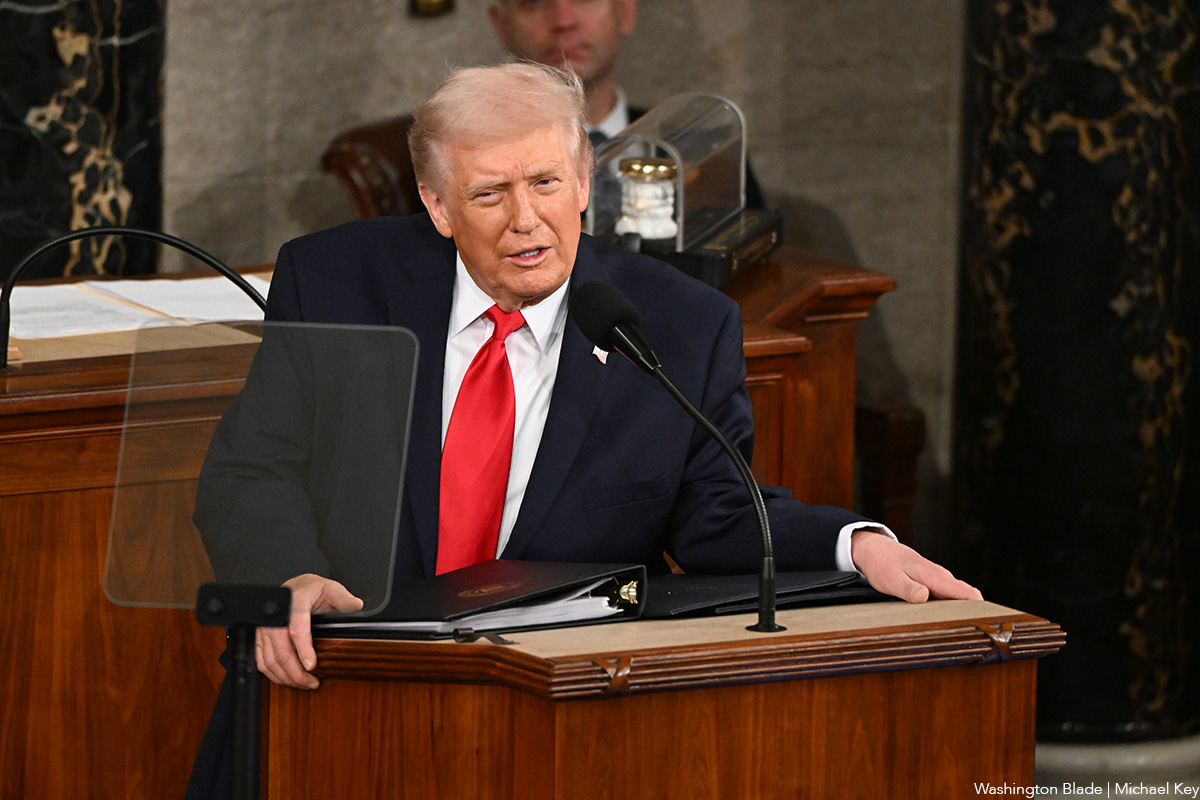
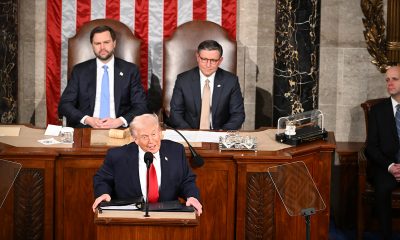
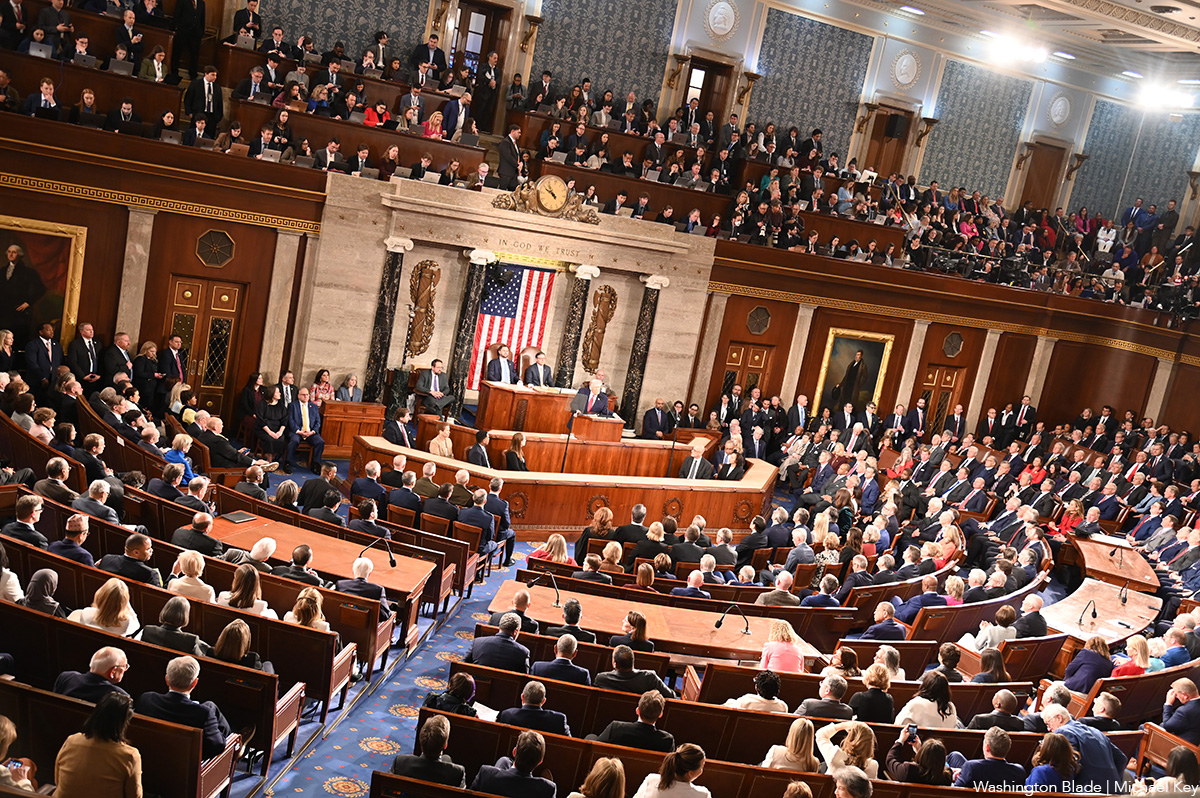
As President Donald Trump delivered his State of the Union address inside the U.S. Capitol — touting his achievements and targeting political enemies — progressive members of Congress gathered just outside in protest.
Their message was blunt: For many Americans, particularly LGBTQ people, the country is not better off.
Each year, as required by Article II, Section 3 of the Constitution, the president must “give to the Congress Information of the State of the Union.” The annual address is meant to outline accomplishments and preview the year ahead. This year, Trump delivered the longest State of the Union in U.S. history, clocking in at one hour and 48 minutes. He spoke about immigration, his “law and order” domestic agenda, his “peace through strength” foreign policy doctrine, and what he framed as the left’s ‘culture wars’ — especially those involving transgender youth and Christian values.
But one year into what he has called the “Trump 2.0” era, the picture painted outside the Capitol stood in stark contrast to the one described inside.
Transgender youth
In one of the most pointed moments of his speech, Trump spotlighted Sage Blair, using her story to portray gender-affirming care as coercive and dangerous. Framing the issue as one of parental rights and government overreach, he told lawmakers and viewers:
“In the gallery tonight are Sage Blair and her mother, Michelle. In 2021, Sage was 14 when school officials in Virginia sought to socially transition her to a new gender, treating her as a boy and hiding it from her parents. Hard to believe, isn’t it? Before long, a confused Sage ran away from home.
“After she was found in a horrific situation in Maryland, a left-wing judge refused to return Sage to her parents because they did not immediately state that their daughter was their son. Sage was thrown into an all-boys state home and suffered terribly for a long time. But today, all of that is behind them because Sage is a proud and wonderful young woman with a full ride scholarship to Liberty University.
“Sage and Michelle, please stand up. And thank you for your great bravery and who can believe that we’re even speaking about things like this. Fifteen years ago, if somebody was up here and said that, they’d say, what’s wrong with him? But now we have to say it because it’s going on all over, numerous states, without even telling the parents.
“But surely, we can all agree no state can be allowed to rip children from their parents’ arms and transition them to a new gender against the parents’ will. Who would believe that we’ve been talking about that? We must ban it and we must ban it immediately. Look, nobody stands up. These people are crazy. I’m telling you, they’re crazy.”
The story, presented as encapsulation of a national crisis, became the foundation for Trump’s renewed call to ban gender-affirming care. LGBTQ advocates — and those familiar with Blair’s story — argue that the situation was far more complex than described and that using a single anecdote to justify sweeping federal restrictions places transgender people, particularly youth, at greater risk.
Equality Virginia said the president’s remarks were part of a broader effort to strip transgender Americans of access to care. In a statement to the Blade, the group said:
“Tonight, the president is choosing to double down on efforts to disrupt access to evidence-based, lifesaving care.
“Rather than allowing families and doctors to navigate deeply personal medical decisions free from federal interference — or allowing schools to respond with nuance and compassion without putting marginalized children at risk — the president is instead advocating for reckless, one-size-fits-all political control.
“At a time when Virginians are worried about rising costs, economic uncertainty, and aggressive immigration enforcement actions disrupting communities and families, attacking transgender young people is a blatant political distraction from the real challenges facing our nation. Virginia families and health care providers do not need Donald Trump telling them what care they do or do not need.”
For many in the LGBTQ community, the rhetoric inside the chamber echoed actions already taken by the administration.
Earlier this month, the Pride flag was removed from the Stonewall National Monument under a National Park Service directive that came from the top. Community members returned to the site, raised the flag again, and filed suit, arguing the removal violated federal law. To advocates, the move was symbolic — a signal that even the legacy of LGBTQ resistance was not immune.
Immigration and fear
Immigration dominated both events as well.
Inside the chamber, Trump boasted about the hundreds of thousands of immigrants detained in makeshift facilities. Outside, Democratic lawmakers described those same facilities as concentration camps and detailed what they characterized as the human toll of the administration’s enforcement policies.
Sen. Ed Markey (D-Mass.), speaking to the crowd, painted a grim picture of communities living in fear:
“People are vanishing into thin air. Quiet mornings are punctuated by jarring violence. Students are assaulted by ICE agents sitting outside the high school, hard working residents are torn from their vehicles in front of their children. Families, hopelessly search for signs of their loved ones who have stopped answering their phones, stop replying to text… This is un-American, it is illegal, it is unconstitutional, and the people are going to rise up and fight for Gladys Vega and all of those poor people who today need to know that the people’s State of the Union is the beginning of a long fight that is going to result in the end of Republican control of the House of Representatives and the Senate in the United States of America in 2026.”
Speakers emphasized that LGBTQ immigrants are often especially vulnerable — fleeing persecution abroad only to face detention and uncertainty in the United States. For them, the immigration crackdown and the attacks on transgender health care are not separate battles but intertwined fronts in a broader cultural and political war.
Queer leadership
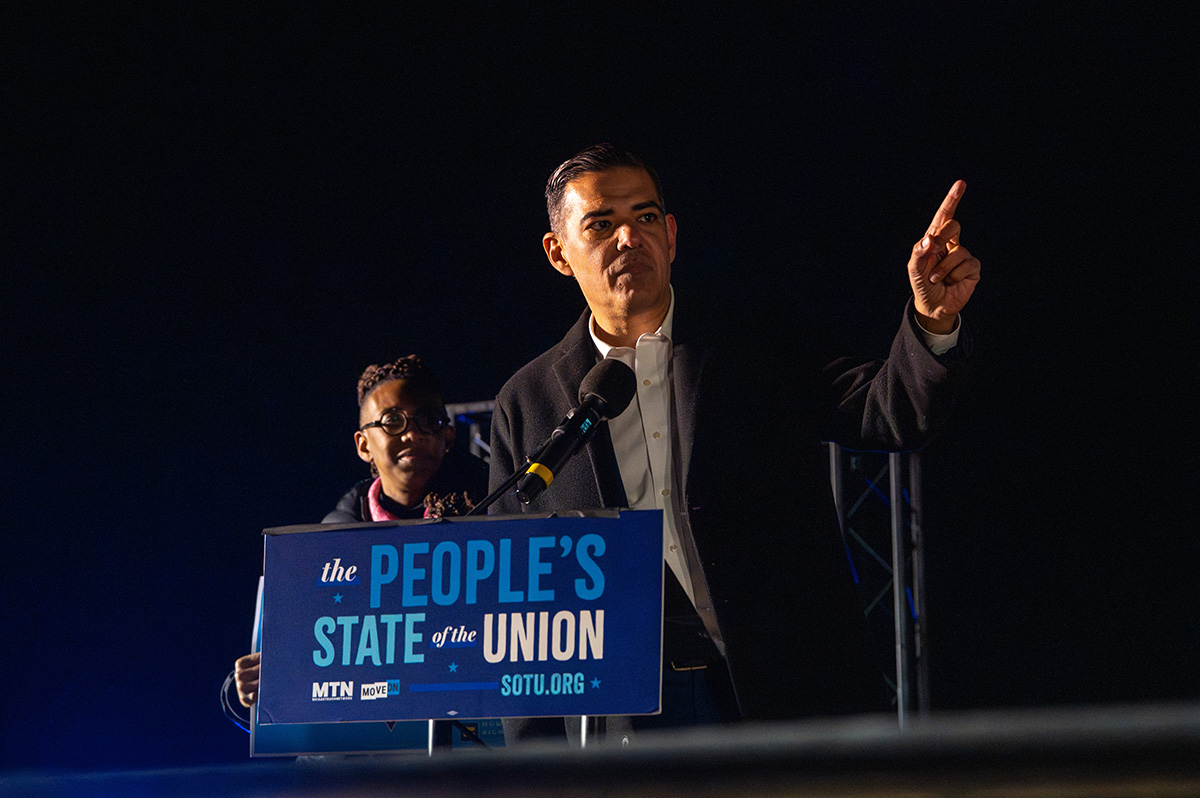
After delivering remarks alongside Robert Garcia, Kelley Robinson, president of the Human Rights Campaign, took the stage and transformed the freezing crowd’s anger into resolve.
Garcia later told the Blade that visibility matters in moments like this — especially when LGBTQ rights are under direct attack.
“We should be crystal clear about right now what is happening in our country,” Garcia said. “We have a president who is leading the single largest government cover up in modern history, we have the single largest sex trafficking ring in modern history right now being covered up by Donald Trump and Pam Bondi In the Department of Justice. Why are we protecting powerful, wealthy men who have abused and raped women and children in this country? Why is our government protecting these men at this very moment? In my place at the Capitol is a woman named Annie farmer. Annie and her sister Maria, both endured horrific abuse by Jeffrey Epstein and Ghislaine Maxwell. As we move forward in this investigation, always center the survivors; we are going to get justice for the survivors. And Donald Trump may call this investigation a hoax. He may try to deflect our work, but our message to him is very clear that our investigation is just getting started, and we will we will get justice for these survivors.”
He told the Blade afterwards that having queer leaders front and center is itself an act of resistance.
“I obviously was very honored to speak with Kelley,” the California representative said. Kelley is doing a great job…it’s important that there are queer voices, trans voices, gay voices, in protest, and I think she’s a great example of that. It’s important to remind the country that the rights of our community continue to be attacked, and then we’ve got to stand up. Got to stand up for this as well.”
Robinson echoed that call, urging LGBTQ Americans — especially young people — not to lose hope despite the administration’s escalating rhetoric.
“There are hundreds of thousands of people that are standing up for you every single day that will not relent and will not give an inch until every member of our community is protected, especially our kids, especially our trans and queer kids. I just hope that the power of millions of voices drowns out that one loud one, because that’s really what I want folks to see at HRC. We’ve got 3.6 million members that are mobilizing to support our community every single day, 75 million equality voters, people that decide who they’re going to vote for based on issues related to our community. Our job is to make sure that all those people stand up so that those kids can see us and hear our voices, because we’re going to be what stands in the way.”
A boycott — and a warning
The list of Democratic lawmakers who boycotted the State of the Union included Sens. Ruben Gallego, Ed Markey, Jeff Merkley, Chris Murphy, Adam Schiff, Tina Smith, and Chris Van Hollen, along with dozens of House members.
For those gathered outside — and for viewers watching the livestream hosted by MoveOn — the counter-programming was not merely symbolic. It was a warning.
While the president spoke of strength and success inside the chamber, LGBTQ Americans — particularly transgender youth — were once again cast as political targets. And outside the Capitol, lawmakers and advocates made clear that the fight over their rights is far from over.
Federal Government
Top Democrats reintroduce bill to investigate discrimination against LGBTQ military members
Takano, Jacobs, and Blumenthal sponsored measure
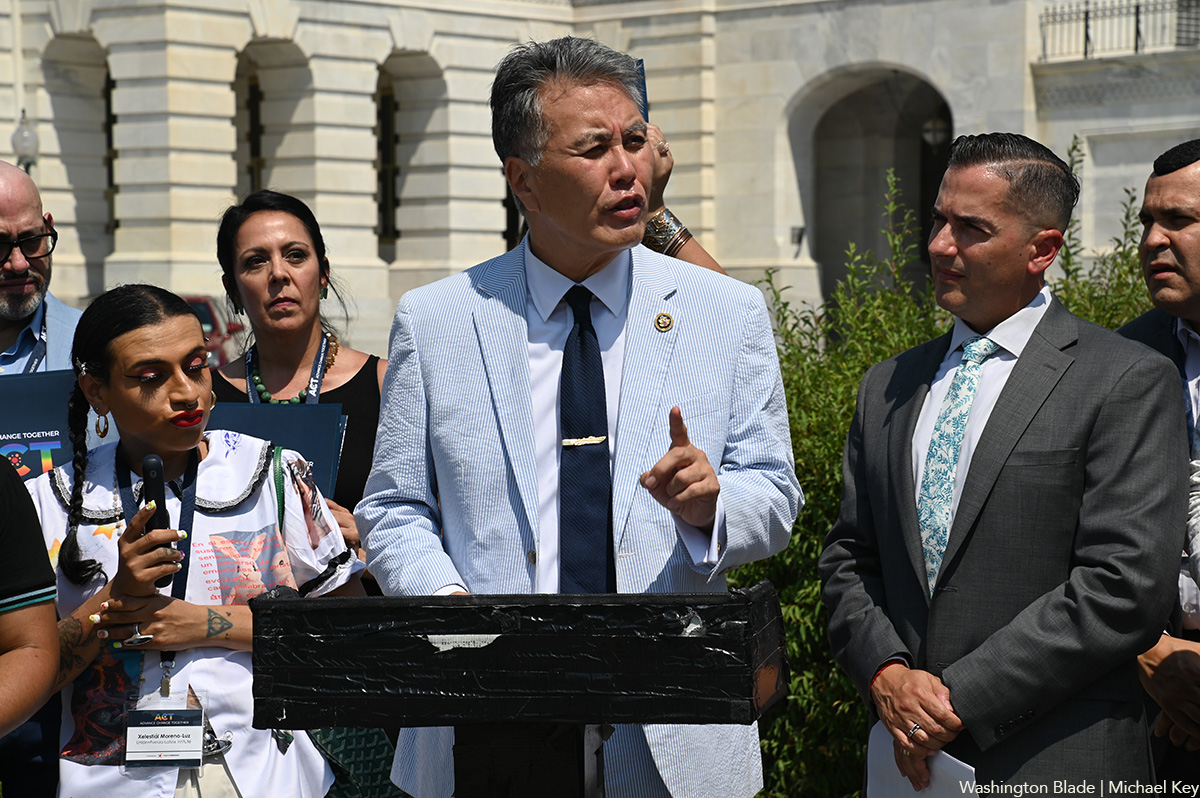
Multiple high-ranking members of Congress reintroduced the Commission on Equity and Reconciliation in the Uniformed Services Act into the U.S. House of Representatives and the U.S. Senate, aiming to establish a commission to investigate discriminatory policies targeting LGBTQ military members.
Three leading Democratic members of Congress — U.S. Rep. Mark Takano (D-Calif.), who is the House Veterans’ Affairs Committee’s ranking member and chairs the Congressional Equality Caucus; U.S. Sen. Richard Blumenthal (D-Conn.), who is the Senate Veterans’ Affairs Committee’s ranking member; and U.S. Rep. Sara Jacobs (D-Calif.) — introduced the bill on Tuesday.
The bill, they say, would establish a commission to investigate the historic and ongoing impacts of discriminatory military policies on LGBTQ servicemembers and veterans.
This comes on the one-year anniversary of the Trump-Vance administration’s 2025 Executive Order 14183, titled “Prioritizing Military Excellence and Readiness,” which essentially banned transgender servicemembers from openly serving in the Armed Forces, leading to the forced separation of thousands of capable and dedicated servicemembers.
In a joint statement, Takano, Blumenthal, and Jacobs shared statistics on how many service members have had their ability to serve revoked due to their sexual orientation:
“Approximately 114,000 servicemembers were discharged on the basis of their sexual orientation between WWII and 2011, while an estimated 870,000 LGBTQ servicemembers have been impacted by hostility, harassment, assault, and law enforcement targeting due to the military policies in place,” the press release reads. “These separations are devastating and have long-reaching impacts. Veterans who were discharged on discriminatory grounds are unable to access their benefits, and under the Trump administration, LGBTQ+ veterans and servicemembers have been openly persecuted.”
The proposed commission is modeled after the Congressional commission that investigated and secured redress for Japanese Americans interned during World War II. Takano’s family was among the more than 82,000 Japanese Americans who received an official apology and redress payment under that commission.
The press release notes this is a major inspiration for the act.
“Qualified servicemembers were hunted down and forced to leave the military at the direction of our government,” said Takano. “These practices have continued, now with our government targeting transgender servicemembers. The forced separation and dishonorable discharges LGBTQ+ people received must be rectified, benefits fully granted, and dignity restored to those who have protected our freedoms.”
“LGBTQ+ servicemembers have long been the target of dangerous and discriminatory policies—resulting in harassment, involuntary discharge, and barriers to their earned benefits,” said Blumenthal. “Establishing this commission is an important step to understand the full scope of harm and address the damage caused by policies like ‘Don’t Ask, Don’t Tell.’ As LGBTQ+ servicemembers and veterans face repugnant and blatant bigotry under the Trump administration, we will keep fighting to secure a more equitable future for all who serve our country in uniform.”
“Instead of righting wrongs and making amends to our LGBTQ+ service members and veterans who’ve suffered injustices for decades, I’m ashamed that the Trump administration has doubled down: kicking trans folks out of the military and banning their enlistment,” said Jacobs. “We know that LGBTQ+ service members and veterans have faced so much ugliness — discrimination, harassment, professional setbacks, and even violence — that has led to unjust discharges and disparities in benefits, but we still don’t have a full picture of all the harm caused. That needs to change. That’s why I’m proud to co-lead this bill to investigate these harms, address the impacts of discriminatory official policies like ‘Don’t Ask, Don’t Tell’ and the transgender military ban, and ensure equity and justice for our LGBTQ+ service members and veterans.”
Takano and Jacobs are leading the bill in the House, while Blumenthal is introducing companion legislation in the Senate.
Takano’s office has profiled and interviewed LGBTQ servicemembers who were harmed by discriminatory policies in the uniformed services.
The Commission on Equity and Reconciliation in the Uniformed Services Act is supported by Minority Veterans of America, Human Rights Campaign, Equality California, SPARTA, and the Transgender American Veterans Association.
In recent weeks, thousands of trans military members were forcibly put into retirement as a result of Trump’s executive order, including five honored by the Human Rights Campaign with a combined 100 years of service, all due to their gender identity: Col. Bree B. Fram (U.S. Space Force), Commander Blake Dremann (U.S. Navy), Lt. Col. (Ret.) Erin Krizek (U.S. Air Force), Chief Petty Officer (Ret.) Jaida McGuire (U.S. Coast Guard), and Sgt. First Class (Ret.) Catherine Schmid (U.S. Army).
Multiple career service members spoke at the ceremony, including Takano. Among the speakers was Frank Kendall III, the 26th U.S. Air Force secretary, who said:
“We are in a moment of crisis that will be worse before it is better. Members of my father’s and mother’s generation would ask each other a question: what did you do during the war? Someday we will all be asked what we did during this time. Please think about the answer that you will give.”
Federal Government
Trump-appointed EEOC leadership rescinds LGBTQ worker guidance
The EEOC voted to rescind its 2024 guidance, minimizing formally expanded protections for LGBTQ workers.

The U.S. Equal Employment Opportunity Commission voted 2–1 to repeal its 2024 guidance, rolling back formally expanded protections for LGBTQ workers.
The EEOC, which is composed of five commissioners, is tasked with enforcing federal laws that make workplace discrimination illegal. Since President Donald Trump appointed two Republican commissioners last year — Andrea R. Lucas as chair in January and Brittany Panuccio in October — the commission’s majority has increasingly aligned its work with conservative priorities.
The commission updated its guidance in 2024 under then-President Joe Biden to expand protections to LGBTQ workers, particularly transgender workers — the most significant change to the agency’s harassment guidance in 25 years.
The directive, which spanned nearly 200 pages, outlined how employers may not discriminate against workers based on protected characteristics, including race, sex, religion, age, and disability as defined under federal law.
One issue of particular focus for Republicans was the guidance’s new section on gender identity and sexual orientation. Citing the 2020 U.S. Supreme Court’s Bostock v. Clayton County decision and other cases, the guidance included examples of prohibited conduct, such as the repeated and intentional use of a name or pronoun an individual no longer uses, and the denial of access to bathrooms consistent with a person’s gender identity.
Last year a federal judge in Texas had blocked that portion of the guidance, saying that finding was novel and was beyond the scope of the EEOC’s powers in issuing guidance.
The dissenting vote came from the commission’s sole Democratic member, Commissioner Kalpana Kotagal.
“There’s no reason to rescind the harassment guidance in its entirety,” Kotagal said Thursday. “Instead of adopting a thoughtful and surgical approach to excise the sections the majority disagrees with or suggest an alternative, the commission is throwing out the baby with the bathwater. Worse, it is doing so without public input.”
While this now rescinded EEOC guidance is not legally binding, it is widely considered a blueprint for how the commission will enforce anti-discrimination laws and is often cited by judges deciding novel legal issues.
Multiple members of Congress released a joint statement condemning the agency’s decision to minimize worker protections, including U.S. Reps. Teresa Leger Fernández (D-N.M.), Grace Meng (D-N.Y.), Mark Takano (D-Calif.), Adriano Espaillat (D-N.Y.), and Yvette Clarke (D-N.Y.) The rescission follows the EEOC’s failure to respond to or engage with a November letter from Democratic Caucus leaders urging the agency to retain the guidance and protect women and vulnerable workers.
“The Equal Employment Opportunity Commission is supposed to protect vulnerable workers, including women, people of color, and LGBTQI+ workers, from discrimination on the job. Yet, since the start of her tenure, the EEOC chair has consistently undermined protections for women, people of color, and LGBTQI+ workers. Now, she is taking away guidance intended to protect workers from harassment on the job, including instructions on anti-harassment policies, training, and complaint processes — and doing so outside of the established rule-making process. When workers are sexually harassed, called racist slurs, or discriminated against at work, it harms our workforce and ultimately our economy. Workers can’t afford this — especially at a time of high costs, chaotic tariffs, and economic uncertainty. Women and vulnerable workers deserve so much better.”

Md. Legislative LGBTQ+ Caucus outlines 2026 priorities

PHOTOS: ‘Defrosted’

Trump will refuse to sign voting bill without anti-trans provisions

Owner of D.C. gay bar Green Lantern John Colameco dies at 79

Man stuck in Lebanon as Iran war escalates

13 HIV/AIDS activists arrested on Capitol Hill

Fla. Senate passes ‘Anti-Diversity’ bill that could repeal local LGBTQ protections

Ugandan activist named Charles F. Kettering Foundation fellow

Liza Minnelli makes surprise appearance at GLAAD Media Awards

Capital Pride must be transparent about sexual misconduct investigation
-

 National5 days ago
13 HIV/AIDS activists arrested on Capitol Hill
-
Florida4 days ago
Fla. Senate passes ‘Anti-Diversity’ bill that could repeal local LGBTQ protections
-
Uganda4 days ago
Ugandan activist named Charles F. Kettering Foundation fellow
-
Celebrity News4 days ago
Liza Minnelli makes surprise appearance at GLAAD Media Awards