Commentary
Midterms proved respecting trans lives isn’t optional; it’s essential to democracy
Pro-trans candidates won across the country
Erin in the Morning on Tuesday reported something worth celebrating: voters decisively rejected candidates who built their campaigns on anti-trans hate. From Virginia to New Jersey to New York City, pro-trans and pro-equality candidates won by wide margins, delivering a stunning rebuke to those — including Democrats — who tried to turn transgender people into a wedge issue. As Erin put it: “conviction, not capitulation, is what wins.”
In recent years, trans people have been caught in a manufactured storm because we make effective political theater. The same playbook that turned immigrants, gay people, and women seeking healthcare into wedge issues has found new life targeting trans people. And like all culture wars, this one’s goal is distraction — keeping voters angry at each other instead of the systems failing them.
I often hear well-meaning people talk about finding “balance” in these debates — that we must weigh competing interests in a pluralistic democracy. And that’s true, to a point. But balance can’t mean deciding whose humanity is negotiable. Power should never come at the expense of another person’s civil or human rights.
That’s why I don’t believe trans concerns need to dominate the discourse — but they must never be abandoned, either. They deserve to be quietly, steadfastly upheld as part of a broader moral and democratic ethic.
If more people understood the human cost of sacrificing trans people for political convenience, they might find better ways. They’d see that being trans — the act of transitioning and living authentically — is not a special interest or a social experiment. It is freedom of expression. It is liberty. It is the pursuit of happiness. And any attack on those rights for trans people signals the erosion of those rights for all Americans.
I wish everyone could see the troves of leaked emails showing exactly how “bathrooms,” “kids,” and “sports” were focus-grouped into political weapons — issues that, for decades, were locally resolved with compassion and common sense, until strategists realized they could divide a nation with them. It’s the stuff of a true-crime podcast. (In fact, TransLash Media’s “The Anti-Trans Hate Machine” has done extraordinary work tracing how these campaigns radicalized even moderate and liberal Americans into adopting the talking points of the extreme right.)
If people truly understood how this machine operates — how far-right strategists deliberately engineered fear and misinformation toward the goal of creating a Christian nationalist state — they might recognize that the threat isn’t trans people at all. It’s the cynical manipulation of our empathy, our faith, and our ideals to maintain a kind of power structure almost nobody in this country actually wants.
Horse-trading human rights has been a feature of American politics since at least the late 19th century, when white Suffragettes sold out Black voters after Reconstruction to secure their own fragile foothold in power — a power that, ironically, never fully materialized. We’ve seen it again and again: from gay rights leaders distancing themselves from trans activists after Stonewall, to civil rights leaders sidelining Bayard Rustin, the gay architect of the March on Washington, out of fear of losing mainstream support. Each time, the doomed logic states that liberation can be negotiated piecemeal, that someone can be left behind now and rescued later. And people wonder why the Left can’t get anything done.
Surely, diverse, collective power could have negotiated better. As just 0.7 percent of the population, trans people can’t add much weight to any political bargain — and aren’t worth the taxpayer dollars funding hundreds of bills designed to limit our freedoms. But the fact that selling each other out never works for anyone is an existential lesson we must finally learn if we ever hope for real progress. At this point, we have nothing to lose at all by doing it differently.
Maybe more people than I think already understand that. At least it looks like more are starting to see it — and to vote accordingly. We live in hope.
Still, I won’t lie: it’s been a brutal year. Everything I feared would happen has unfolded faster and worse than I imagined. I didn’t see it coming that trans people would literally be called “domestic extremists,” or that people I once considered heroes — like Gov. Gavin Newsom — would join in scapegoating us.
I’ve had to learn a new skill I never wanted: how to protect my privacy and physical safety while my country considers out loud whether I should be listed as a terrorist for the crimes of existing, for teaching people the etiquette of basic decency toward trans people, and for joining a movement to secure our place in the American Dream.
Once I got over the shock, fear, and most of the anxiety of all that, I had a realization I didn’t expect: I can handle anything now.
It’s a strange kind of empowerment, tempered by bitter sadness and deep disappointment. But “power is the point,” right? If the far right — and the everyday liberals who pre-complied with them by dropping trans rights — have taught me anything, it’s that I am far more powerful than any of the doomed ways they can imagine to stop me or my community.
Because freedom of expression, liberty, and the pursuit of happiness aren’t just founding tenets of this nation — they are the heartbeat of trans people, who have existed across every era and culture and will never cease to do so. You can repress us, legislate against us, or even rename us as threats. But you only reveal, through your attempts, how powerful we really are, because we never perish.
To my friends who want progress, as we desperately do: stop wasting energy trying to silence us. Embrace us, and harness our power toward achieving the goals that matter to all of us.
Scott Turner Schofield is an actor, writer, producer, speaker, and trans activist who transitioned 25 years ago and followed their calling to become an advocate.



Botswana
Lorato ke Lorato: marriage equality, democracy, and the unfinished work of justice in Botswana
High Court considering marriage equality case
As Botswana prepares for the resumption of a landmark marriage equality case before the High Court on July 14–15, the country finds itself at a critical constitutional crossroads.
At first glance, the matter may appear to be about whether two women, Bonolo Selelelo and Tsholofelo Kumile, can have their love legally recognized. At its core however, this case is about something far more profound: the dismantling of patriarchy, the decolonization of law, and the integrity of Botswana’s constitutional democracy.
Beyond marriage: a question of power
Marriage, as a legal institution, has never been neutral. It has historically functioned as a mechanism for regulating women’s bodies, sexuality, and social roles within a patriarchal order. To deny LBQ (lesbian, bisexual, and queer) women access to marriage is not merely to exclude them from a legal benefit, it is to reinforce a hierarchy of relationships, where heterosexual unions are deemed legitimate and all others invisible. This case therefore challenges the very foundations of who gets to love, who gets to belong, and who gets to be protected under the law.
As feminist scholars have long argued, patriarchy is sustained through institutions that appear ordinary but are deeply political. The law is one such institution. And it is precisely here that this case intervenes: by asking whether Botswana’s legal system will continue to uphold exclusion, or evolve to reflect the constitutional promise of equality.
A constitutional journey: Botswana’s courts and human dignity
This is not the first time Botswana’s courts have been called upon to affirm the dignity of LGBTQI+ persons. Over the past decade, the judiciary has built a progressive body of jurisprudence grounded in equality, nondiscrimination, and human dignity.
In Attorney General v. Rammoge and Others (Court of Appeal Civil Appeal No. CACGB 128-14, 2016), the Court of Appeal upheld the right of LEGABIBO to register as an organization. The court affirmed that:
“The refusal to register the appellant society was not only unlawful, but a violation of the respondents’ fundamental rights to freedom of association.”
This was followed by the ND v. Attorney General of Botswana (MAHGB-000449-15, 2017) case, where the High Court recognized the right of a transgender man to change his gender marker. The court held:
“Gender identity is an integral part of a person’s identity … and any interference with that identity is a violation of dignity.”
In Letsweletse Motshidiemang v. Attorney General (MAHGB-000591-16, 2019), the High Court decriminalized same-sex activity, declaring sections of the Penal Code unconstitutional. Justice Leburu powerfully stated:
“Human dignity is harmed when minority groups are marginalized.”
This decision was affirmed by the Court of Appeal in Attorney General v. Motshidiemang (CACGB-157-19, 2021), where the court emphasized:
“The Constitution is a dynamic instrument … it must be interpreted in a manner that gives effect to the values of dignity, liberty, and equality.”
These cases collectively establish a clear principle: the Constitution of Botswana protects all persons, not just the majority.
The marriage equality case now asks a logical next question: If LGBTQI+ persons are entitled to dignity, identity, and freedom from criminalization, why are their relationships still denied recognition?
Decolonizing the law: What is truly ‘UnAfrican’?
Opponents of marriage equality often argue that homosexuality is “unAfrican.” This claim, while politically powerful, is historically inaccurate. Same-sex relationships and diverse gender identities have existed across African societies long before colonial rule. What is foreign, however, are the laws that criminalize these identities.
Botswana’s anti-sodomy laws were inherited from British colonial legal systems, not from indigenous Tswana culture. As scholars of African history have demonstrated, colonial administrations imposed rigid Victorian moral codes that erased and suppressed existing sexual diversity. To claim that homosexuality is unAfrican, while defending colonial-era laws, is therefore a contradiction.
A truly decolonial approach to the law requires us to ask: Whose morality are we upholding? And whose history are we erasing?
Marriage equality, in this sense, is not a Western imposition: it is part of a broader project of reclaiming African dignity, plurality, and humanity.
Democracy on trial: the question of separation of powers
This case also raises important questions about the health of Botswana’s democracy.
Following the 2021 Court of Appeal decision affirming the decriminalization of same-sex relations, Botswana witnessed public demonstrations, including marches led by groups such as the Evangelical Fellowship of Botswana (EFB), opposing the judgment and calling for the retention of discriminatory laws.
While public participation is a cornerstone of democracy, these events raise deeper concerns about the separation of powers. Courts are constitutionally mandated to interpret the law and protect fundamental rights, even when such decisions are unpopular. When judicial decisions grounded in constitutional principles are publicly resisted on moral or religious grounds, it risks undermining the authority of the courts and the rule of law itself.
Democracy is not simply about majority opinion: it is about the protection of minority rights within a constitutional framework.
Botswana is not a theocracy
It is also important to clarify a recurring misconception: Botswana is not a Christian nation.
Botswana is a secular constitutional democracy and more accurately, a pluralistic society that recognizes and respects diversity of belief, culture, and identity. The Constitution does not elevate one religion above others, nor does it permit religious doctrine to dictate legal rights. The law must serve all citizens equally, regardless of faith.
To frame marriage equality as a threat to Christianity is therefore misplaced. The question before the courts is not theological, but constitutional: Does the exclusion of same-sex couples from marriage violate the rights to equality and nondiscrimination?
Love, equality, and the future of justice
At its heart, this case is about love, but it is also about power, history, and justice. It asks whether Botswana is prepared to move beyond colonial legal frameworks and patriarchal norms, and to embrace a future grounded in equality, dignity, and inclusion.
It asks whether the Constitution will continue to be interpreted as a living document, one that evolves with society, or remain constrained by outdated moral assumptions. Ultimately, it asks whether Botswana’s democracy can hold true to its founding promise: that all persons are equal before the law.
As the High Court prepares to hear this case in July 2026, the nation has an opportunity to affirm not only the rights of two individuals, but the broader principle that love, in all its diversity, deserves recognition, and protection.
Lorato ke lorato.
Love is love.
Justice, if it is to mean anything at all, must make space for it.
Nozizwe is the CEO of LEGABIBO (Lesbians, Gays and Bisexuals of Botswana)
I recently lost my dog, Argo.
He was a pit bull, big, sweet, endlessly cuddly, and for 15 years he was my constant. The kind of presence you stop consciously noticing until they’re gone and the quiet hits you all at once. Pit bulls have a reputation. Argo never got the memo. He just loved people, completely and without condition, from the moment he met them until his last day.
I wasn’t prepared for what happened next.
My phone filled up. Instagram lit up. Texts came in from people I hadn’t heard from in months, in some cases years. Hugs from neighbors. Messages from colleagues. Condolences from people I’d lost touch with, some through nothing more than the slow drift of busy lives in a busy city, and some honestly through small tiffs and misunderstandings that neither of us ever bothered to resolve.
And sitting with all of that love pouring in, I found myself asking a question I wasn’t expecting: Why has it taken this long?
We do this in D.C. We get caught in our heads, our calendars, our ambitions. We let weeks turn into months. We let a small misunderstanding calcify into distance because nobody wants to be the first one to reach out, nobody wants to seem like they need something. We perform resilience so well that sometimes the people who care about us most don’t know we need them.
And then something breaks open, a loss, a moment of real vulnerability, and suddenly people show up. And you realize the connection was always there. It just needed permission.
Argo gave people permission. Even in dying, he did what he always did when he was alive. He brought people together.
I’ll be honest with you about where I’ve been lately. As I’ve climbed the entrepreneurial ladder, something quietly shifted. People stopped seeing Gerard. They started seeing a title, a resource, someone who could give them something or who owed them something. A character. Not a person. And when most of your day is spent inside other people’s problems and crises, you can start to feel it, a slow creep of cynicism that you don’t even notice until one day you realize you’ve gone numb.
And I’m not alone in that. Look around. We just watched innocent people die while those in power looked us in the face and called it something else. We watched people erupt over a 10-minute halftime performance like it was the greatest threat to our country. Everywhere you look there is something designed to make you angry, or exhausted, or both. Anger and numbness have become survival strategies. I understand it. I’ve lived it.
But here is what Argo reminded me.
The world is not what the loudest voices say it is. The world is what shows up when something real happens. And what showed up for me, after losing my sweet boy, was people. Caring, loving, present people who put down whatever they were doing to reach out to a friend. Some of them I hadn’t spoken to in too long. Some of them I’d had friction with. All of them showed up anyway.
That is the world. That is what it actually is underneath all the noise.
I think we’ve forgotten that. Or maybe we haven’t forgotten it, maybe we’re just so tired and overstimulated and battle-worn that we’ve stopped letting ourselves feel it. Because feeling it requires vulnerability, and vulnerability feels dangerous right now. It’s easier to scroll. It’s easier to stay mad. It’s easier to keep a wall up and call it wisdom.
Argo spent 15 years showing me a different way. He never met a stranger. He never held a grudge. He never saved his love for people who deserved it on paper. He just gave it, freely, every single time. Not a reward. Not a transaction. Just the most natural thing in the world.
Grief burns off everything that isn’t essential and leaves only what matters. What’s left for me is this: the world is full of good people. You may be surrounded by more of them than you know. And if you’ve gone numb, or angry, or so busy surviving that you’ve stopped connecting, I want you to know that the feeling can come back. It came back for me.
Reach out to someone today. Close a distance you’ve let grow. Tell someone they matter. Not because everything is perfect, but because connection is how we survive when it isn’t. Living disconnected, mad and closed off isn’t living at all. It’s a slower kind of dying.
Death came to teach me how to live. I hope this saves you some time.
Gerard Burley, also known as Coach G, is founder and CEO of Sweat DC.
Commentary
Defunding LGBTQ groups is a warning sign for democracy
Global movement since January 2025 has lost more than $125 million in funding
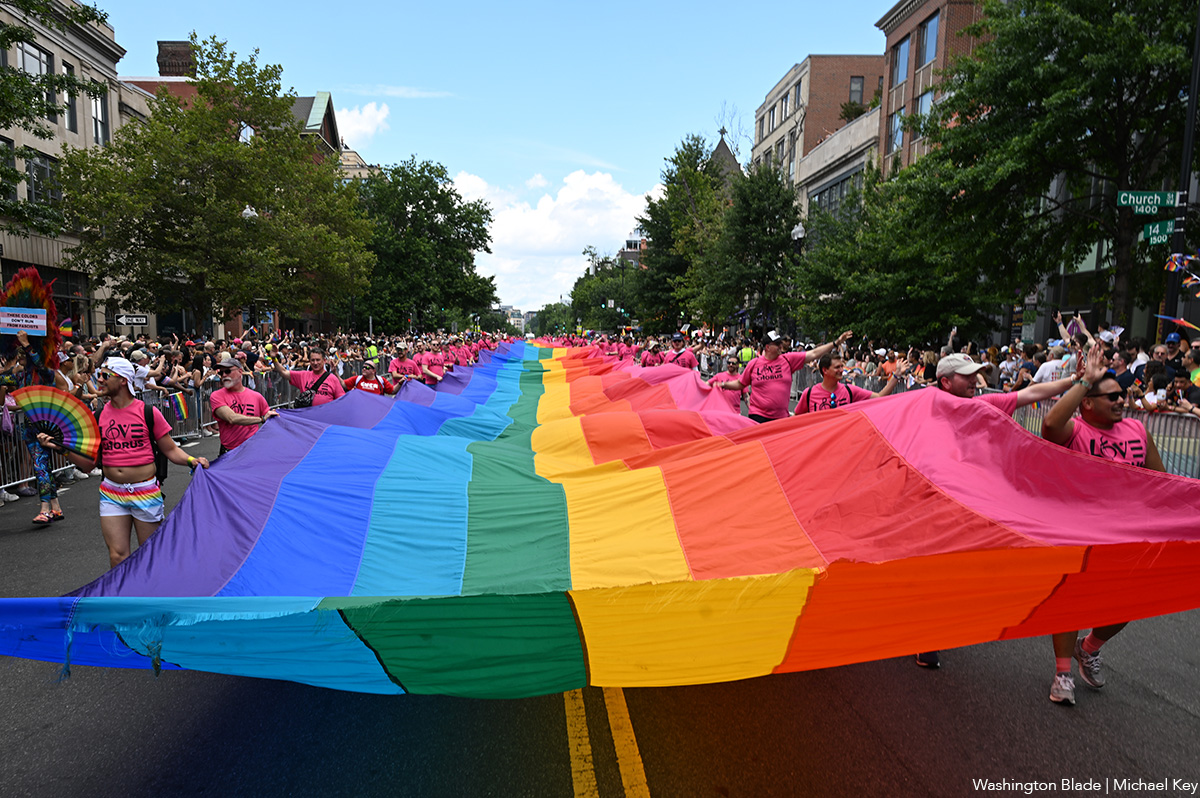
In over 60 countries, same-sex relations are criminal. In many more, LGBTIQ people are discriminated against, harassed, or even persecuted. Yet, in most parts of the world, if you are an LGBTIQ person, there is an organization quietly working to keep people like you safe: a lawyer fighting an arrest, a shelter offering refuge from violence, a hotline answering a midnight call. Many of those organizations have now lost so much funding that they may be forced to close.
One year ago this week, the U.S. government froze foreign assistance to organizations working on human rights, democracy, and development worldwide. The effects were immediate. For LGBTIQ communities, the impact has been severe and far-reaching.
For 35 years, Outright International has helped build and sustain the global movement for the rights of LGBTIQ people, working with local partners in more than 75 countries. Many of those partners are now facing sudden closure.
Since January 2025, more than $125 million has been stripped from efforts advancing the human rights of lesbian, gay, bisexual, transgender, intersex, and queer people globally. That figure represents at least 30 percent of yearly international funding for this work. Organizations that ran emergency shelters, legal defense programs, and HIV prevention services have been forced to close or drastically scale back operations. At Outright alone, we lost funding for 120 grants across nearly 50 countries. We estimate that, without intervention, 20 to 25 percent of our grantee partners risk shutting down entirely.
But this is not only a story about one community. It is a story about how authoritarianism works, and what it costs when we fail to recognize the pattern.
The playbook is not subtle
Researchers at Outright and partners across human rights and democracy movements have documented the same sequence playing out across sectors worldwide: governments defund organizations before passing restrictive legislation, eliminating the groups most likely to document abuses before abuses occur.
In December, CIVICUS downgraded its assessment of U.S. civic freedoms from “narrowed” to “obstructed,” citing what it called a “rapid authoritarian shift.” The message was unmistakable: independent organizations that hold power to account are under growing pressure, in the United States and around the world.
And the effects have cascaded globally. When one of the world’s largest funders of democracy support and human rights work withdraws, it doesn’t just leave a funding gap. It sends a signal to authoritarians everywhere: the coast is clear.
The timing is not coincidental. In the super election year of 2024, 85 percent of countries with national elections featured anti-LGBTIQ rhetoric in campaigns. Across the 15 countries we tracked, governments proposed or enacted laws restricting gender-affirming care, rolling back legal gender recognition, and censoring LGBTIQ expression. The defunding often came first. Governments know that if they can starve the movement, there will be no one left to document what comes next.
Why US readers should care
It may be tempting to see this as a distant crisis, especially at a moment when LGBTIQ rights in the United States are under real pressure. But this story is closer to home than it appears. American funding decisions often help determine whether organizations protecting LGBTIQ people abroad can keep their doors open. And when independent organizations are weakened, no matter where they are, the consequences do not stay contained. The same political networks driving anti-LGBTIQ legislation in the United States share strategies and resources with movements abroad. Global repression and domestic rollback are not separate stories. They are the same story, unfolding in different places.
LGBTIQ organizations are often the first target, but never the last
Why target LGBTIQ communities first? Because we are politically easier to isolate. The same playbook — foreign funding restrictions, bureaucratic harassment, banking access denial — is now being deployed against environmental groups, independent media, women’s rights organizations, and election monitors. When one part of our community is silenced, all of us become more vulnerable. What happens to us is a preview of what happens to everyone.
This is not speculation. It is documented history. In Hungary, the government restricted foreign funding for civil society before passing its “anti-LGBTQ propaganda” law. In Russia, “foreign agent” designations preceded the criminalization of LGBTIQ identity. In Uganda, funding restrictions on human rights organizations came before the Anti-Homosexuality Act. The pattern repeats because it works.
And yet, even as these attacks intensify, victories continue. In 2025, Saint Lucia struck down a colonial-era law criminalizing consensual same-sex intimacy after a decade of regional planning and coalition-building. Courts in India, Japan, and Hong Kong upheld trans people’s rights. Budapest Pride became the largest in Hungarian history — and one of the country’s biggest public demonstrations — despite a government ban. In Thailand, years of patient advocacy culminated in marriage equality becoming law in 2025, the first such victory in Southeast Asia.
These wins happened because our movement built the capacity to survive hostility. Legal defense funds. Documented evidence. Regional coalitions. Emergency response networks. The organizations behind these victories are precisely the ones now facing drastic funding cuts and even closure.
What we are doing and what we need
On Jan. 20, 2026, Outright International publicly launched Funding Our Freedom, a $10 million emergency campaign running through June 30, 2026. We have already secured over $5 million in pledges from more than 150 donors. But the gap remains enormous.
The campaign supports two priorities that must move together. Half of the funds go directly to frontline LGBTIQ organizations facing sudden shortfalls: keeping staff paid, maintaining safe spaces, securing legal support, and continuing essential services. The other half supports Outright’s global work: documenting abuses, training activists, and advocating for LGBTIQ inclusion at the United Nations and other international forums. This is how LGBTIQ people remain seen, heard, and defended, even when governments attempt to erase them.
We structured Funding Our Freedom this way because frontline support without protection is fragile, and global advocacy without frontline truth is hollow. Both must survive.
Funding Our Freedom is not charity. It is how we keep the global LGBTIQ movement alive when governments try to erase it.
A call to those who believe in equality and democracy
If you are part of the LGBTIQ community, this moment is personal. Whether you give, share this work, host a small fundraiser, or bring others into the effort, you become part of what keeps our global community connected and protected.
If you are an ally or simply someone who believes in fairness, free expression, and accountable government, this fight is yours too. The defunding of LGBTIQ organizations is not an isolated decision. It is a test case. If it succeeds, the same tactics will be used against every group that challenges power and defends vulnerable people.
We are not asking for sympathy. We are asking for commitment. The organizations now being forced to close are the ones that document abuses, provide legal defense, support people in crisis, and show up when no one else will. If they disappear, we lose more than services. We lose the ability to know what is happening and to respond.
Authoritarians understand this. That is why they target us first.
The question is whether the rest of us understand it in time.
Maria Sjödin is the executive director of Outright International, where they has worked for over two decades advocating for LGBTIQ human rights worldwide. Learn more at outrightinternational.org/funding-our-freedom.

‘Jonah’ an undeniably compelling but unusual memory play

The Oscar-losing performance that’s too good to miss

Trump tells Fox News he won the ‘gay vote’ — but polls tell a different story

Anti-trans visa ruling echoes Nazi regime destroying trans documents

Japanese Supreme Court to consider marriage equality

D.C. goes gaga for Gaga

Menaka Guruswamy celebrated as India’s first openly LGBTQ MP

HRC to host National Rainbow Seder

Gay priest credited with boosting church support for LGBTQ Catholics