Local
Most D.C.-area cities receive highest score in HRC Equality Index
‘Record breaking’ 132 jurisdictions nationwide receive top ranking
The Human Rights Campaign Foundation on Nov. 18 released its 14th annual Municipal Equality Index report showing that a record number of 132 cities across the country, including nine in Virginia and seven in Maryland, received the highest score of 100 for their level of support for LGBTQ equality through laws, policies, and services.
Among the D.C.-area cities and municipalities receiving a perfect score of 100 were Alexandria, Arlington County, Fairfax County in Virginia and College Park, Bowie, Gaithersburg and Rockville in Maryland.
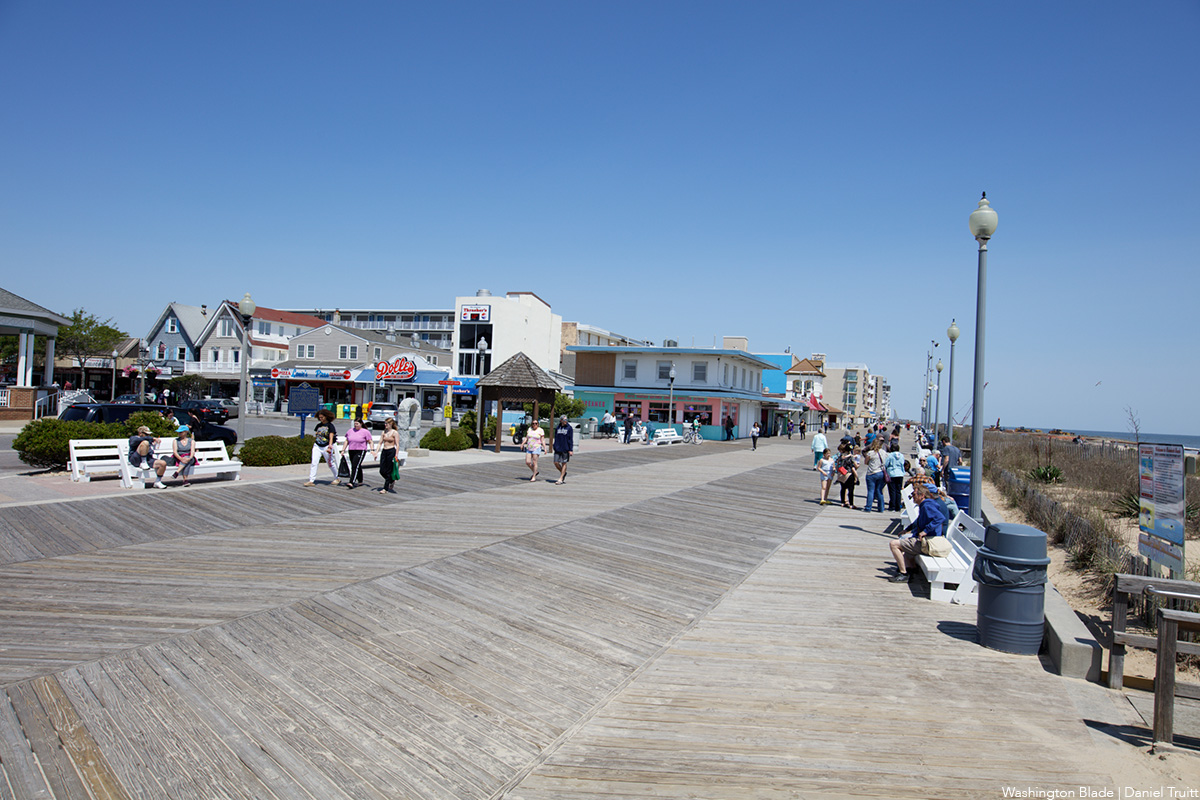
The city of Rehoboth Beach is listed as the only city or municipality in Delaware to receive a score of 100. Rehoboth city officials released a statement hailing the high score as a major achievement over the previous year’s score of 61, saying the improvement came through a partnership with the local LGBTQ advocacy and services group CAMP Rehoboth.
The HRC Foundation, which serves as the educational arm of the Human Rights Campaign, the nation’s largest LGBTQ advocacy organization, includes the District of Columbia in a separate State Equality Index rating system under the premise that D.C. should be treated as a state and receive full statehood status.
In its 2024 State Equality Index report, D.C. and 21 states, including Maryland, Virginia, and Delaware, were placed in the “highest rated category” called Working Toward Innovative Equality, which does not use a numerical score.
“The 2025 MEI shows a record breaking 132 cities scoring the highest possible marks on the index, representing a combined population of approximately 49 million people,” the HRC Foundation said in a statement announcing the 2025 report.
“This high-water mark is critical as pressure continues from states that pass laws and policies that seek to shut transgender people – particularly trans youth – out of public life,” the statement continues. It adds that many cities that have put in place trans supportive laws and policies, including health insurance benefits, “are in many cases no longer able to provide that coverage in a meaningful way as a result of discriminatory decisions made by state legislatures.”
The statement goes on to say, “However, more cities than ever are doing what the MEI characterizes as ‘testing the limits of restrictive state laws’ – pushing back against various checks on municipal power or discriminatory state laws – with nearly 70 cities doing so.”
The HRC statement notes that this year’s Municipal Equality Index rated a total of 506 cities. It says that number includes the 50 state capitals, the 200 largest cities in the U.S., the five largest cities or municipalities in each state, the cities that are home to the state’s two largest universities, and the 75 cities or municipalities that have high proportions of same-sex couples.
The report shows this year’s index rated 11 cities or municipalities in Virginia with the following rating scores: Alexandria, 100; Arlington County,100; Fairfax County, 100, Richmond, 100; Charlottesville, 100; Chesapeake, 80; Hampton, 100; Newport News, 100; Norfolk, 91, Roanoke, 100, and Virginia Beach, 100.
In Maryland a total of 10 cities were rated: Annapolis, 100; Baltimore, 100; Bowie, 68; College Park, 100; Columbia, 100; Frederick, 100; Gaithersburg, 100; Hagerstown, 75; Rockville, 100 and Towson in Baltimore County, 85.
A total of eight cities were rated in Delaware: Rehoboth Beach, 100; Bethany Beach, 51; Milford, 83; Dover, 69; Wilmington, 76; Newark, 72; Smyrna, 59; and Middletown, 64.
The full 2025 HRC Foundation Equality Index Report can be accessed at hrc.org.

Rehoboth Beach
BLUF leather social set for April 10 in Rehoboth
Attendees encouraged to wear appropriate gear

Diego’s in Rehoboth Beach hosts a monthly leather happy hour. April’s edition is scheduled for Friday, April 10, 5-7 p.m. Attendees are encouraged to wear appropriate gear. The event is billed as an official event of BLUF, the free community group for men interested in leather. After happy hour, the attendees are encouraged to reconvene at Local Bootlegging Company for dinner, which allows cigar smoking. There’s no cover charge for either event.
District of Columbia
Celebrations of life planned for Sean Bartel
Two memorial events scheduled in D.C.
Two celebrations of life are planned for Sean Christopher Bartel, 48, who was found deceased on a hiking trail in Argentina on or around March 15. Bartel began his career as a television news reporter and news anchor at stations in Louisville, Ky., and Evansville, Ind., before serving as Senior Video Producer for the D.C.-based International Brotherhood of Electrical Workers union from 2013 to 2024.
A memorial gathering is planned for Friday, April 10, 11:30 a.m.-1:30 p.m. at the IBEW International Office (900 7th St., N.W.), according to a statement by the DC Gay Flag Football League, where Bartel was a longtime member. A celebration of life is planned that same evening, 6-8 p.m. at Trade (1410 14th St., N.W.).
District of Columbia
D.C. Council member honored by LGBTQ homeless youth group
Doni Crawford receives inaugural Wanda Alston Legacy Award

About 100 people turned out Tuesday evening, April 7, for a presentation by D.C.’s Wanda Alston Foundation of its inaugural Wanda Alston Legacy Award to D.C. Council member Doni Crawford (I-At-Large) for her support for the foundation’s mission to support homeless LGBTQ youth.
Among those who attended the event was Japer Bowles, director of D.C. Mayor Muriel Bowser’s Office of LGBTQ Affairs, who delivered an official proclamation issued by Bowser declaring April 7, 2026 “A Day of Remembrance for Wanda Alston.”
Alston, a beloved women’s and LGBTQ rights activist, served as the city’s first director of the then newly created Office of LGBTQ Affairs under then-Mayor Anthony Williams from 2004 until her death by murder on March 16, 2005.
To the shock and dismay of fellow LGBTQ rights advocates, police and court records reported Alston, 45, was stabbed to death inside her Northeast D.C. house by a man high on crack cocaine who lived nearby and who stole her credit cards and car. The perpetrator, William Martin Parrott, 38, was arrested by D.C. police the next day and later pleaded guilty to second-degree murder. He was sentenced in July 2005 to 24 years in prison.
Crawford was among those attending the award event who reflected on Alston’s legacy and outspoken advocacy for LGBTQ and feminist causes.
“I am deeply humbled and honored to receive this inaugural award,” Crawford told the Washington Blade at the conclusion of the event. “I think the world of Wanda Alston. She has set such a great foundation for me and other Council members to build on,” she said.
“Her focus on inclusivity and intersectionality is really important as we approach this work,” Crawford added. “And it’s going to guide my work at the Council every day.”
Crawford was appointed to the D.C. Council in January of this year to replace then Council member Kenyan McDuffie (I-At-Large), who resigned to run for D.C. mayor as a Democrat. She is being challenged by four other independent candidates in a June 16 special election for the Council seat.
Under the city’s Home Rule Charter written and approved by Congress, the seat is one of two D.C. Council at-large seats that cannot be held by a “majority party” candidate, meaning a Democrat.
A statement released by the Alston Foundation last month announcing Crawford’s selection for the Wanda Alston Legacy Award praised Crawford’s record of support for its work on behalf of LGBTQ youth.
“From behind the scenes to now serving as an At-Large Council member, she has fought fearlessly for affordable housing, LGBTQ+ funding priorities, and racial justice,” the statement says. “Council member Crawford’s leadership reflects the same courage and conviction that defined Wanda’s legacy.”
Organizers of the event noted that it was held on what would have been Wanda Alston’s 67th birthday.
“Today’s legacy reception was a smashing success,” said Cesar Toledo, the Alston Foundation’s executive director. “Not only did we come together to celebrate Wanda Alston on her birthday, but we also were able to raise over $10,000 for our homeless LGBTQ youth here in D.C.,” Toledo told the Blade.
“In addition to that, we celebrated and we acknowledged a rising star in our community,” he said. “And that is At-Large Council member Doni Crawford, who we named the inaugural Wanda Alston Legacy Award recipient.”
At the request of D.C. Council Chair Phil Mendelson (D-At-Large) the Council voted unanimously on Jan. 20, 2026, to appoint Crawford to the Council seat being vacated by McDuffie.
Council records show she joined McDuffie’s Council staff in 2022 as a policy adviser and later became his legislative director before McDuffie appointed her as staff director for the Council’s Committee on Business and Economic Development for which McDuffie served as chair.

Calendar: April 10-16

BLUF leather social set for April 10 in Rehoboth

Celebrations of life planned for Sean Bartel

The ‘X’ returns to court

LGBTQ community explores arming up during heated political times

D.C. is the place for the Democratic Socialists of America

PHOTOS: The Bonnet Ball

Key lifestyle changes can help patients cope with diabetes

Trump budget would codify expanded global gag rule