The White House
Empty seats, canceled shows plague Kennedy Center ahead of Trump renaming
It would take an act of Congress to officially rename the historic music venue, despite the Trump-appointed board’s decision.

The board of the Kennedy Center in Washington, D.C., voted to rename it the Trump-Kennedy Center, according to the White House Press Office.
White House Press Secretary Karoline Leavitt announced the decision in a post on X Thursday, thanking the president for his work on the cultural center “not only from the standpoint of its reconstruction, but also financially, and its reputation.”
Speaking to reporters later that day at the White House, Trump said he was “surprised” and “honored” by the board’s vote.
“This was brought up by one of the very distinguished board members, and they voted on it, and there’s a lot of board members, and they voted unanimously. So I was very honored,” he said.
Earlier this year, GOP Rep. Mike Simpson of Idaho introduced an amendment that would have renamed the building after first lady Melania Trump, later saying she had not been aware of his efforts prior to the amendment’s public introduction.
Despite the board’s vote (made up of Trump-appointed loyalists), the original laws guiding the creation of the Kennedy Center during the Eisenhower, Kennedy, and Johnson administrations explicitly prohibit renaming the building. Any change to its name would require an act of Congress.
Trump has exerted increasing control over the center in recent months. In February, he abruptly fired members of the Kennedy Center’s board and installed himself as chair, writing in a Truth Social post at the time, “At my direction, we are going to make the Kennedy Center in Washington D.C., GREAT AGAIN.”
In that post, Trump specifically cited his disapproval of the center’s decision to host drag shows.
He later secured more than $250 million from the Republican-controlled Congress for renovations to the building.
Since Trump’s takeover, sales of subscription packages are said to have declined, and several touring productions — including “Hamilton” — have canceled planned runs at the venue. Rows of empty seats have also been visible in the Concert Hall during performances by the National Symphony Orchestra.
“The Kennedy Center Board has no authority to actually rename the Kennedy Center in the absence of legislative action,” House Minority Leader Hakeem Jeffries told reporters.
For decades, the Kennedy Center has hosted performances by LGBTQ artists and companies, including openly queer musicians, choreographers, and playwrights whose work helped push LGBTQ stories into the cultural mainstream. Those artists include the Gay Men’s Chorus of Washington, Harvey Fierstein, and Tennessee Williams.
In more recent years, the center has increasingly served as a space for LGBTQ visibility and acceptance, particularly through Pride-adjacent programming and partnerships.
That legacy was on display at this year’s opening production of Les Misérables, when four drag performers — Tara Hoot, Vagenesis, Mari Con Carne, and King Ricky Rosé — attended in representation of Qommittee, a volunteer network uniting drag artists to support and defend one another amid growing conservative attacks.
“We walked in together so we would have an opportunity to get a response,” said Tara Hoot, who has performed at the Kennedy Center in full drag before. “It was all applause, cheers, and whistles, and remarkably it was half empty. I think that was season ticket holders kind of making their message in a different way.”
The creation of the Kennedy Center is outlined in U.S. Code, which formally designates the institution as the John F. Kennedy Center for the Performing Arts.
As a result, it appears unlikely that Congress will come together to pass legislation allowing the historic venue to be renamed.

The White House
Kristi Noem ‘devastated’ as husband’s alleged fetish spending surfaces
Former DHS head ‘blindsided’ by allegations
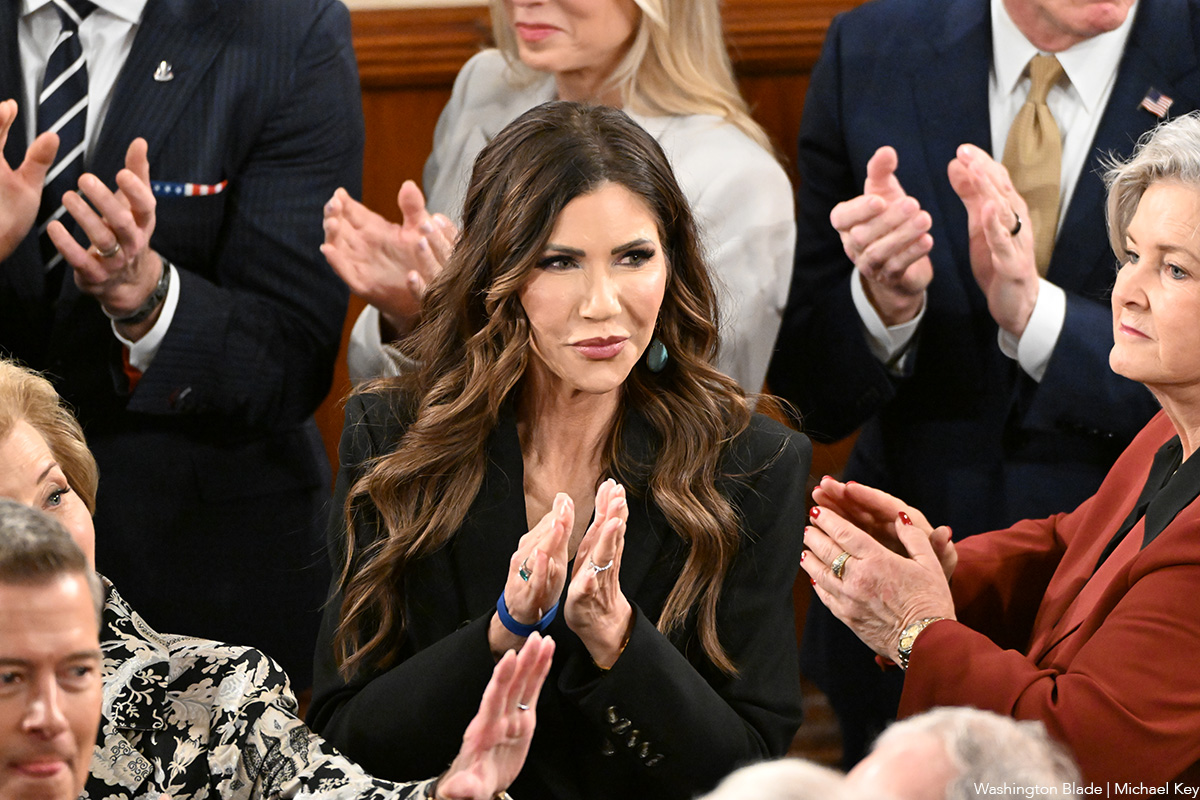
Former Department of Homeland Security Secretary Kristi Noem said she is “devastated” after reports alleged her husband paid large sums to fetish models and shared cross-dressing photos while married to her.
The Daily Mail first reported the story on March 31, accusing 56-year-old Bryon Noem — the former second gentleman of South Dakota and husband to the former DHS secretary — of exchanging hundreds of messages with three women in the “bimbofication” fetish scene. According to the report, he praised their surgically enhanced bodies and was asked to send them money though various online accounts during the 14 months his wife led the nation’s largest federal law enforcement agency.
He sent them at least $25,000 via Cash App and PayPal, according to the story, that also included photos reportedly show him wearing pink shorts and a flesh-colored top with balloons simulating breasts.
When the payments were delayed or failed to be sent, the women would get mad and ignore him, the story reads. At least one woman who didn’t receive money after texting Noem was so disgruntled she posted about his behavior on social media before later deleting it.
The allegations quickly went viral across social media and major news outlets. Representatives for Kristi Noem told the New York Post she was “devastated” and that her family was “blindsided” by the claims, while requesting privacy and prayers.
President Donald Trump, when asked by the Daily Mail, expressed surprise that the Noem family had confirmed the photos’ authenticity.
“They confirmed it? Wow, well, I feel badly for the family if that’s the case, that’s too bad,” Trump told the outlet that broke the story. “I haven’t seen anything. I don’t know anything about it. That’s too bad, but I just know nothing about it.”
Kristi and Bryon Noem met in high school and married in 1992, according to the Daily Mail. They have two daughters, Kassidy, 31, and Kennedy, 29, and a son, Booker, 23.
The controversy comes after Noem’s recent removal from one of the highest-ranking positions in Trump’s Cabinet. Markwayne Mullin was sworn in as Homeland Security Secretary last week, though Noem remains part of the president’s team as special envoy to the Shield of the Americas, a U.S.-led regional security organization focused on coordinating efforts to combat organized crime, drug trafficking, and illegal migration throughout the Western Hemisphere.
Noem’s political career spans more than a decade across state and federal government jobs. She served in the South Dakota House of Representatives from 2007 to 2011, in the U.S. House of Representatives from 2011 to 2019, and as Governor of South Dakota from 2019 to 2025.
She was confirmed as Secretary of Homeland Security during Trump’s second term, serving from 2025 until her removal following widespread backlash over escalating U.S. Immigration and Customs Enforcement operations, which included separating children from their families and two separate fatal shootings of U.S. citizens by ICE officers during protests. Trump reportedly decided to fire Noem from DHS after her congressional hearing related to the deaths, in which she stated that the president had approved a $200 million-plus government-funded DHS advertising campaign that prominently featured her.
The reports about her husband have also reignited speculation about Noem’s personal life, including rumors involving Trump supporting political operative Corey Lewandowski, described by some as the “worst-kept secret in D.C.”
Some accounts suggest Bryon Noem was aware of the alleged relationship — and benefited from it. Political commentator Ryan James Girdusky fueled that speculation during an August 2025 episode of the It’s a Numbers Game podcast, citing what he described as “D.C. gossip” that a top Cabinet official — rumored to be Noem — had privately claimed her husband was gay.
“A reporter walked up to her and said, ‘Why are you having this affair? Why haven’t you met up with your husband? Why aren’t you divorcing your husband?’” Girdusky said on the podcast. “And she blurted out to this reporter, who I know, and said, ‘Oh, my husband’s gay.’”
Unlike the unverified claims surrounding her husband, Noem’s political record on LGBTQ issues is well documented.
In 2024, while serving as governor, her administration canceled a contract with a community health worker organization, resulting in a $300,000 settlement with a transgender advocacy group. The contract had included a roughly $136,000 state-administered federal grant, of which about $39,000 had already been distributed, according to the group’s attorneys.
Noem also championed a series of policies restricting trans rights. She signed executive orders in 2021 barring transgender girls and women from competing on women’s sports teams at public schools and colleges in the state. In addition to using executive authority to enact these policies, she signed legislation into law. She enacted House Bill 1080, which bans age-appropriate, medically necessary health care for trans youth — despite widespread support for such care from major medical associations and global health authorities.
Noem also supported legislation aimed at restricting trans athletes, though she ultimately vetoed one bill, citing potential legal challenges from the NCAA while maintaining support for its intent. Additionally, she signed a Religious Freedom Restoration Act that LGBTQ advocates say enables discrimination under the guise of protecting religious liberty.
The White House
Thousands attend ‘No Kings’ protests in D.C.
Protesters demand accountability, defend democracy, and oppose Trump administration
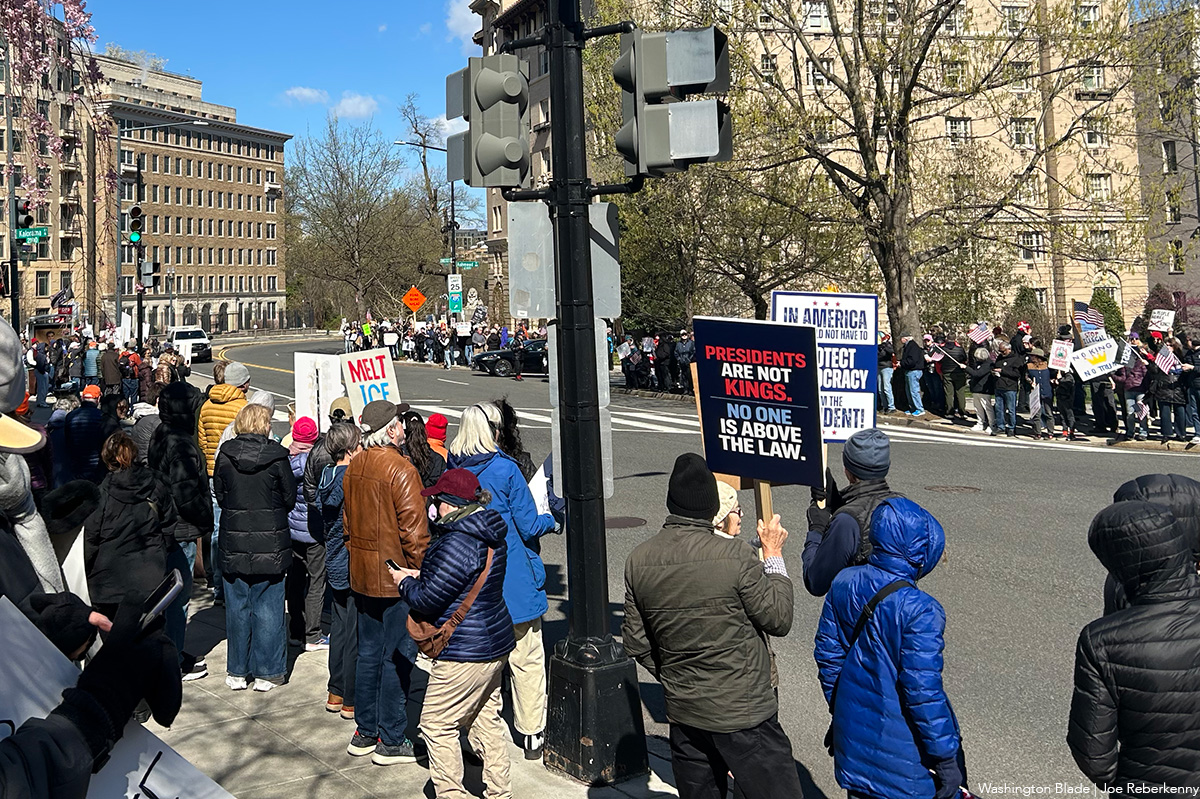
Across all 50 states — and D.C. — more than 8 million people came out nationwide from towns big and small, red and blue, to make their voices heard. That united voice echoed what nearly 20,000 protesters declared in the nation’s capital back in October 2025: the citizens of the U.S. would not sit idly by as President Donald Trump and his administration erode democracy, attempt to restrict human rights, loosens First Amendment protections, and begin wars without congressional approval.
While there were countless differences among the thousands who joined the “No Kings” protests this weekend in the DMV — from creeds and socioeconomic statuses to races, sexualities, and gender identities — there was one thing that united them all during the chilly March 28 weather: a commitment to making their voices heard.
By 10 a.m., the Washington Blade estimated around 200 people had braved bitter winds and temperatures hovering around 40 degrees, with bright sun, to stand along the cherry blossom-adorned streets of Kalorama and Connecticut Avenue. Protesters carried signs large and small from criticizing Trump’s disregard for the “everyman” to handmade signs emphasizing love, calling for the melting of ICE, and addressing issue-specific concerns like ending the wars in Gaza and Iran — both policies propagated by Trump.
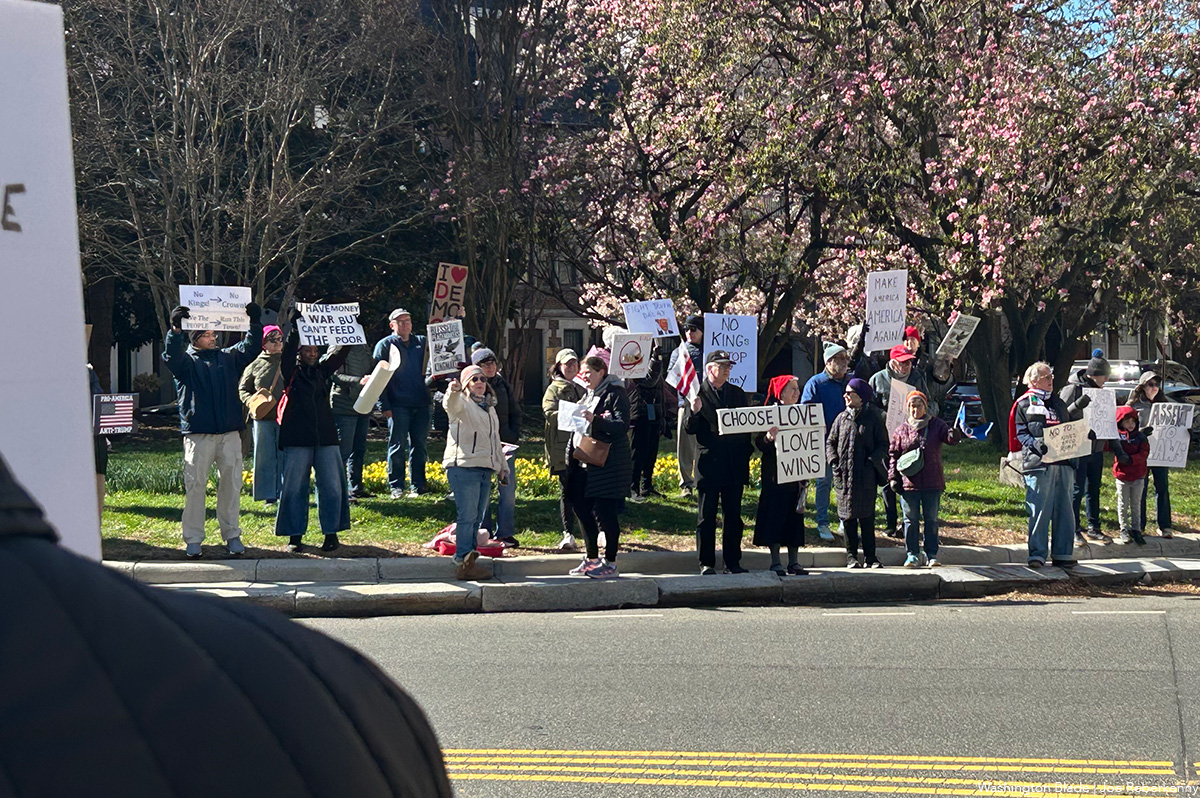
While a solid group of D.C. residents came out with babies in strollers and dogs on leashes, the Kalorama protest skewed older with a majority-white crowd.
On the other side of town, the more heavily attended protest in Anacostia started at 1:30 p.m., crossing the Frederick Douglass Bridge.
MS Now estimates that over 20,000 people marched across the bridge, sending a clear message to the president, his administration, and the Republican-controlled federal government: federal overreach is not what the majority of Americans want to see, hear, or witness as protesters in the thousands came out for, as organizers say “the single largest non-violent day of action” in American history.
The two marches on Saturday differed in both theme and location — the Kalorama protest felt like a small-town demonstration in a big city, covering a wide variety of topics, whereas the Anacostia protest was more focused, directly calling out and pushing back against the actions of Stephen Miller (the White House chief of staff)and other Trump allies.
Many participants shared their reasons for marching with glee — shouting as cars honked in support passing by and discussing the broader issues within the current political climate with those standing next to them: some neighbors, some friends, others complete strangers. Regardless, an important discussion was happening across the city.
A surprise to many participants — and the Blade reporter covering the event — was seeing U.S. Rep. Sara Jacobs (D-Calif.) stand outside in near-freezing temperatures with her staff and some signs.
Jacobs used the exclusive — and more intimate — ability to speak on her experience watching everything unfold from inside the halls of Congress.
“We had votes until midnight last night, so I couldn’t make it back to San Diego for the march, but it’s important to show up and cheer on people standing up and making their voices heard,” Jacobs said. “This is just the start. We need to make our voices heard every day through the end of the year.”
Jacobs also used the opportunity to criticize congressional inaction from those on the other side of the aisle, reminding the Blade that a legislator’s job is to protect and secure the people they represent — not the interests of a wannabe king or corporations that back many congressional campaigns through PACs.
“It makes me angry at my Republican colleagues who won’t stand up to Trump. Actions like this inject courage into my colleagues — they need to see that the American people have their back,” she added, eventually emphasizing the public responsibility lawmakers have to protect the Constitution and everyone in the country (which the Supreme Court had pointed out as far back as 1886 with Yick Wo v. Hopkins). “Congress is not going to save people. This is about everyone showing up and making our voices heard and building the democracy we want.”

Ashley Gould, a tourist visiting from Missouri, told the Blade that despite Washington being seen as one of the most politically active towns in the country, over the past few years, she and many other politically active Missourians have been preparing for this moment and were zealous to have their voices heard together as one.
“I’m actually visiting my sister from Missouri, and we’ve been doing this since the first No Kings protest [there]. I wanted to see how you guys did it here,” she said. “As someone in a red state, we’re not represented in Congress right now, so I don’t personally have a say in any of this. If I can do one small thing, I want kids in our town to see me trying to make a difference, get petitions signed. This is all we have.”
Gould continued, “I don’t know if it’s going to cause an impact for elected officials, but I hope that little kid who sees us with the posters sees that we do have a voice—and maybe one day they can, if they can’t right now.”
Gary Bowman, another early protest-goer, held a sign that pointed out the obscurity — and unconstitutional nature — of the current administration’s actions.
“I hate the direction the country is going in, and Donald Trump is not fit to be in office,” Bowman said, adding that his choice of sign exemplified that. “It’s obvious based on his policies — his attacks on the trans and LGBTQ communities — that he’s trying to suppress people. And the Republican Congress isn’t helping.”
When asked how the phrase “No Kings” resonates with him, especially since this is the third one held in two years, Bowman said it may be catchy for headlines or help inspire creative signs (like Trump on a golden throne or toilet), but the march and protest are about something much more important.
“‘No Kings’ is a catchphrase for me; I’m more concerned about losing our democracy. We, the people, have a voice we should use,” he said, elaborating on how this administration’s course of action disregards rules designed to prevent an authoritarian — or wannabe-authoritarian — from taking power. “I don’t think Trump is overstepping … I think he’s shattering democratic norms. He wants to do what’s right for Donald Trump, not for anyone else.”
He concluded bluntly that unless everyone — including Republicans in power — stand up to the president for these ludicrous choices, change won’t happen, regardless of how loud he or any other Trump critics scream at protests.
“Until we have a Congress that would actually look at protests and take action, it won’t matter. He’ll just get pissed off and act against them,” Bowman said.
When asked what he could say to those in charge, he finished strongly: “If I could say one thing to him? Fuck off, Donald Trump.”
Jameson Woosley and Elena Lacayo were standing on the corner of Kalorama Road, holding their baby tight as pink cherry blossom trees swayed behind them, as if to cheer on the protesters.
“It’s the degradation of democracy. Every day there’s an overreach by the executive branch, and Congress just sits on their hands,” Woosley said, standing side by side with Lacayo.
“It’s terrifying for my baby. This administration has turned people who’ve done nothing wrong into criminals — it’s Orwellian. Up is down, war is peace,” Lacayo noted. “I was raised in another country with authoritarians… I’m a citizen here, and I’m going to use every right I have to advocate for those who can’t.”
Lacayo then spoke about how, for many, direct protests against government action (and inaction) are the only choice — especially under a supermajority federal government with the White House, Supreme Court, and both chambers of Congress.
“We have no choice but to believe change can come. This is what we can do. We must continue fighting; that’s what the human spirit is about,” she said.
Woosley emphasized the growing impact of the protests, saying, “Every protest gets bigger, and opinion polls keep swinging in the right direction … We need to speak up and get all the right people out to bring positive change.”
“These people are nothing without us,” Lacayo added.
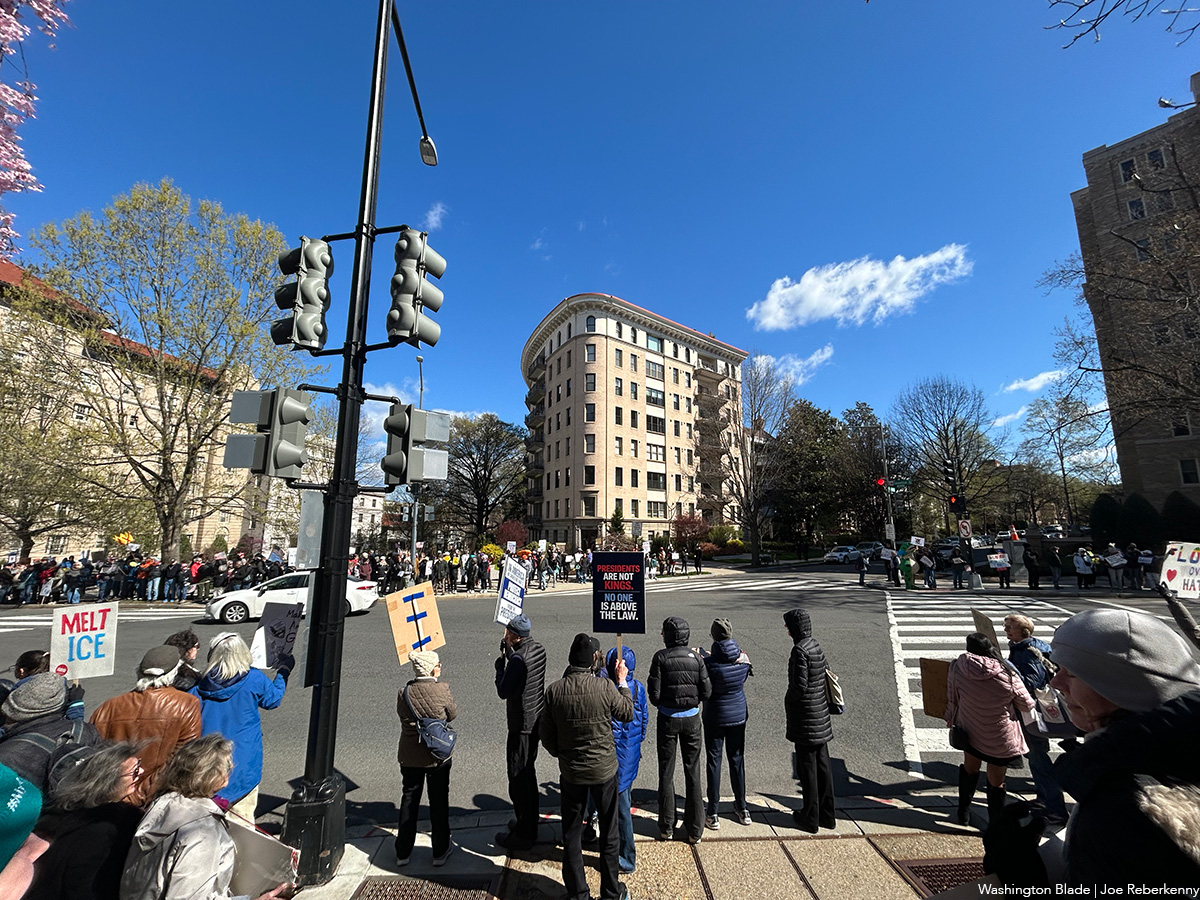
Beth Davis, a former resident of Kalorama, shared with the Blade that this place holds special meaning for her — and her children — which is in part why she chose this one over the larger protest in Anacostia.
“I used to live in the neighborhood, so this is special for me. It’s easy to bring the kids and let them be part of the movement,” Davis said, as her elementary-aged children ran around the manicured grass while bundled up, enjoying the lively atmosphere.
“What’s happening to immigrant communities is horrific, and I want to show solidarity. Also, the Iran war — it’s terrifying what’s happening,” she added before explaining what the “No Kings” name actually means to her. “’No Kings’ makes me think of the extreme grab for power — it’s unprecedented.”
Davis then noted the importance of protesting when it seems like the main goal is often to iisolate : “Coming to protests makes people feel like they’re not alone, and that momentum carries into elections,” she explained, noting why she not only brought her two children to this protest—and many others in the past as well– but uses these as real world teaching moments. “We bring kids to teach them their civic responsibilities. My oldest has been to about ten protests.”
Another remarkable aspect of D.C. protests is the diversity of participants. Teachers, retail workers, students, and even some congresspeople turned out. In Kalorama on Saturday, the No Kings protest brought out Anne Plant, a biochemist and fellow at the National Institute of Standards and Technology, where she was previously chief of the Biosystems and Biomaterials Division.
Plant focused on many issues when speaking to the Blade, but started with what many consider the most important: Trump-era policies making civic engagement more difficult, particularly regarding civil rights.
“A lot of things are going wrong, and the only way to change them is for people to act. D.C. has no statehood, no vote — it’s a civil rights issue,” Plant said. “To deny the vote to any group of U.S. citizens doesn’t make sense. These people work for us; we should be able to hold them accountable.”
She held a small, hand-painted sign with two cohesive messages: “Reject Fascism. Defend democracy.”
“Some of what’s going on now is not healthy for society. No one will benefit; it’s just ruination,” Plant concluded. “Seeing more people out here shows that others feel the same, and momentum is what it takes to move things.”
Religious activists also joined the marches. Sister Diane and Sister Claire, two Catholic nuns, were out protesting Trump and his agenda.
“We’re sisters, Catholics in support of LGBTQ rights. I work with immigrants, and we wanted to stand in solidarity,” Sister Diane said.
Sister Claire reflected on the era the U.S. is in now: “It’s so disturbing. I’m almost glad my folks aren’t alive anymore for all they cared about. It’s heartbreaking, but we need something for the future.”
John Jones, another attendee teeming with energy and anger against the regime, captured the urgency of the moment succinctly.
“We’ve got to do something. I needed to be part of the community and let them know we’re tired of all the madness,” Jones told the Blade before detailing specific atrocities by the Trump-Vance administration.
“Rounding up legal people who follow the rules — throwing them away just because he’s racist, or his friends tell him to be racist. Helping pay for a war, bombing Gaza, killing people for no reason, manipulating the stock market for personal gain. It’s crazy,” he said, still holding out hope that small acts — like the protest gathering — show everyday Americans they have power, advocating for even more people to come out for the next No Kings protest.
“I hope protests can spark change. I won’t hold my breath, but the more people out here, the more they [in power] seem to be listening.”
Patty Bowring, who had moved with her family from the United Kingdom to join her husband in D.C. for his career, is set to return soon due to immigration restrictions. She, her children, and her mother came out to protest because she believes it is just as important for non-citizens to have the right to both protest and exist in a country founded and enriched by immigrant and enslaved labor.
“Even though we’re British, we’re leaving America in two months because of the administration. But this affects everybody — it’s hugely dangerous and worrying,” Bowring said.
Despite the somber mood, she kept a smile and joked: “I hope it’s the death of dinosaurs and that nothing more radical comes next. I want them to be happy,” also pointing out that the mixed messages at the protest could dilute impact. “Protests need a clearer message. ‘Anti-fascist’ should be the focus; too many other messages muddy things.”
Finally, John Norrin highlighted the continuity of civic engagement, informing the Blade that this protest — albeit a smaller version — happens every week on the corner.
“I’m here with friends, looking for more,” Norrin said. “There’s a regular protest every Thursday morning, and I’m going to start joining … The kings today are mostly figureheads, but we also have dictators not called kings who act like one. We have an elected representative trying to be a king.”
He, much like others around him — even with Jacobs standing mere feet away — criticized Congress’ inaction.
“Congress is understepping. They should assert their rights under Article One — declare war, impose tariffs — but they’re too afraid to follow their oath,” Norrin said, eventually shifting to a note of hope. “If at least 3.5 percent of the populace regularly protests, there’s a good possibility for change. I hope that happens here. Some friends will go to Connecticut to join larger groups. I had to figure out which protest in D.C. to join—it took a while.”
The White House
Trump tells Fox News he won the ‘gay vote’ — but polls tell a different story
Trump falsely claims LGBTQ support on Fox despite polling showing overwhelming opposition.
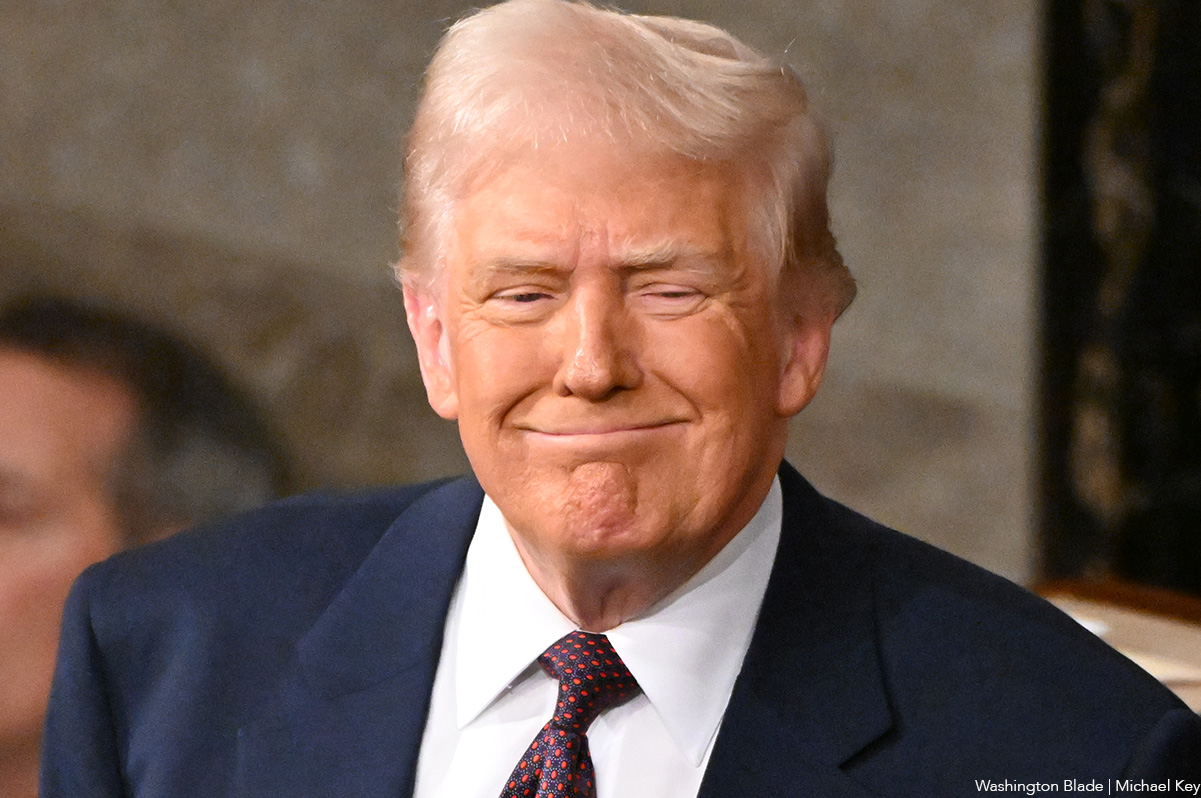
President Donald Trump claimed he won the “gay vote” in 2024, despite evidence showing otherwise.
While appearing by phone on Fox News’s panel show “The Five” on Thursday, Trump falsely claimed he performed particularly well among gay voters while discussing the ongoing war in Iran — a conflict he initiated without formal congressional approval.
“Now I think I did very well with the gay vote, OK? I even played the gay national anthem as my walk-off, OK?” Trump said on air.
“And I think it probably helped me. But I did great. No Republican’s ever gotten the gay vote like I did and I’m very proud of it, I think it’s great. Perhaps it’s because I’m from New York City, I don’t know…”
His claim contradicts 2024 polling from NBC News, which found that the GOP presidential ticket captured fewer than 1 in 5 LGBTQ male voters — a figure that may also include bisexual and transgender men. Trump’s support among LGBTQ female voters was even lower, at just 8%.
White LGBTQ voters favored Vice President Kamala Harris over Trump by a margin of 82% to 16%, while LGBTQ voters of color backed Harris by an even wider 91% to 5%.
Trump also used the appearance to criticize “Gays for Palestine,” saying: “Look at ‘Gays for Palestine’… they kill gays, they kill them instantly, they throw them off buildings, and I’m saying, ‘Who are the gays for Palestine?’”
He further pointed to his campaign’s use of the song “Y.M.C.A.” by the Village People — which he has repeatedly described as a “gay national anthem” — noting that it was frequently used as a walk-off song at rallies, as an indication that he and his campaign were supported by the gay community. The track, long associated with camp and hyper-masculine gay imagery, became a staple of Trump campaign events.
The Village People were later booked to perform at Turning Point USA’s inaugural ball celebrating Trump’s second inauguration. Lead singer Victor Willis previously criticized Trump’s use of the song dating back to 2020 and considered legal action to block it, but ultimately said there was “not much he can do about it.” He later acknowledged the renewed exposure was “beneficial” and “good for business,” boosting the song’s popularity and chart performance.
Despite Trump’s claims of strong support from gay voters, polling has consistently shown otherwise — even as several prominent gay men have held roles in or around his orbit, sometimes dubbed the “A-gays.” These include Richard Grenell, former executive director of the Kennedy Center and Special Presidential Envoy for Special Missions; Treasury Secretary Scott Bessent; Under Secretary of State Jacob Helberg; Department of Energy official Charles T. Moran; and longtime supporter Peter Thiel, co-founder and CEO of Palantir.
His efforts to portray himself as aligned with the gay community stand in conflict with policies advanced under his leadership. These include removing LGBTQ-related data from State Department reports, attempting to narrowly redefine gender identity in federal policy, restricting access to gender-affirming health care, and rolling back anti-discrimination protections. His administration also rescinded initiatives focused on LGBTQ health equity, data collection, and nondiscrimination in health care and education — moves advocates say contribute to stigma and worsen mental health outcomes.
Additionally, some HIV programs and community health centers have lost funding from the federal government after supporting initiatives inclusive of transgender people as a direct result of Trump-Vance policies.

Kristi Noem ‘devastated’ as husband’s alleged fetish spending surfaces

Colo. activists condemn SCOTUS conversion therapy ruling

Is Ghana’s selective justice a human rights contradiction?

Supreme Court ruling against conversion therapy bans could affect Md. law

Glisten report details hostile climate for LGBTQ students

‘Out for McDuffie’ event held at D.C. gay bar

The Oscar-losing performance that’s too good to miss

‘Jonah’ an undeniably compelling but unusual memory play

PHOTOS: ‘No Kings’ rally and march