Connect with us

Virginia

Prominent activists join ‘Living History’ panel at Freddie’s Beach Bar

Event organized by owner of new Friends of Dorothy Café in Alexandria

Published

on

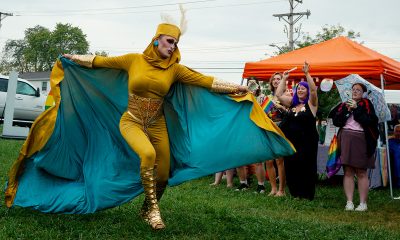
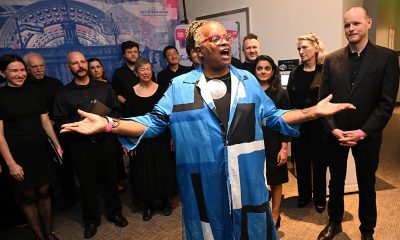
Panelists speak at the 'Living History' discussion at Freddie’s Beach Bar on Thursday. (Photo by Kate Pannozzo)

Six prominent LGBTQ community leaders and elders, including a beloved drag performer, talked about their role in advancing the rights of LGBTQ people and their thoughts on how the upcoming generation of LGBTQ youth should get ready to join the movement participated in an April 23 “Living History” panel discussion at Freddie’s Beach Bar.

The event was organized by Dorothy Edwards, who plans to open Friends of Dorothy Café in Alexandria. She said the café will be an LGBTQ community “intergenerational space” that will host events like the one she organized at Freddie’s Beach Bar.

“It will be a space for connection, storytelling, and belonging, especially for LGBTQ+ youth and community members who don’t always have places like that,” she said in a statement announcing the event at Freddie’s.

The six panelists at the Freddie’s event included Kierra Johnson, president of the D.C.-based National LGBTQ Task Force; Freddie Lutz, owner of Freddie’s Beach Bar located in the Crystal City section of Arlington, Va.; Donnell Robinson, who for many years performed in drag as the icon Ella Fitzgerald; Taylor Chandler Walker, a local transgender rights advocate, author and public speaker; Heidi Ellis, coordinator of the D.C. LGBTQ Budget Coalition; and Leti Gomez, an LGBTQ Latino community advocate and chair of the board of the American LGBTQ+ Museum.

Dr. Ashley Elliott, an LGBTQ community advocate and clinician who also goes by the name Dr. Vivid, served as moderator of the panel discussion, asking each of the panelists a serious of questions before opening the event to questions from the audience.

Among the issues discussed by the panelists was who was “centered” and who was excluded in the earlier years of LGBTQ organizing. Elliot also asked the panelists to address topics such as racism within queer spaces, gender dynamics, and strategies for coalition building between the LGBTQ community and other movements, including civil rights, feminism, and immigrant rights.

Each of the panelists expressed various thoughts on how the LGBTQ rights movement can make changes in response to the questions: “What can we do better?” and “Who is being left out?”

“I’m overwhelmed and so thankful that everyone on this panel said yes and agreed to come,” Edwards told the Washington Blade at the conclusion of the event. “I think every one of those people, including the moderator, was so brilliant and has done such good work for this community,” she said.

Edwards noted that each of the panelists, who have been involved in LGBTQ advocacy work for many years, talked about how they interact with younger LGBTQ people who are just beginning to become involved in activism.

“Truly, it’s an intergenerational conversation, and their wisdom and their words and their experiences can be disseminated to younger generations and people who want to do this work, people who want to fight for our community,” Edwards said.

“I was pleasantly surprised,” Lutz said. “I thought it was a good turnout, and everybody was very enthusiastic and engaged,” he said. “And I think it was great and fabulous.”     

Lutz has operated Freddie’s Beach Bar for more than 25 years and has hosted numerous LGBTQ events. A sign above the front entrance door to the popular LGBTQ bar and restaurant says, “Straight Friendly Gay Bar.”

Edwards said the April 23 event was recorded and she will make arrangements for the recording to be released for others to view it. The Blade will post the link in this story when it becomes available.   
Advertisement
FUND LGBTQ JOURNALISM
SIGN UP FOR E-BLAST

Virginia

Winsome Earle-Sears launches campaign against Va. marriage equality amendment

Former LG lost to Abigail Spanberger in 2025 gubernatorial race

Published

on

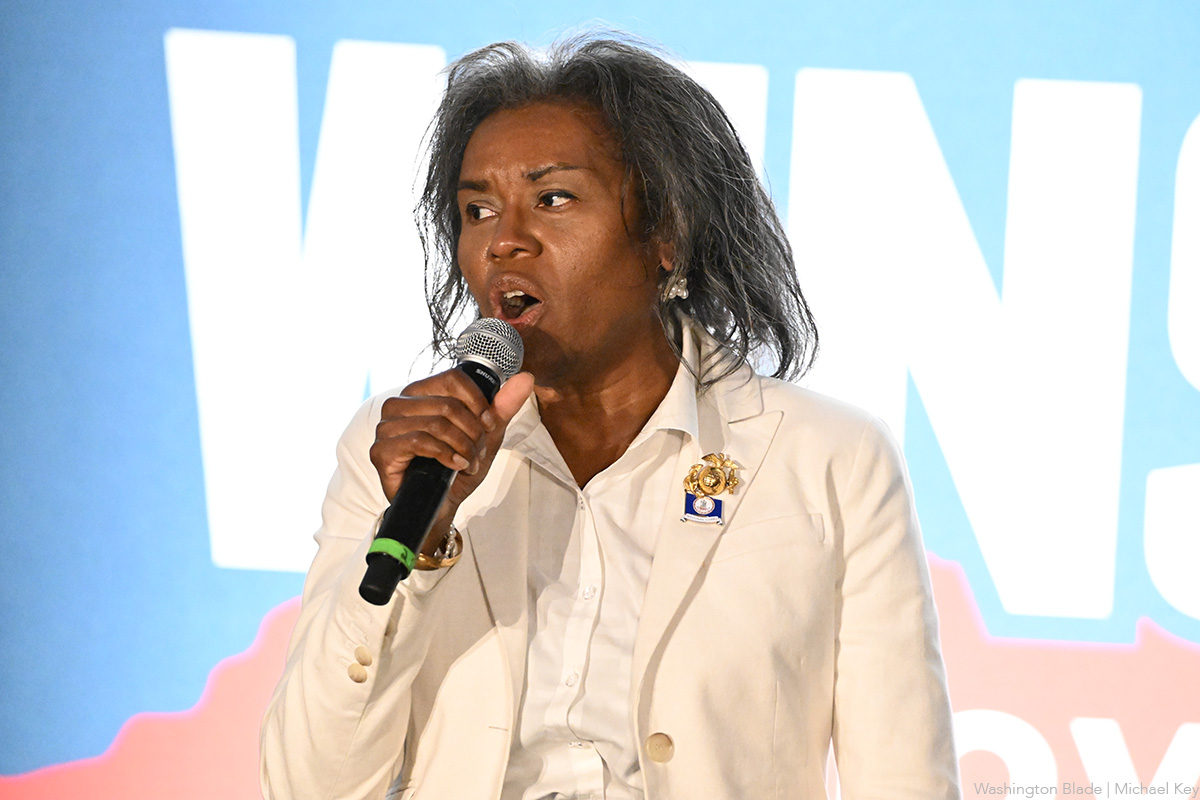
Former Virginia Lt. Gov. Winsome Earle-Sears (Washington Blade photo by Michael Key)

Less than a year after losing Virginia’s gubernatorial race, former Lt. Gov. Winsome Earle-Sears is campaigning across the state against constitutional amendments that would protect marriage equality and reproductive freedom.

She is launching a statewide “Life and Marriage Tour” ahead of November’s election.

Although same-sex couples can legally marry under the U.S. Supreme Court’s 2015 Obergefell v. Hodges decision, Virginia’s constitution still contains language that defines marriage as between one man and one woman. Supporters say removing the language would protect marriage equality should federal precedent change.

The original ban was written into the state constitution in 2006. 

It has been hinted at in the past by Supreme Court Judge Clarence Thomas that he would consider revisiting Obergefell v. Hodges regarding contraception and marriage rights for same-sex couples. He stated this in his concurring opinion regarding the Dobbs v. Jackson ruling, which allows for state-level abortion bans.

Equality Virginia Executive Director Narissa Rahaman said removing the ban would bring the state’s constitution in line with existing law.

“20 years after banning marriage equality, it’s time for our commonwealth to fully complete our evolution — and finish the job on protecting marriage equality for all,” Rahaman said.

In an email to supporters, Earle-Sears said these amendments “raise serious concerns” and could alter principles about which Virginians care.

“That is why our efforts are focused not only on informing voters, but also encouraging them to carefully consider these proposals and vote NO on both amendments,” Earle-Sears said.

Virginia voters will consider three constitutional amendments this November.

Earle-Sears is campaigning for voters to reject two of them: the Virginia Remove Constitutional Same-Sex Marriage Ban Amendment and the Right to Reproductive Freedom Amendment.

A “Yes” vote on the Same-Sex Marriage Ban Amendment would include removing a provision that states marriage is between one man and one woman and prohibitng the state from denying a marriage license to two adults based on their sex, gender, or race, according to the Virginia Department of Elections.

In 2025, during debates against now Gov. Abigail Spanberger, Earle-Sears argued it is not discrimination to think that gay people should not be allowed to marry. She claims it conflicts with her faith.

According to ABC 8, in 2024 she wrote that she had a “moral opposition” to marriage equality, after former Gov. Glenn Youngkin, a Republican, signed a marriage equality bill that barred denying marriage licenses based on sex, gender, or race.

According to the Virginia Department of Elections, a “Yes” vote on the Reproductive Freedom amendment supports adding a section to the state constitution that would give Virginians the right to make and carry out decisions regarding reproductive healthcare, except in specific exemptions.

The Virginia Department of Elections wrote that if accepted, the amendment would allow the state government to pass laws to regulate abortion care in the third trimester of pregnancy, but require abortion care when it is medically needed to protect the life and health of the pregnant person or because the fetus is not viable.

During the 2025 election cycle, Earle-Sears was clear on her anti-abortion stance.

According to the Virginia Independent, she utilized campaign funds to donate to the Family Foundation of Virginia. The group is a faith-based, anti-abortion, and anti-in vitro fertilization non-profit.

The “Life and Marriage Tour” will include traveling throughout Virginia to speak with citizens, churches, community organizations, and local leaders. The exact locations have yet to be announced.

Continue Reading

Virginia

LGBTQ community center opens in Leesburg, Va.

Equality Loudoun holds ribbon-cutting ceremony at new space

Published

on

Equality Loudoun staff and volunteers join with local elected officials and supporters in cutting a rainbow ribbon to mark the opening of the Equality Loudoun Community Center in Leesburg, Va. on Saturday. (Washington Blade photo by Michael Key)

A group of supporters crowded inside of the new Equality Loudoun Community Center in Leesburg, Va. on Saturday for an open house and ribbon-cutting ceremony. Air quality issues stemming from the wildfires in Canada required the ceremony to be held indoors. Local elected officials were joined by LGBTQ community organizers and supporters to mark the occasion.

The Virginia LGBTQ organization Equality Loudoun was founded in 2003 and organized the first Loudoun Pride Festival in 2022. The Equality Loudoun Community Center, located in the Village at Leesburg shopping area (1507 Dodona Terrace SE, Suite 105, Leesburg, Va.), will now house the organization’s community and youth programming.

“This is a day that we have anticipated for some time,” said Sean Murphy, Equality Loudoun vice president. “Equality Loudoun was founded in 2003 and has been migrating from place to place to wherever will have us to host our meetings, to host our gatherings. We are so grateful to our many, many allies that have provided space for us.”

Murphy continued, “We really have believed for a long time that it’s important for us to have a home, a place to anchor the community, a place for people to feel belonging, and a place for people to find one another, and find people who are like them and have something in common.”

Attendees of the ceremony included Leesburg Mayor Kelly Burk, Leesburg Vice Mayor Todd Cimino-Johnson, Leesburg District Supervisor Kristen C. Umstattd of the Loudoun County Board of Supervisors, and U.S. Rep. Suhas Subramanyam (D-Va.).

‘This new community space is more than just a building: it’s an investment in people,’ said Leesburg Mayor Kelly Burk at the Equality Loudoun Community Center ribbon-cutting ceremony. (Washington Blade photo by Michael Key)

“I wish that there was a place like this when I was teaching,” Mayor Burk, a retired Loudoun County Public Schools special education teacher, told the crowd. “So often, I’d have a student, and there was nowhere to send them. They were looking around, trying to see: ‘who’s like me, where can I go, where can I relate, what is happening?’ Middle school is terrible for everybody. But it’s especially terrible if you’re different. And so, I congratulate you on the fact that you had the initiative to do this, the guts to continue it, and the tenacity to make it happen.”

Programming at the LGBTQ community center will include youth programming, game nights and support groups, according to Equality Loudoun Executive Director Katie Cash.

Cash told the Blade, “That’s actually a new thing that we’re branching into that we received a grant this year for: to focus on youth activities. So we’ll have youth support groups that we’re going to work with the Ryan Bartell organization on. Additionally, we’ll have other peer support groups that are run by organizations that are in the space. We’ll have craft nights, we’ll have activity nights, so it’ll be open for drop-in hours on different days as well. On top of normal programming that we’ve been doing as an organization, which can be a series of different craft [activities], social activities, game nights, movie nights, that we’ve been doing for years. Instead of hunting for locations.”

Equality Loudoun is primarily funded through donations, according to Cash. Those interested in supporting the work of the organization and community center can visit eqloco.org for more information.

When asked about future programming at the center, Cash told the Blade that they are seeking feedback from the community.

“We have all the dreams that we have for the space,” Cash said. “But everything’s built off of what kind of resources, what kind of events does the community want hosted? What will they come out for? What do they care about coming out for, and making sure that happens for them.”

(Washington Blade photo by Michael Key)

Rep. Subramanyam told the Blade, “I’m just so excited about this community center. Equality Loudoun has been so instrumental to so many people in our community. And for them to finally have this center — and it’s been part of their vision for a long time — just is an incredible experience. So I’m so proud to be a supporter of them and I look forward to the center being a sanctuary and a place for people to turn to for many years to come.”

View on Threads
Continue Reading

Maryland

Va., Md., advocates brace for next fight after Supreme Court sports ruling

Neither state has statewide ban on trans student athletes

Published

on

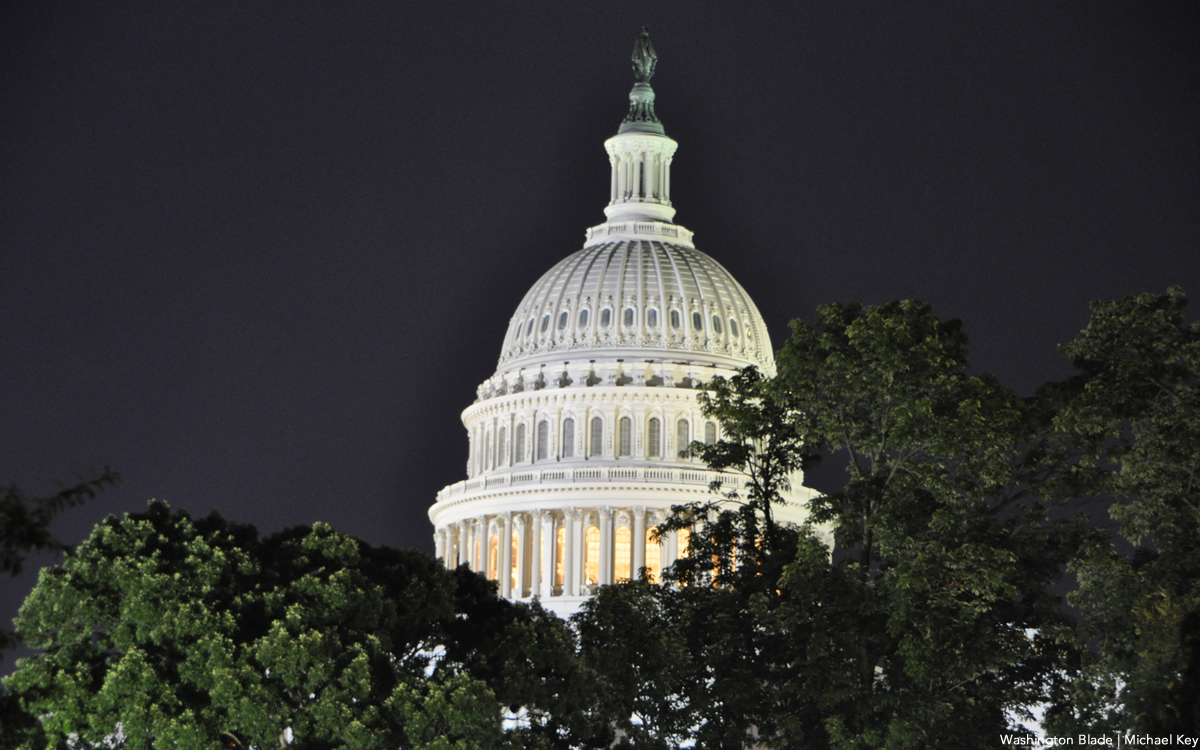
U.S. Supreme Court (Washington Blade photo by Michael Key)

On June 30, the U.S. Supreme Court cleared the way for states to enforce laws barring transgender students from participating on school sports teams consistent with their gender identity, a decision LGBTQ advocates say could encourage additional restrictions across the country.

While neither Maryland nor Virginia currently has a statewide ban on trans student athletes, advocates say the decision could reshape future legislative battles and school policies throughout the region.

Directly following the case, attorneys for trans student athletes spoke out about the case and how detrimental it could be to students.

“This ruling is deeply harmful for transgender women and girls who only asked for the ability to participate in sports with their peers,” said Sasha Buchert, senior attorney and director of the Nonbinary and Transgender Rights Project for Lambda Legal, in a press release from the American Civil Liberties Union.

The next step is figuring out how states will move forward, specifically in Maryland and Virginia.

As of right now, neither state has bans on trans athletes in schools. The new Supreme Court decision also does not require states to enact bans, only that bans are allowed if states or school districts choose to enforce them.

According to the ACLU, 27 states have banned trans youth from participating in school sports since 2020. Most of these states also require sex testing, which the organization says is invasive for all female athletes.

Equality Virginia Executive Director Narissa Rahaman said that while she has heard a lot of frustration following the decision, people are ready to take action.

“Families, parents and youth have lived through disappointing changes to the Virginia Department of Education’s model policies for the treatment of transgender students, and the Virginia High School League’s decades-old policy that allowed transgender students an opportunity to play sports with their friends,” Rahaman said in a statement to the Washington Blade.

She believes they are not ready to give up this fight quite yet.

As of now, trans and nonbinary students are protected under Virginia law, and Rahaman wants that to continue.

“This ruling will likely embolden right-wing members of the General Assembly to pursue trans athlete bans, and we will continue to defeat every bill like we have the past five legislative sessions. Now is our time to be proactive,” Rahaman said.

She also calls upon Democratic Gov. Abigail Spanberger to defend trans youth in Virginia from what she describes as bullies and to continue to stand up to federal attacks on the trans community in general.

For trans students, Rahaman wants to ensure that they continue to know that they belong and have a place in school sports. 

“To the transgender young people watching this decision unfold: you belong on your team, in your school, in your community, and here in Virginia. This ruling does not change that. A single Supreme Court decision cannot define your worth or your future,” Rahaman said.

For people who may be outside the community but want to help, she encourages them to speak with trans and nonbinary people in their community, befriend the families of youth to show their support, and continue to speak up on these issues when needed.

According to ACLU of Virginia, high schooler Eliza Munshi was told she could not compete on the girls’ track team because she was trans. To prove a point, she decided to compete with the boys.

She had previously competed on the girls’s track team before her Virginia school decided to enforce the ban demanded by President Donald Trump. With pink hair and pink makeup, she decided to continue her love for the sport alongside boys. According to Munshi, her entire community rallied for her.

“I did it to prove a point. I knew I could do it. I knew it wouldn’t phase me. My gender itself and that label has been the least important part of my transition: I want to look how I want to look. I want to dress how I want to dress. If you don’t like that, then that’s not my business,” Munshi said.

DOE has launched Title IX probe against Md. school districts

In the weeks leading up to the ruling, multiple Maryland school districts were included in a Title IX probe stating that not enforcing sex-based protections guaranteed by federal law. Currently, there have been no updates on the lawsuit or the district’s decisions.

According to the U.S. Department of Education, the federal probe is based on parent complaints that the school districts were violating a specific Trump-Vance administration addition to Title IX, stating it aligned the sex-based protections “with biological reality, not ideological fantasy.”

According to FreeState Justice, an LGBTQ advocacy group in Maryland, while this is a disappointing ruling to see, they will continue to fight for trans student-athletes in Maryland and want trans youth to know that they belong.

“Every young person deserves the opportunity to participate in school and community life without being singled out because of who they are. These decisions send a harmful message to transgender youth that they are somehow less deserving of that opportunity,” said Phillip Westry, the group’s executive director.

Westry wants to make sure the community knows that their commitment to the organization has not changed and will continue to provide the same legal services they have prior and to advance policy solutions, to ensure “every LGBTQ+ Marylander can live with dignity, safety, and equal opportunity.”

Another issue brought up by trans advocates is the issue of testing women to determine whether they are biologically female or not.

According to Human Rights Watch, as of 2023, World Athletics required cis women with increased testosterone levels to undergo medical procedures to have it reduced to avoid advantages. Other forms of “sex verification” may include genetic testing, screenings of an athlete’s anatomy or chromosomes. 

However, this can become detrimental because not all women have ovaries, a uterus, or XX chromosomes, meaning cisgender women could potentially be included in these bans, depending on how the specific state plans to enforce them.

Continue Reading

Popular