Opinions
No Pride without Disability Pride
Anti-ableism must become part of the foundations of queer activism

On Saturday, June 20, Capital Pride hosted the Pride Parade through the heart of Washington, D.C. I broke my foot just a couple days before and couldn’t attend, but beyond my mobility, Pride celebrations have always been difficult as a multiply disabled, queer person. As someone who is autistic with heat and sensory sensitivities, and autoimmune conditions, I also want to be part of Pride celebrations, to feel part of and be in community with others, but it is rare that Pride celebrations — not just Pride marches — are accessible to me.
Back in 2022, I wrote a piece for The Unwritten issuing a call to action: “it’s time to make all queer spaces accessible” after a woman in a wheelchair was denied entry to my favorite — and one of the few remaining — lesbian bars A League Of Her Own. Back in 2022 when I had just moved to Washington, D.C. for graduate school, the bar became my queer safe space where I watched Willow Pill’s win on season 14 of “RuPaul’s Drag Race.” Pill, who openly discussed having cystinosis, a rare genetic disorder that causes the build-up of the amino acid cystine on the show, was the first person who openly discussed how being disabled affected the way she was able to share and experience her queerness. Because of her disability, she admitted that she would have to quit performing drag much sooner than her fellow queens.
Yet four years after I published the piece, little has changed. Many Pride celebrations remain inaccessible to people who use mobility aids, have sensory or heat sensitivities, or require ASL interpretation or audio description to participate. When queer, disabled people ask for these services, ask for events that include everyone, we are met with excuses about expense and convenience, about serving the majority of community members rather than all — and invitations to future events that never end up planned or taking place.
For many queer, disabled people like me, this sends a very clear message about whose presence is valued and prioritized at Pride celebrations and it is part of larger systems of racism, ableism, and transphobia that are solidified when people participating in Pride forget the event’s roots. While many people pointed out that corporations and cities cancelled their participation and events this year, it’s important to recognize that Pride was never about pinkwashing, was never about getting free rainbow fans in the street or catering events to a socio-political status quo. Pride began as a protest against police brutality.
When we remember that history, it becomes clearer than ever that events focused on our visibility must be accessible. In the United States today, Immigration and Customs Enforcement agents have hurt and even killed disabled people during the arrest and detention of immigrants and people of color. Autistic and individuals with cognitive disabilities, especially neurodivergent people of color, are at much higher risk of being hurt or even killed by the police, and disabled people are increasingly at risk for sexual violence in institutions and when living in their communities. Pride began as a fight against state-sanctioned violence.
If people want Pride to remain true to its roots and honor the people who paved the way like Marsha P. Johnson who herself was disabled, we need Pride to be accessible.
While I can recommend that people who are set to host Pride celebrations next year arrange shaded and cool space for people to sit, rest and recover, provide water and food for people to sip and snack on to keep their energy and blood sugar up, offer sensory support including earplugs and headphones, and access services like ASL interpretation, audio description, and captioning for events, this is not enough.
It can’t just be about tacking on accessible services to an already planned event, it has to involve electing disabled queer people to Pride leadership boards, thinking about accessibility from the very beginning when we envision events for the LGBTQ+ community, and incorporating anti-ableist action into queer protesting. Anti-ableism (and anti-racism and xenophobia) has to become part of the very foundations of our queer activism before we can make changes that push for our collective liberation. And queer people’s and disabled people’s liberations are inextricably linked—both are rooted in bodily autonomy, access to healthcare, and right to love and marry as we chose (today, many disabled people are denied access to marriage without losing lifesaving medical care).
And it’s not just disabled queer folxs who benefit from accessible events. Everyone can benefit from events that focus on preserving and protecting our bodies and energy.
How many people use captions when they watch a show, or could use a shaded, cool, sensory-friendly space at Pride amid all the sounds and smells of the parades and festivals? How many people could use access to food, water, and chairs to sit or mobility aids so that they are not hurting the following day? How many more people would show up, would lend their voices to the fight for gender-affirming care, for trans rights, if the protests we organized and participated in were accessible? And how would the visible inclusion of disabled queer and trans people change our collective perceptions and goals of intersectional activism–knowing that not everyone can access gender affirming care because of their disabilities?
Making events accessible isn’t just about including disabled folxs, it’s about crafting spaces that serve and uplift everybody and all bodies in our fight for liberation. For disabled people who have long been infantalized and desexualized (while at the same time being fetishized and facing increased sexual violence), making Pride accessible is about affirming that disabled people are whole people who also have rich, diverse sexualities and gender expressions.
And let’s be clear, it’s not up to disabled queer folx to do this work for the community. For too long, disabled people are asked to educate their peers and superiors on accommodations and accessibility services, on what anti-ableist action looks like. It’s the responsibility of a community that itself has long been marginalized to recognize the ways in which ableism is interwoven into the very power systems that disenfranchise and deny the rights of queer and trans people and educate themselves. Along with creating pathways to leadership uplifting queer disabled folxs and planning events that are accessible by design, this is about queer and trans people educating themselves in and committing to anti-abelist action.
If Pride is truly about protesting state-sanctioned violence against us, against all marginalized communities, it cannot involve events that are inaccessible, events that routinely exclude a part of the community. There’s a reason that Disability Pride Month is scheduled the month after Pride month in the U.S. — it should be a continuation of protests fighting for the liberation of all bodies, rather than some.
Emma Cieslik is a D.C.-based museum worker and public historian.




Commentary
Washington Blade responds to concerns over White House pool duties
Inaccurate media reports create confusion but we stand with our colleagues
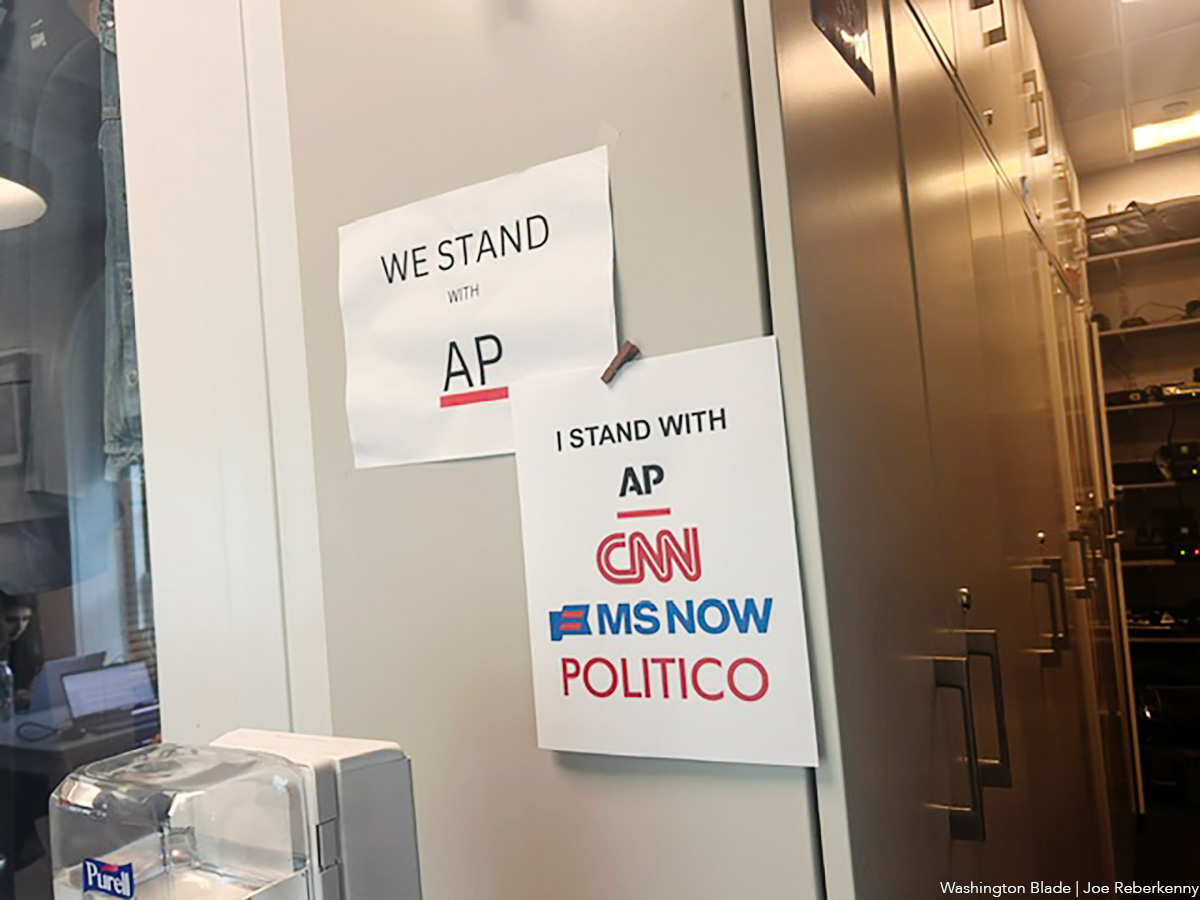
Last week, President Trump announced his unconstitutional ban of CNN, MSNow, and Politico from the White House. Coincidentally, on Monday, it was the Washington Blade’s turn to serve as the print pool reporter on duty covering the president’s actions that day. This important responsibility is shared and rotated among the print members with each serving roughly once per month. The Blade is the only LGBTQ outlet with a seat in the briefing room, a slot in the pool rotation, and membership in the White House Correspondents’ Association, something we fought for decades to secure after enduring years of discrimination, ridicule, and resistance to openly queer journalists working inside the White House. We take our responsibilities there seriously.
There are two pools that cover the president: broadcast and print. The other four members of the broadcast pool — ABC, CBS, NBC, and Fox News — agreed to boycott their pool duties. There has been no boycott among the print pool, which is a separate entity. I called the president of the White House Correspondents’ Association on Monday to confirm that no outlets in the print pool were boycotting.
A boycott by the Blade would set us back and lead to our expulsion from the pool and briefing room and our replacement by a right-wing outlet sympathetic to President Trump’s approach to attacking the media. The LGBTQ community is far better served with the Blade in the room than a far-right blogger taking our seat.
Let’s be clear: the Blade stands for diversity, equity, and inclusion and we stand for the First Amendment and freedom of the press. In solidarity with the broadcast pool, we made two important decisions on Monday — the first day anyone had to think about any of this. First, we refused to take or share any videos or still photos of the president, which would have undermined the broadcast boycott. Second, when Politico’s turn comes up for pool duty in mid-October, the Blade will not fill in and cover for them while they are banned. Politico must be readmitted and allowed to do their job.
After a rough day navigating and reporting on all of this, the Advocate published a reckless and inaccurate story suggesting that the Blade had crossed a picket line. Not true, as there is no print pool boycott. They claimed that I wouldn’t talk to their reporter. Also not true. I called their reporter within 90 minutes of receiving his message and he didn’t take the call or call me back. Their story named me and our White House reporter, immediately exposing us to public criticism and worse. The environment in D.C. is so toxic and even violent these days that subjecting our staff to unfair and false accusations like this invites harassment, doxxing, and worse. To do that without even talking to us is next level irresponsible and the antithesis of journalism.
On Tuesday, I talked to two reporters and an editor at the Advocate but they refused to retract anything in their inaccurate story. If the reporter had returned my call, I could have explained all of this but they are more concerned with clickbait and sensational headlines, a dangerous practice in these troubled times.
Back to the pool. The Blade was in the briefing room in the Reagan era, when Press Secretary Larry Speakes made jokes about AIDS and the reporters in the room laughed out loud. We endured all of that abuse and worse for decades, always standing in the back of the room and never being called on. The Blade’s journalists persevered. When President George W. Bush was re-elected in 2004, the Blade’s White House credentials were revoked amid an earlier press crackdown. Notably, no one boycotted or stood up for us. When Barack Obama won election in 2008, I received an email from his communications director informing me that effective midnight on Jan. 20, 2009, the Blade’s credentials would be restored.
So we have had quite a ride navigating administrations and their changing requirements for gaining access but always playing the long game. As Barney Frank used to say, “If you’re not at the table, then you’re probably on the menu.” The Blade is at the table and we do our best to ensure the LGBTQ community’s issues are addressed by both parties.
Thanks for reading and supporting the Blade’s work. If you have questions about our approach, you can reach me at [email protected].
Kevin Naff is editor of the Washington Blade. Reach him at [email protected].
Opinions
Young people should know history of the fight for human rights
Trump is working to erase contributions of marginalized people
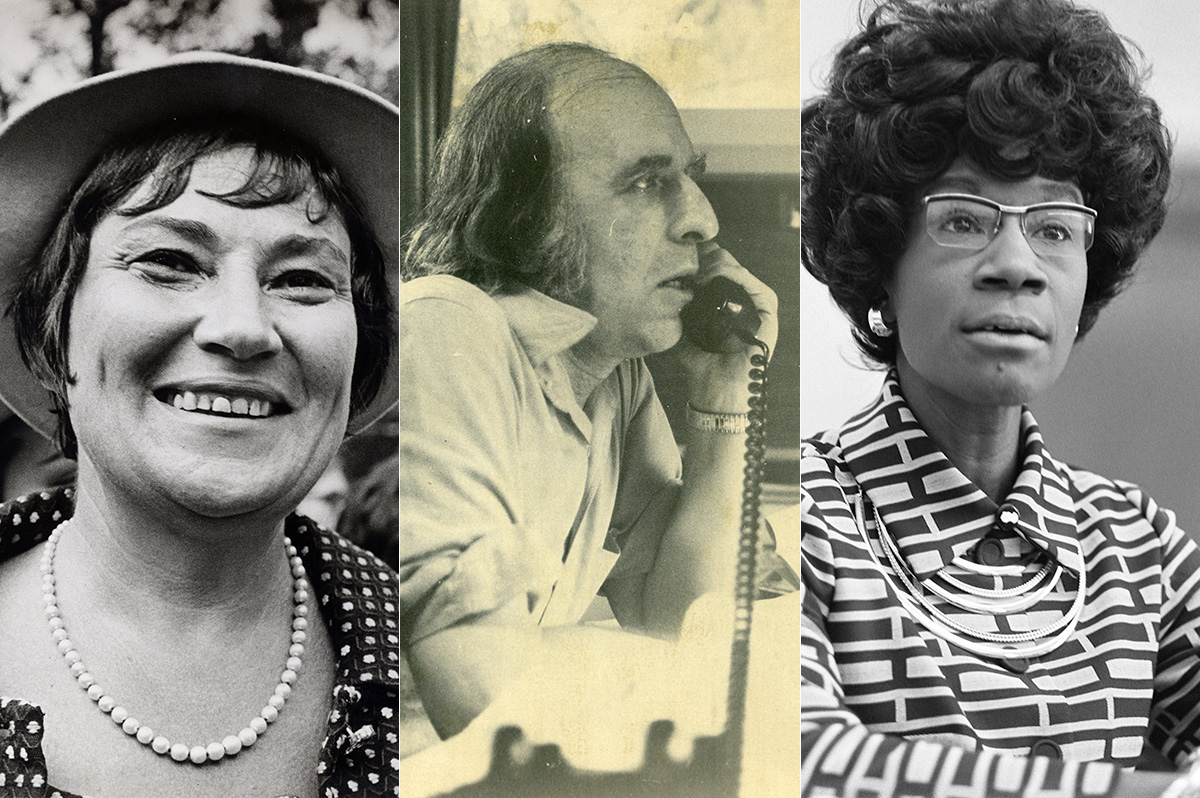
When talking with otherwise really smart young people, I am amazed how little knowledge many of them have about the fight for human rights in the United States. Our country was founded by white men, who didn’t think about giving full rights to Black Americans, women, the LGBTQ community (what they knew of it, or called it). They wrote in the Declaration of Independence, “We hold these truths to be self-evident, that all men are created equal, that they are endowed by their Creator with certain unalienable Rights, that among these are Life, Liberty and the pursuit of Happiness.” But that referred to all white men, and intentionally didn’t mention women. For 250 years, the country has been trying to make up for that, and making progress in fits and starts. We have yet to fully succeed. Today the felon, and his fascist aides, in the White House, are working daily to take us backwards.
For that reason alone, it is important for younger generations to understand the fight for human rights, know who was fighting for those rights, and understand it is an ongoing fight. Often, when listening to some millennials speak, one would think the world began with them. They either forgot, or never learned, about all those who fought for the rights they now have. I realize this was true for previous generations as well. In 2016 I co-hosted a fundraiser for Pete Buttigieg during his run for president. He is an undeniably brilliant guy. Yet when he spoke of marriage equality, he just thanked Justice Kennedy for it. I reminded him after he spoke, while it’s nice to thank Kennedy for his vote, it shouldn’t be done without acknowledging the many activists who worked for decades, to get to the point that allowed Kennedy to cast that vote. In the same way it was clear to me during the Hillary Clinton campaign for president, many young women didn’t understand the work many of their own mothers had done, to fight for their right to control their own healthcare, and women’s rights in general. They took for granted the rights they had. Now, after losing some of them, many will realize the fight for their rights is never-ending.
When I speak to younger members of the LGBTQ community, I am amazed how many don’t know the history of the AIDS epidemic, many thinking it was always a disease you could deal with by taking medication. They don’t understand the work so many activists did to bring attention to this devastating disease, and get the healthcare so many needed. Those like Cleve Jones, Larry Kramer, Dr. Anthony Fauci, and so many others. Recently, I realized how many young women don’t know the names of Gloria Steinem, Betty Friedan, Shirley Chisholm, Bella Abzug — women who fought for their rights. And this is just recent history, no less knowing about the Suffragettes, the strong women who fought for their right to vote. I’ve met young women who don’t know what the ERA is, and others who think it passed. Many don’t know the nation couldn’t get 38 states to approve an amendment to include them in the Constitution. The same for young members of the LGBTQ community who don’t know what the Equality Act is. Others think it passed, and are shocked when told it didn’t and in 27 states, they can be married on Sunday, and kicked out of their home, and fired from their job, on Monday. They don’t know names like Frank Kameny, Harvey Milk, Barney Frank, or the history of the Mattachine Society, or the Stonewall Riots.
Our current president is trying to wipe out all this history, and reverse any progress that has been made. Knowing this, it makes it even more important for school systems across the nation to fight to educate our children. We should ensure no child can graduate high school, without taking a course called “The 250-year fight for human rights in the United States.” They need to understand the history, and learn about the people who fought for their rights. They need to know how far we have come in 250 years, and understand, as we begin the next 250, how far we still have to go, to ensure real, full equality, for all.
Peter Rosenstein is a longtime LGBTQ rights and Democratic Party activist.
Commentary
What LGBTQ veterans are building after ‘Don’t Ask, Don’t Tell’
DADT repeal took effect on Sept. 20, 2011. Trans servicemember ban reinstated

Fifteen years ago this month, the repeal of “Don’t Ask, Don’t Tell” took effect. At the time, the importance of the change was obvious: gay, lesbian, and bisexual Americans would no longer have to hide who they were to wear the uniform. What was harder to see was what would follow: a generation of LGBTQ veterans able to carry their service openly into American civic life.
Earlier this month, Alaska state Rep. Andrew Gray, an Army veteran, stood before the Anchorage Assembly and asked the city to recognize Sept. 20 as LGBTQ Veterans Day.
His former command sergeant major, Mike Grunst, followed him to the microphone. A 35-year veteran who had served in combat, Grunst called troops who had served while hiding who they were “the bravest I have ever served with.”
Then Denise Sudbeck stepped forward. A Vietnam-era Navy veteran, she thanked the country for the privilege of serving and asked that the next generation have the same chance.
The Assembly approved the recognition.
Nothing about the scene required a new vocabulary. A veteran made a request of his community. A commander vouched for those who served beside him. Another veteran asked that younger Americans inherit the opportunity she valued. They entered the civic record simply as veterans.
That identity can do more than win recognition.
When federal policy abruptly ended the careers of transgender servicemembers this year, veterans and servicemembers in California began asking a practical question: What happens when those Americans come home?
Republican Assemblyman Jeff Gonzalez, a Marine combat veteran, began one hearing with questions about transgender military service. He listened as veterans explained how the military handles medical care and deployment case by case.
Then the discussion turned to separation.
“I don’t wanna see any veteran homeless,” Gonzalez said. Before the hearing ended, he was asking: “How can I help? How can I understand? How can I be a good advocate?”
The legislation that followed would provide housing, employment and transition assistance to discharged servicemembers. Republican state Sen. Shannon Grove spoke for it. The Senate passed it 32 to 0.
Americans have plainly not settled their disagreements over transgender people. Nor should military service be a prerequisite for rights that belong to every citizen.
But military service creates relationships that are difficult to reduce to the abstractions of the culture war. Before a legislature, “the transgender issue” can become a veteran who deployed, an officer who led troops, or the person who once stood beside you.
The political question changes because the human relationship has already changed.
The pattern is beginning to appear across the country. Kansas is among the states recognizing LGBTQ Veterans Day for the first time this year. New York and Virginia are pursuing broader state-level programs for LGBTQ veterans.
Sept. 20 is deliberate. On that day in 2011, “Don’t Ask, Don’t Tell” ended.
We usually remember repeal for what LGBTQ Americans gained: the ability to serve openly. Fifteen years later, we can also see what the country gained.
A gay veteran can stand before his local government beside the commander who once led him. A transgender servicemember can sit before a legislator who begins with doubts and ends by asking how he can help. A veteran from an older generation can ask her neighbors to give those who follow her the same chance to serve.
This is citizenship in practice.
The enduring legacy of “Don’t Ask, Don’t Tell” repeal is not only that Americans were finally allowed to serve openly. It is also what they can now build after coming home.

Charles Bowers, former owner of Baltimore gay bar the Hippo, dies

Being a female firefighter comes with unique risks, and rewards

Writing a play about Lincoln leads down a rabbit hole to a closet

Trump-appointed judge restores White House TV pool access