a&e features
45 years of faith
MCC-DC celebrates milestone with year-long celebration
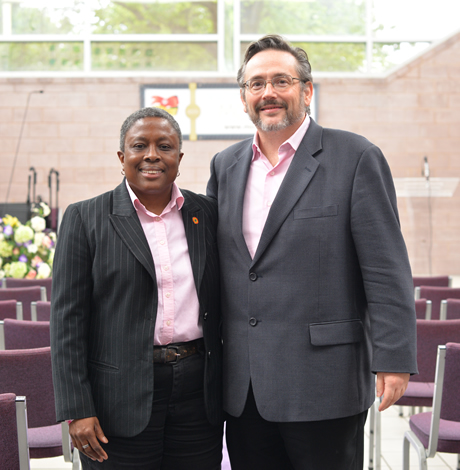
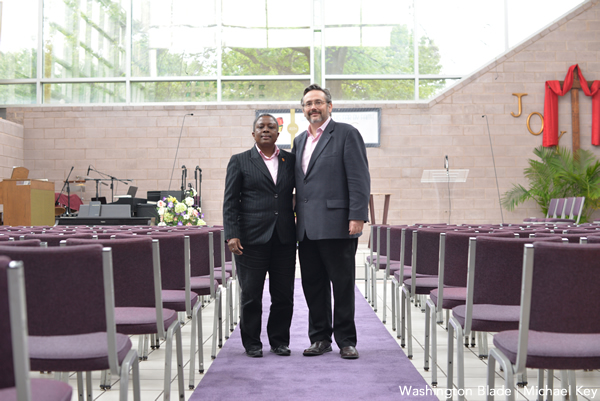
Rev. Cathy Alexander and Rev. Dwayne Johnson at Metropolitan Community Church of Washington. The church is celebrating its 45th anniversary this year. (Washington Blade photo by Michael Key)
MCC-DC 45th anniversary gala dinner/dance
Saturday, May 21
National Press Club
529 14th St., N.W.
6:30-10:30 p.m.
$70
Attract Millennials! Keep long-time parishioners engaged! Embrace technology! But don’t alienate traditionalists! Demands on clergy in any church these days are demanding, but for traditionally LGBT churches, there are additional factors.
“We’re human, we have ups and downs and highs and lows just like everybody else,” says Rev. Cathy Alexander, associate pastor at the Metropolitan Community Church of Washington, the city’s oldest and largest mostly LGBT church which is celebrating its 45th anniversary this year with a series of events. “I try to make sure I minister from a place of abundance and overflowing rather than need. For me, it’s super encouraging when I see spiritual light in somebody’s eyes.”
The year-long celebration culminates this weekend with a dinner and dance Saturday night at the National Press Club in which senior pastor Rev. Dwayne Johnson says members are “planning to eat and dance the night away.” On Sunday, May 22, Rev. Candace Shultis, who was on staff at MCC-D.C. from 1983-2007, will return to preach at the 9 and 11 a.m. services. Long-time member Cecelia Hayden Smith coordinated a history project in which over the last 45 days, people from the church’s past have shared their testimonies at mccdc.com and in daily e-blasts to the congregation.
Known colloquially as MCC-D.C., the church is part of the Universal Fellowship of Metropolitan Community Churches, a large denomination with a special ministry to LGBT believers. The D.C. church’s roots go back to 1970 when a group started meeting as Community Church of Washington. The church was chartered as an MCC church on May 11, 1971. Membership peaked around the turn of the millennium when it wasn’t uncommon for 500 or more people to come through the doors on an average Sunday.
But with most mainline protestant denominations in Washington now welcoming gays, attendance at MCC-D.C. has waned with average Sunday attendance hovering around 210.
Johnson says this is not necessarily a bad thing.
“Part of our early mission was to change society, to transform the world and ourselves and MCC accomplished that on many levels,” Johnson says. “Yes, more churches are welcoming now but that’s not a loss for us. That speaks to the power of our message and the work we’ve done. We applaud other churches who make it possible for more people to find love and God, so all of that is good. But yes, it does make our job a different challenge.”
Other challenges range from MCC-specific matters such as parking issues, street closings for major city events and marathons often held on Sunday mornings, a maturing membership base and more to issues common to churches of all kinds — engaging Millennials and influencing visitors who approach church membership with a consumer mentality. In 2010-2012 as same-sex marriage became increasingly available, Johnson says there were more weddings than he could humanly conduct without neglecting other aspects of ministry. There were often 50-60 a year held at the church then. It’s now tapered off to a more manageable 15-20 annually.
Johnson says the church will continue to meet needs if members there keep a few key points in mind.
“We’re conditioned culturally to be shoppers and consumers so people carry that mentality with them when they go to restaurants or wherever,” he says. “But it’s so important when people come here that they experience the presence of God and for there to be authenticity and integrity and for them to be spiritually grounded. It’s not a shopping experience. It’s a God experience.”




a&e features
What ‘Queer Eye for the Straight Guy’ can still teach us
Producer David Collins on lasting impact of hit series
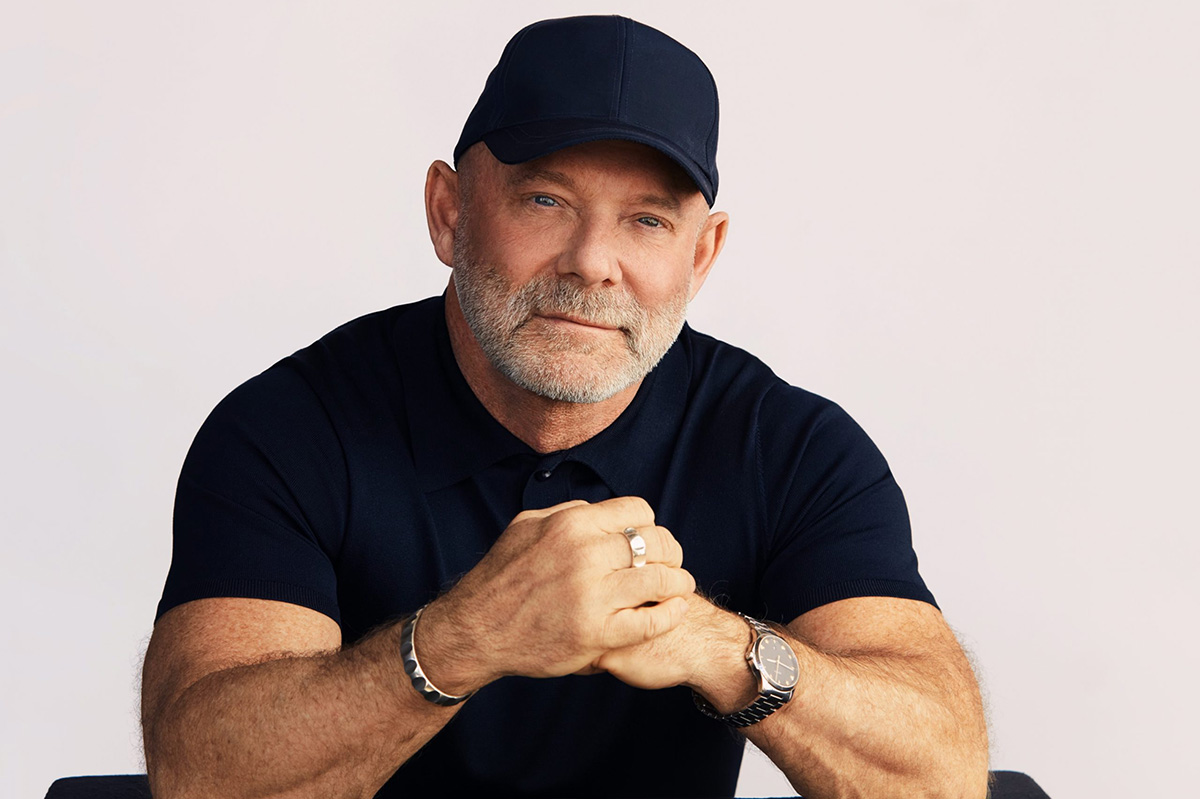
It’s hard to imagine where LGBTQ+ television would be without “Queer Eye for the Straight Guy,” the trailblazing reality series that premiered in 2003.
Each episode of this Emmy-winning show saw a group of gays converge on a struggling man — the titular straight guy — and offer nonstop wit while organizing his endlessly messy life. This program about a group of homosexual helpers took the world by storm, furthering the love of gay television begun by shows like “Will and Grace” but bringing it into the growing medium of reality TV. Of course, it wasn’t perfect; “Queer Eye for the Straight Guy” often cast its experts less as multi-faceted queer folks and more as sources of early 2000s gay jokes. But despite these pitfalls, it’s undeniable that the original program explored the realities of being gay in a way audiences had never seen before. It was a monumental piece of LGBTQ+ representation, and its success is largely owed to the man who fought to get this show made: producer David Collins.
Collins spoke with the Blade from his Los Angeles home, where he’s spent the past few years living with his husband and his two daughters. David spoke fondly of his many years in the industry, detailing how it feels to be such a huge part of LGBTQ+ history. He explained, however, that he didn’t initially set out to alter how queer people were seen on television. “I never went out to make gay television,” said the producer. “I went out to tell great stories.”
“I’m a hillbilly from Ohio, and I thought I was going to be an editor,” David laughed, looking back on his career. “I interned at the Cincinnati Film Office, and I showed up to work my very first day, and the film commissioner was like, ‘Get to the airport right now and pick [someone] up. Don’t talk to them.’ Well, I ended up picking up Jodie Foster.” Collins raved about this car ride that changed his life, with the pair becoming friends and Foster pushing him to become a producer who puts their own media out into the world. Eventually, he did just that, and after learning about the wild new genre that was reality TV, he pitched a series to Bravo: “Queer Eye for the Straight Guy.”
“I was obsessed with Esquire magazine, and they had five categories: fashion, grooming, interior design, culture, food, and wine. So I gave them each a gay, and the Fab Five were born!” Collins said, describing how viewers quickly fell in love with the concept and earned the program four seasons and an Emmy for Outstanding Reality Program. He spoke about how proud he felt creating a show that centered real gay people, not characters in a story, remembering, “To stand in the middle of Times Square and look up and see this massive billboard with the original Queer Eye guys…it wasn’t even a dream come true, because it wasn’t a dream I had even fathomed.”
With his series, people were watching actual gay men and learning the realities of a queer culture that had always been portrayed as a danger to society. Collins tearfully recounted hearing about queer people using the show as a way to connect with their family, saying, “What I’m most proud of that’s come out of Queer Eye [are] the conversations that that series has allowed to have people around their kitchen tables with little boys in Ohio like me who were scared to death that they were going to burn in hell because their pastor was telling them that they were a sinner.”
Now, for all of its trailblazing, the program wasn’t wholly positive; the show’s focus on the central ‘straight guy’ meant it rarely delved into the lives of its Fab Five. Collins regretted that lack of depth but understood that earlier audiences weren’t accustomed to such a nuanced look into queerness — that would have to wait for the reboot.
When “Queer Eye” came out in 2018, audiences were introduced to not only a new Fab Five, but a whole new format (that didn’t rely on a straight person). Now, the series would assist queer folks and allies alike, spotlighting these individuals as well as the queer experts helping them improve their lives. The show has been applauded for its amazing makeovers, but where it truly stands out is its representation, offering a look into individuals across the country and the struggles — along with the immense joys — of being queer in America today.
Fans were disappointed to hear that “Queer Eye” would be ending after its 10th season, but David stressed that they wouldn’t have to be sad for long. “What I will say to you is this: hang tight,” he teased. “There’s yet another version of ‘Queer Eye’ to come, and we’re working on that now.” In the meantime, Collins is continuing his work with new shows like the “House of Stassi,” a series centered on “Vanderpump Rules’”prolific waitress. He’s excited about these new projects, but emphasized that his heart will always belong to “Queer Eye for the Straight Guy” and all that it continues to do for viewers 19 years after its finale.
“It’s not about your new outfit or your new couch or your new whatever. It’s about your humanity,” said Collins, speaking about the core lesson he hopes people take away from the Queer Eye franchise. “It’s about seeing yourself. It’s about dignity. It’s about how confidence breeds success.”
A valuable message that queer folks can benefit from even more now than they did in 2003. And, while it’s unclear just what lies ahead for this franchise, one thing is for sure: “Queer Eye for the Straight Guy” helped people everywhere understand the power that exists within our queerness. It’s a truth that has impacted countless pieces of LGBTQ+ television today, and it’s one that Collins promises to keep alive through whatever hit show he creates next.
a&e features
Jason DePuy on coping with homophobia in ‘Big Brother’ house
First drag queen contestant on CBS show fought to stay positive
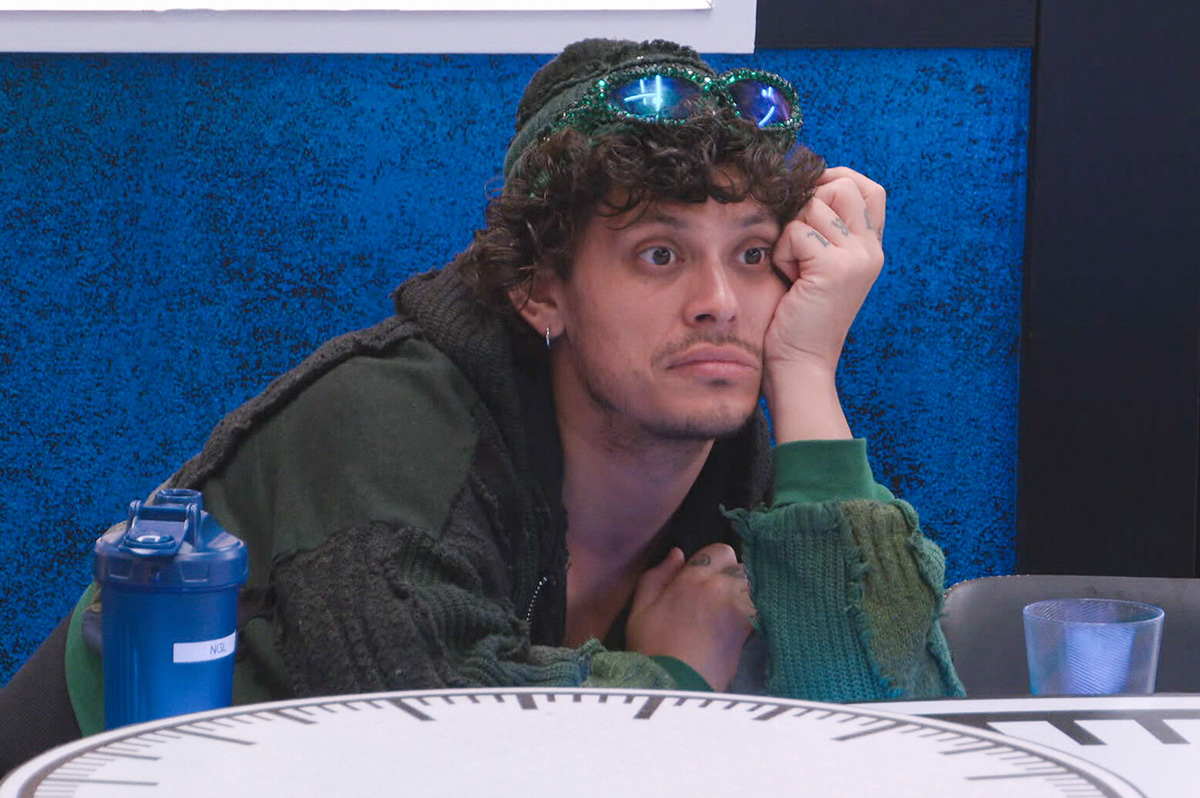
One week after Jason DePuy (known as Salina EsTitties on “RuPaul’s Drag Race”) was bullied and eventually evicted from CBS’s “Big Brother” house, the queer drag performer is still emotionally processing his feelings.
During his 24 days in the reality TV competition, DePuy often had a rough time, with fellow cast member Kamuela “Kamu” Kirk making homophobic comments and feeling isolated.
In a conversation with Head of Household Rick Devens, Kirk left viewers upset when he said, “Bro, miss me with the drag stuff. Miss me. I’m still an MMA guy, and I have an image to uphold.”
Former “Big Brother” contestant Frankie Grande called his words ‘homophobic’ and ‘gross.’ Another comment, where Kirk said he wanted to end DePuy’s career, also received strong backlash online.
Now that he is out of the house, DePuy has been shocked and deeply touched by the love from “Big Brother” fans and former contestants. We chatted with DePuy for this Blade exclusive.
“To know that my community was rallying for me outside the house was the most wonderful thing. Seeing how much people were just wanting to shower me with love was incredible. Even my friends, I went to say hi and give them a hug, and they’re like, ‘Uh, uh, come here.’ They had to hold me and let me know America was feeling for me in a way that I had no idea.”
He added: “To see that reality was just overwhelming, and I couldn’t ask for more.”
Known as a messy player in the house, DePuy often had to fight to stay positive and stand up for himself.
“No one was coming to my rescue. In real life, it’s easy to block people, but in the house, I didn’t have that luxury, so I had to find it within myself to learn how to speak up for myself in a way that wasn’t nasty or biting. I didn’t attack anyone personally, which is what I was the most proud of.”
DePuy acknowledged he has had a history of putting his foot in his mouth when it came to certain “Drag Race”moments, being in the public eye, and making a fool of himself. “I’ve learned my lessons; to see how I handled myself in the ‘Big Brother’ house was amazing.”
While DePuy has been sober for 14 and a half years and has a strong spiritual foundation, in the Big Brother house, he often felt like he couldn’t communicate what he was feeling.
“As a queer person, a person of color, a drag queen, I have to be very careful about how I move. I don’t have the luxury or privilege to just act a certain way or say a certain thing. I have to be very careful; I’m representing me. But who I am is a Latino, a person of recovery, a drag queen, a queer person in the community. I know that there’s a lot of pressure that comes with that. I felt it was safer for me to sit there and just breathe than try to do anything crazy.”
He continued: “I couldn’t speak to the personal attack that was happening in the house, because in my mind I was like, ‘no, this is a game, and I have to play it, put that aside.’”
Not only can viewers watch the episodes, but they can also watch the live feeds of what’s happening. Seeing the fans’ social media posts from people who had watched the episodes and the live feeds also contributed to DePuy realizing that his feelings of discomfort were valid.
“To know that I wasn’t delusional in those moments, that others could see what was happening, has been a lot to take in. Fans and friends let me know the comments made went beyond the game…I’m like, ‘Oh, so my instincts were correct.”
One of the most poignant moments on the live feeds occurred when DePuy was crying, alone in his room, and said how he missed his gay community.
“I really missed my friends. I missed my queer community. We’re so colorful. We’re so loud. We’re so vibrant. We speak off the cuff, and we’re very truthful and honest with how we speak, and it’s fun. We have fun lingo.”
DePuy had to censor his expressions in the house. “Because I can say one thing, but it can mean something different to straight people than it does with my queer brothers and sisters. So, there was a sense of code-switching that I had to do. I had to even put aside some of my queerness in a way sometimes to fit in.”
DePuy was thrilled to be the very first drag queen to ever be cast on the show.
“I’m honored to have been chosen. There’s a million drag queens out there, and to know that I was a contender to come in the house and not even be in drag was like a wow for me. I’m over here in Hollywood, running around these streets with a wig and heels just to make a dollar to survive, and I have to rely on drag to do that. And then to be offered this opportunity and be given the privilege to say, ‘hey, you don’t have to put on the wig for you to be valuable here,’ is just insane to me.”
Prior to his shows, DePuy has been hustling for 15 years, flipping burgers and doing drag at night.
“That has been my life these past since I was 17. So it’s been a long journey; the opportunity to do this out of drag is a very big blessing. I’m honored and grateful to be the representation of my community.”
If you missed Jason on “Big Brother: Unlocked,” the episode can be seen on CBS.com. He will be back on the show for the finale.
a&e features
Rainbows in Revolt on a mission to make LGBTQ artists’ voices heard
Rainbows in Revolt on a mission to make LGBTQ artists’ voices heard
Last month’s Pride celebration in D.C. was so fun. Walking around my first Capital Pride with a $15 lemonade I was loving the madness and the color. Artists and small businesses battling banks you’ve never heard of collecting your personal information so you can spin a wheel to snag free merch. Great music blaring, people actually smiling and enjoying themselves, the “Great” American State Fair could never!
The Monument Stage was on Pennsylvania Avenue, directly in front of the National Gallery of Art and I can’t think of a better venue to see live music. How does someone get on the lineup for Pride? How do we accelerate the visibility of the most talented voices in our community to perform in places like this?
There is certainly not a talent gap, but there is a visibility gap. Chappell Roan went from playing for two people in a parking lot to owning the main stage at Coachella in one year. Whether it is shadowbanning or bias in AI, algorithms have been shown to suppress queer artists. In a digital age, how can queer people break through and show the world how talented they are?
Allison and Matt of Rainbows in Revolt are on a mission to make openly LGBTQ+ artists’ voices heard. Their goal is to find “musicians whose queerness is central to their identity as an artist,” and accelerate them to a place where they can actually reach fans.
The only time queer events seem to be in the spotlight is June, but this should be year round, according to Allison and Matt. Rainbows in Revolt wants to act as a “nucleus” for different sub-communities, finding common ground in the universal language of music.
Matt and Allison founded Rainbows as a way to make cheaper, higher quality merchandise for queer artists. While Rainbows has already pledged 20% of their profits to the LGBTQ+ community, with 10% to Whitman-Walker Health and 10% to LGBTQ+ organizations in need, this is just the beginning of the work that they do.
Rainbows “does the dirty work” that artists normally struggle to do on their own with limited resources. Interviews, artist profiles, social promotion, playlist discovery, radio outreach, and merch-funded support. This work is normally expensive, time consuming, and requires lots of different skills. Musicians don’t want to be editing clips to post online. Standup comedians don’t want to make graphics for their tour dates. They want to write more. They want to focus on their craft.
In addition to helping artists find their audience, Rainbows has built other digital tools to help queer people connect, including an interactive Safe Space Map for most major cities. It is hard to know which places are truly safe and supportive just from a simple Google search. Attitudes and actions change, and there should be a simple way for queer people to find other places that align with them. The Safe Spaces Maps are all up to date, and are tagged and filterable. Instead of relying on forums and word of mouth, Rainbows has created a centralized way to find authentic community quickly.
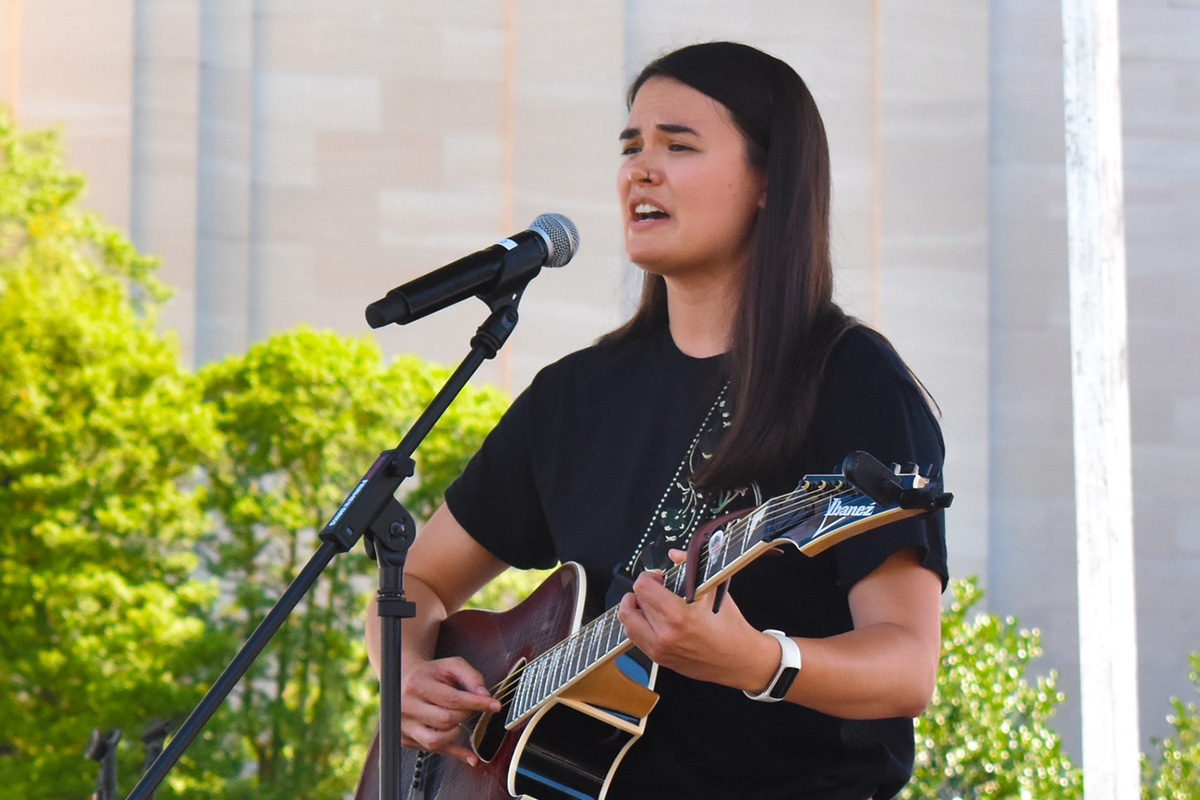
I had a chance to talk with Allison and Matt at Pride where Lily Erin, one of their signature artists, was performing on the Monument stage. Lily Erin is a folk singer who is familiar and forging her own path. Her bittersweet sound echoes through Acadia, and her garb mirrors the New England athletes I grew up with. Gorp Core meets streetwear. A graphic tee, hiking shorts, and creamsicle Jordans.
Her debut single, “Bus Stop,” tells a sad story about unconditional love, and the conditions that still seem to come with it. Graduating into lockdown, Erin needed a new way to connect with herself and others. Lily made “Bus Stop” without an intention to share it, but doing so was a liberation. People have been responding to her honesty around queer-ness, family, and the “ghosts which haunt us” even in the daytime.
Rainbows in Revolt has helped Lily Erin go from bars and backyards to The Monument Stage at Pride. This is a meteoric rise, and a testament to both Erin’s talent and the work of Rainbows to promote her. “A little encouragement goes a long way with early artists,” and by “planting a seed” Rainbows is already seeing their artist garden grow. Community is power, and Erin is a perfect example of how effective simple modern techniques of promotion can be.
A next step for Rainbows is putting on shows themselves. On Oct. 3, Rainbows in Revolt will host an Evening with Ray Boltz at the National City Christian Church. Boltz grew up in the Catholic Church and for many years was the soundtrack to many services, youth camps, and church groups. He was celebrated by millions until he came out in 2008. Allison remembers her community “never playing his music again.”
Rainbows in Revolt is helping him to return to the church, and proving that identity does not need to be exclusive. We live in a complicated world with complicated lines being drawn. Boltz proves that these lines don’t exist, and will be breaking down barriers to bring together communities. To Allison, “a trans woman standing next to a straight white man in church is a powerful teacher.”
The Safe Space maps bridge all types of spaces, and one of the unlikely ones is, perhaps, churches. Matt said that “BYU has only nine safe spaces around their campus and seven of them are churches.” Not all churches are anti-gay, and many times they are the only place for people to find community.
Rainbows in Revolt is just getting started bridging gaps and building community.

Log Cabin Republicans remove transgender rights from mission

Not all trans people are the same

Queer team brings girl power to fully baked ‘The Wrong Girls’

Democrat Maureen ‘Mo’ Madden takes on longtime GOP stronghold in Delaware’s 38th

Comings & Goings

PHOTOS: Nellie’s Drag Brunch

Remembering Barbara ‘Boo’ Price, a pioneering force in women’s music

Russian LGBTQ rights group to shut down

Winsome Earle-Sears ‘Life and Marriage Tour’ to include Northern Va. stops