Books
Trans lives, startling photos
New York-based coffeetable book captures biographical shots


(Photo courtesy Rizzoli)
‘On Christopher Street: Transgender Stories’
Photographs by Mark Seliger, foreword by Janet Mock
Rizzoli International Publications
$55
160 pages
Everybody, as they say, has a story to tell.
An ancestor was captured in an early war. Parents overcame adversity in a new country. A health scare, a welcome blessing, a lucky streak, a chance meeting, we all have our tales to share. And in “On Christopher Street: Transgender Stories,” photographs by Mark Seliger, you’ll read a few.
Where would you go if you just wanted to be yourself?
If you’re transgender and living in or near Manhattan, you’d go to Christopher Street in the West Village. There, you could find support, advice, community or family, if you needed it. Recently, you might have also run into photographer Seliger, who says in a brief statement that he noticed the “freedom of expression and gender identity” that was once abundant is “vanishing” from the area. High-end condos, cafes and restaurants are moving in and the trans community is being pushed aside; here, Seliger put a marker on it before it’s gone.
“I realize that everybody has a trans story, that being trans is something that affects all of us,” he says, using his camera as storyteller.
Being in prison as a trans woman, says one photo subject, is like being “caged.” You don’t belong with the men. They won’t put you in the women’s lock-down. Everybody knows what’s going on and sometimes, the guards have one more slap-down in store for you just before you’re released.
Many stories begin with “I was 4” or 5 or 8 when the teller realized that they were in the “wrong body.” Families were supportive or not, transitioning “is not easy,” and the decision for or against surgery is deeply personal but ultimately, it’s the “inner peace” that matters. Still, lying about being trans can backfire and even if nobody knows, there’s a “constant state of paranoia and fear” that may yet linger.
And then there’s the place itself: Christopher Street has “a dark side,” with drugs, prostitution and harassment. That means that for LGBT youth, which comprise 40 percent of the nation’s street kids, it isn’t always safe.
And so there I was, quietly reading “On Christopher Street: Transgender Stories,” when it suddenly ended. The surprise was not that it did so, but that I was so wrapped up in this book that I didn’t notice the last pages looming.
Yes, it’s that kind of thing, filled with photographical portraits that are worth the clichéd thousand words, and then some. Photographer Mark Seliger’s subjects seem mostly at ease in snapshots that feel random but natural; some people are identified, some are not, and not all of them weigh in verbally. Those who do tell tales that hit hard, in part because they leave readers with the sense that there’s more, but that it’s too difficult to speak.
This large-size, elegantly presented coffee table book is one you’ll return to again and again because what’s inside is so compelling. If it’s true what they say about everyone having a story, “On Christopher Street” is filled with good ones.


Books
Bros + romance + fantasy = ‘Bromantasy.’
New book a romp full of humor, dragons, kings, and adventure
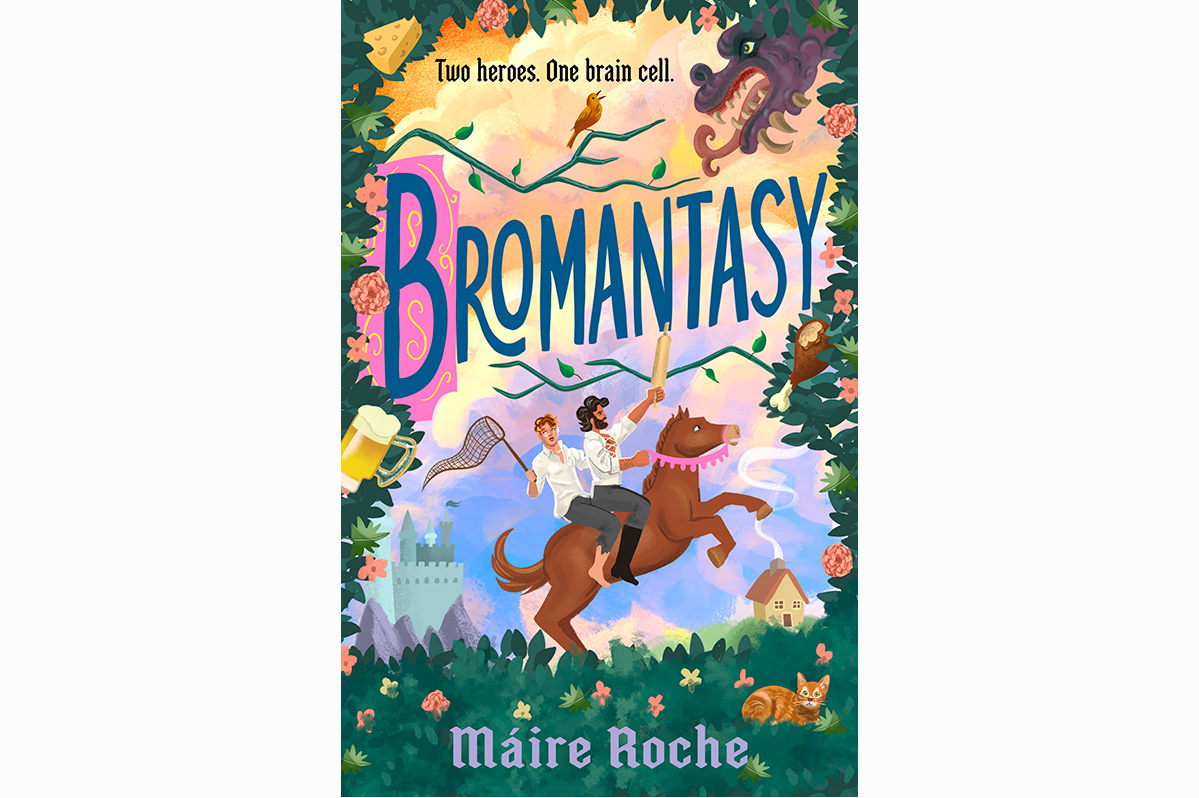
‘Bromantasy’
By Maire Roche
c.2026, G.P. Putnam’s Sons
$20/339 pages
“Danger” just happens to be your middle name.
Any fray, any tussle, anytime anybody needs help, they count on you to step in and save the day. You’re brave, smart and strategic, kind to old people, children, and small animals and, as in the new book “Bromantasy” by Maire Roche, dragons.

Of all the things there were to do – preserving food, keeping house for himself and his best friend Morningthall “Mo” Elmthorn, advanced skincare, and drinking at the local tavern down the road – the one thing Juniper O’Reilly couldn’t resist was a good brawl. It happened so often that Juniper honestly looked forward to it, though Mo wasn’t a fan.
Mo was more grown-up, calm, thoughtful, able, and Juniper loved him for it. He loved Mo, in fact, since they were little boys. He loved Mo in ways that they didn’t talk about, so they kept a wall between their bedrooms in their cottage.
Except for that one time.
They didn’t talk about that, either.
Instead, as they did often, on a warm fall night, Juniper and Mo went to the tavern, where mead was served and they could learn about the king’s weekly quests. There, Juniper could also find a good brawl, which is how he and Mo accidentally got into trouble: Juniper trounced one of the king’s men and was forced into a quest.
He didn’t want to fight dragons and he felt bad that Mo had been dragged along. He felt even worse leaving their farm, sleeping on the ground, wearing the same clothes every day, and not having enough skincare product along. A campfire added to the problem. A roving, lying prince, also in search of dragons, didn’t help. And though a quest was no place for a child, Juniper and Mo found a frightened little girl they had no choice but to protect.
A child with strange eyes, sharp teeth, and fire on her breath.
“And just like that, Juniper and Mo had a dragon.”
Bros + romance + fantasy = “Bromantasy.” It also could equal one of two other things: a romp full of humor, dragons, kings, princes, and adventure.
Or it could equal a whole lot of eye-rolling.
It’s a fact that this book is funny, in the way that a 1980s high school comedy movie is funny – meaning that it’s dippy, giddy, and very caricaturish but you’ll laugh quite often. The story contains everything you want in a fantasy romance (a “romantasy”), including human-like alternate species, a life-changing journey, and plenty of nudge-nudge-wink skirting around the attraction the two main characters have for one another. It’s a decent story, convoluted in just the right way. Purely, it’s an escape.
So why wouldn’t you want to read it? See above, and depending on your favorite reading genre. High-brow literature, this ain’t.
For the right reader, “Bromantasy” is a decent-enough vacation read, something not too taxing or hard on the brain. It’s for novel lovers, dragon hunters, king’s questers, princes, and romantics. For everyone else, this tale is just middling.
The Blade may receive commissions from qualifying purchases made via this post.
Books
Something’s off about Dad. When is it time to step in?
‘When Memory Fades’ can help when families face dementia

‘When Memory Fades’
By Nathaniel Chin, MD
c.2026, St. Martin’s Essentials
$30/422 pages
Mom called you in a panic the other day.
She’d lost her keys and by the time you arrived to help, she’d found them. In the refrigerator.
These kinds of things keep happening, not often but often enough, and you don’t know quite what to worry about. But in the new book “When Memory Fades” by Nathaniel Chin, MD, you’ll learn about the journey ahead, for both of you.
You can’t remember why you walked into a room. You got lost last week, going to the bank. Popular wisdom says that things like that are normal as we age, but Chin says that’s not true – although the answer may not be a worst-case scenario, either. Yes, memory problems could just be signs of stress, dehydration, or lack of sleep – or is it time to see a doctor?
Chin says maybe, yes.
He was working his way through medical residency when his father, a geriatrician in Madison, Wisc., was diagnosed with Alzheimer’s. Chin, now a geriatrician, was blindsided, but that diagnosis also changed his life.
Here, he writes about the brain, and how Alzheimer’s and dementia are diagnosed, explaining that dementia has many faces and, depending on a doctor’s evaluation, memory problems might be slowed or improved. He shares his father’s illness with readers, but he also writes about his mother, a steadfast, steady caretaker.
Her story reminds reader-guardians to care for themselves, too.
Know how to talk the talk, so that you can have “a more productive” conversation with your doctor. Understand that there’s nothing “normal” about dementia or Alzheimer’s. Know the statistics – African Americans are affected with dementia twice as much as whites – and know how to lower your risks. Learn here what questions to ask, how to break the news to everyone, and any legal matters that will be important soon. And know how to tend to you.
Says Chin, “The best action you can take is to educate yourself… The more you understand, the better equipped you are to make sound judgments.”
Something’s off about Dad, just a lot of little things that don’t add up. When is it time to step in? “When Memory Fades” can help you decide.
Wise, wide-spread, comprehensive, and compassionately helpful, this is a book you can read and then take it to the doctor with your loved one. It’s a book that makes sense when nothing else does, and its biggest feature is that it smoothly transitions from easy-to-grasp science and charts, to gentle coaching for caregivers. Author Nathaniel Chin, MD writes with storytelling, humility, grace, and experience from both sides of the Alzheimer’s/dementia issue, and his words are reassuring but also urgent. Learn, but don’t wait, he says. Know how to safeguard yourself. See your doctor, and don’t fear testing. Watch for signs of depression. And never, ever stop asking for help.
Read those last seven words, and find “When Memory Fades” now. It’s a book to have on your shelf, whether you’re 45 or 95 because, as you’ll see, dementia happens and knowledge is key.
Books
New book chronicles gay man’s life in hippie commune
Vietnam War-era tale a serious, sexy, joyous memoir
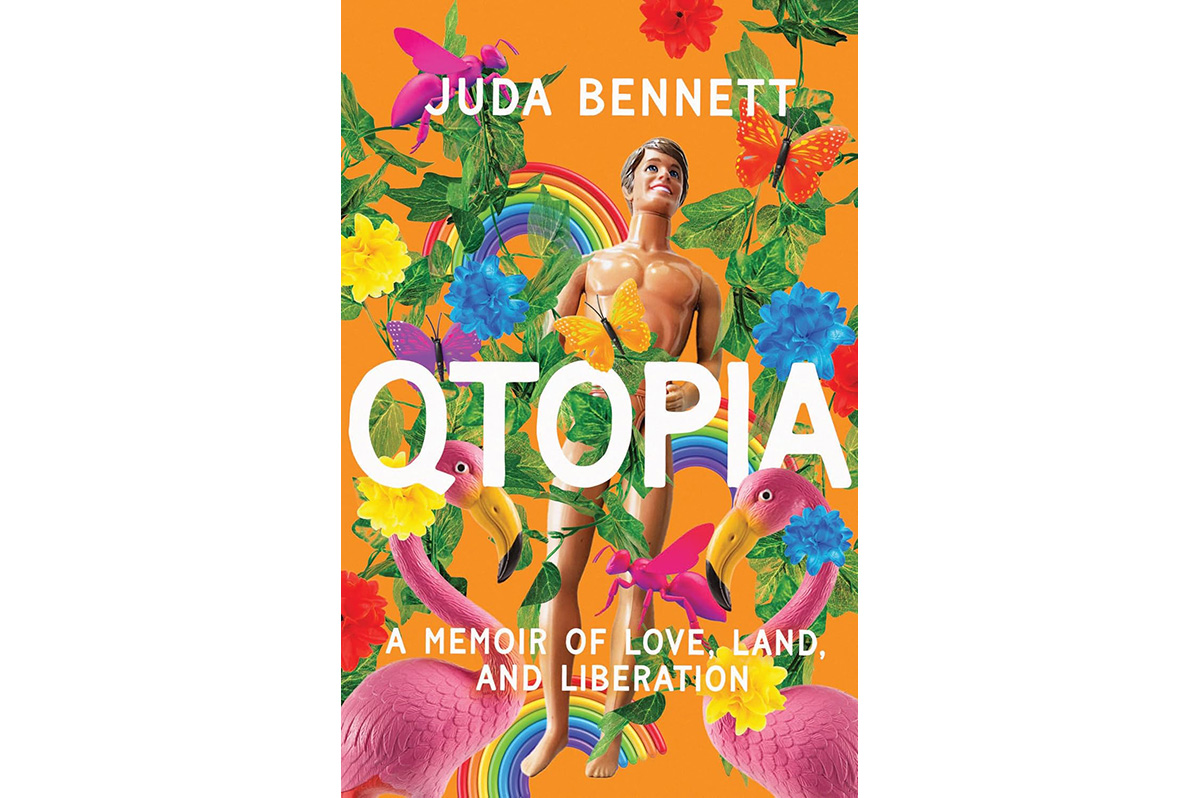
‘Qtopia: A Memoir of Love, Land and Liberation’
2026, University of Wisconsin Press
By Juda Bennett
Duffel packed, the new high school graduate could not fall asleep. “On the night before my departure, I stared at the duffel bag as if it were a body bag. We lived close to Dover, where the dead from Vietnam were shipped.”
It is 1971, and Charles was leaving home to join a hippie commune in rural Virginia. “I kept imagining bodies fitting into the bag and popping out in the middle of the night,” Juda Bennett writes in his memoir, “Qtopia: A Memoir of Love, Land and Liberation.” During Bennett’s high school years from 1968-1971 some 35,000 U.S. soldiers were killed in the Vietnam War, the vast majority processed at Dover Air Force Base.
Young Bennett was clueless about what lay ahead but he had a commune’s brochure in his pocket, certain his destiny was not in the military. “My father was a walking recruitment center, and my mother could have worked for the USO. Uncle Sam and the Andrews Sisters had nothing on them.” Inspired to find his way out of suburban Wilmington, Del., he boarded a Greyhound bus to Lexington, Va., and communes yet unknown. “Qtopia” is a serious, sexy and joyous memoir about a young man who knows he’s different in search of chosen family and, over coming decades, his own queer Utopia.
“We are leaving; you don’t need us,” was the popular refrain in the day from the Crosby, Stills & Nash song “Wooden Ships.” Communards like young Charles (going by the moniker C.B. with a full beard covering his handsome, androgynous features) were living it. How far this is from urban queer stories of the ‘70s. For this reason alone, it is marvelous reading about hot naked hippies farming together in the country, living and loving in secluded teepees when everything seemed possible. Novels like “Drop City” by T.C. Boyle (2003) and “Arcadia” (2012) by Lauren Groff set in hippie communes had no gay characters, only free-love for straights. When C.B.’s parents arrive to visit his back-to-the-land commune North Mountain bearing gifts like the orange powder Tang and Frosted Flakes, he “maintained” as the saying went. “It was a great time for visitors to see how hard we had worked—fields of sorghum swaying in the breeze, acres of vegetables in neat rows with beans, tomatoes and peppers hanging down….I was still thin as a matchstick, but I was a strong and muscular matchstick,” he tells the story of his development. By contrast, he had considered suicide before leaving home; this memoir fills in the pain, too.
There are times when C.B.’s voice as a teen communard with a secret is so authentic and rich, it is like reading fictional stories of American innocents on journeys of their own like J.D. Salinger’s character Holden Caulfield or Demon Copperhead from rural Virginia by Barbara Kingsolver. He tells us there was this guy Mark at North Mountain who had been pressuring him to sleep on the mattress next to his. C.B. was known as the only gay at North Mountain. One of the hippie women warned him Mark is “a square, the biggest downer.” Stepping out of the memoir, C.B. directly addresses the reader about the Mark issue, “I don’t want to write about Mark anymore because he’s not important to my story, and I didn’t even like him.” Got it. Hitchhiking with C.B. is like that, too.
“I got my best ride of the whole hike from a truck driver named TJ….If an eighteen wheeler…is willing to stop for you, it is because the driver wants something from you…I will forever remember this trucker as the most beautiful man I could have had sex with if I weren’t so innocent.”
North Mountain required the hippies work one week a month in Richmond to earn cash for the commune. For C.B., this translated into seven communards living in one small apartment on this cultish mission. It was in a Richmond park where he meets a stranger who would sexually abuse him over a month until C.B. ends it. Furious, the man threatens to shut down the commune if he does not obey. In a state of panic, C.B. attempts suicide by overdosing on every pill he can get his hands on. The memoir takes the reader through the author’s horror by deepening the shadows. What was the specific nature of the abuse? How did this stranger have credible power to threaten the commune? Entitled “What It’s Like to Die,” the chapter is a skillfully told, expressionistic turning point from an innocent’s hell to salvation at the intentional queer Lavender Hill commune in Central New York. C.B. desperately needed to “find my people.”
He’s a resilient young man after living in three communes by the time he hit San Francisco. His two gay neighbors on Ashbury Street—Crow and Moonsnake—pressure him to get a new “hippie name.” Walking home from Golden Gate Park he zeroes in on a passing streetcar, “North Judah.” Goodbye “Charles,” Judah will be his new hippie name. Crow and Moonsnake, approve: “If that’s what the Universe called out to you.” If you remember the Sixties…
“Too often,” Bennett writes, “we think of dropouts as withdrawing from life, but in truth, I think they are in a heightened state of seeking their rightful path and purpose. Nothing stays the same.” Juda Bennett remains a believer to this day, “Always putting my faith in my journey to Utopia”.
(Charles Francis is president of the Mattachine Society of Washington, D.C., and author of “Archive Activism: Memoir of a ‘Uniquely Nasty’ Journey.”)

Log Cabin Republicans remove transgender rights from mission

Not all trans people are the same

Queer team brings girl power to fully baked ‘The Wrong Girls’

Democrat Maureen ‘Mo’ Madden takes on longtime GOP stronghold in Delaware’s 38th

Comings & Goings

Russian LGBTQ rights group to shut down

Winsome Earle-Sears ‘Life and Marriage Tour’ to include Northern Va. stops

White House targets gender-affirming care funding, states fight back

Madonna nominated for 11 MTV VMAs

Man charged with anti-gay assault in D.C. accepts plea offer
-

 Russia5 days ago
Russian LGBTQ rights group to shut down
-
Virginia4 days ago
Winsome Earle-Sears ‘Life and Marriage Tour’ to include Northern Va. stops
-
White House4 days ago
White House targets gender-affirming care funding, states fight back
-
Celebrity News4 days ago
Madonna nominated for 11 MTV VMAs