Local
Wone hearing to discuss S&M devices
A prosecutors’ request to introduce evidence that police found a collection of S&M devices in the home of three gay men implicated in the 2006 murder of Washington attorney Robert Wone is expected to be debated Friday during a D.C. Superior Court hearing.
The hearing follows a prosecutors’ February court filing seeking permission to submit evidence at trial alleging that defendants Joseph Price, Victor Zaborsky and Dylan Ward engaged in “conduct” not identified in the charges pending against them that could further link them to the murder. The trial is scheduled to begin May 10.
The three have been indicted on charges of obstruction of justice, conspiracy to obstruct justice, and evidence tampering in connection with Wone’s August 2006 stabbing death inside their house near Dupont Circle. Authorities have yet to charge anyone with the murder itself.
The men have pleaded not guilty to the charges and have said an unknown intruder killed Wone after entering their home through a rear door while they slept in their respective bedrooms.
According to the prosecutors’ filing last month, the new evidence includes a collection of sex toys and S&M books and manuals seized from the defendants’ home. Some of the devices are used to tie and restrain someone engaged in S&M activity while other devices seized are used to administer an electric shock to a person’s genitals, the prosecutors say.
While noting that these devices are not illegal and their use does not constitute a crime, prosecutors say in the court filing that “said evidence clearly passes” federal rules of evidence “as its probative value is exceedingly high and the prejudicial effect is quite low.”
Police have said Wone was restrained, immobilized with a paralytic drug, sexually assaulted and then stabbed to death, most likely in a guest bedroom in the upscale townhouse where the three men lived at the time.
Legal observers say the request to use the S&M devices as evidence at trial suggests that prosecutors might use it to develop a possible motive for the murder that the defense claims is lacking in the government’s case.
But in a separate court filing in February, defense attorneys accuse prosecutors of seeking to use the S&M devices, which the defense labels “erotic accessories,” as sensational and inflammatory “evidence” that has no relevance to the case and which would prejudice the jury.
“Here there is no evidence that Wone was restrained in any fashion and absolutely no evidence that any one of the erotic accessories was used on Wone for any purpose, never mind in connection with his death,” defense attorneys say in their filing.
Among the items seized from the Swann Street home of the three men, according to the prosecutors filing, are “floggers,” “assorted dildos,” “scrotal harness with weight attachments,” and devices designed to administer an electric shock to various parts of someone’s body, including the penis and anal area.
The 39-page defense filing, among other things, disputes an assertion by prosecutors’ that an autopsy finding traces of Wone’s own semen inside his rectum and on his genitals is evidence that he was sexually assaulted before being murdered. Defense attorneys say in their filing that they will present testimony at trial by expert witnesses showing that the traces of Wone’s semen on his body did not contain any sperm cells.
The lack of sperm cells indicates that the semen found on the body was due to a normal discharge of various bodily fluids including urine and seminal fluids that occurs when men die and internal muscles relax, the defense filing says.
“There were no obvious, external signs of sexual assault, restraint or electro-torture,” says the defense filing. “Indeed, the government itself did not claim that Wone was sexually assaulted until after the FBI tested the forensic swabs [of Wone’s genital and anal areas] more than two years after Wone’s death,” it says.
Investigators said Wone, 32, who was a college friend of Price, spent the night at the men’s home after working late in his downtown office. Wone was married to a woman and lived in Oakon, Va. Family members have said he was straight.
Price and Zaborsky, who are domestic partners, and Ward told police an intruder killed Wone after entering the home while they were asleep in their respective bedrooms.
Police and prosecutors dispute that claim, saying there’s no evidence of a break-in. They point to an autopsy showing Wone suffered from three “clean,” surgical-like stab wounds, with no signs of struggle. They also have said the autopsy indicates the wounds could only have been inflicted if Wone was immobilized by a drug.
But the defense team says in its court filings that the autopsy and chemical tests of the body have not found any traces of a paralytic drug, and it disputes the government’s claim that such drugs quickly dissipate within the body and can’t be found by chemical tests. The defense filing does not address the issue of the “clean” stab wounds that prosecutors say could only happen if a person is immobilized by an anesthesia-type drug.
Killer ‘known to’ men?
In their Feb. 5 court filing, which was made public Feb. 15, prosecutors reiterate earlier statements that they lacked evidence to charge anyone with the murder itself. But for the first time, they say that they believe “the killer is someone known to and being protected by” Price, Zaborsky and Ward.
“Given the sophistication and success of the defendants’ cover-up of the murder of Robert Wone, the evidence obtained to date does not yet establish beyond a reasonable doubt who actually killed Robert Wone,” says the court filing.
“Although the government investigation into the murder continues, there is ample admissible evidence demonstrating the killer is someone known to the defendants, and not, as the defendants told the police, an unknown, unseen, unheard, phantom intruder who entered without force, took nothing from the home, went to the farthest reaches of the second floor of the home, stabbed Robert Wone (while Robert Wone lay immobile), and then fled without a sound and without taking any item from the home or disturbing anything therein,” it says.
The government’s filing also for the first time suggests that Joseph Price’s brother, Michael Price, could be a person of interest linked to the Wone murder.
In October 2006, two months after the murder, D.C. police arrested Michael Price and an accomplice on a charge of burglarizing the Swann Street home where the murder took place, saying they entered the then vacant home using a key that Joseph Price had given Michael Price sometime earlier. At the time, police said they had no evidence to link the burglary to the murder.
In their court filing last month, prosecutors say they found that Michael Price had been enrolled in a course at Montgomery College, studying to be a phlebotomist from June through August of 2006. A phlebotomist is trained to draw blood from patients at hospitals or other medical facilities through the use of special hypodermic needles.
“Course attendance records reflect that Michael Price attended each and every scheduled class beginning on June 7, 2006, and running through July 31, 2006,” the government filing says. “However, those same records reflect that the first time he missed class was on Aug. 2, 2006, the night Robert Wone was killed.”
The filing adds in a footnote, “It should be noted that Michael Price’s partner, Louis Hinton, provided an alibi for Michael Price at the time of the murder.”
In a related development, defense attorneys last week filed motions asking that the case against Joseph Price, Zaborsky and Ward be “severed” so that each one would have a separate trial.
These and the filings by prosecutors seeking to introduce the S&M-related evidence are expected to be debated at Friday’s court status hearing before Judge Lynn Leibovitz.





Baltimore
The fight to save one of Baltimore’s last gay bars
Leon’s closed in July after its owner’s death
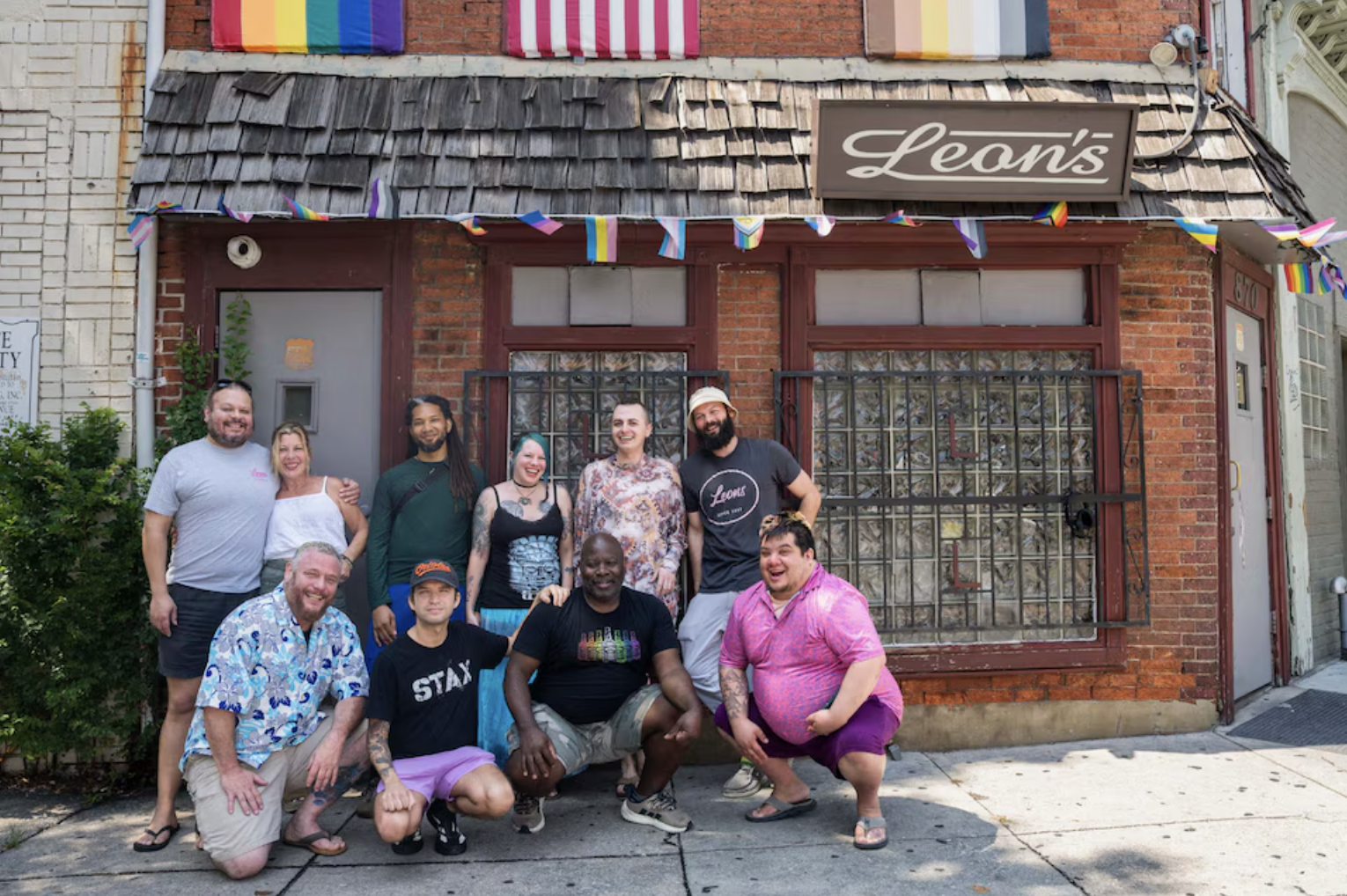
By JULIE SCHARPER and WESLEY CASE | Soon after Jim Becker came out as gay in 1967, he ducked into a Mount Vernon bar called Leon’s.
In the dark, smoky bar, men used pseudonyms for fear of being outed, as homosexual acts were illegal in Maryland. Bartenders, wary of vice squad raids, would blow a whistle if couples leaned in for a kiss.
But to Becker, arriving at Leon’s was a kind of homecoming. He could explore his identity, connect with other gay men and build community in the anxious years before the 1969 Stonewall uprising, a pivotal moment in the LGBTQ rights movement.
The rest of this article can be read on the Baltimore Banner’s website.
District of Columbia
Gay-owned pizzeria in Dupont Circle burglarized
Protest Pizza owners say community has expressed support
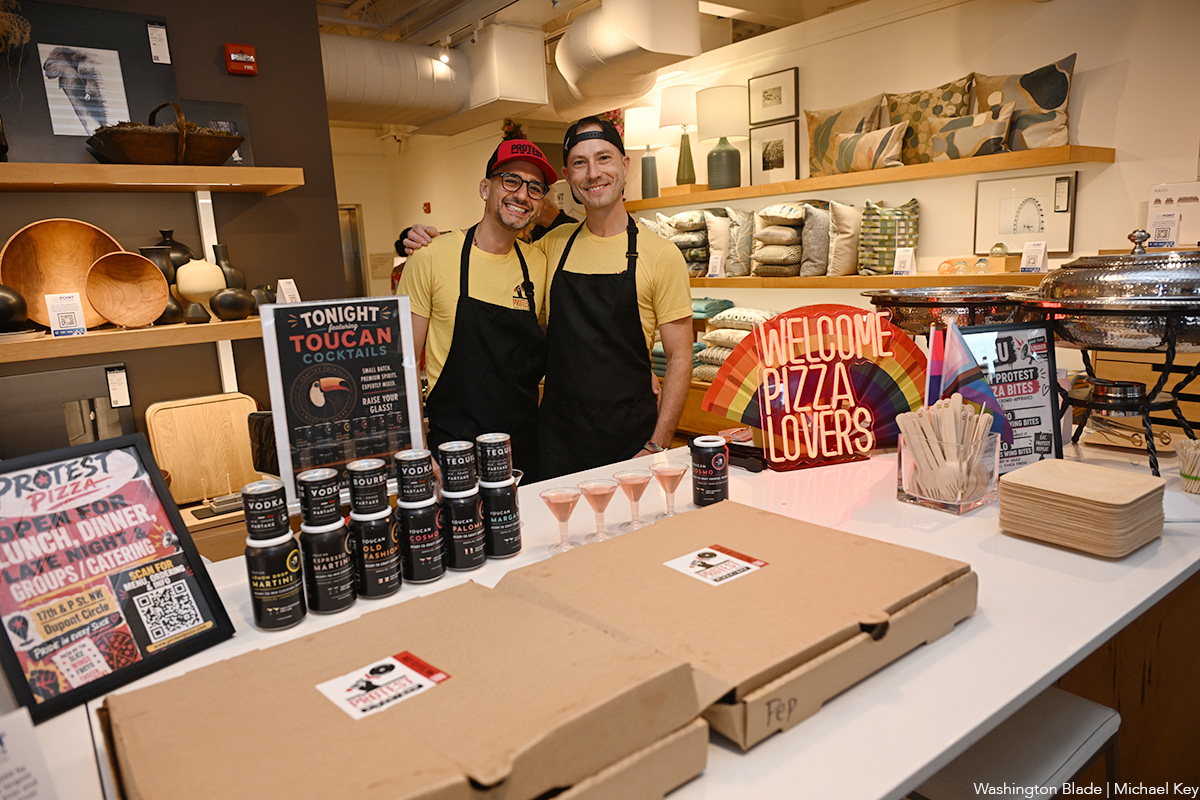
Gay activist Randy Downs said he and his business and life partner Ricky Bennett are grateful for the support they have received from the Dupont Circle community after they released a video showing a suspect breaking into their recently opened pizza shop and taking money from a cash register shortly before 3 a.m. on Friday, Aug. 21.
The surveillance video shows a man wearing black clothing with his face covered, smashing the glass front door of Protest Pizza, located at 1633 ½ P St., N.W. The video, which Downs and Bennett provided to D.C. police, also shows the suspect climbing over the bar to get to a cash register, which he opened to take out cash.
A D.C. police report obtained by the Washington Blade lists the incident as a Burglary in the Second Degree and says the owners reported “approximately $78 in cash” was taken from the cash register. The report says the incident is not listed as a suspected hate crime.
Downs told the Washington Blade that after he and Bennett reported the break-in and theft on social media, they received an overwhelming showing of support from neighbors and others, including business owners, from across the nation.
“The break-in was upsetting, but it is not what will define Protest Pizza,” Downs said. “What defines us is how quickly people showed up,” he told the Blade. “One person came looking for a cash register; our community saw a gathering place worth protecting. The response reminded us that Protest’s real value was never in the register.”
Downs said he and Bennett, who live around the corner on the section of 17th Street, N.W., near several other bars and restaurants, including the gay bar JRs are located, opened Protest Pizza in November 2025.
“Ricky and I built Protest Pizza as a positive, welcoming, queer owned neighborhood restaurant and bar — a space for protest and joy,” he said.
A D.C. police spokesperson said police offer a reward of up to $1,000 for information leading to an arrest and conviction of a suspect responsible for the type of burglary and theft that occurred at Protest Pizza. Police say anyone with information to help solve this type of crime should call the police tipline at 202-727-9099.
District of Columbia
Advocates honored at Engendered Spirit Awards
Annual ceremony held at conclusion of Trans Pride DC
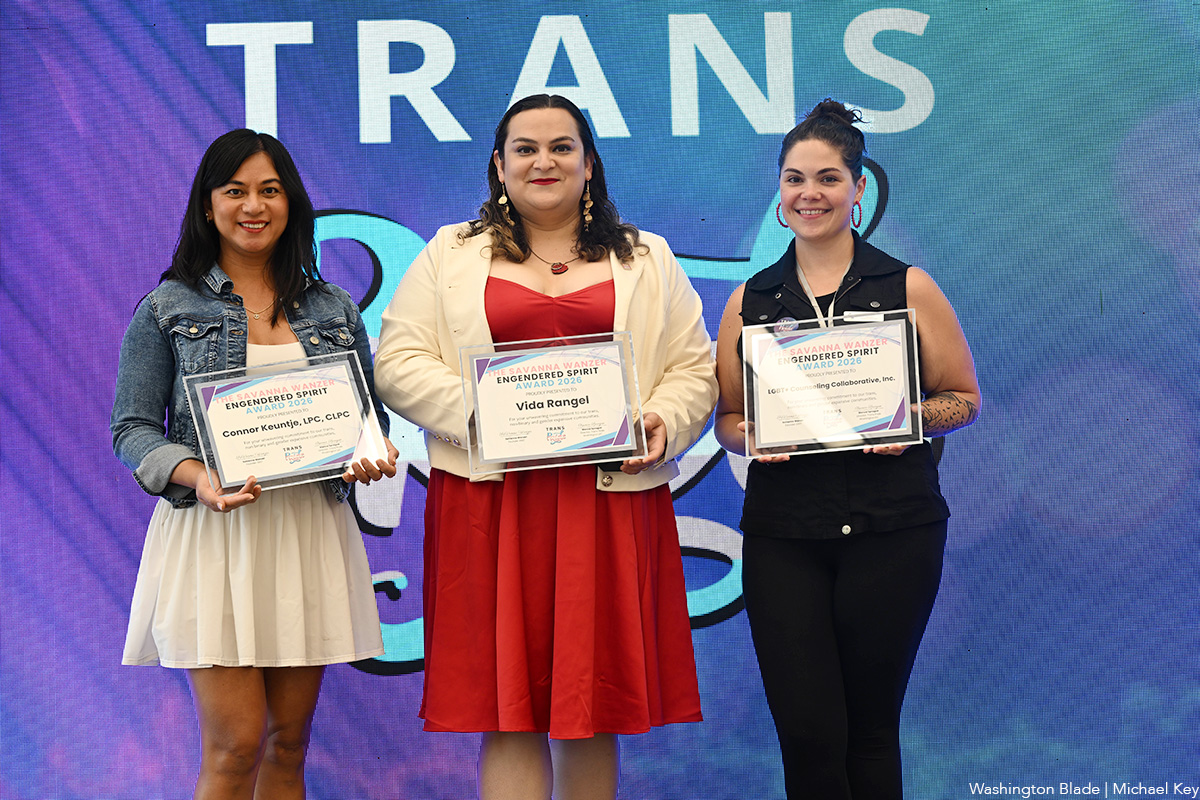
The 2026 SaVanna Wanzer Engendered Spirit Awards ceremony took place at the Martin Luther King, Jr. Memorial Library in D.C. on Saturday. The ceremony was held at the conclusion of the day-long Trans Pride DC: Encore.
Honorees included D.C. Mayor’s Office of Community Affairs Deputy Director Vida Rangel; the LGBT+ Counseling Collaborative, Inc.; and Connor Keuntje, CLP, CLPC.
Trans Pride DC: Encore was held throughout Saturday with several workshop sessions and a virtual conversation with actress and advocate Dominique Jackson.
The annual Engendered Spirit Awards were renamed the “SaVanna Wanzer Engendered Spirit Awards” in honor of SaVanna Wanzer, founder of D.C. Trans Pride. Wanzer died on April 24 of this year.
Speakers at the ceremony included Japer Bowles, director of the D.C. Mayor’s Office of LGBTQ Affairs and Bianca Sprague, executive director of D.C. Trans Pride.
“The intent behind this award and honoring members of our communities, organizations, and allies, is to really elevate all of the work that they’re doing to provide resources, tools, learning opportunities and connections: centering trans folks, gender non-conforming, and gender diverse individuals,” Sprague said.

Dolly Parton dies at 80

Monument to LGBTQ Canadians officially unveiled

The fight to save one of Baltimore’s last gay bars

When home becomes a journey: migration, memory, and the African diaspora

Gay-owned pizzeria in Dupont Circle burglarized

Trump-Vance administration’s LGBTQ brain drain: what you need to know

UPDATE: Impulse Group’s ‘PrEP Pool Party’ cancelled

Not all trans people are the same

Calendar: August 21-27