News
Nuevo programa de radio estadounidense enfoca en temas LGBT en Cuba
Joe Cardona es presentador de ‘Arcoíris’ en Radio Martí
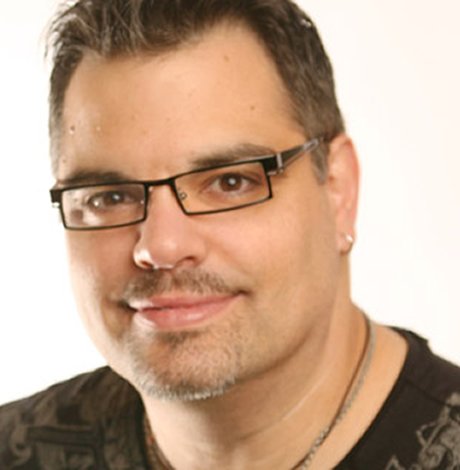
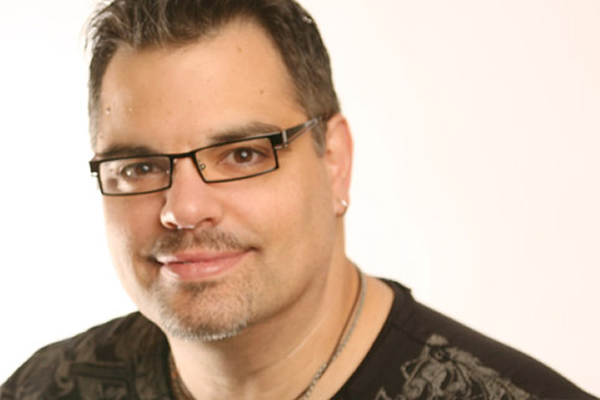
Joe Cardona es el presentador de “Arcoíris,” un nuevo programa en Radio Martí con un enfoque en los temas LGBT en Cuba. (Foto cortesía de Joe Cardona)
“Arcoíris” se transmitó por primera vez en Radio Martí el 28 de julio.
El programa se transmite cada sábado y domingo entre las 4-5 pm. Joe Cardona, un cineasta cubanoamericano y aliado que dirigió “The Day It Snowed in Miami,” un documental sobre la campaña de Anita Bryant en contra de la ordenanza de derechos gay del Condado Dade en 1977, presenta “Arcoíris.”
Nelson Gandulla Díaz, fundador de la Fundación Cubana por los Derechos LGBTI, un grupo LGBT independiente, apareció en “Arcoíris” el 25 de agosto. Gandulla, un fuerte crítico de Mariela Castro, la hija del expresidente cubano Raúl Castro que promueve los temas LGBT en Cuba como directora del Centro Nacional de Educación Sexual (CENESEX), habló con Cardona desde España donde ha pedido asilo.
“Arcoíris” el 1 de septiembre enfocó las experiencias de prisioneros gay en Cuba. Ignacio Estrada Cepero, fundador de la Liga Cubana contra la SIDA que ahora vive en Miami con su esposa, Wendy Iriepa Díaz, una mujer trans que una vez trabajó para CENESEX, también ha aparecido en el programa.
La familia de Cardona es originaria de La Habana y la Provincia de Matanzas. El dijo al Washington Blade el pasado mes durante una entrevista telefónica desde Miami que su programa “todo es de llevar los temas LGBT al público en Cuba.”
Activistas LGBT cubanoamericanos en el sur de Florida han aplaudido el programa.
“Arcoíris” es una ventaja importante al mundo alrededor para la comunidad LGBTQ cubana,” dijo Tony Lima, director ejecutivo de SAVE, en un comunicado de prensa de Radio Martí.
Presentador del programa ‘mira más allá’ de Mariela Castro
“Arcoíris” debutó casi tres meses después del presidente cubano Miguel Díaz-Canel tomó posesión del cargo. También empezó transmitirse contra el contexto del debate sobre la nueva constitución del país con una enmienda que extendería los derechos matrimoniales a parejas del mismo sexo.
Se están realizando ahora una serie de consultas públicas que permiten al público de comentar sobre la nueva constitución. Se espera que la Asamblea Nacional a finales de este año la finalice antes de un referéndum en febrero de 2019.
El debate, que incluye oposición pública de iglesias evangélicas, se está realizando menos de 60 años después del encarcelamiento de hombres gay en campos de trabajo — las UMAPs — después de la revolución cubana que llevó al poder Fidel Castro, el tío de Mariela Castro.
Partidarios de Mariela Castro, entre otras cosas, notan que Cuba ahora ofrece cirugías de reasignación de sexo gratuitas por su sistema nacional de salud. Gandulla y otros activistas LGBT independientes en Cuba dicen que confrontan el maltrato e incluso a la detención si critican públicamente a Mariela Castro, que es parlamentaria, o el gobierno cubano.
“Casi miro más allá de Mariela Castro,” Cardona dijo al Blade. “Miro a CENESEX como otro apparatchik del gobierno.”
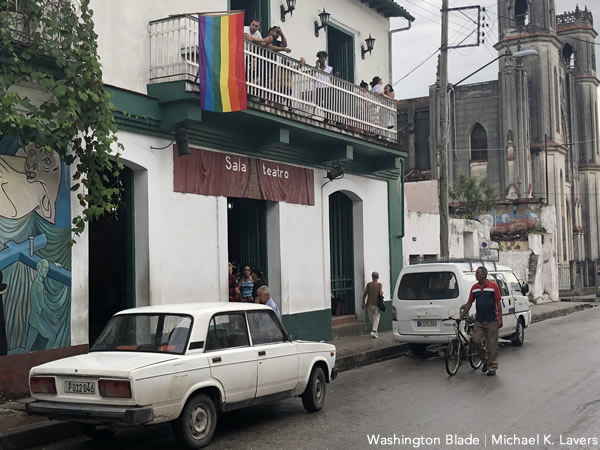
El Mejunje es un centro cultural LGBT en Santa Clara, Cuba. Se realizó una marcha para conmemorar el Día Internacional contra la Homofobia, la Transfobia y la Bifobia en la ciudad el 15 de mayo de 2018. (Foto del Washington Blade por Michael K. Lavers)
Gobierno cubano es fuerte crítico de Radio Martí
Radio Martí empezo de transmitir a Cuba en 1985.
La Oficina de Transmisiones a Cuba en Miami, que es parte de la Agencia de Información Internacional de EEUU, funde Radio Martí y Televisión Martí. Los dos Martí tienen un presupuesto combinado de $28.1 millón.
El gobierno cubano ha criticado fuertemente Radio Martí y Televisión Martí.
El Miami New Times el pasado mes reportó que menos de 10 por ciento de cubanos escuchan a transmisiones de Radio Martí y menos de un por ciento de cubanos miran programas de Televisión Martí, en parte, porque el gobierno cubano ha podido bloquearlos para que no lleguen a la isla. Los críticos continúan instando al gobierno federal a que disminuya su financiamiento de Radio Martí y Televisión Martí.
Un acuerdo de 2014 entre el gobierno cubano y la administración de Obama para normalizar las relaciones diplomáticas entre La Habana y Washington incluyó acceso ampliado al internet en Cuba.
El presidente Trump el año pasado reimpuso restricciones de viaje y comercio con Cuba, aunque su empresa y varios de sus asociados han violado el bloqueo estadounidense contra la isla comunista. Acceso al internet en Cuba sigue limitado y costoso, aunque ahora hay más de 700 hotspots de WiFi públicos por todo el país y un programa piloto de la empresa estatal de telecomunicaciones de Cuba permite a los cubanos de tener conexiones de internet en sus hogares.
“No soy el tipo que prohíbe a nadie viajar allí,” Cardona dijo al Blade el viernes desde Miami. “Obviamente lo aliento, pero le digo a la gente, ve allí con los ojos abiertos.”




U.S. Federal Courts
Renee Good’s family files two federal lawsuits
ICE officer killed lesbian mother of three in Minneapolis in January

The family of lesbian woman who a U.S. Immigration and Customs Enforcement killed in Minneapolis in January have filed two federal lawsuits.
The Associated Press notes Renee Good’s partner, Becca Good, and her brother, Brent Ganger, in the lawsuits accuse the Trump-Vance administration and ICE officer Jonathan Ross of “unjustified and excessive use of force.”
Renee Good was a 37-year-old mother of three.
Ross on Jan. 7 shot and killed her in Minneapolis.
The shooting took place during the Trump-Vance administration’s so-called Operation Metro Surge that targeted Somalis and other immigrant groups in Minneapolis. U.S. Customs and Border Protection agents on Jan. 24 shot and killed Alex Pretti, a 37-year-old nurse who worked for the U.S. Department of Veterans Affairs, in Minneapolis.
Both shooting sparked outrage across the U.S. and around the world.
“Every morning, she is my first thought. I think about how the kids are growing up without their mama, and how I will grow old without the love of my life. I think about how we should have had 40 more years together. But I also think about what she would have wanted after all of this,” said Becca Good in a statement the Human Rights Campaign released after she and her partner’s family announced the lawsuits.
“As we have tried to navigate our own massive loss, I am also devastated by how many other lives have been destroyed in this darkest of times. So many other families are dealing with the loss of their loved ones; to everyone who has had to witness it — the pain of this moment extends far beyond our family,” added Becca Good. “What happened to us should never happen to any family. No child should grow up without a parent because of it. No one should lose their sister or their daughter. No one should have to live without their soulmate. Accountability — real accountability — is the only way to make sure that no other family has to go through what we have.”
HRC President Kelley Robinson in her own statement said the Good family “is one of our own — and today, the Human Rights Campaign joins them in demanding justice.”
“It has been eight months and 24 days since Renee was shot and killed by an ICE agent, and the United States government has failed to take responsibility for its actions,” said Robinson. “Her partner, Becca, and brother Brent, have made the brave and bold decision to hold the government accountable, and we stand with them. Like every person murdered by ICE, Renee should be alive today. The Goods were robbed of what every American family deserves: to be together.”
Turkey
House Democrats urge White House to confront Turkish government over anti-LGBTQ crackdown
More than 60 lawmakers signed letter to Secretary of State Marco Rubio

More than 60 House Democrats on Thursday called upon the Trump-Vance administration to confront the Turkish government over its anti-LGBTQ crackdown.
Turkish authorities last month detained dozens of people during raids that targeted the country’s LGBTQ community, advocacy groups, and HIV/AIDS service organizations. Journalists were among those taken into custody outside an Istanbul courthouse on Sept. 15 during a protest against the raids that are part of the government’s “My Family Is Safe” campaign.
Council for Global Equality is among the groups that organized a protest outside the Turkish Embassy in D.C. on Sept. 18.
View on Threads
U.N. High Commissioner for Human Rights Volker Türk on Sept. 21 during a U.N. LGBTI Core Group event that took place on the sidelines of the U.N. General Assembly specifically referenced Turkey.
The Core Group is a group of U.N. member states that have pledged to support LGBTQ and intersex rights.
The U.S. withdrew from the Core Group after the Trump-Vance administration took office. The White House has not publicly commented on Turkey’s anti-LGBTQ crackdown.
“These developments warrant an urgent diplomatic response from the United States to protect the rights of freedom of expression, association, and assembly for all Turkish citizens, regardless of their sexual orientation or gender identity,” reads the letter the lawmakers sent to Secretary of State Marco Rubio. “We therefore urge you to use all available channels to raise these concerns directly with the Turkish government; press for the immediate release of those arrested and detained for their legitimate human rights activities; and ensure that the U.S. Embassy in Ankara closely monitors related judicial proceedings.”
“We further urge the Department to press Turkish authorities to cease efforts to criminalize LGBTQI+ organizations and advocacy and to affirm the right of all people to peacefully assemble,” it adds.
Arizona Congresswoman Yassamin Ansari and U.S. Rep. Dina Titus (D-Nev.) spearheaded the letter. House Speaker Emerita Nancy Pelosi (D-Calif.); House Foreign Affairs Ranking Member Gregory Meeks (D-N.Y.); Del. Eleanor Holmes Norton (D-D.C.); Delaware Congresswoman Sarah McBride, and U.S. Rep. Mark Takano (D-Calif.), who chairs the Congressional Equality Caucus, are among the 65 House Democrats who signed the letter.
“The United States must be a leader in defending human rights and what is happening in Turkey demands an urgent diplomatic response. It’s absolutely appalling to see LGBTQI+ people and the organizations that stand up for their rights be targeted by the (President Recep Tayyip) Erdogan regime,” said Ansari in a press release. “I stand proudly with the LGBTQI+ community here and abroad and will continue to fight for their right to live openly, freely, and without fear, anywhere and everywhere.”
The press release notes the Human Rights Campaign, the Council for Global Equality, and the Planned Parenthood Federation of America support the letter.
“Turkey’s attacks on its LGBTQI+ community are a disturbing reminder that the fight for equality and human rights does not stop at our borders. No one should be silenced or detained for simply being who they are or peacefully demanding dignity and freedom,” said HRC Government Affairs Senior Director Jennifer Pike Bailey. “We are grateful to Representatives Ansari and Titus for recognizing that the fight for LGBTQI+ equality is global and that, even amid the many challenges facing our community here at home, we cannot turn our backs on LGBTQI+ people facing persecution abroad.”
A State Department spokesperson on Friday told the Washington Blade that “as a matter of policy, we do not comment on congressional correspondence.”
Federal Government
988 restores crisis services for LGBTQ youth

The lifesaving 988 call-in number to help people experiencing mental health crises or suicidal thoughts has once again restored its specialized services for LGBTQ youth.
The lifeline, which used to have the option to “press 3” to be directly sent to specialized services for LGBTQ youth facing mental health crises or suicidal thoughts, was returned on Wednesday following an over-year-long battle with the Trump-Vance administration, which removed the service in May 2025.
The Press 3 option rolled out as a pilot program in 2022 through a government contract with the Trevor Project, a suicide prevention and crisis intervention organization for LGBTQ people.
Then, in June 2025, the federal government announced that the lifeline would be eliminated within a month. By July 2025, 988 Lifeline’s “Press 3” services were terminated.
Openly gay U.S. Sen. Tammy Baldwin (D-Wis.) helped lead Congress in reversing the removal of the lifesaving resource from American phones. As a member of the Senatw Labor-HHS Appropriations Subcommittee, she started the process of securing $535 million for 988 — a $15 million increase — as well as dedicated funding for LGBTQ youth specialized services.
Then, in September 2025, Baldwin, along with U.S. Sen. Lisa Murkowski (R-Alaska), introduced bipartisan legislation in the Senate, the 988 LGBTQ+ Youth Access Act, to codify the 988 Lifeline’s specialized services for LGBTQ young people.
At the same time, U.S. Rep Raja Krishnamoorthi (D-Ill.) introduced the legislation in the House of Representatives alongside U.S. Reps. Michael Lawler (R-N.Y.) Sharice Davids (D-Kan.) Brian Fitzpatrick (R-Pa.) and Seth Moulton (D-Mass.)
The Senate passed Baldwin’s bipartisan funding bill in January 2026, funding the Department of Health and Human Services with explicit language mandating the return of 988’s LGBTQ youth specialized services.
In February 2026, Congress passed legislation mandating that the previously eliminated “Press 3” specialized services be restored and funded with $33,100,000 — but it was unclear if the Press 3 option would still be allowed under current executive orders, namely Executive Order 14168, or “Defending Women From Gender Ideology Extremism and Restoring Biological Truth to the Federal Government.”
Despite the securing of federal funding for the Press 3 resource, the battle to get the 988 LGBTQ+ Youth Access Act through Congress is ongoing — and would provide codafied protection from this removal ever happening again.
According to data on the Trevor Project’s website, LGBTQ young people are more than four times as likely to attempt suicide than their peers.
Baldwin’s office touts the immense help the lifeline provides to LGBTQ people in their moments of greatest need. The press release on the reinstatement of Press 3 highlighted the continued demand for the service:
“The volume of calls, texts, and chats 15 percent higher than a year earlier and nearly 50 percent higher than two years ago. Since the lifeline launched, it has received over 27 million contacts, including over 18 million calls, 4 million texts, and 3 million chats.”
Advocates for LGBTQ rights and mental health awareness have agreed with the increasing numbers and hailed the return as a win for everyone.
“Suicide and mental health struggles touch every community across our state, and that’s why creating the 988 crisis lifeline to make sure help is there for everyone is one of my proudest accomplishments,” said Baldwin said in a statement. “But, last year, the Trump administration decided to make these real struggles a political football and ripped away the specialized line that helped LGBTQ children. This was a deliberate choice. The Trump administration chose to put children’s lives on the line to score some political points.
“I’ve fought tooth and nail to restore this lifesaving resource. When I realized the Trump administration was not going to do it on their own, I wrote it into federal law to require them to restore the Press 3 option,” the Wisconsin senator said. “This lifesaving resource never should have gone away in the first place, but I am glad the lifesaving support Press 3 provides is once again there for people who need it.”
“I’m proud that we secured the funding to restore this lifesaving LGBTQ+ crisis line and successfully pressured the Trump administration to bring the program back,” Krishnamoorthi said. “When an LGBTQ+ young person reaches out for help in a moment of crisis, they deserve to reach a counselor trained to understand and support them. This program should never have been taken away, and now we need to make sure it stays available for every young person who needs it. I’m grateful to the Trevor Project, NAMI Chicago, Equality Illinois, the American Foundation for Suicide Prevention, and all the advocates and young people who worked alongside us to bring these services back.”
Jaymes Black, CEO of The Trevor Project who works with the SAMHSA, in their press three operations celebrated the return of the resource.
“We are grateful to see that the 988 Suicide & Crisis Lifeline’s ‘Press 3’ specialized services for LGBTQ+ youth have been restored. Resuming this national resource will be critical in addressing the public health crisis of suicide among LGBTQ+ young people, and supporting the estimated more than 1.8 million LGBTQ+ youth who seriously consider attempting suicide in the U.S. each year,” Black said via a statement. “We are thankful for the large coalition of bipartisan lawmakers, mental health advocates, allies, and supporters who fought tirelessly for this restoration. We will monitor the launch and usage of these important services to ensure all LGBTQ+ youth are supported with clinically best standards.”
If you or someone you know needs mental health resources and support, please call, text, or chat with the 988 Suicide & Crisis Lifeline or visit 988lifeline.org for 24/7 access to free and confidential services. Trans Lifeline, designed for transgender or gender-nonconforming people, can be reached at (877) 565-8860. The lifeline also provides resources to help with other crises, such as domestic violence situations. The Trevor Project Lifeline, for LGBTQ+ youth (ages 24 and younger), can be reached at (866) 488-7386. Users can also access chat services at TheTrevorProject.org/Help or text START to 678678.

Annapolis Pride arrives this weekend

Calendar: October 2-8

Renee Good’s family files two federal lawsuits

House Democrats urge White House to confront Turkish government over anti-LGBTQ crackdown

988 restores crisis services for LGBTQ youth

HRC National Dinner 2026: A night of music, activism, LGBTQ history

Lesbian Bar Project co-founder: purity politics could destroy our remaining spaces

529 openly LGBTQ candidates running in Brazilian election

HRC report: LGBTQ students face ‘far greater challenges’ in non-supportive states

Meet the LGBTQ candidates running for U.S. House, Senate
-

 LGBTQ Non-Profit Organizations5 days ago
HRC National Dinner 2026: A night of music, activism, LGBTQ history
-
Bars & Parties5 days ago
Lesbian Bar Project co-founder: purity politics could destroy our remaining spaces
-
Brazil5 days ago
529 openly LGBTQ candidates running in Brazilian election
-
National5 days ago
HRC report: LGBTQ students face ‘far greater challenges’ in non-supportive states