Local
Trans group struggles with financial crisis
T.H.E. hit by IRS tax liens, possible suspension of city funds
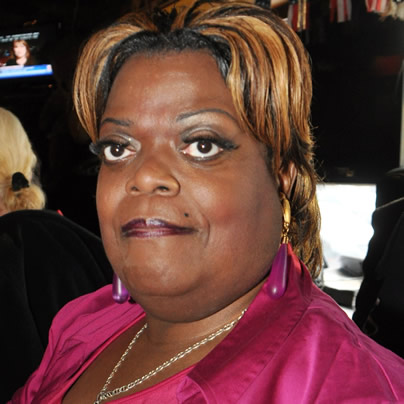
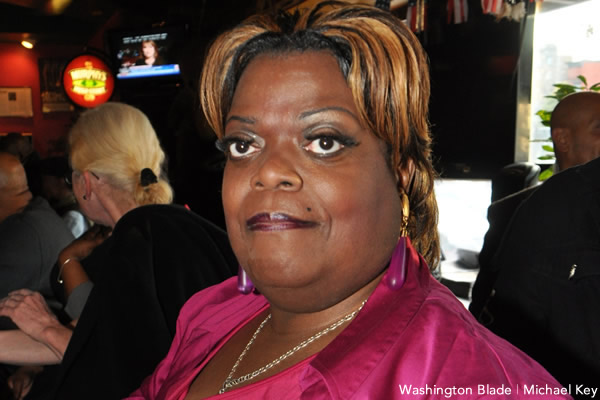
Longtime activist Earline Budd is reportedly among THE staffers experiencing problems getting paid. (Blade file photo by Michael Key)
Transgender Health Empowerment, a non-profit group that has provided a wide range of services for D.C.’s transgender community for more than a decade, is struggling with a financial crisis that has prevented it from paying its employees on time and has triggered staff layoffs and resignations, according to multiple sources familiar with the organization.
Public records at the D.C. Recorder of Deeds office show that the IRS filed at least 10 liens against THE over the past three-and-a-half years. Most are due to THE’s failure to pay employee payroll taxes, the records show.
Sources familiar with the situation say the liens prompted the D.C. Department of Health to suspend some or all of its funding for THE for HIV/AIDS-related services. The funding suspension reportedly was triggered by a procurement rule that restricts city funding for vendors or contractors that are in violation of the law, including federal tax law, the sources said.
A former THE employee and current client said they each were told by THE staffers that a delay in city funding forced the group to cut back on its drop-in services at its headquarters at 1414 North Capitol Street, N.W., and to limit services to clients by appointment only.
“The whole month of March we didn’t get a paycheck,” said the former employee, who was laid off in April because of THE’s financial problems, the former employee told the Blade.
Among THE employees not getting paid or getting paid late are THE official and longtime transgender activist Earline Budd, THE Director of Programs Brian Watson, and transgender activist Jeri Hughes, sources familiar with the group said.
Top officials with THE and the Department of Health have not responded to repeated requests by the Blade for information about the cause of THE’s financial problems and the status of city funding for the group.
“At this particular time, there’s no comment,” Brian Devine, THE’s finance manager, told the Blade. Devine said THE Executive Director Anthony Hall also had no comment.
“We just had a board meeting and that was one of the issues we spoke of,” said Devine, adding that the board decided not to issue a statement about the situation at the present time.
DOH spokesperson Najma Roberts said she would make inquiries about the THE funding status when contacted by the Blade last week. As of press time this week she had not responded.
The Blade filed a Freedom of Information Act request with the DOH deputy general counsel, Phillip Husband, on April 3 seeking the information that the department has yet to release through Roberts, the press spokesperson. Husband said the department usually takes up to 15 business days to respond to a FOIA request.
“My biggest concern is THE’s clients,” said transgender activist Ruby Corado, director of Casa Ruby, an LGBT community center in Columbia Heights that caters to the Latino and transgender communities.
Corado said some of THE’s clients have been coming to Casa Ruby after being told that THE’s drop in center had curtailed its services.
Corado and other transgender activists called THE the D.C. area’s preeminent service provider and advocate for the transgender community.
They note that THE also operates the city’s only housing facility dedicated to homeless LGBT youth. The facility known as the Wanda Alston House has been nationally recognized as an innovative resource for LGBT youth that offers counseling, employment and vocational training, and other services.
Among THE programs funded by DOH is its highly acclaimed Comprehensive Risk Counseling Services or CRSC program, which offers risk reduction interventions for preventing HIV infection among transgender people, especially transgender women, whom experts say are at high risk for HIV. THE also offers HIV testing and counseling.
“THE is a transgender institution for D.C.,” Corado said. “There are a lot of people counting on its services, especially those living with HIV. It is an organization that cannot go away,” she said.
“So the question I have is what is the Department of Health doing about this,” Corado said. “Why aren’t they talking about what happens to those clients? Are those clients OK?”
Transgender activist Alexandra Beninda, who serves on the D.C. Human Rights Commission, was among those who praised THE for its work in the transgender community but said she was unaware that the group was having financial problems.
She said she hoped the community would rally in support of THE but expressed concern that news of the group’s problems had not gotten out to those who might be willing to help.
Mara Keisling, executive director of the D.C.-based National Center for Transgender Equality, said she, too, was unaware of the THE financial problems.
“They are the centerpiece for local transgender efforts,” Keisling said.
Records of the IRS liens against THE filed with the D.C. Recorder of Deeds show that between March 2010 and earlier this year the group owed the IRS a total of $260,075. The records don’t show how much of that amount was for unpaid taxes and how much, if any, was for interest and penalties.
The records show that THE has since made payments of $91,912 to pay off the back taxes and currently owes the IRS $168,163.
As a non-profit, tax-exempt organization, THE doesn’t pay taxes on its income from donors or from government grants and contracts. The records indicate that most of the money owed is for employee payroll taxes.
Due to THE’s refusal to comment on the matter it couldn’t immediately be determined what caused the underlying financial problems that prevented THE from paying its employee payroll taxes.
Ron Simmons, executive director of the D.C. AIDS service group Us Helping Us, which also receives city funding, said smaller community based groups like THE sometimes encounter cash flow problems when the city takes too long to reimburse the group for its services. He said DOH in the past has taken 90 days or longer to reimburse vendors and service providers.
“Among other things, they are the only LGBT homeless shelter for youth,” Simmons said. “We absolutely can’t let them go under,” he said of THE.
THE’s most recently filed IRS 990 finance report that is available for public viewing is for the fiscal year of Oct. 1, 2009 through Sept. 30, 2010.
The report shows that THE’s income for the year was $960,834 and its expenses came to $1,093,816, with a deficit of $132,982.
District of Columbia
Capital Pride chair resigns from board after just 10 months
Anna Jinkerson ‘taking step back to move forward’

Anna Jinkerson, who has served as chair of D.C.’s Capital Pride Alliance Board of Directors for the past 10 months and has served on the board for the past four years, confirmed she is resigning from the board effective Sept. 30.
Capital Pride Alliance serves as the lead organizer of D.C.’s annual LGBTQ Pride events.
“I am taking a step back to move forward and plan to stay engaged in the community,” Jinkerson told the Washington Blade in a statement. “Serving as a volunteer leader during a period of transition following World Pride was both an honor and a challenge,” she said.
“Throughout my tenure, I focused on strengthening accountability, improving communications, supporting staff and volunteers, and helping position the organization for long-term success,” she told the Blade in her statement. “Meaningful organizational progress requires collaboration, dedication, and a shared commitment to serving the community, and I am proud of the work accomplished during this period.”
In February of this year, during Jinkerson’s tenure on the board, Capital Pride announced it had expanded the size of its board from 12 to 25 members.
Around that same time one of the existing board members, transgender activist Taylor Lianne Chandler, announced in a letter to fellow board members that the Blade obtained from an anonymous sender that she was resigning from the board. Among her reasons for resigning, she said in the letter, was the board’s failure to address “sexual misconduct” within the Capital Pride organization.
In the letter, which she confirmed for the Blade was authentic, Chandler said she and other board members raised “credible concerns” of alleged sexual misconduct within the Capital Pride organization and the board chose not to adequately respond to those concerns.
Chandler told the Blade a Capital Pride investigation identified an individual implicated in a “pattern” of sexual harassment related behavior, but said she was bound by a Non-Disclosure Agreement that applied to all board members and she could not provide further details.
When the Blade contacted Capital Pride for comment on Chandler’s allegations, Jinkerson responded with a statement saying Capital Pride was addressing her concerns.
“When concerns are brought to CPA, we act quickly and appropriately to address them,” Jinkerson said. “As we continue to grow our organization, we’re proactively strengthening the policies and procedures that shape our systems, our infrastructure, and the support we provide to our team and partners,” she said.
In her statement to the Blade this week commenting on her planned resignation from the Capital Pride board, Jinkerson appeared to refer to the concern raised by Chandler.
“I am proud to have advocated for sexual harassment training, supported staff and volunteers when concerns were raised, engaged community leaders in important conversations, and helped advance practices that strengthen safety, transparency, and accountability,” she said.
“As I step away from board service, I do so with gratitude for the opportunity to serve and with confidence in the organization’s future,” she added. “I am taking a step back to move forward, and I look forward to remaining actively engaged in our community and continuing to support efforts that advance equality, belonging, and pride for all.”
District of Columbia
Over 2,000 turn out for Hands Around the Kennedy Center protest
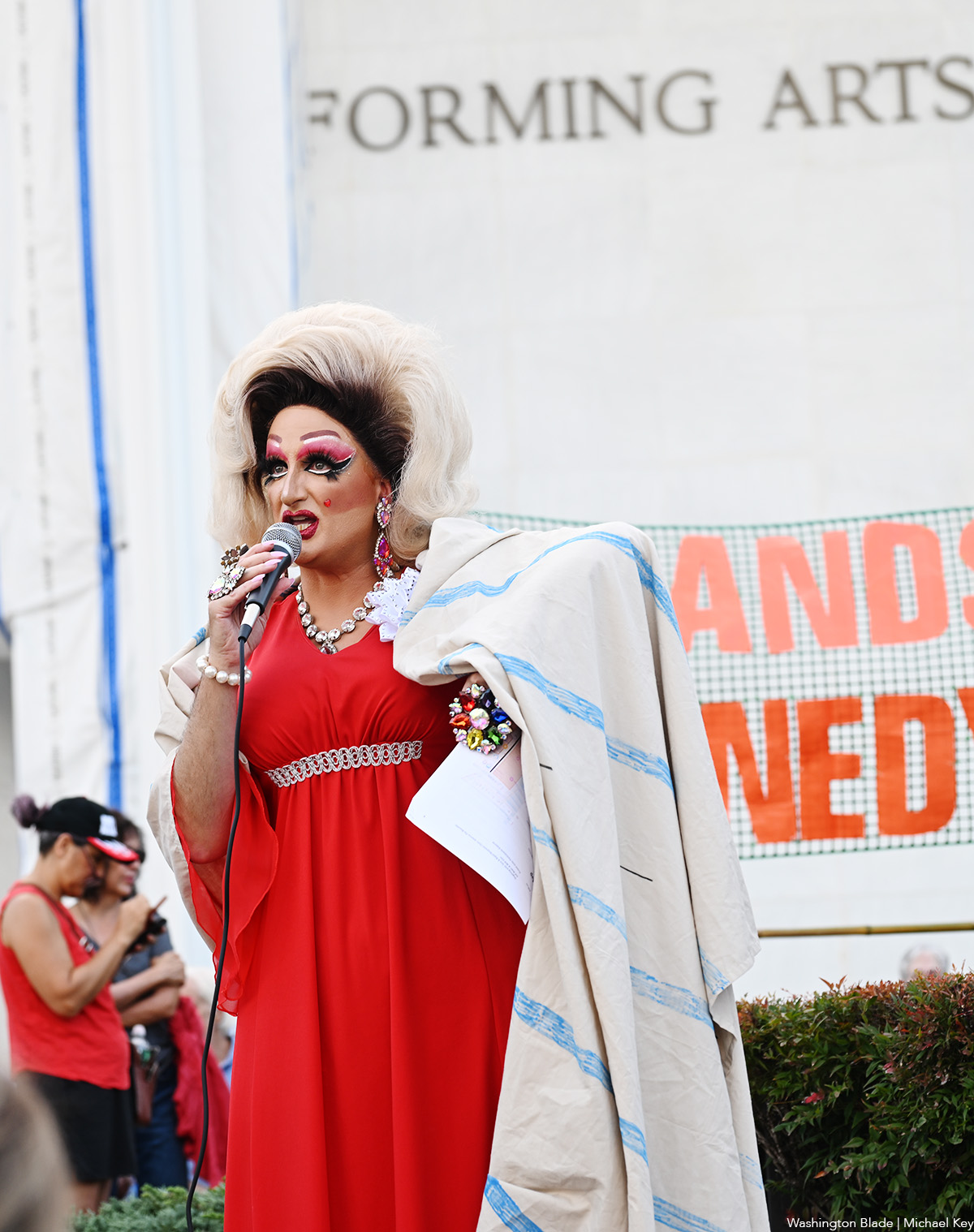
Drag performer Tara Hoot serves as MC, Gay Men’s Chorus of DC performs, attendees shout for Trump to keep ‘hands off’ Kennedy Center
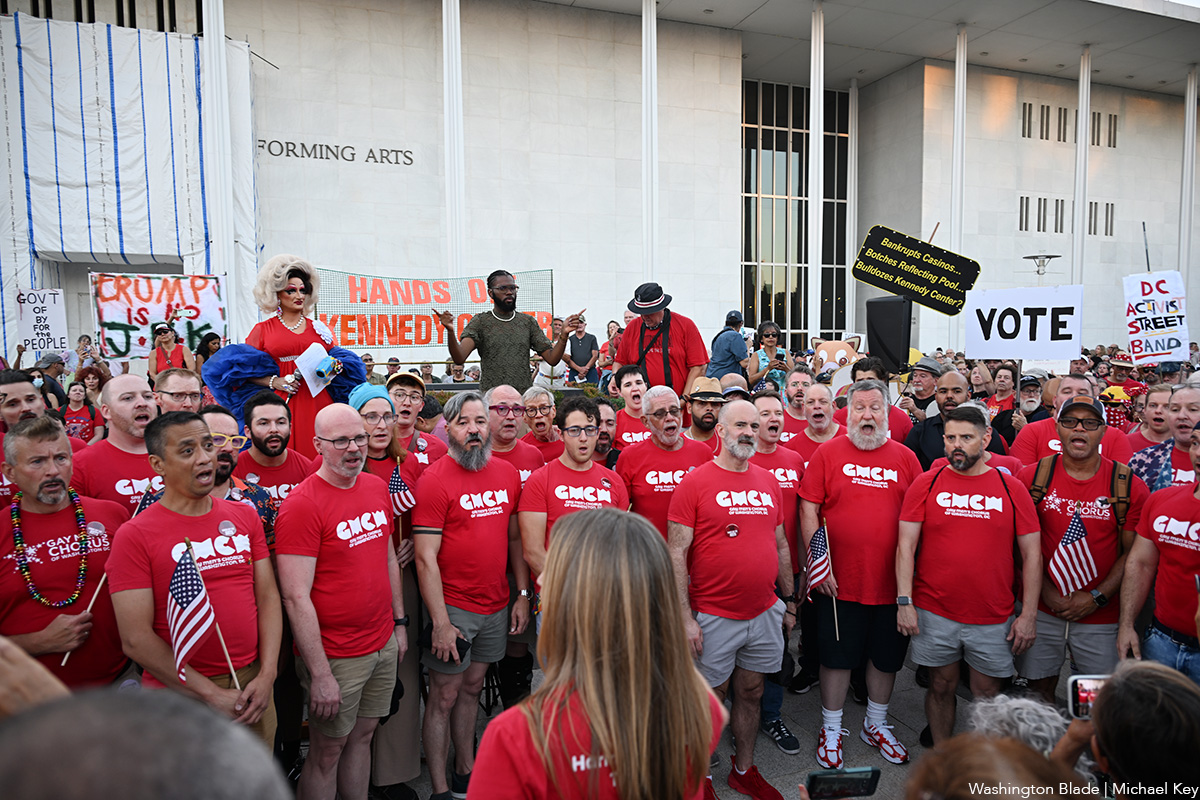
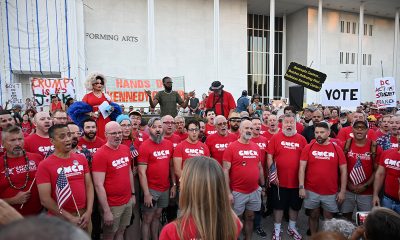
More than 2,000 supporters of the John F. Kennedy Center for the Performing Arts turned out on Sept. 18, for a rally in support of the performing arts center and a vocal protest against President Donald Trump’s threats to permanently close the center and possibly demolish it.
The event was organized by a group called Hands Off the Arts, which initially called for participants to form a “human chain” around the Kennedy Center’s main building following a rally on the plaza in front of the building.
However, due to a decision by the Trump-controlled Kennedy Center’s board of trustees to close the center earlier in the week and install fencing around part of the building, participants could only form the chain around part of the building, according to organizers.
Drag performer Tara Hoot, who co-organized the event and served as master of ceremonies for the rally preceding the “human chain,” said the large turnout could have fully surrounded the building at least twice had the fencing not prevented a full encirclement.
Among the musicians and singing groups that performed at the rally was the Gay Men’s Chorus of Washington, which, like other rally performers, had performed at the Kennedy Center in past years. They drew loud applause after singing one of their favorite songs from the Broadway musical show Ragtime, which includes the lyrics, “Will justice be demanded by 10 million men? Make them hear you. When they hear you, I’ll be near you again.”
View on Threads
Prior to their performance, Gay Men’s Chorus of Washington’s artistic director, Thea Kano, spoke at the rally, reminding participants that shortly after the Trump takeover of the center last year, Kennedy Center officials cancelled a concert the chorus was scheduled to perform there for World Pride 2025.
A Kennedy Center spokesperson said the cancellation was due to a scheduling conflict, but chorus members and LGBTQ activists believe it resulted from policies put in place by Trump and his leadership team at the Kennedy Center following Trump’s statements that he would end controversial “woke” performances that he claimed the majority of Americans disapprove of.
“Now this building sits empty in silence,” Kano told the crowd at the rally. “Let us raise our voices together and bring back the Kennedy Center as it was intended, a place where American culture could be celebrated and elevated, embracing the vibrancy with the spectrum of identify without censure and without politics,” she said.
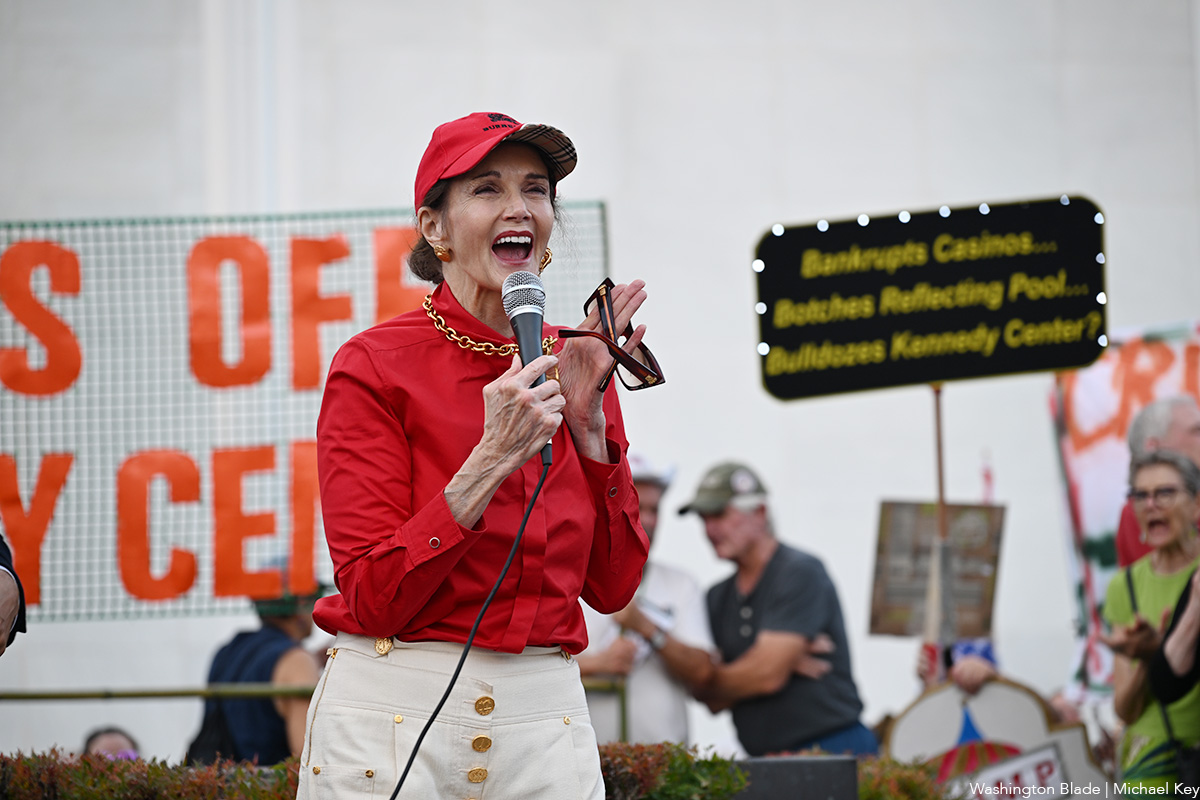
Among the others who spoke at the rally were U.S. Rep. Don Beyer (D-Va.), U.S. Rep. Jonathan Jackson (D-Ill.), and D.C. Councilmember Robert White (D-At-Large).
Most speakers, along with LGBTQ participants in the hands-around-the-building event expressed strong opposition to Trump’s demand that the Kennedy Center name be changed from the John F. Kennedy Center for the Performing Arts to the Donald J. Trump and the John F. Kennedy Center for the Performing Arts.
At Trump’s request, his appointed board initially made that name change and placed Trump’s name on the front wall of the building along with the Kennedy name. But following legal action taken by opponents who pointed out that Congress must approve such a name change, a judge ordered the removal of Trump’s name from the building. Trump has said he will take steps to reverse that order and has said he will stop plans to renovate the Kennedy Center building and possibly demolish it if his name is not restored in the Kennedy’s Center’s official name.
Throughout the Sept. 18 rally, LGBTQ participants repeatedly responded to the Trump threats by shouting, “Hands Off!”
Chris Raleigh, one of the founders of Hands Off the Arts and a lead organizer of the Sept. 18 event at the Kennedy Center who spoke at the event told the Washington Blade that more similar events are being planned and he welcomes the support the event has received from the LGBTQ community.
“The LGBTQ community was here first, and we’re following them,” he said. “They’ve been the spearhead; they’ve been the vanguard. And I’m so thankful for heroes like Tara Hoot,” he said, adding, “It’s because they know what it means and how this is a safe place – the theater – for many LGBTQ people.”
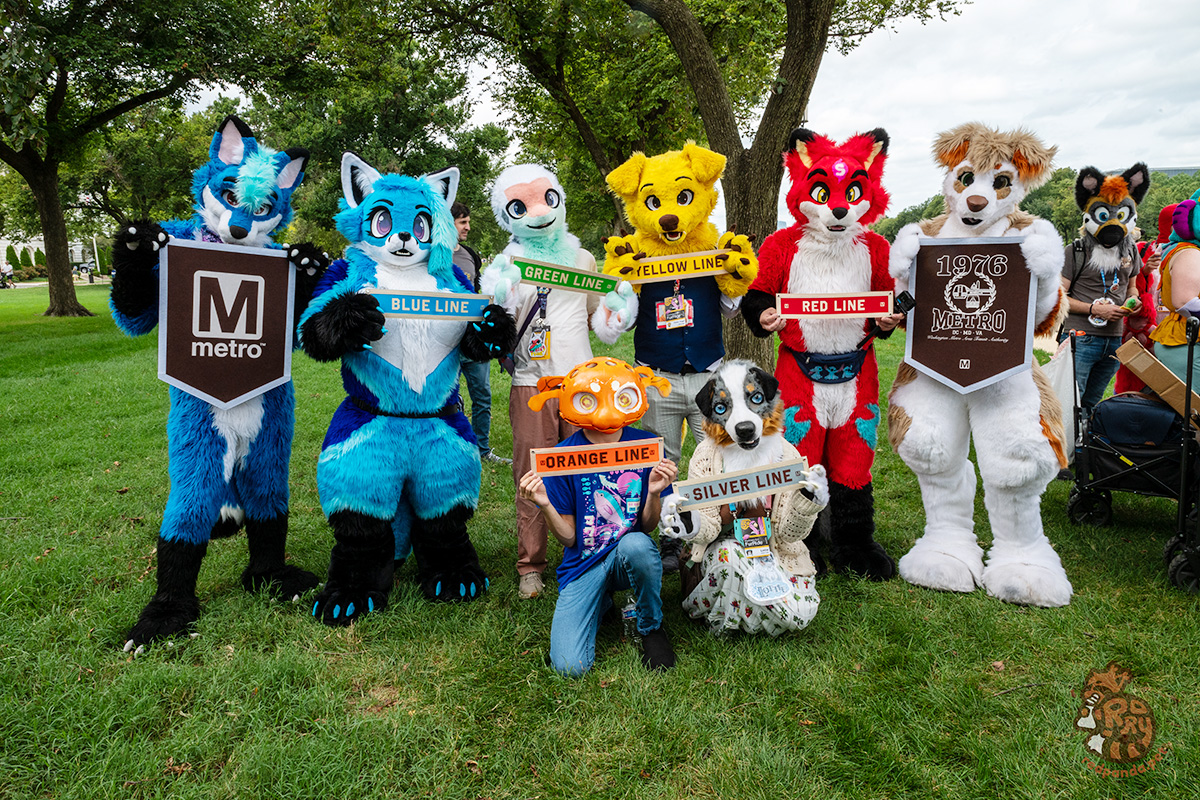
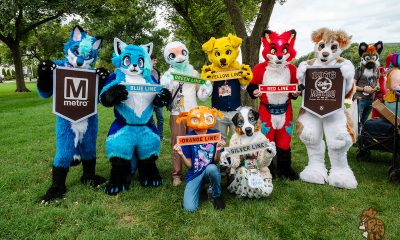
The DMV’s own furry group was on full display on the Metro on Sept. 12.
Shutterpaws is a volunteer-led 501(c)(3) non-profit organization located in Maryland.
The furry group has been doing the FurRide event since 2024 and has blown up in popularity for furries around DMV. They showcased themselves on the Silver and Blue Lines near the Smithsonian on Sept. 12.
“A lot of careful planning goes into running these events, with the goal being a seamless and enjoyable experience for everyone who attends,” says Zayre, a Shutterpaws staff member. “There’s a lot that you learn just by trial and error, and as Shutterpaws hosts more and more events, our team of event organizers continues to learn and refine our approach to keep things running smoothly and finding new ways to engage with our community.”
With a larger growth of participation in the community comes many challenges with the group, especially when it comes to the Metro rides and organizing.
“The biggest challenge that we face as organizers is keeping things fresh and finding new and engaging venues to host events,” says Zayre. “Recently we saw a lot of success hosting a meet at On Target Battlezone, an indoor NERF gun battle arena where our crew was welcome to show up and play both with and without a fur suit.”
Nevertheless, Shutterpaws receive overwhelming support from the community and partners.
“Across the DMV there are so many amazing places to host a Shutterpaws event so we can pursue our mission of helping connect fur suiters and photographers, and we’re blown away with the amount of support we’ve received from our community partners,” says Zayre.
Shutterpaws plans to do more events for anyone in the DMV who is interested.
Their next event in collaboration with DC Fur Meet will take place at Pitchers (2317 18th St., N.W.) on Saturday. Visit Shutterpaws’ website for more information.

Dutch prime minister visits Stonewall Inn

Clavicular charged in alleged rape of teenage influencer

Gov. Whitmer to serve as keynote speaker for Saturday’s HRC National Dinner

Capital Pride chair resigns from board after just 10 months

Spike in HIV cases prompts Fiji to declare national emergency

Activists protest outside Turkish Embassy in D.C.

A roundup of fall events not to be missed

Over 2,000 turn out for Hands Around the Kennedy Center protest

Furries take over the Metro