Local
Looking back on the hoopla
Black couples took pride in being first to wed in D.C.
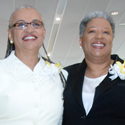
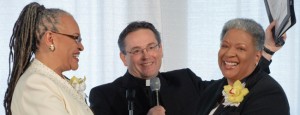
Revs. Darlene Garner and Candy Holmes were married at the Human Rights Campaign headquarters on March 9. (Photo by Joe Tresh)
On the eve of this weekend’s Black Pride festivities, the Blade checked in with two of the first same-sex couples who wed here in March to find out how they’re doing now that the hoopla has subsided, how they’ve fared as gay or lesbian couples among their black friends and families and their thoughts on the importance of Black Pride.
Three of the first couples to wed in Washington on March 9, the first day it was legally possible, were Angelisa Young and Sinjoyla Townsend, Reggie Stanley and Rocky Galloway and Revs. Darlene Garner and Candy Holmes. All three couples exchanged vows and rings at a carefully orchestrated event at Human Rights Campaign headquarters. All three couples are black.
“We were all asked to identify couples we knew locally who were planning to seize the opportunity immediately and we all put feelers out,” says Ellen Kahn, HRC’s family project director.
Garner said she thinks it was a coincidence that all three couples are black, but says it was still significant.
“Washington, D.C. is known by some as a chocolate city, so it was great that the first couples to be married were African-American couples,” she said.
Stanley and Galloway, a couple for six years, said no one would have noticed if all the couples had been white and that although they planned to wed regardless, controversial remarks made by Council member Marion Barry, who’s black and represents D.C.’s predominantly black Ward 8, inspired them to get married as soon as the law would allow. Barry, who’d previously been supportive of gay rights, said last year after voting against a bill to recognize same-sex marriages performed elsewhere in D.C., that his Ward “don’t have but a handful of openly gay residents” and that the majority of his constituents are opposed to same-sex marriage.
“He was basically saying that black gay folks don’t exist in his ward so we thought it was important to be visible and present,” Stanley said. Though he and Galloway live in Ward 4, they said they felt it important to show Barry there are many black gay D.C. residents.
Garner and Holmes, who had dated off and on for 14 years, said they decided to wed immediately for several reasons, some practical, others symbolic. As ordained ministers in the Fellowship of Metropolitan Community Churches, a liberal, mostly gay Christian denomination, they felt it was important to make a public stand.
“We recognized in many ways our place as role models as both representative of the black community and the LGBT community locally,” Garner said. “So we were happy to take our stand as a legally married couple standing side by side through the struggles.”
Garner works full-time in ministry but Holmes ministers part-time while also holding a full-time government job. She said that was also a factor in their decision to wed at HRC.
“None of it was lost on us,” Holmes said. “Being a couple and being African American and being lesbian, and with me being a federal government worker and also clergy, that’s a lot and so there are a lot of voices and things we represent, so it’s something we took very seriously and I think that’s significant.”
Stanley knew some HRC leaders through his own LGBT activism work.
“HRC was very forward looking and they were really interested in showing all aspects of what marriage can look like both here and across the country,” he said. “They realized there would be national coverage so I think they realized it was important for this visual to be seen.”
Garner and Holmes initially planned to make themselves available on HRC’s behalf to help field press inquiries and counter the anti-gay marriage stances several local black clergy, such as Bishop Harry Jackson of Hope Christian Church, had taken.
“We were initially going to fly away somewhere and get married,” Garner said. “But when it became clear that we could get married here, they asked if we’d like to do it with them. It became kind of a collaboration.”
Was there any concern their special day would become a circus? Both couples said HRC handled the day so well, it didn’t feel that way.
“There really was no media barrage at all,” Galloway said.
The women agree.
“We were able to experience the typical giddiness of any engaged couple looking forward to their wedding,” Garner said. “HRC did a phenomenal job and our primary focus stayed on the fact that we were getting married. We did not take into consideration at all that the world might be watching.”
Garner and Holmes plan a religious ceremony during their denomination’s annual conference in Acapulco in June.
The couples met standing in line that morning to get their licenses. They had their ceremonies at HRC in the order they got their licenses.
“We all cried and applauded and supported one another,” Holmes said. “Then when one came back, the next couple marched in so we were all there together, then we had a joint reception.”
“It was lovely,” Garner said. “HRC converted one of their big meeting rooms into a wedding chapel and we were able to create the ceremony we wanted to have from processional to recessional, with music and presiders and everything just as we wanted.”
The couples — Young and Townsend did not respond to interview requests — said life has returned to normal after the barrage of media attention.
“Things are great,” Galloway said. “Just like with any wedding, there’s a lot of activity leading up to it, but we’re back to a normal life now.”
Both couples said they encountered zero negative feedback but were greeted with many cheers, applause and congratulations, both on the day itself and after.
“People have recognized me and stop me in the hall to congratulate me,” Holmes said. “It’s been wonderful.”
And both couples say Black Pride remains important. Some of the reasons why, they said, popped up during the marriage wars, with the Barry incident and elsewhere.
“We were more active with it in our single days than in later years,” Galloway said. “But it’s still important to show diversity among the gay community. It’s a wonderful weekend and continues to be a very important event.”
Garner and Holmes will be out of town this weekend but said they fully support Black Pride. Garner, one of the founders of the National Coalition of Black Lesbians and Gays, said misperceptions about black gays persist.
“There’s still this perception that all gay people are white and that all black people are straight and many people really cling to that myth,” she said. “So it’s especially important for black LGBT people to come out, be visible and speak out so we continue to break down the barriers that other people have constructed to keep us all segregated from each other.”




The Comings & Goings column is about sharing the professional successes of our community. We want to recognize those landing new jobs, new clients for their business, joining boards of organizations and other achievements. Please share your successes with us at [email protected].
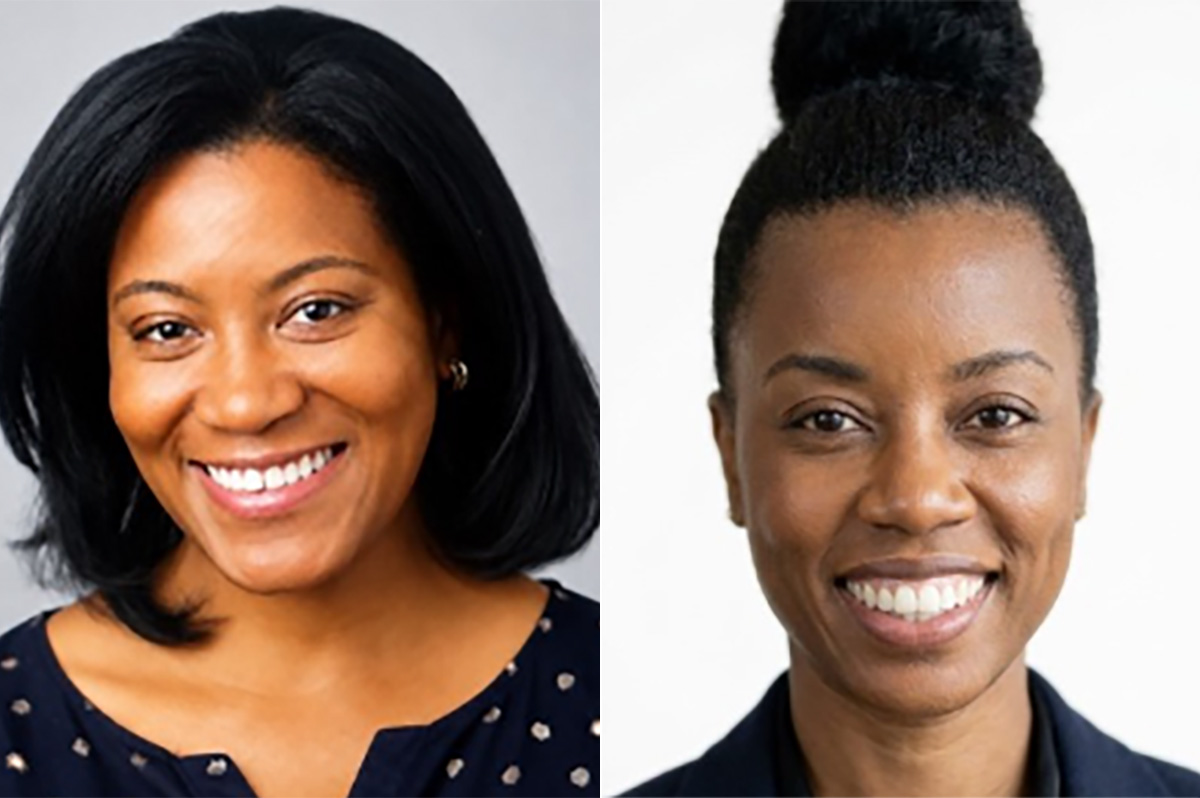
Congratulations to Leigh Miles Jackson, Ph.D., named executive director of The Institute for Health Research & Policy at Whitman-Walker, and Angel Earle, Ph.D. named as chief operating officer, Whitman-Walker Health System.
Upon her appointment Dr. Jackson said, “Under my leadership, I would love for The Institute for Health Research & Policy at Whitman-Walker to be known as a trusted, forward-looking research organization that shapes policies, strengthens practices and creates measurable change for the community.” Dr. Jackson spent 12 years with the National Academies of Sciences, Engineering and Medicine, leading national initiatives on minority-serving institutions and economic evidence for investments in children, youth and families. Dr. Jackson holds an extensive educational background, including postdoctoral fellowships in developmental Psychology and Neurogenomics from Vanderbilt University, a Ph.D. in molecular and systems pharmacology from Emory University and a bachelor’s degree in chemistry from Wake Forest University.
Upon her appointment Dr. Earle said, “When we talk about parity and inequities and research, it’s never just about the dollars that are out there. It’s about making sure that we’re cultivating a change that embraces equity at the heart of everything that it does. As the COO for Whitman-Walker Health System I will be working closely to support The Institute for Health Research & Policy at Whitman-Walker and the Whitman-Walker Foundation to drive advancement in research and support the strategic goals of all of the Whitman-Walker Heath System entities.”
Dr. Earle is a genetic epidemiologist and senior executive. She brings a background from the London School of Economics and the University of South Carolina, with expertise in global health, corporate strategy and socioeconomic policy. She has co-authored peer-reviewed research on cancer genetics, nephrology biomarkers and reproductive genomes.
Dr. Heather Aaron, CEO of Whitman-Walker Health System said, “both leaders bring research-driven expertise and operational strength to the organization as it continues expanding research, health care access, and health outcomes for residents across the Washington, D.C., region, including the LGBTQ+ community, people living with and at risk for HIV, and communities experiencing persistent health disparities.”
The Institute for Health Research & Policy at Whitman-Walker is also expanding its research agenda beyond HIV to address the complex health conditions affecting people living with and at risk for HIV, as well as the broader communities The Institute for Health Research & Policy at Whitman-Walker serves.
District of Columbia
Former Capital Pride board member reiterates sexual harassment allegation
Trans activist says resignation of board chair won’t change org’s culture
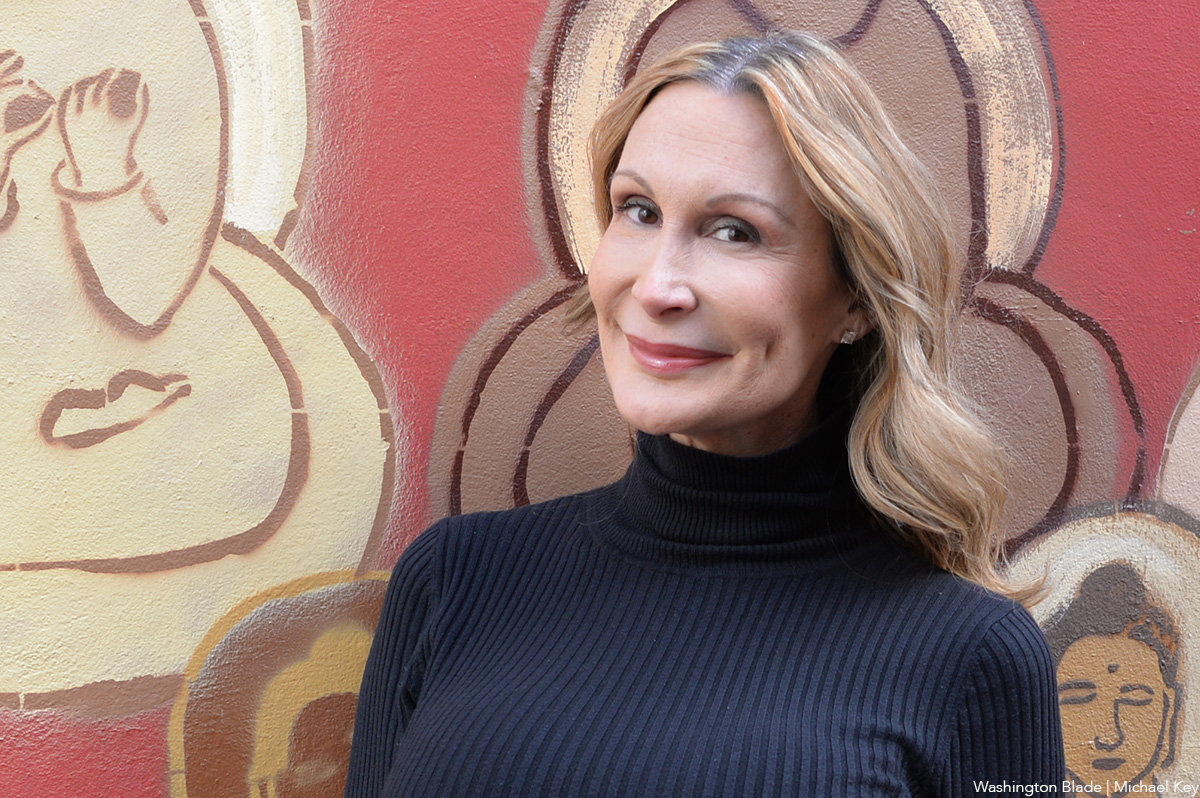
Taylor Lianne Chandler, who earlier this year resigned from the Capital Pride Alliance Board of Directors after expressing concern that the board failed to address instances of “sexual misconduct” within the Capital Pride organization, said this week she doesn’t believe her concerns will be addressed following the resignation of the board’s current chairperson.
Capital Pride Alliance serves as the lead organizer of D.C.’s annual LGBTQ Pride events.
Anna Jinkerson, who has served as chair of the Capital Pride board for only 10 months and has served on the board for the past four years, confirmed she is resigning from the board effective Sept. 30.
In a statement to the Washington Blade commenting on the possible impact of Jinkerson’s resignation, Chandler said Capital Pride board member Natalie Thompson would be replacing Jinkerson as board chair, and she didn’t expect that change to impact what she called Capital Pride’s problematic “culture.”
But Ryan Bos, the Capital Pride president and CEO, told the Blade that Thompson had not been selected as the new board chair and that a new chair would not be selected until the board holds an election scheduled for October.
Chandler, who identifies as transgender, said it was a Capital Pride board member who told her that Natalie Thompson had been or would be selected as the new Capital Pride board chair. She didn’t identify the board member.
“My concerns about how Capital Pride has handled serious allegations of sexual misconduct have not disappeared with a change in leadership,” she told the Blade in her statement. “When leadership continues to socialize, smile for photographs, and share spaces with someone facing serious allegations, what message does that send to the people who say they were harmed,” she said.
Chandler has told the Blade a Capital Pride investigation identified an individual implicated in a “pattern” of sexual harassment-related behavior but said she was bound by a Non-Disclosure Agreement that applied to all board members and she could not provide further details.
When asked by the Blade to comment on Chandler’s allegations at the time she resigned from the board in February of this year, board chair Jinkerson said Capital Pride acts “quickly and appropriately” to address concerns such as those raised by Chandler. But she and other Capital Pride officials did not at that time or since then specifically acknowledge whether someone associated with the organization engaged in sexual harassment.
“The community deserves transparency, accountability, and leadership willing to make difficult decisions,” Chandler said in her statement to the Blade this week. “Changing the chair doesn’t change the culture,” she added. “Actions do.”
In response to a request from the Blade for an update on its response to Chandler’s allegations about alleged sexual misconduct within the Capital Pride organization, Bos sent the Blade a statement on behalf of Capital Pride.
“The Capital Pride Alliance takes allegations of harassment, misconduct, and unsafe behavior seriously,” the statement says. “The organization follows standard procedures and engages appropriate resources to support a thorough, confidential, and impartial review, when information is reported.”
The statement adds, ”Because these matters require maintaining confidentiality and protecting the privacy of personnel, volunteers, and governance processes, we will not comment on specific individuals, allegations, investigative findings or communications involving law enforcement.”
It concludes by stating, “We remain committed to fostering a safe, respectful, and inclusive environment, appropriately addressing concerns raised, and continuing to strengthen our policies, governance practices, and organizational culture.”
Although the statement refers to “communications involving law enforcement,” Capital Pride has not disclosed whether instances of alleged sexual harassment or, as stated by Chandler, a possible instance of sexual assault, have been reported to D.C. police.
A D.C. police spokesperson, in response to a Blade inquiry, said they have no record of a sexual harassment or sexual assault complaint surfacing from the Capital Pride office, which is located in the D.C. LGBTQ+ Community Center building at 1827 Wiltberger Street, N.W.
But the Blade has obtained a D.C. police incident report that appears to confirm Capital Pride COO June Crenshaw’s claim in a recent Facebook post that she reported at least one incident of sexual harassment related to Capital Pride to D.C. police.
The report, which was filed on Oct. 11, 2025, states that Crenshaw told a police officer who prepared the report that another person told her “that a board member of Capital Pride Alliance groped his genitals at a Capital Pride event.” The report says Crenshaw told the officer the person who reported being groped “did not want to speak to the police at this time.”
The incident report, which is a public document, says the groping reportedly happened on Oct. 8, 2025. It concludes by saying Crenshaw was given “resource information” to provide to the person who said he was groped. It does not identify that person or the board member who allegedly committed the groping.
Officials at Capital Pride recently exchanged testy public Facebook posts with Chandler. Crenshaw criticized Chandler for her social media posts on the matter.
“It is remarkable to watch people publicly accuse others of failing to create safe spaces when, during the time they themselves held positions of leadership and significant volunteer responsibility, they claim to have witnessed deeply troubling behavior, yet never reported what they allegedly witnessed to fellow leaders, law enforcement, the Office of the Attorney General, legal counsel, or staff responsible for addressing such concerns,” Crenshaw wrote. “When I became aware of allegations or personally witnessed conduct that required intervention, I reported what I knew through the appropriate channels, including to law enforcement and other relevant authorities. Investigations were conducted. Those processes created records, documentation, correspondence, timelines, and conclusions.”
Chandler responded, “I was NOT in organizational leadership or fully informed about the scope of these allegations when much of what you reference occurred. I was read into the situation after becoming an executive officer. By that point, the investigation had already concluded, and we were awaiting the final report. … Once that report became available to me, and once I understood the seriousness and scope of what was being alleged, my position was anything but ambiguous: I did not believe this individual should be welcomed at, participate in, or have access to official Pride events.”
Capital Pride’s attorney Nick Harrison then joined the exchange, accusing Chandler of violating confidentiality rules.
“You served on the Board for years. You cannot now present yourself as an outsider with no responsibility for what occurred during your tenure,” Harrison wrote. “When the situation became difficult, you resigned, provided your resignation letter to the media, disclosed confidential organizational matters, and recast yourself as the victim.”
Again, no one has publicly identified the person Chandler references as being welcome at Pride events and photographed with Capital Pride leadership.
District of Columbia
Center for Black Equity’s annual gala to take place Oct. 3
Advocacy group to honor Black LGBTQ community champions
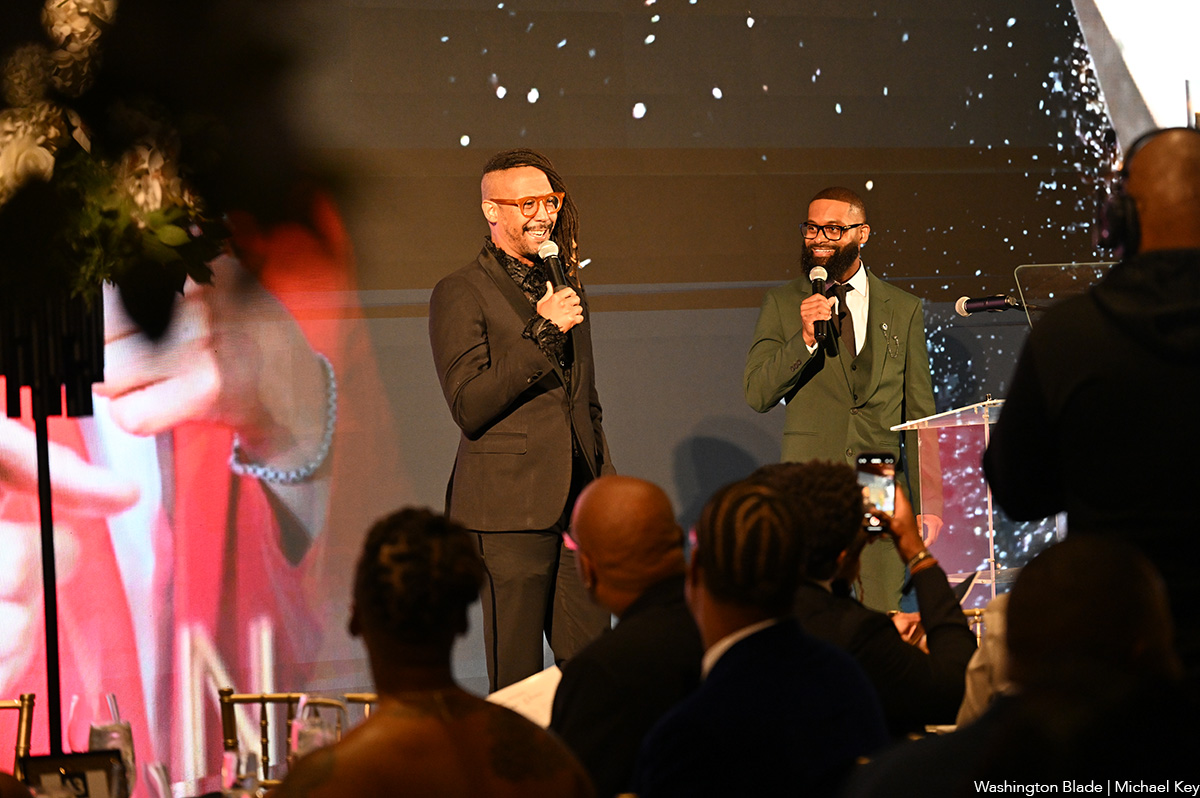
The Center for Black Equity, the D.C.-based international network of LGBTQ activists and organizations that advocate for Black LGBTQ communities and organize Black Pride events worldwide, will hold its annual 2026 BE Gala in D.C. on Oct. 3.
The event, to be held at the Conrad Washington Hotel at 950 New York Ave., N.W., among other things, will honor at least a dozen “distinguished Black individuals” and organizations that champion Black LGBTQ communities, according to a statement released by the Center for Black Equity.
“The honorees will receive awards recognizing extraordinary leadership, advocacy, and service across civil rights, public health, the arts, media, entrepreneurship, and community life,” the statement says.
“With an elegant atmosphere and a bold mission, this unforgettable evening brings together advocates, allies, and change makers committed to equity and joy,” the statement says in referring to the Oct. 3 BE Gala.
The statement notes that tickets for the event, which serves as a fundraiser for the Center of Black Equity, begin at $250 for individuals and include dinner and two drinks. It says reserved tables for eight were being offered for $2,000, and “Premier” tables for eight were selling for $2,500 and include seating near the stage.
“The BE Gala is more than an evening of celebration,” according to the statement. “It is an opportunity to honor Black LGBTQ+ leadership while investing in the work of the Center for Black Equity.”
Kenya Hutton, the Center for Black Equity’s CEO, told the Washington Blade the name “BE” for the gala is not an acronym. “The name is rooted in the idea of being: being seen, being celebrated and being fully and authentically yourself,” he said.
“BE Gala creates a space to celebrate Black LGGTQ+ people for who they are, the lives they lead and the impact they make,” he added.
The Center for Black Equity until 2012 was called the International Federation of Black Prides and was founded by organizers of D.C.’s Black Pride celebration.
Its current website includes a statement saying it’s mission is to “promote a multinational LGBTQ+ network dedicated to improving health and wellness opportunities, economic empowerment, and equal rights while promoting individua and collective work, responsibilities, and self-empowerment.”
The 2026 Center for Black Equity award honorees as announced in its statement released this week are:
Courtney Snowden: Welmore Cook Advocacy & Service Award
Clover Barnes: Ernest Hopkins Public Health Leadership Award
Nikki Alexander: Unsung Hero Award
Darryl G. Moore: Center for Black Equity Leadership Award
The Freelux Project: Center for Black Equity Small Business Award
Tori Cooper: Earline Budd Transgender Leadership Award
Bishop Steven R. Sawyer: Bishop Kwabena Rainey Cheeks Spiritual & Community Leadership Award
Rev. Carmarion D. Anderson-Harvey: Bishop Kwabena Rainey Cheeks Spiritual & Community Leadership Award
Monroe Alise: Trans Power in Media Award
Justin N. Stewart: National Black Pride Image Award
Marlene McNeese: Curtis L. Etherly Jr. Ally Award
Venton Jones: Eleanor Holmes Norton Civil Rights & Justice Award
In Our Own Voices, Inc.: Ruth Ellis Community Impact Award

Factors to consider when hiring an interior designer

PHOTOS: HRC National Dinner

The LGBTQ real estate map is being redrawn

I’m 66, he’s 27. Is it love or am I being played?

What’s frightening is also funny in ‘Venus’

Washington Blade responds to concerns over White House pool duties

Clavicular charged in alleged rape of teenage influencer

Caso Karlina: Una sentencia histórica contra las terapias de «conversión»

Young people should know history of the fight for human rights

Dutch prime minister visits Stonewall Inn
-

 Commentary5 days ago
Washington Blade responds to concerns over White House pool duties
-
Online Culture5 days ago
Clavicular charged in alleged rape of teenage influencer
-
Ecuador5 days ago
Caso Karlina: Una sentencia histórica contra las terapias de «conversión»
-
Opinions5 days ago
Young people should know history of the fight for human rights