Africa
LGBTQ people omitted from South Africa Census
Advocacy groups have urged the government to change course
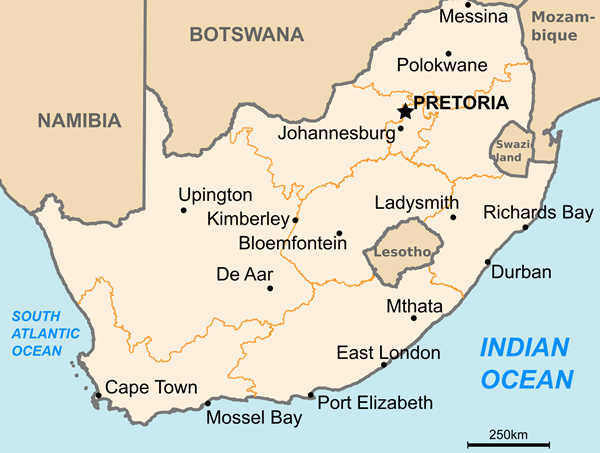
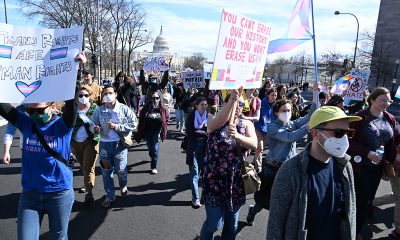
Advocacy groups are up in arms with Statistics South Africa (StatsSA) over the exclusion of LGBTQ people in the ongoing national Census which will end on Feb. 28.
Although South Africa is deemed to be among the most liberal countries when it comes to LGBTQ rights on the African continent and globally, this time, it seems as if the government made a costly error by including only male and female boxes on the questionnaire.
Reacting to the exclusion of LGBTQ people on the 2022 national Census questionnaire, Nolwazi Tusini, communications and media manager at Iranti, a Johannesburg-based media advocacy organization that advocates for the rights of LGBTQ people, said the data will be used to make conclusions about gender in ways that completely exclude transgender and non-binary people.
“According to StatsSA, the Census 2022 questionnaire includes a question relating to sex which provides only two options, male or female, and this refers to a biological make-up of the person or the sex that is assigned at birth. This effectually means that transgender and intersex persons will not be counted in the upcoming Census,” said Tusini. “The Census solely relies on counting a society that is cisgender and excludes a significant part of South Africa’s population.”
“Furthermore, history has taught us that the data captured from the responses to the question on sex is often used to make conclusions about gender in ways that completely exclude transgender and non-binary persons,” added Tusini. “For example, using this data to tell us about the number of cisgender women and cisgender men residing in South Africa and their employment status.”
The current questionnaire also does not include questions relating to sexual orientation and will therefore, not yield any data relating to lesbian, gay and bisexual people in South Africa. This is contrary to South Africa’s Constitution, which recognizes South Africans by their diverse sexual orientations.
“By StatsSA’s own admission, the current structure of the Census 2022 does not actively enumerate LGBTQIA+ persons. This effectively renders LGBTQIA+ persons invisible and is not in line with the South African Constitution which enshrines the rights to equality and self-determination,” said Tusini. “This urges a greater conversation around legal gender recognition in this country, where it permeates and how it’s understood and then accepted across government departments.”
Iranti Executive Director Jabu Pereira said StatsSA was encouraging the state to erase the existence of the LGBTQ community,
“We regard this Census as unconstitutional because its very design is premised on exclusion and if a census excludes a significant population such as the LGBTQIA+ community, then by its very nature it encourages the state to erase our very existence,” said Pereira.
Bruce Walker of Pretoria LGBTQIA+ Gay Pride concurred with Pereira, saying the omission of the LGBTQ community in the ongoing Census was a move aimed at “erasing their existence.” Walker said their organization has already launched campaigns against the count.
“Considering the news of the exclusion of the LGBTQIA+ identities in the Census we felt it necessary to voice our outrage on this. We feel this is a direct attack on the community,” said Walker.
“There are a few points that we feel should be addressed before this Census is held,” added Walker. “Why are there only two options relating to sex? Male or female. Why is there no intersex or transgender here? Why are people who do not identify with either excluded? Why are there no questions about sexual orientation? This is a missed opportunity for the government to better understand the LGBTQIA+ community.”
Pretoria LGBTQIA+ Gay Pride’s directed the following questions to StatsSA:
– Why have you excluded a large portion of South Africa in this Census? Do you feel that the LGBTQIA+ community is not part of the population?
– If you think the LGBTQIA+ is not part of the community then why should we participate in the Census? Is this not against our constitutional rights? Why did you not engage with LGBTQIA+ organizations when compiling the questions? Is this not the first step to excluding the LGBTQIA+ rights in the constitution? Is the government now going to stop LGBTQIA+ rights in the workplace?
– Will the LGBTQIA+ community rights that we have fought for now be revoked? Will gay marriage now be revoked? What would the people say if you had only black or white under race?
– We as a Pride organization are outraged at this and we are extremely disappointed at the silence from political parties. We are putting out petitions out in the community and online. Why must we wait 10 years for the next Census? If we do not get a satisfactory response from Census 22 and the government then we will be asking our community not to participate in this Census at all. After all they do not think we are part of the population.
“An attack on one party of the LGBTQIA+ community is an attack on the whole community,” said Walker.





Egypt
Egyptian authorities refuse to allow gay cruise to dock in country
Scarlet Lady earlier this week blocked from visiting Turkey
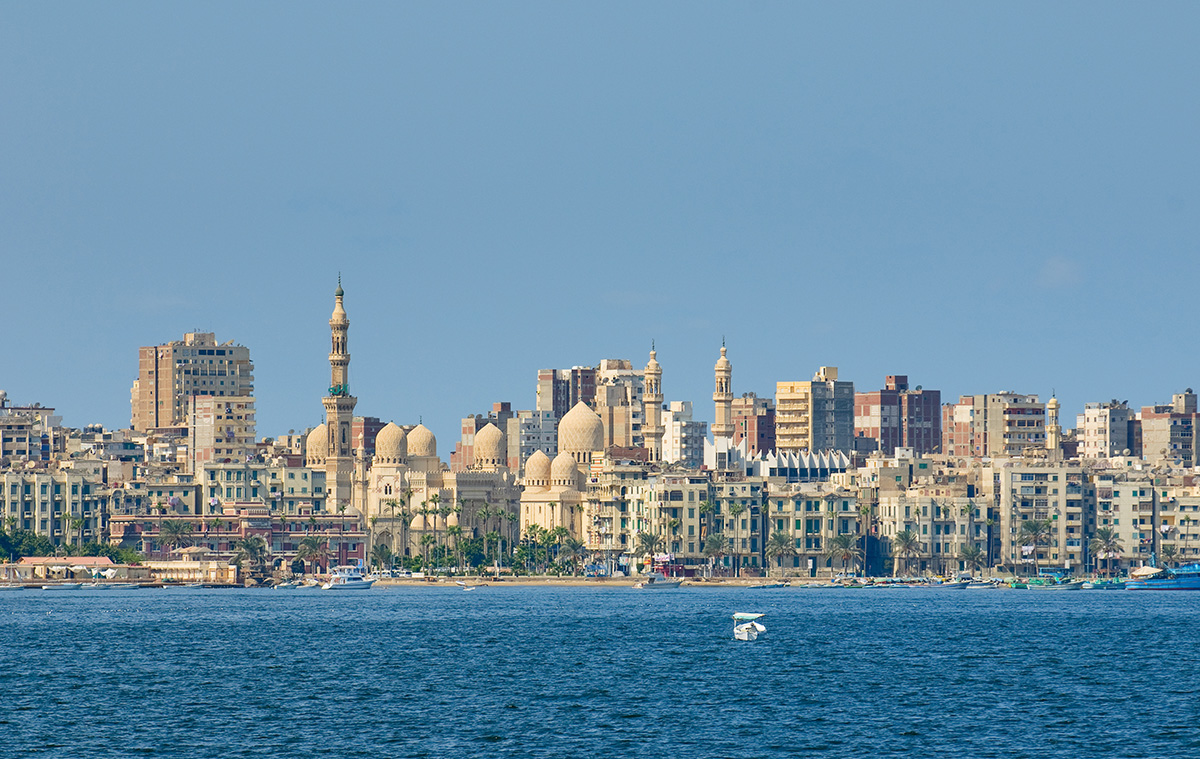
Egyptian authorities have refused to allow a gay cruise to dock in the country.
The Scarlet Lady, a Virgin Voyages ship that Atlantis Events chartered, was to have docked in Alexandria, a port city on the Mediterranean Sea. The Washington Blade obtained a letter that Atlantis Events President Rich Campbell sent to passengers on Thursday, hours before the cruise was to have arrived.
“Early this morning, we were informed that Scarlet Lady has been denied entry into Egyptian waters and, as a result, will no longer be able to call in Alexandria today,” he wrote.
“I know how much this visit meant to so many of you,” added Campbell. “We successfully sailed a similar itinerary last year, so we were surprised by this unfortunate decision.”
Campbell noted “both the Atlantis and Virgin Voyages teams worked tirelessly to make this call in Alexandria a possibility.”
“This news came as a surprise to all of us, and we’re just as disappointed as you are,” he said.
The 10-day cruise left Athens on July 5. It is scheduled to end in Trieste, Italy, on July 15.
The ship had been scheduled to dock in Kusadasi, a Turkish resort town on the Aegean Sea, and Istanbul earlier this week. Turkish authorities refused to allow it in the country.
Former Tempe, Ariz., Mayor Neil Giuliano, who is an LGBTQ+ Victory Institute board member, is among those on the cruise.
“Just a few hours before arriving in Alexandria, Egypt — a city founded by and named for one of the ancient world’s best-known homosexuals — government authorities rescinded permission for our ship of 2,000 gay men to enter Egypt,” wrote Steve May, who is also on the ship, on Thursday in a Facebook post.
Alexander the Great founded Alexandria in 331 B.C.
“As with Turkey, we have been sent away not because of what we did, but because of who we said we are,” said May. “‘I am what I am’ is too much liberty for some to bear. So it was in the United States as well not long ago, where even I ended up as a convicted homosexual after a military trial in 2001 for saying ‘I am gay.’ This is just a reminder that for all the progress we have made, our freedom is never secure — for any of us, regardless of who or how we love. Back to Europe!”
Discrimination and persecution based on sexual orientation and gender identity is commonplace in Egypt. The Egyptian Football Association, along with the Football Federation Islamic Republic of Iran, objected to playing in the World Cup’s “Pride Match” that took place in Seattle on June 26.

Iran and Egypt on Friday faced off during the World Cup’s “Pride Match” in Seattle.
Iran is among the handful of countries in which consensual same-sex sexual relations remain punishable by death. Discrimination and persecution based on sexual orientation and gender identity is commonplace in Egypt.
Friday’s match coincided with Pride weekend in Seattle. The Egyptian Football Association and the Football Federation Islamic Republic of Iran both objected to playing in the “Pride Match.”
Egypt and Iran tied 1-1.
FIFA, for its part, allowed Pride flags inside the stadium during the match.
“The FIFA World Cup 2026 is an inclusive event that welcomes people from all backgrounds,” a FIFA spokesperson told the Washington Blade in a statement. “Fans of all sexual orientations and gender identities are welcome at matches and events. General statements of human rights, including rainbow flags and other flags representing sexual orientation and gender identity, are permitted under the FIFA World Cup 2026™ Stadium Code of Conduct and may be displayed inside stadiums provided they are used in a manner consistent with the code.”
Human Rights Watch welcomed FIFA’s decision to allow Pride flags inside the stadium. Outright International, a global LGBTQ and intersex rights group, distributed Pride flags in Seattle on Friday, which was Pride Match Day.
“Visibility matters,” said Outright International Executive Director Maria Sjödin. “Pride is now being celebrated in more than 100 countries, including this weekend in Seattle. For many LGBTIQ people, seeing a Pride flag in public is a reminder that they are not alone, and that their rights and dignity are recognized.”
FIFA President Gianni Infantino earlier this year told Die Weltwoche, a Swiss magazine, that “there will be no ‘Pride Match’ at the (FIFA) World Cup.”
“There will be a FIFA World Cup match in Seattle, and on the same day, events organized by external organizations will be taking place in the city,” said Infantino. “But that has nothing to do with the match itself.”
Peter Tatchell, a long-time LGBTQ activist from the U.K. who is director of the Peter Tatchell Foundation, was among those who traveled to Seattle for Friday’s match. Tatchell accused FIFA of not vetting World Cup teams — specifically Iran, Egypt, Saudi Arabia, Ghana, Senegal, Qatar, Tunisia, Morocco, Iraq, Uzbekistan, and Algeria — over whether they would allow gay players.
“FIFA is protecting LGBT+ visibility in the stands while failing to protect LGBT+ players on the pitch,” said Tatchell.
South Africa
White House to end PEPFAR funding for South Africa
State Department says country failed to respond to 2025 executive order demands
The Trump-Vance administration will end PEPFAR funding for South Africa.
A State Department spokesperson on Wednesday told the Washington Blade the State Department “will begin a phased drawdown of PEPFAR programming in South Africa, with most programs ending by Sept. 30, 2026, and critical personnel support continuing through March 31, 2027.”
Semafor last week reported South Africa has received more than $8 billion in PEPFAR funding since President George W. Bush created the program to combat the global HIV/AIDS pandemic in 2003.
President Donald Trump on Feb. 7, 2025, issued an executive order that addressed what it described as “egregious actions of the Republic of South Africa.” The State Department spokesperson with whom the Blade spoke noted the directive included five specific requests:
• South African government provides exemptions or alternatives for U.S. companies to Broad-Based Black Economic Empowerment laws and other race-based mandates.
• Senior government officials (e.g., president, deputy president, or minister of justice) unequivocally condemn all race-based incitement to violence, including the “Kill the Boer” song, more frequently.
• The South African government prevents the implementation of measures that would allow expropriation without fair compensation and due process under the Expropriation Act of 2024.
• South African Police Service designates rural crime a “priority crime” and increases resources dedicated to high-crime rural areas.
• South Africa refrains from actions that would significantly interfere with the implementation of the refugee program, within the confines of South African law.
“The United States communicated to the government of the Republic of South Africa multiple times at many levels that PEPFAR funding was likely to be terminated in the absence of progress on the five asks,” said the State Department spokesperson.
The State Department spokesperson further noted South Africa is “one of the largest economies in sub-Saharan Africa” and “has funded the vast majority of its own HIV response, estimated at 76 percent of the total, including procurement of all treatment commodities.”
“South Africa will continue to be supported by the Global Fund, including for the introduction and scale up of lenacapavir through Global Fund Resources,” the spokesperson told the Blade.
Lenacapavir is groundbreaking HIV prevention drug that users inject twice a year. Eswatini, which borders South Africa, is among the African countries that have received doses of the drug through PEPFAR.
HIV/AIDS service organizations in the U.S. and around the world have sharply criticized the Trump-Vance administration over plans to not fully fund PEPFAR and to cut domestic HIV/AIDS funding.
Secretary of State Marco Rubio shortly after the current White House took office issued a waiver that allowed PEPFAR and other “life-saving humanitarian assistance” programs to continue to operate during a freeze on nearly all U.S. foreign aid spending. HIV/AIDS service providers around the world with whom the Blade has spoken say PEPFAR cuts and the loss of funding from the U.S. Agency for International Development, which officially closed on July 1, 2025, has severely impacted their work.

NYC lawmakers seek to repeal bathhouse ban

Black Educated Lesbians: A movement rooted in community

Hegseth uses transphobic slur while campaigning for Iowa congressman

What ‘Queer Eye for the Straight Guy’ can still teach us

I respect AOC, even though I often disagree with her

PHOTOS: Nellie’s Drag Brunch

‘Maddie’s Secret’ defies campy expectations

Remembering Barbara ‘Boo’ Price, a pioneering force in women’s music

White House targets gender-affirming care funding, states fight back