District of Columbia
Slain D.C. trans woman honored at vigil
Family, friends gather on street where fatal stabbing occurred
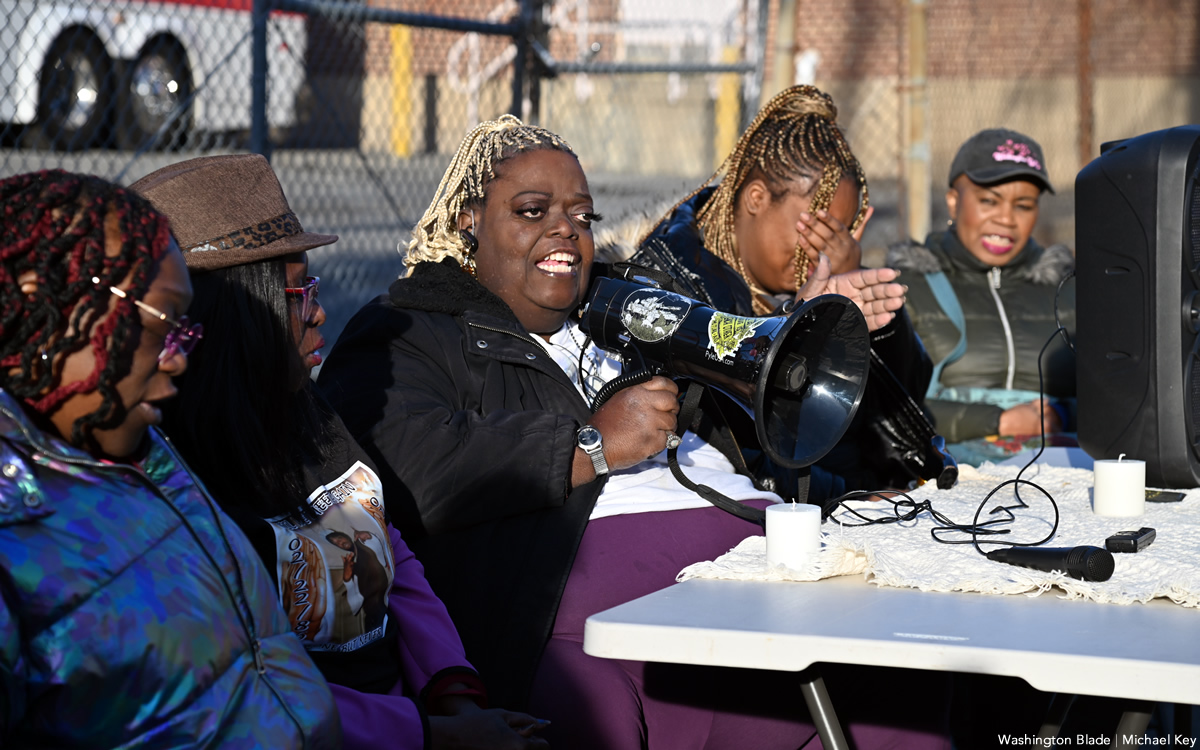
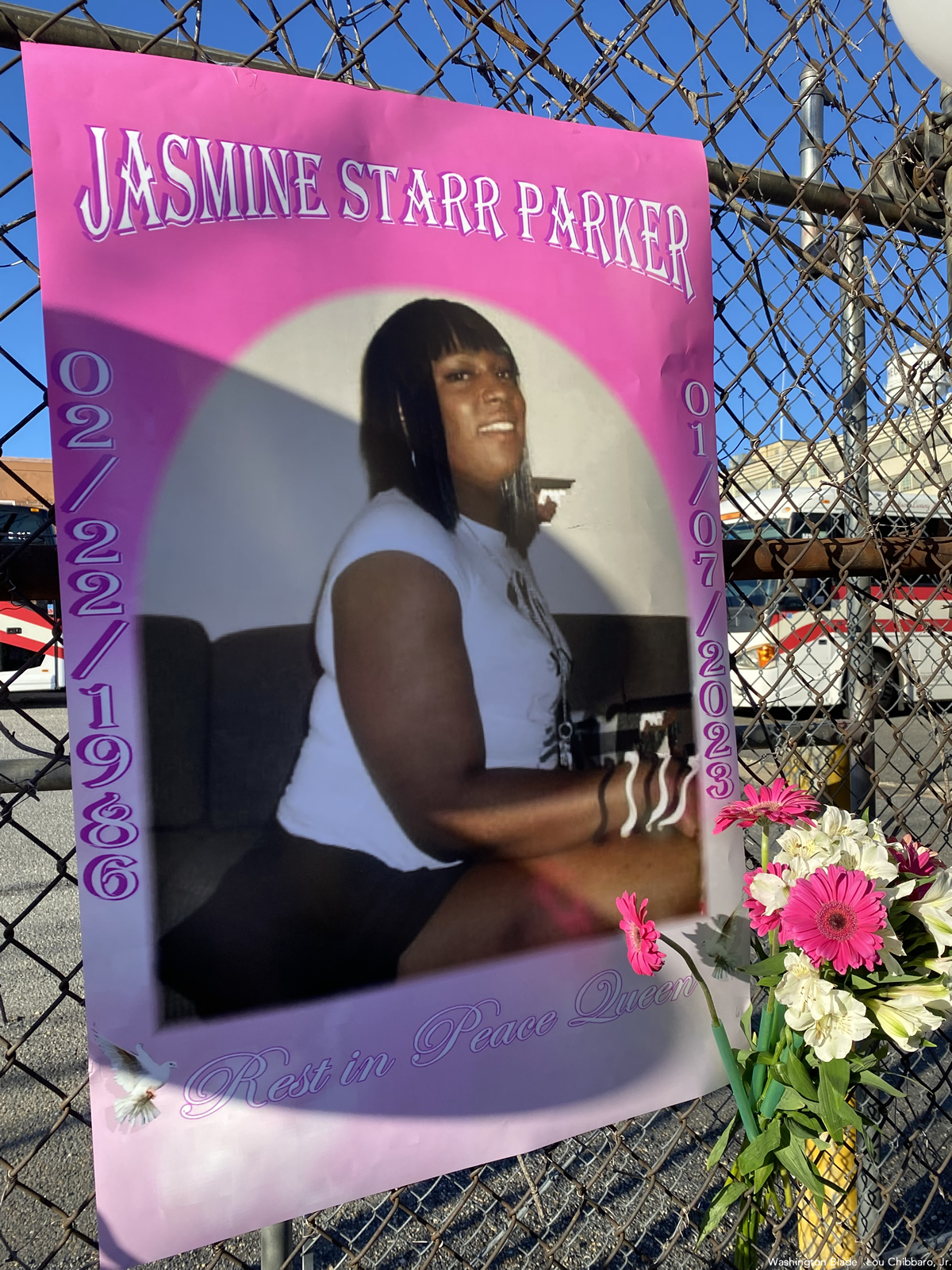
Nearly 100 people turned out on Jan. 16 to honor the life of D.C. transgender woman Jasmine Star Parker at a vigil held on the 2000 block of Gallaudet St., N.E. where D.C. police say she was found stabbed to death at 3 a.m. on Jan. 7.
Among those participating in the vigil were Parker’s mother, brother, and sister, who have expressed their love and admiration for their deceased loved one.
Earline Budd, executive director of the D.C. group Empowering the Transgender Community (ETC), which organized the vigil along with D.C. Mayor Muriel Bowser’s Office of LGBTQ Affairs, told the gathering she knew Parker for many years and observed first-hand how Parker did her best to overcome discrimination and bias as a trans woman of color.
“We’re here today to remember a life taken away from us on Jan. 7, the life of Star Jasmine Parker,” Budd said. “Star was 36 years old. And Star deserved to live. So, today I want to take an opportunity to first of all let there be blessings in this place.”
Budd pointed out that the table where she and others who spoke at the vigil was set up on the sidewalk in front of a tall chain link fence were Parker’s body was found, with her blood still visible on the pavement.
D.C. police said that as of this time, they have no suspects and no known motive for the Jan. 7 homicide. A police spokesperson said the case was not listed as a suspected hate crime, but that could change if new information is obtained. Police are urging anyone with information about the case to call police at 202-727-9099.
A $25,000 reward is being offered for information leading to the arrest and conviction of the person or persons responsible for the murder.
Police initially identified Parker as Jasmine Star Mack. But family members and Earline Budd have since said that the beloved trans woman was known to the family as Jasmine Star Parker and preferred to be called Star. Parker was her birth surname.
Budd said Parker’s family informed her that a viewing and funeral service for Parker would be held Friday, Jan. 20, at Meridian Baptist Church at 5354 Sheriff Road in Capitol Heights, Md., beginning at 10 a.m. for the viewing and 11 a.m. for the service.
Among those attending the vigil were members of the D.C. police LGBT Liaison Unit, including Lt. Livio Rodriguez, director of the police Special Liaison Division, which oversees the LGBT Liaison Unit. Budd praised the LGBT Liaison members, saying they have been longtime supporters of the transgender community.
Parker’s mother, Arlene Witherspoon and her brother, Andre Tinsley, told those attending the vigil that Parker was raised in a religious family and she embraced God during many of her times facing hardship.
Parker’s sister, Pamela Witherspoon, was scheduled to speak at the vigil but told Budd she was too emotionally distraught to speak. In earlier interviews with WUSA 9 and the Washington Post, Pamela Witherspoon told how her sister faced hardship from discrimination in spite of her upbeat personality as someone who was “always singing and dancing — just trying to make you laugh,” she told WUSA 9.
“She wasn’t the type of person that did things to people,” WUSA 9 quoted Witherspoon as saying. “I don’t understand why. What did she do to deserve this? I’ll never understand that.”
Members of the community who spoke at the vigil during an open mic session, including longtime D.C. transgender activist Taylor Chandler and Center for Black Equity Deputy Director Kenya Hutton, said the city was not doing enough to address the problems of discrimination and threats of violence faced by members of the trans community, especially trans women of color.
“We have the ability to do more,” Chandler said. “There is no reason why we should be having this vigil for Star. We need to be giving more money to organizations that value Black trans lives.”
Japer Bowles, director of the Mayor’s Office of LGBTQ Affairs, said he agreed that the city should be doing more to address problems faced by the transgender community.
“Circumstances have put Star and many members of the community of D.C. in the danger that they’re in,” Bowles told the gathering. “And that is a failure from where I’m at, my job,” he said. “And it’s something that we are working on with the community.”
Added Bowles, “And this is D.C., the nation’s capital, where we have done more. And we have a record of doing more. And we need to do more,” he continued. “So, I promise we will do more.”
Sebrena Rhodes, the D.C. Advisory Neighborhood Commissioner representing the area where Parker was killed in the Ivy City neighborhood, said although the area is faced with crime, this was the first known homicide to take place in the neighborhood in a long time.
“I’m sure everyone loved her for who she is,” Roads said of Parker in her remarks at the vigil. “I’m deeply sorry. I live here in Ivy City. We all have to work together.”
Budd told the Washington Blade that the area is known as a place where some transgender sex workers congregate for what Budd and others who spoke at the vigil called survival sex work made necessary when discrimination and transphobia prevent trans women from finding other means of employment.
“Well, we talk about survival sex,” Budd said. “It’s not a secret. And you know, when people ask, what was she doing here, I say what does it matter? What does it matter? The fact that her life was taken, that’s what matters, whether she was here doing survival sex work or whatever.”
Rev. D. Amina B. Butts, pastor at D.C.’s LGBTQ-friendly New Hope Baptist United Church of Christ, appeared to sum up the sentiment of most of those attending the vigil by calling for an end to the hostility and violence faced by transgender people in D.C. and across the nation.
“It’s hard to find words of comfort,” she said. “There are no words to describe what has happened. It is a travesty of injustice. It needs to stop,” she continued. “Right now, in the name of the Divine, it needs to stop. We command that it stops.”


District of Columbia
Man charged with anti-gay assault in D.C. accepts plea offer
Community service offered in exchange for dismissing hate crime charge

A Germantown, Md., man arrested by D.C. police on a charge of simple assault with a hate crime designation for allegedly assaulting a gay man while using “homophobic slurs” has agreed to an offer by prosecutors to plead guilty to simple assault without the hate crime designation and with the promise of having the charge dismissed if he completes, among other requirements, 48 hours of community service work.
Dean Edmundson, 26, standing beside his attorney, officially accepted the offer of a Deferred Sentencing Agreement at an Aug. 18 status hearing in D.C. Superior Court after Senior Judge Hiram Puig-Lugo explained the details of the agreement and confirmed Edmundson’s decision to waive his right to a trial.
Among other things, the judge said the agreement offered by prosecutors with the Office of the United States Attorney for D.C. includes the requirement that he successfully completes 48 hours of community service work, stays away from the victim of the assault, writes a letter of apology to the victim, and does not violate any other laws or get into trouble for the next 12 months.
Puig-Lugo then announced he scheduled a sentencing hearing for Edmundson for Aug. 18, 2027, at which time a determination will made on whether he has fulfilled all the requirements under the agreement and whether the simple assault charge will be dismissed. The judge added that if it is determined that Edmundson did not fulfil the terms of the agreement the charge would remain in place and he could be sentenced to a possible maximum penalty of 180 days in jail and a $1,000 fine.
Edmundson, who appeared in court wearing a business suit with a dress shirt and tie, was released on his own recognizance following his arrest by D.C. police on Feb. 7, 2026.
Police and court records show he was initially charged by arresting officers with simple assault with a hate crime designation. In a statement announcing the arrest, D.C. police said, “On Saturday, Feb. 7, 2026, at approximately 7:45 p.m. the victim and suspect were in the 1500 block of 14th Street, Northwest. The suspect requested a ‘high five’ from the victim. The victim declined and kept walking,” the statement says.
A follow-up arrest affidavit filed by police states that Edmundson followed the victim and called him “bald, ugly, and gay,” and then “pushed the victim with both hands, shoving them, causing the victim to feel the force of the push.” The affidavit adds, “The victim stated that they felt offended and that they were also gay.”
According to the court records, the Office of the U.S. Attorney filed its official charge of simple assault against Edmunson on Feb. 9 without the hate crime designation. The office has not responded to a request by the Washington Blade for its reason for dropping the hate crime designation. The office has also not immediately responded to a follow-up inquiry from the Blade this week asking if prosecutors consulted the victim to obtain the victim’s thoughts about the plea offer.
The Blade, which has a policy of not disclosing the identify of crime victims in cases like this without their consent, could not immediately obtain contact information to reach the victim for comment.
Court records show that Edmundson rejected an earlier plea agreement offer by prosecutors and he was scheduled for a non-jury trial on Aug. 18. The records show his attorney filed a motion earlier this month asking the judge to convert the trial into status hearing on that same day after his client accepted the Deferred Sentencing Agreement offer by the U.S. Attorney’s office. The judge approved the motion without objection from prosecutors.
The Comings & Goings column is about sharing the professional successes of our community. We want to recognize those landing new jobs, new clients for their business, joining boards of organizations and other achievements. Please share your successes with us at [email protected].
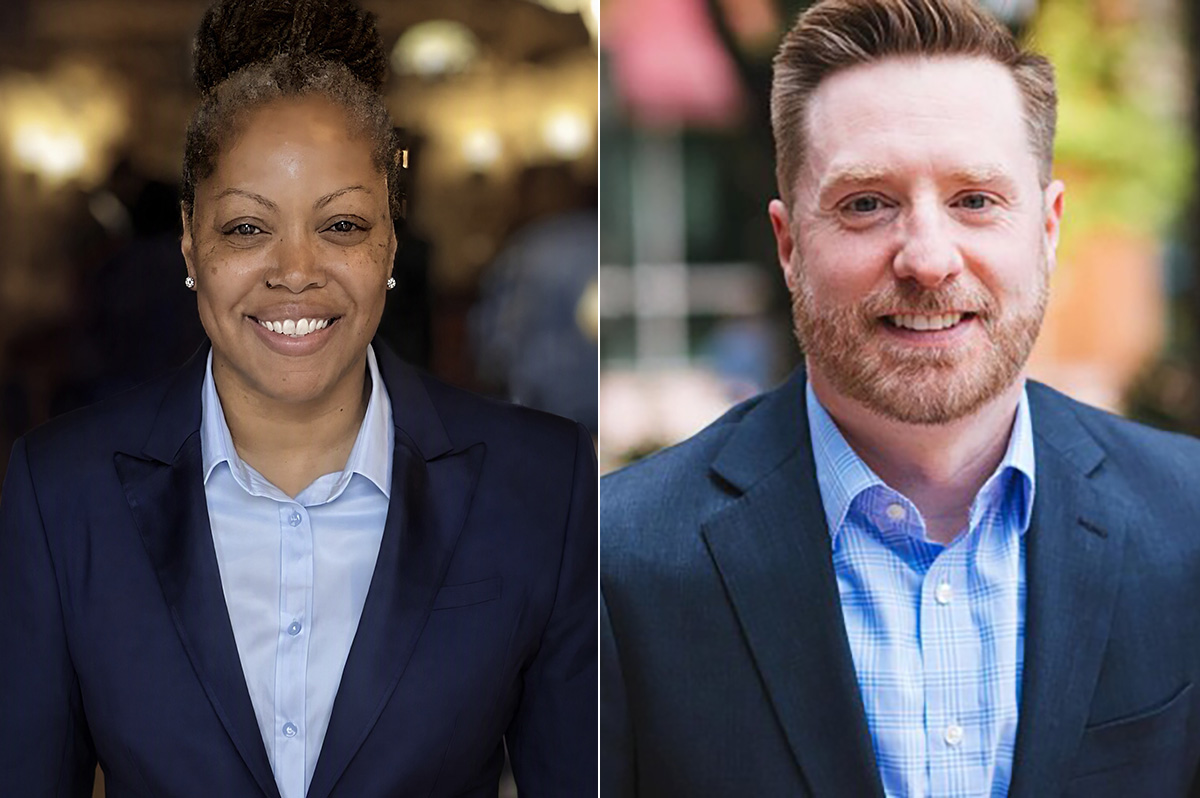
Congratulations to Carla Lester, LICSW on her new position as Chief Program Officer with SMYAL. Upon accepting the position she said, “SMYAL deeply aligns with my passion for honoring, protecting, and upholding the rights of all individuals, particularly LGBTQ+ youth and others who have been historically underserved, to belong to communities that affirm their identities, treat them with dignity and respect, and support their well-being. At this point in my career, I was ready to transition to an organization whose mission more closely reflected my values and was rooted in the community. SMYAL offered the opportunity to serve both an organization and a population whose mission not only resonates deeply with me but also intersects with my own multiple identities.”
Lester is a healthcare and human services executive with more than 20 years of experience in behavioral health, federal and state health insurance programs, housing, health care, education, and community-based services. She has held senior roles at Carelon Behavioral Health, Pathways to Housing and N Street Village, leading clinical programs, Housing First initiatives, homeless outreach, trauma-informed services, and integrated case management.
She earned master’s degrees in Social Work and Divinity, and maintains active clinical social work licenses in D.C. and Maryland.
Congratulations also to Tad Czyzewski on his new position as Chief Development Officer at SMYAL. On accepting the position, he said, “While I’ve spent much of my nonprofit career in the arts, the current social and political environments made me want to apply my skills and passion more directly toward supporting and strengthening our community. SMYAL and this role felt like the right place to do that.”
Czyzewski brings more than two decades of experience in nonprofit leadership and strategy, fundraising, and business development. Prior to joining SMYAL, he served for eight years as executive director of The Choral Arts Society of Washington, where he led fundraising, financial management, and community engagement. During his tenure, he helped raise more than $15 million in contributed revenue. He guided the organization through a major rebrand and the COVID-19 pandemic.
Prior to that Czyzewski served as Business and Development Director for Washington Revels, and held leadership and advisory roles with Chorus America, the DC Commission on the Arts and Humanities, and the National Endowment for the Arts. He began his career in the corporate sector, including at Capital One, where his work in product development and marketing contributed to new financial products and more than $2 billion in deposits.
Czyzewski is a lifelong musician, has performed professionally as a classical singer, including with the Washington National Opera and the National Symphony Orchestra.
District of Columbia
Gay ANC commissioner sues D.C. over police ‘failure’ to pay reward money
Lawsuit says information led to conviction in murder, armed robbery cases

Gay D.C. Advisory Neighborhood Commissioner Tom Donohue on Aug. 11 filed a lawsuit in D.C. Superior Court charging that D.C. police acted improperly and violated a local law by not paying him $30,000 in reward money for his role in helping police identify and arrest — and obtain the subsequent conviction — of one man charged with murder and another man charged with armed robbery in separate cases.
Although the lawsuit alleges improper action by D.C. police in carrying out the city’s Crime Solvers reward program, it names as defendants the District of Columbia and the Office of the Attorney General for D.C., which, among other things, defends the city against lawsuits.
Donohue, who is a member of the city’s ANC Rainbow Caucus consisting of LGBTQ elected ANC members, held a news conference outside the D.C. Superior Court building on Aug. 11 to talk about the lawsuit before entering the courthouse to officially file it.
The lawsuit states that Donohue “provided key video evidence that led to the arrest and conviction” of a man initially charged with first degree murder for allegedly running over a bicyclist with his car after the two got into an argument.
The lawsuit states that police had offered a $25,000 reward for information leading to the arrest and conviction of the defendant in that case, but police “arbitrarily slashed the payment to $5,000 without prior notice or policy justification.”
Court records show that D.C. resident Eric Beasley was charged with first degree murder for killing David Farewell, 45, by hitting him with his car on Sept. 4, 2020, on the 2100 block of Young Street, S.E. The records show the evidence for the case was based in large part on video camera footage of the incident obtained by police. Donohoe has said he provided that video camera evidence.
The records show that during Beasley’s October 2023 trial a jury was unable to reach the required unanimous verdict, and the judge declared a mistrial.
According to the records, Beasley later agreed to an offer by prosecutors to plead guilty to a lesser charge of involuntary manslaughter and was sentenced in September 2024 to eight years in prison, a development that angered the victim’s family members who called it a “slap on the wrist,” according to a Fox 5 News report.
Donohue’s lawsuit says the second case in which he provided police with pivotal information involved a series of armed robberies known as the Fairlawn Serial Armed Robbery Spree that occurred in the Fairlawn neighborhood in Southeast D.C. in 2023 near where Donohue lives.
The lawsuit says evidence consisting of video surveillance footage provided by Donohue to police enabled police to determine they initially wrongfully arrested an 18-year-old male for the robberies. “Using Plaintiff’s security video, MPD identified, arrested, and convicted the actual robber, David Crocker, who was sentenced to 18 years in federal prison,” the lawsuit states.
It says one of the detectives investigating the case recommended a $10,000 reward for Donohue’s help in the case based on the police Crime Solvers reward program. The detective’s recommendation was approved by then-Assistant D.C. Police Chief Kyle Ramey on Aug. 4, 2025, according to the lawsuit.
But it adds, “Nevertheless, MPD improperly withheld payment.”
When contacted by the Washington Blade for comment on Donohue’s lawsuit allegations, a D.C. police spokesperson said “MPD does not comment on pending or ongoing litigation.”
Gabriel Shoglow-Rubenstein, who serves as press secretary for the D.C. Office of the Attorney General, which will be defending the city against the Donohue lawsuit, said he would look into obtaining a possible comment but said the office has a similar longstanding policy of not commenting on pending litigation.
“This action arises from the District of Columbia Metropolitan Police Department’s arbitrary, bad-faith, and legally unsupportable failure to honor its public reward promises and administrative obligations to Plaintiff,” the lawsuit states.
It says the MPD violated the city’s Freedom of Information Act or FOIA law by not responding to Donohue’s request for information and documents related to the decision not to pay him the full reward money.
“MPD’s reduction of Plaintiff’s homicide reward from $25,000 to $5,000, and its withholding of his approved $10,00 robbery reward, were undertaken completely devoid of written standards, making such decisions inherently arbitrary, capricious, and an abuse of administrative discretion,” it says.
It calls for Donohue to be awarded $30,000 in compensatory damages consisting of the $20,000 “unpaid balance” for the homicide case reward and $10,000 for the robbery case reward. It also calls for reimbursement for “reasonable” litigation costs and attorney’s fees. Donohue told the Washington Blade that at this time he is representing himself without an attorney.
Donohue told the Blade that the refusal by D.C. police to pay him the full reward money also limited his plans to donate some of that money to the family of murder victim David Farewell to help pay for a burial stone. He said that due to the family’s limited resources Farewell is buried in an unmarked grave

Exploring Renée Richards’s life through lens of a trans author

Log Cabin Republicans remove transgender rights from mission

Not all trans people are the same

Queer team brings girl power to fully baked ‘The Wrong Girls’

Democrat Maureen ‘Mo’ Madden takes on longtime GOP stronghold in Delaware’s 38th

Winsome Earle-Sears ‘Life and Marriage Tour’ to include Northern Va. stops

White House targets gender-affirming care funding, states fight back

Madonna nominated for 11 MTV VMAs

Man charged with anti-gay assault in D.C. accepts plea offer

Thailand’s first openly gay senator attends World Pride in Amsterdam
-

 Virginia5 days ago
Winsome Earle-Sears ‘Life and Marriage Tour’ to include Northern Va. stops
-
White House5 days ago
White House targets gender-affirming care funding, states fight back
-
Celebrity News4 days ago
Madonna nominated for 11 MTV VMAs
-
District of Columbia4 days ago
Man charged with anti-gay assault in D.C. accepts plea offer