Hungary
Hungarian government moves to ban public Pride march in Budapest
Successful effort will be admission ‘there is no longer democracy’

The Hungarian government last week said it will ban a public Pride march in the country’s capital.
“There will be no Pride in the public form in which we have known it in recent decades,” Gergely Gulyás, Prime Minister Viktor Orbán’s chief of staff, said on Feb. 27 during the government’s weekly press conference in Budapest, according to Politico. “We believe that the country should not tolerate Pride marching through the city center.”
The Budapest Pride march is scheduled to take place on June 28.
Politico reported that Gulyás during the press conference referenced a proposed constitutional amendment that states “the right of children to physical, mental, and moral development is irrevocable.” Politico also noted Gulyás did not tell reporters how the march would violate it.
“This should be decided by the court or the police, if necessary,” said Gulyás. “I don’t know if only a constitutional amendment is needed or if other laws should be changed as well, but as we said, Pride in its current form will not take place.”
Orbán and members of his ruling Fidesz party over the last decade have moved to curtail LGBTQ and intersex rights in Hungary.
A law that bans legal recognition of transgender and intersex people took effect in 2020. Hungarian MPs that year also effectively banned same-sex couples from adopting children and defined marriage in the constitution as between a man and a woman.
An anti-LGBTQ propaganda law took effect in 2021. The European Commission sued Hungary, which is a member of the European Union, over it.
MPs in 2023 approved the “snitch on your gay neighbor” bill that would have allowed Hungarians to anonymously report same-sex couples who are raising children. The Budapest Metropolitan Government Office in 2023 fined Lira Konyv, the country’s second-largest bookstore chain, 12 million forints ($31,482.31), for selling copies of British author Alice Oseman’s “Heartstopper.”
Former U.S. Ambassador to Hungary David Pressman, who is gay, participated in the Budapest Pride march in 2024 and 2023. Pressman was also a vocal critic of Hungary’s anti-LGBTQ crackdown.
“It is impossible not to see echoes of this in your Parliament’s vote earlier this year to encourage neighbors to report to the authorities their gay neighbors raising children,” said Pressman during a 2023 Budapest Pride reception, referring to Nazi Germany’s occupation of Hungary and the post-World War II Communist governments that ruled the country until 1989. “Turning neighbor on neighbor conjures a dark past of covert agents and informants, of fear and betrayal, in this country and this region that I do not need to recount.”
Budapest Pride spokesperson Johanna Majercsik on Monday noted to the Washington Blade in an email that Orbán “openly threatened Budapest Pride in his annual speech (on Feb. 22), and since then several government members have joined in this communication.”
“It is expected that they will try to make it impossible to organize the Pride march with some kind of legal amendment—all this by referring to the so-called child protection law from 2021, which is actually a Putin-style propaganda law,” said Majercsik. We have no further information at this point and are waiting for the amendment(s).”
Majercsik said the Hungarian government will “be admitting that there is no longer democracy” in the country if it “tries to actually ban the Pride march.”
“It is important to know that the Pride march is a demonstration that falls under the scope of the right of assembly, a right that is strictly protected by the constitution of Hungary,” said Majercsik. “Therefore, we will do everything we can to fight for the right of assembly of all Hungarians. We strongly believe that this case could also set a precedent, as if the government succeeds in banning the Pride march, after they could ban any other assembly (e.g. farmers, teachers, judges, etc.).”
Majercsik noted the Hungarian Helsinki Committee is offering Budapest Pride legal advice.
Elections will take place in Hungary in 2026.
Editor’s note: International News Editor Michael K. Lavers reported from Budapest in April 2024.






Hungary
New Hungarian government to scrap anti-LGBTQ adoption law
Prime Minister Peter Maygar ousted Viktor Orbán in April
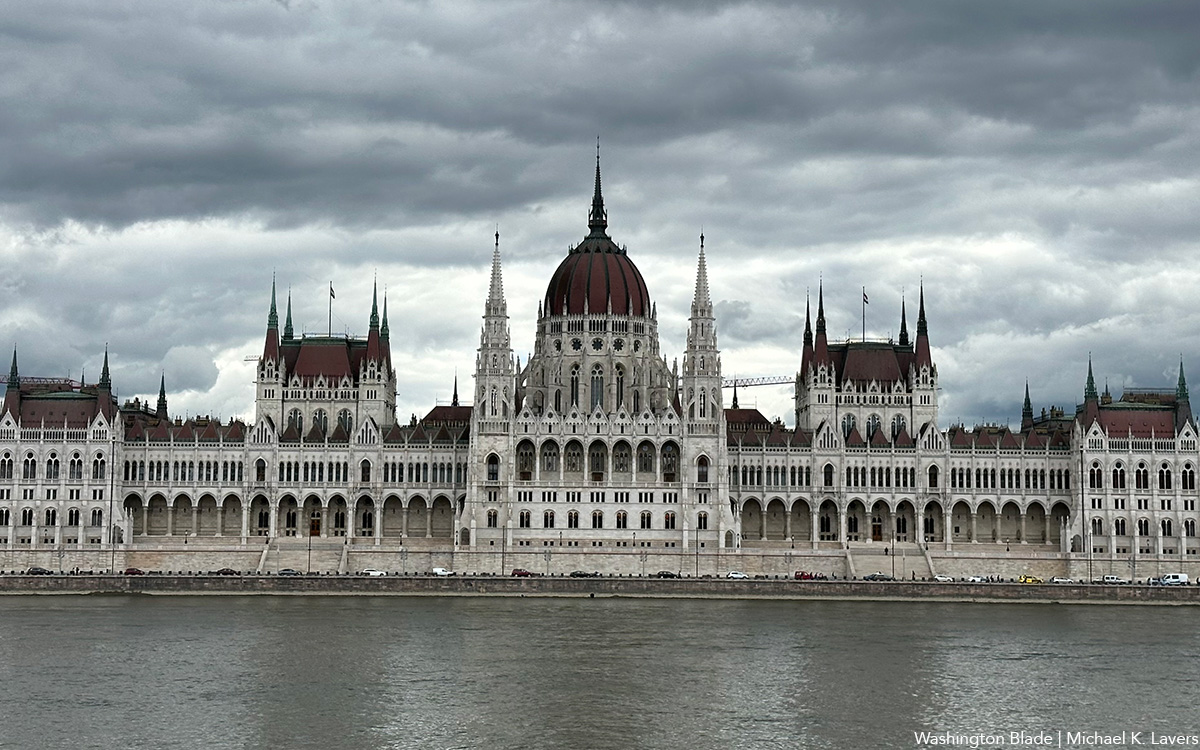
Hungarian Prime Minister Peter Maygar has said his government will amend a law that essentially bans same-sex couples from adopting children.
Lawmakers approved the effective adoption ban in 2020, when then-Prime Minister Viktor Orbán’s government was in power. Maygar announced plans to amend the law on Saturday when he was speaking to supporters in Budapest, the Hungarian capital.
Orbán and his government faced widespread criticism over its anti-LGBTQ crackdown that also included laws banning Pride events.
Maygar in April ousted Orbán in Hungary’s elections.
Hungary
Tens of thousands participate in post-Orbán Budapest Pride march
New government allowed event to take place without restrictions

Tens of thousands of people on Saturday took part in the annual Budapest Pride march in the Hungarian capital.
The march took place less than two months after new Prime Minister Péter Maygar took office.
Hungarian lawmakers in 2025 passed a bill that banned Pride events and allowed authorities to use facial recognition technology to identify participants. MPs later amended the Hungarian constitution to ban public LGBTQ events.
More than 100,000 people defied the ban and participated in last year’s Budapest Pride parade. The event became one of the largest protests against then-Prime Minister Viktor Orbán and his government since he took office in 2010.
Magyar’s center-right Tisza party ousted Orbán’s Fidesz-KDNP coalition in elections that took place on April 12. The European Union’s top court, the EU Court of Justice, days after Orbán’s ouster struck down Hungary’s anti-LGBTQ propaganda law that MPs approved in 2021.
Hungarian police last month announced they would allow the Budapest Pride march to take place without restrictions.
Authorities subsequently dropped charges against Budapest Mayor Gergely Karácsony over his role in organizing the city’s 2025 Pride march. Officials in Pécs, a city near Hungary’s border with Croatia, have also dropped charges against Géza Buzás-Hábel, who organized a 2025 Pride event.
Hungary
Charges against Budapest mayor for organizing Pride march dropped
Country’s new government took office last month
Hungarian authorities on Thursday dropped charges against Budapest Mayor Gergely Karácsony over his role in organizing the city’s 2025 Pride march.
Karácsony spoke at the event, even though then-Prime Minister Viktor Orbán’s government banned it.
More than 100,000 people defied the ban and participated in the march that took place on June 28, 2025. The Associated Press notes the Budapest Chief Prosecutor’s Office in January charged Karácsony with “organizing the unlawful assembly despite a prohibition order.”
Karácsony, who has been Budapest’s mayor since 2019, described himself as a “proud defendant” after his indictment.
“It seems that in this country, this is the price you pay if you stand up for your own freedom and the freedom of others,” he said in a statement, according to the AP. “If anyone thinks they can ban me, deter me, or prevent me and my city from doing so, they are gravely mistaken.”
Budapest is Hungary’s capital and largest city.
Prime Minister Péter Magyar took office last month after his center-right Tisza party ousted Orbán’s Fidesz-KDNP coalition in elections that took place on April 12.
Hungarian police on May 29 announced they will allow the Budapest Pride march to take place this year.
The European Union’s top court, the EU Court of Justice, days after Orbán’s ouster struck down Hungary’s anti-LGBTQ propaganda law that MPs approved in 2021. The BBC notes Hungarian authorities cited the decision in their decision to drop the charges against Karácsony.
Authorities in Pécs, a city near Hungary’s border with Croatia, have also dropped charges against Géza Buzás-Hábel, who organized a 2025 Pride event.

D.C.’s LGBTQ homeless facilities face possible hit from Trump funding cuts

10 years later, we still can’t shake Barry Jenkins’s ‘Moonlight’

‘Some Like It Hot’ a wild ride at renovated Bernard Family Theatre

Bessent says Trump chose him for his qualifications, not his sexuality

Alianza para la Inclusión fortalece la defensa de derechos LGBTQ en Centroamérica

Annapolis Pride arrives this weekend

Calendar: October 2-8

Eliot Glazer’s new book an engaging collection of essays

Equality Chamber hosts Pride in Business Expo and Profits & Pours