2026 Midterm Elections
LGBTQ political candidates see surge in threats, harassment: report
Majority fear physical attack, discouraging them from running
A new study reveals that LGBTQ candidates running for public office are seeing an unprecedented amount of harassment and threats as President Trump and his far-right MAGA supporters continue to strip protections for minority groups at all levels of government.
The LGBTQ+ Victory Institute, the nation’s largest LGBTQ candidate training and leadership organization, recently partnered with Loyola Marymount University to collect data on the rising political violence experienced by LGBTQ candidates. The organization is closely affiliated with the LGBTQ+ Victory Fund, its sister political action arm dedicated to helping LGBTQ candidates get elected.
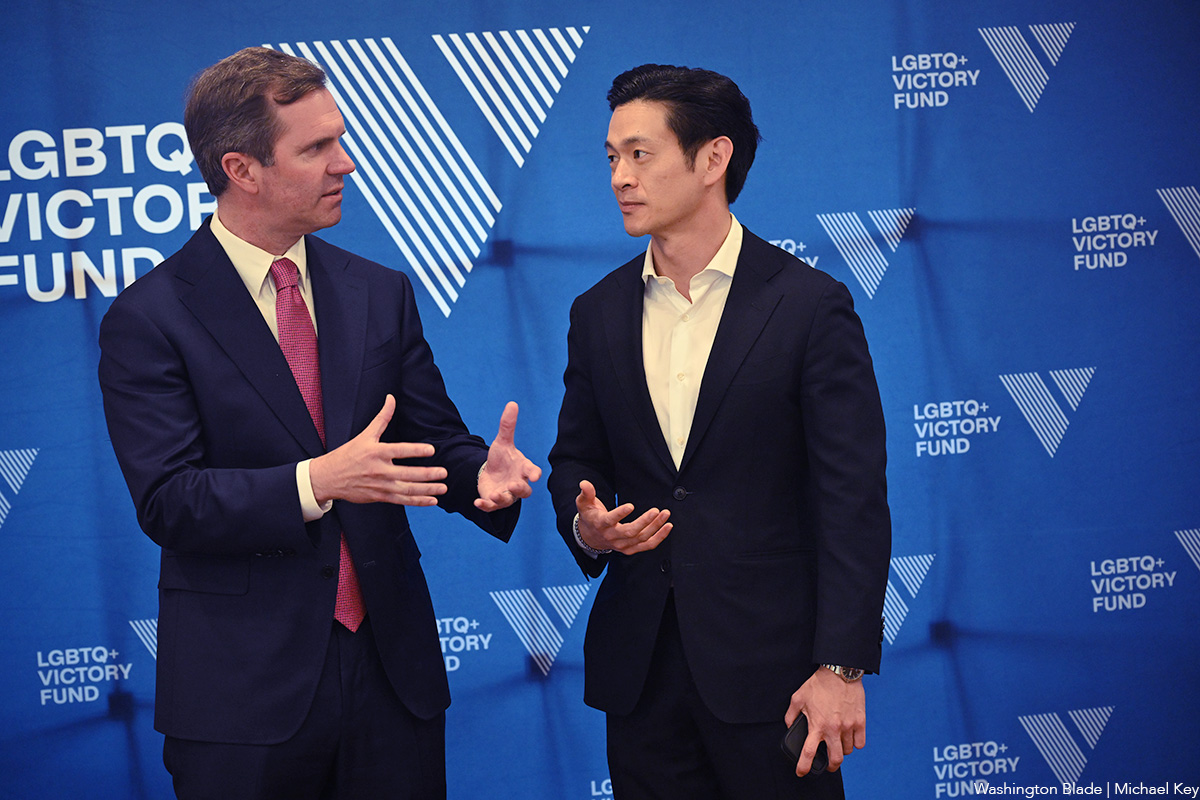
The Washington Blade sat down with Evan Low, president and CEO of the LGBTQ+ Victory Institute and LGBTQ+ Victory Fund, to discuss what the data reveals about the climate LGBTQ candidates have found themselves in.
Low argued that the findings cannot be separated from the broader political environment facing LGBTQ Americans in 2026. Anti-transgender legislation continues to surge across the country while federal recognition of LGBTQ communities has diminished. This is the second consecutive year Trump has declined to recognize June as Pride month. He also made no public statement commemorating Juneteenth, the anniversary marking the emancipation of enslaved people in the United States.
The survey included 215 LGBTQ+ candidates who ran for office between 2023 and 2025 from 42 states, Puerto Rico, and Washington, D.C., and asked about their experiences while running for office.
The data, while not particularly surprising given the highly divisive political era we have been living through under Trump 2.0, contains stark findings showing that LGBTQ candidates are not only finding it more difficult to run for office — something protected under the First and Fourteenth Amendments — but that it has also become increasingly dangerous for openly LGBTQ candidates to do so.
One of the report’s most significant findings focuses on what happens before an LGBTQ person’s name ever appears on a ballot or yard sign: widespread fear among prospective candidates. Nearly 9 in 10 candidates worried that running as an openly LGBTQ+ person would increase their risk of harassment or attack, while 4 in 5 feared physical violence.
Key Takeaways From the Data
Harassment Is the Norm — Not the Exception: Nearly two-thirds of LGBTQ candidates experienced in-person harassment, while nearly 8 in 10 faced online abuse, with many encountering it regularly.
The escalation from rhetoric to serious threats mirrors the current political climate. One in three candidates received death threats online, and one in seven experienced them in person, highlighting the severity of the current threat environment.
Campaigns Altered by Safety Concerns: More than half of candidates changed how or where they campaigned due to safety fears, and nearly 1 in 5 described the impact as significant — limiting public engagement and visibility.
Security Out of Reach: Fewer than 1 in 10 candidates could afford private security, even as threats escalated, underscoring a growing inequity in who can safely run for office.
Severe Mental Health Impact: Nearly two-thirds of candidates said attacks negatively impacted their mental health, with some reporting long-term trauma and lasting psychological effects.
“What we’re seeing is not just harassment, it’s a systemic challenge to participation,” said Elliot Imse, the now former executive director of LGBTQ+ Victory Institute. “When candidates are forced to change their behavior, limit public engagement, or reconsider running altogether because of safety concerns, that’s not just a personal issue — it’s a breakdown in the conditions required for a healthy democracy.”
“This isn’t theoretical — I, like so many LGBTQ+ candidates and elected leaders, have lived it,” said Daniel Hernandez, vice president of political programs at LGBTQ+ Victory Fund. “From surviving gun violence to having my own campaign office targeted, I know how real these threats are and how deeply they affect candidates, their teams, and their families. The LGBTQ+ Victory Institute has been doing this work for years — preparing candidates, supporting them through these challenges, and making sure they’re not facing it alone. This report makes clear the stakes are higher than ever. If we want people to step up and serve, we have to meet this moment with the resources, support, and commitment to their safety demands.”
Low, who before leading the Victory organizations was an openly gay elected official representing California’s 26th Assembly District, which includes portions of Silicon Valley and San Jose, views the findings as both a political violence issue and a threat to democracy itself.
“We’re living in a moment in a time in which the pendulum is swinging backwards,” Low told the Blade. “We’ve seen a historic amount of anti-LGBTQ+ legislative proposals across this country. So naturally, when members of our community are targeted, it gives that license then to be harassed and discriminated against accordingly. It absolutely is a challenge to democracy.”
The data also shows that LGBTQ candidates face unique barriers to entry — many of them financial. Low argued that reducing those barriers would help diversify candidate pools and create a more representative democracy.
“Does [the current system] disproportionately then impact and limit the segment within our populations to serve? The answer is absolutely yes. When you think about the increased challenges of a barrier to entry– that’s why we’re focused on doing the report in the first place. It also then goes to show the importance of how we utilize taxpayer dollars and budgets accordingly to help encourage and support members of the community to run for office.”
He used that point to emphasize the importance of the LGBTQ+ Victory Institute, not only in collecting data on these trends but also in helping LGBTQ candidates navigate them.
“That’s the fundamental reason why there’s the need for the Victory Fund of the Victory Institute,” he said. “It’s to say that the members of our community will not face this or run alone. They should know that there is a national network, a national organization that will be the wind in their sails to help guide them.”
So far in 2026, the Victory Fund has endorsed at least 249 candidates.
In addition to providing financial support, the Victory Institute helps LGBTQ candidates prepare for the realities of the campaign trail, including coping with harassment, threats, and personal security concerns.
Low expanded on what that reality looks like in 2026 as anti-transgender legislation continues to surge and federal recognition of LGBTQ communities has diminished.
“Part of that discussion is we don’t try to sugarcoat it,” he said when emphasizing the realities facing LGBTQ candidates. “We will speak truth about ‘Here’s how to put a campaign budget together’ and ‘Here’s best practices on public speaking.’ But also we have to deal with showing the unfortunate reality on ‘Here’s how to keep your family safe.’ ‘Here’s how to retain and keep in mind your mental health’…especially when you see members of our community being doxxed constantly by bots and such hate speech.”
He also highlighted the unique challenges facing transgender candidates running for office, particularly as hundreds of bills across the country continue to target transgender people.
“We hear that many times there may be individuals from the community, specifically the trans community, who may want to run for office, but their existence is criminalized, which is to say that they may live in a state or jurisdiction in which it’s criminal to exist; laws prohibiting them from being who they are,” Low said.
“When many of our candidates run for office, they are not running because they are trans, they’re not running because they’re gay or a member of their community, they’re running to advance the quality of life on the key issues on housing affordability, health care, education, you name it, and so these are the campaign issues, but the challenge exists as well.”
Those pressures often lead candidates to question whether running for office is worth the personal toll.
“Many times the candidate and/or elected official will speak candidly with members of our organization to say, ‘Is it worth it anymore? What should I do? Is this something that I should continue? This is taking a personal toll on my family, but I care about the call to service and making a difference in my community.'”
Low also spoke about what he sees as more than simple anti-LGBTQ bias in politics, pointing instead to the growing number of laws targeting LGBTQ people.
“I don’t think it’s simply bias — it’s fact. Again, we can cite laws on the books and proposals across the country, so no wonder why the conversation is so toxic and hostile to members of our community.”
Despite those threats, Low said LGBTQ candidates continue to run for office in record numbers.
“While this political violence report does reflect the hard truth about the challenges to our community, we have seen more candidates apply for an endorsement and sign up for our programs than we’ve ever seen before. We have seen more candidates run for federal office than we ever have had in the history of our 35 years as an organization. What does that tell us? It tells us that yes, it is a challenging and harmful time, yet members of our community are willing to run toward the front lines and answer the call for service.”
The data shows that queer women and transgender candidates are among those most heavily impacted by political violence and heightened political polarization.
“We’ve seen specifically LGBTQ+ women and members of our trans community being disproportionately impacted by [political violence]. When you disaggregate the data, it is also really important to address within our community. We do know anecdotally, as well as from the report, that it may be more challenging for LGBTQ+ women and our trans individuals given some of the other cited conclusions.”
Two of the issues that disproportionately affect transgender candidates and LGBTQ women are mental health challenges and increased security needs.
“What we’ve seen is some of the top demands for services. In many jurisdictions, governmental entities do not have budgets for it– either access to mental health services, as well as public safety services,” he explained. “Security — whether it be surveillance cameras around their homes — those are the key areas. Oftentimes candidates are left to their own devices and may not have access to those key areas to support them.”
Low noted that when LGBTQ candidates are elected, they can advance policies aimed at reducing discrimination, pointing to legislation he championed while serving in California.
“I passed a bill to require Peace Officers Standards and Training curriculum on diversity training for members of the LGBT community. Police officers would have to go through diversity and sensitivity training with respect to members of the LGBT community. That’s something that I very much would like to see amplified, not just state by state, but at the federal level — federal funding to support standards and trainings in dealing with members of the LGBT community.”
“The key data points reflect an increase in not only violence but also intimidation and increased barriers to entry over the years. You can make the direct nexus between that of the increase in anti-LGBTQ legislation and the current rhetoric that exists in this political environment. It’s not just here in the United States — you see it globally as well. So it is something that most certainly we’re seeing increase.”
When asked about the long-term consequences, Low warned that political violence could make American democracy less representative and discourage future generations of LGBTQ leaders from seeking office.
“I think we will likely see a decrease in the diversification of candidates and their lived experiences. It can be insurmountable for those from a younger generation who have to put food on the table and support their families. When it takes political violence to a different level and doxxing and being harassed online, it’s taken on a whole new meaning. We may see that deterioration of the quality and caliber of candidates, or not as much participation from the wide segment of our LGBTQ+ community.”
The Blade also asked how he feels about the future given the current political climate.
“One can always be optimistic and hopeful for the future, but I won’t hold my breath.”
When asked what success would look like for the LGBTQ+ Victory Fund and LGBTQ+ Victory Institute, Low said he hopes to see a decrease in threats against candidates, more LGBTQ people elected to office, and fewer legislative efforts targeting the community.
“I think certainly a decrease when we do this report again and have seen a decrease [in threats] is oftentimes telling. But similarly, seeing less of the legislative proposals in various state houses that are hostile, that criminalize our existence, is another key factor. Those are the two data points that we would cite and highlight as it relates to the political climate with respect to LGBTQ+ leaders.”





2026 Midterm Elections
Trump uses anti-trans slur against Democratic Senate candidate
President mocked Annie Andrews

President Donald Trump used an anti-trans slur against Democratic South Carolina Senate candidate Annie Andrews on Monday as he sought to rally support for Republicans in the state’s Senate race.
In a post on Truth Social, Trump attacked Andrews three times, referring to her as “trannie” while promoting U.S. Sen. Darline Graham (R-S.C.)’s campaign.
Andrews is running against Graham for a Senate seat in the solidly Republican state.
Earlier this year, Graham was specially appointed to the seat following the death of her brother, Lindsey Graham, who represented South Carolina in the Senate from 2003 to 2026.
Andrews, the Democratic nominee from the state, is a pediatrician that lives in Charleston with her three children. She told NBC News that she will “work with anyone to put South Carolina first.”
“As a mom and a pediatrician, I’m in this race to fight for my patients, my three kids, and South Carolina,” Andrews said, adding that “lowering costs and making life better for families across our state is going to take all of us working together.”
Andrews used the attention from the president’s attack to emphasize what she described as a focus on policy issues rather than the culture wars that have dominated much of the political debate.
“If you care more about your bills than the politics in Washington, this campaign is for you,” she added.
Trump’s remarks have drawn criticism from leaders on both sides of the aisle.
Senate Minority Leader Chuck Schumer (D-N.Y.) condemned Trump’s words Monday night on social media, calling his attacks on Andrews “despicable.”
“Annie Andrews is a mom and pediatrician who’s always put her community first — and she’s exactly who South Carolina needs representing them in the Senate,” Schumer said on X.
Former South Carolina Gov. David Beasley, a Republican, also criticized the president’s attack on Andrews, urging voters to “reject politics based on division and hate.”
“This is abhorrent. Elections don’t have to be about cruelty and lies. South Carolina deserves better,” Beasley wrote Monday night on X.
South Carolina has not elected a Democratic senator in nearly three decades.
Andrews’s campaign website does not mention her positions on LGBTQ issues.
The Washington Blade reached out to Andrews’s campaign for comment on Trump’s attack and her positions on transgender rights but did not hear back by time of publication.
2026 Midterm Elections
Meet the LGBTQ candidates running for U.S. House, Senate
Pappas would become first out gay man elected to upper chamber

The midterm elections are often seen as a report card for the party in power, giving voters an opportunity to weigh in on the direction of the country after two years of unified control of the federal government. With Republicans controlling the White House, Congress and the Supreme Court, the 2026 elections could reshape the balance of power in Washington and determine what the next two years of federal policy will look like.
Among the candidates looking to shape that future are a large number of openly LGBTQ politicians running for federal office. All of the candidates listed below openly identify as members of the LGBTQ community and are running as Democrats, seeking seats in both the U.S. House of Representatives and the U.S. Senate. (See below for a list of LGBTQ incumbents.)
The New Candidates
U.S. Senate:
Chris Pappas — NH
The United States House of Representatives:
Cait Conley — NY-17
Jeremy Moss — MI-11
JoAnna Mendoza — AZ-06
Marni von Wilpert — CA-48
Scott Wiener — CA-11
Chris Gallant — NY-1
JD Ford — IN-5
Janelle Sarauw — U.S. Virgin Islands
If all of these candidates running for federal office win their seats, this would make the federal government the queerest legislative term for Congress ever.
Chris Pappas would become the first openly gay male senator if he wins the race against Republican John E. Sununu. Pappas is currently leading early polls 50% to Sununu’s 42%, and is seen as a fairly centrist Democrat with a slew of accomplishments passed through the House since his election in 2018 that make him a desired candidate for the purple “Granite State.”
Cait Conley is fighting to take two-term incumbent Republican Mike Lawler’s seat for New York’s 17th district, covering parts of Westchester, Rockland, Putnam and Dutchess counties. Conley has a long history of working as a public servant through her extensive military service, which includes six overseas deployments with the Army and work with the National Security Council. Current polling shows she has an advantage over her opponent, 64% to his 36%, making this one a race to watch.
Jeremy Moss is running for election in Michigan, after quickly rising in the ranks within the Great Lake state. Moss, who was elected to his city’s city council, then to the state House, then to state Senate has had a lengthy connection with state politics for someone so young. He also served as the state’s first gay president pro tempore. He is running in the Detroit suburbs, including Oakland County. Nearly all polling puts Moss in the lead with some already giving him 99%.
JoAnna Mendoza is a veteran of the U.S. Navy and U.S. Marine Corps running for a House seat for the Tucson and southeastern Arizona area. She has been outspoken about how the cost of everyday necessities under the current leadership of President Trump and Republicans in Congress has made people in her state less safe. She is currently locked in a tight race with her Republican counterpart, leading Juan Ciscomani 47% to 45%.
Marni von Wilpert is running to represent northern San Diego County. She has experience representing the area as a San Diego City Council member, former prosecutor, and Obama workers’ rights attorney. Von Wilpert holds a narrow lead over Republican Jim Desmond, 45% to 42%.
Scott Wiener is looking for a chance to take former House Speaker Nancy Pelosi’s seat in the San Francisco area. Weiner holds a narrow lead over the Pelosi-endorsed San Francisco supervisor Connie Chan. A New York Times poll has him leading 45% to Chang’s 40%.
Chris Gallant has a slew of federal accomplishments under his belt, from working as an FAA air traffic controller to serving in the U.S. Army and New York Army National Guard, including as a Black Hawk helicopter pilot, and is a volunteer firefighter on Long Island. Despite all of this dedication to public service, he’s running in a solidly red district with recent predictions favor LaLota 81 to 26.
JD Ford is fighting to represent the northern Indianapolis suburbs and north-central Indiana against Republican incumbent Victoria Spartz. He was the first and only openly LGBTQ person elected to the Indiana Legislature, running his campaign on making living more affordable. Polling puts him slightly behind Spartz 48% to 46%.
Janelle Sarauw is trying to win the U.S. Virgin Island’s seat in the U.S. Congress. While there is no voting power, the seat can participate in debates. Sarauw is likely to win the seat after sweeping the primary earlier this year, and will face off against Shelley Moorhead, an independent, in November.
The Incumbents
Becca Balint — VT-At Large
Emily Randall — WA-06
Eric Sorensen — IL-17
Mark Pocan — WI-02
Mark Takano — CA-39
Ritchie Torres — NY-15
Robert Garcia — CA-42
Sarah McBride — DE
Sharice Davids — KS-03
Becca Balint is running for reelection to represent all of Vermont, making her one of the few candidates on this list who represents an entire state rather than a congressional district. Balint, a former teacher and Vermont state senator, has made housing affordability, mental health, and protecting democracy central parts of her platform. Recent polling gives Balint a substantial lead over Republican challenger Gerald Malloy, 60% to Gerald’s 30%.
Emily Randall is running for reelection in Washington’s 6th Congressional District, which includes the Olympic Peninsula and parts of the Kitsap Peninsula across Puget Sound from Seattle. Randall, who previously served in the Washington state Senate, has made expanding access to affordable health care a major part of her platform. She appears to be in a relatively strong position for reelection where she won 60% of the vote in Washington’s August top-two primary, while her Republican opponent Teresa Fox received about 25%.
Eric Sorensen is running for another term representing western Illinois. The former television meteorologist has centered his congressional work on lowering costs for working families. There is no public polling in the race, but a current nonpartisan forecast gives Sorensen 59% of the vote compared to Republican Dillan Vancil, with 40%.
Mark Pocan is seeking to continue representing Madison and south-central Wisconsin. Pocan, who has served in Congress since 2013, has focused on issues including health care affordability, workers’ rights and LGBTQ+ equality. There is no public polling of the race, but the current field has no Republican candidate, and a nonpartisan forecast gives Pocan more than a 99% modeled chance of winning.
Mark Takano is running for reelection in California’s 39th congressional district, which includes Riverside and portions of the Inland Empire east of Los Angeles. Takano has made health care and veterans’ issues major parts of his congressional work. There is no public polling of the race, but in his primary he came in first with 61% of the vote compared to Republican Steve Manos’s 39%.
Ritchie Torres is running for another term representing New York’s 15th congressional district in the Bronx. Torres, who previously served on the New York City Council, has made housing, economic development, education, and public safety major parts of his platform. There is no current public polling of the race, but multiple prediction sites have it squarely his to win.
Robert Garcia is seeking another term representing California’s 42nd congressional district, which includes Long Beach and southeastern Los Angeles County. Garcia, the former mayor of Long Beach, has focused on issues including infrastructure, transportation, education, and LGBTQ+ rights while in Congress. There is no public polling of the race, but forecasting has Garcia winning the seat over Republican Brian Burley 99% to 1%.
Sarah McBride, is running for reelection to represent Delaware’s sole congressional district, meaning she represents the entire state. McBride, who made history as the first openly transgender member of Congress, has centered her campaign on lowering health care costs, protecting reproductive health care, and strengthening workers’ rights. There is no public polling of the general election, but a current nonpartisan forecast gives McBride a 99.1% modeled chance of winning against Republican Joseph Arminio.
Sharice Davids is seeking another term representing Kansas’ 3rd Congressional District, which covers the Kansas side of the Kansas City metropolitan area. Davids, a former White House fellow and attorney, has made agriculture, lowering costs, and health care central parts of her platform. There is no current public polling of the race, but prediction polling shows she has a 94% chance of winning her race.
2026 Midterm Elections
LGBTQ issues, attacks on Democrats dominate unusual RNC midterm convention
“Trumpapalooza” emphasized the gains Republicans need to maintain control of the federal government.

The Republican Party held an unusual midterm convention in Dallas last week, where President Donald Trump and other prominent GOP officials spoke in hopes of building enthusiasm and support ahead of the November elections.
The two-day gathering at the American Airlines Center was the first midterm convention of its kind for the Republican Party. Unlike a traditional presidential nominating convention, there was no official party business or nominations. Instead, the event was designed to energize Republican voters and unite the party behind its candidates and broader message heading into the midterm elections.
Trump, who spoke during both nights of the convention, repeatedly emphasized the importance of Republicans turning out to vote in the midterms — elections in which incumbent presidents and the parties in power have historically faced significant challenges.
“I’m asking you to pretend that I’m on the ballot,” the president implored attendees on the first day.
On the second night, Trump delivered another direct appeal to Republican voters.
“You know what happens if you don’t vote? You go to hell,” he said.
Trump also urged attendees at one point to “cheat like hell” to keep Republicans in control of Congress.
The president also used the event to promote Republican candidates, including Texas Attorney General Ken Paxton, the GOP nominee in the state’s closely watched Senate race against outspoken LGBTQ rights supporter James Talarico.
“He may not dress right, he may not talk exactly perfectly, and he may not be the best-looking guy I’ve ever seen, but he’s the greatest attorney general in America and he deserves to be your next senator,” Trump said when talking about Paxton.
Among those in attendance were gay Treasury Secretary Scott Bessent, Rep. Brandon Gill (R-Texas), North Carolina Senate nominee Michael Whatley, and Ohio Republican Sen. Jon Husted.
Both days, there were thousands of empty seats, including almost all of the upper level, despite Trump insisting the arena was “packed” with “thousands” more waiting outside.
The convention’s message frequently emphasized personal and political attacks on Democrats, often over detailed policy discussions. Speakers repeatedly targeted Democratic candidates and progressive figures, with Michigan Democratic Senate nominee Abdul El-Sayed among those mentioned throughout the event.
The first lady was notably absent from the event.
Five RNC officials described the scope of the party’s nationwide “election integrity” effort to Axios. They said strict enforcement of voting laws and preventing noncitizens from registering and voting are top priorities, even as analysts say voter fraud is rare and there is no evidence of any systemic or significant problem.
President Trump also proposed giving American adults $5,000 if Republicans retain control of the House and Senate, a proposal that immediately raised questions about its legality and implementation.
The Republican base has also fractured over several key issues during the last 18 months, including the war in Iran, the handling of the release of the Epstein files, surging gas prices, and rising costs driven by tariffs. The convention was organized as an effort to rally Republicans around the party and motivate turnout despite those divisions and broader concerns heading into the midterms.
A protester carrying a Mexican flag interrupted Vice President JD Vance’s speech on Sept. 10.
“It’s about sending a message to the Democratic Party that if you send your crazies, we’re going to send you packing,” Vance said of the stakes of November’s elections.
More than 100 protesters also marched through downtown Dallas during the RNC Midterm Convention, briefly blocking traffic near the American Airlines Center.
At the convention both nights, an image that can only be described as a thirst trap of Democratic socialist commentator and creator Hassan Piker was shown on the jumbotron, garnering attention on social media.
The social media star posted a video shortly after images of him, abs and all, appeared on the jumbotron, sitting at a desk and completely dumbfounded at the thought that “my meat pic was on the jumbotron at the republican midterm convention.”
Piker has been a frequent target of conservative and Republican figures because of his criticism of the Israel-Palestine war, the war in Iran, and his broader critiques of the establishment and political institutions of both parties. Piker and El-Sayed were two of the most targeted progressive figures during the convention.
Another figure from the other side of the aisle who made an appearance was Democratic Sen. John Fetterman, who in recent months has adopted more conservative positions on some issues and continued to voice strong support for Israel — an issue on which there are divisions within the Democratic Party.
“Yes, I’m a Democrat. Why am I here talking to you today? Because well, I’m a common sense Democrat,” Fetterman said in the prerecorded video that also aired on the American Airlines Center’s jumbotron. “I’m always going to stand with America. I’m always going to reject the extremes and socialism and that anti-American way of life.”
“We’ll work with President Trump to fight and defend the steel way of life right here in the steel valley,” he added.
Fetterman’s prerecorded appearance was a notable moment at an event otherwise dominated by Republican officials and speakers.
Also at the event, accusations began to spread online about alleged Grindr outages in the area of the convention — a juxtaposition with the anti-LGBTQ positions the Republican Party officially reflects and its emphasis on “family values.”
A spokesperson for Grindr told Snopes, “Grindr has not experienced recent outages. Third party sources that often make these claims rely on unreliable data such as self-reporting, while Grindr reports outages directly on its status page.” The status page showed no outages in August or September 2026.
Another person, who goes by the name of Nick Pringle online, garnered over eight million views on an Instagram video in which he claims he was about to start working “undercover as a male escort” at the convention.
In the video, he appears to be in a hotel bathroom and says he will post for the sake of exposing hypocritical Republican lawmakers who have used their power to champion what he described as hateful and divisively anti-LGBTQ legislation.
The Blade reached out to Pringle via Instagram to ask whether he ultimately carried out what he described in the video and whether he had any evidence or additional information to share about his experience at the convention, but did not hear back by the time of publication.

Essential queer horror classics for Halloween

Solidarity beyond the parade: the actual cost of Pride

Physician: addiction doesn’t always look the way you think it does

Calendar: October 9-15

ICC unseals arrest warrants for Taliban officials accused of persecuting LGBTQ people, women

Alianza para la Inclusión fortalece la defensa de derechos LGBTQ en Centroamérica

The facts about Victory Fund’s investigation and the path forward

In Ga., 2 trans candidates believe voters are ready for them

Bessent says Trump chose him for his qualifications, not his sexuality

10 years later, we still can’t shake Barry Jenkins’s ‘Moonlight’
-

 Central America5 days ago
Alianza para la Inclusión fortalece la defensa de derechos LGBTQ en Centroamérica
-
Opinions5 days ago
The facts about Victory Fund’s investigation and the path forward
-
Georgia5 days ago
In Ga., 2 trans candidates believe voters are ready for them
-
Federal Government5 days ago
Bessent says Trump chose him for his qualifications, not his sexuality