National
Polling unreliable on marriage initiatives: report
Study shows campaigns do little to move voters

A new report is shedding light on the effectiveness of statewide campaigns against same-sex marriage, although the findings are raising additional questions.
The report — which examines the trend of public opinion on same-sex marriage in 33 states that have had the issue on the ballot — found efforts during campaign periods had very little impact on moving voters to oppose same-sex marriage bans on Election Day.
Additionally, the report found polling data gathered during campaigns on marriage initiatives is misleading because a greater percentage of people vote in favor of same-sex marriage bans than the percentage who tell pollsters they will support the ban.
Patrick Egan, author of the report and a gay political science professor at New York University, made the findings public Tuesday.
He said that he had limited explanations for what caused this behavior among voters. But at a press event in San Francisco, Egan explained that his report dismisses a number of theories popularly used to explain why polling data for marriage ballot questions doesn’t accurately reflect election results.
One theory that Egan advances in his report — but says he finds no evidence to support — is the idea that responders are lying to pollsters when they say they’ll vote against a same-sex marriage ban so that they seem more tolerant.
Such a phenomenon would be similar to the “Bradley effect,” a theory that polling participants would lie to pollsters by saying they’ll vote for a non-white person in an election and instead vote for a white candidate at the polls.
Egan dismissed this theory with regard to marriage initiatives after looking at several contexts in which voters may feel more social pressure to vote in opposition to bans on same-sex marriage, such as in states with a greater population of openly gay, lesbian and bisexual people, or polls conducted by live interviewers as opposed to automated pollsters.
In all these contexts, Egan said he could find “no discrepancy” in voters being more truthful about what they’re telling pollsters in certain states or in certain situations.
“All of the findings here just show that voters do not appear to be lying to public opinion pollsters when they are asked about their support for same-sex marriage bans,” Egan said.
Another theory that Egan refutes with regard to the discrepancy between polls and election results is that voters are confused about what a “yes” vote and a “no” vote entails on an initiative. Egan said this theory doesn’t hold up because polling information is as unreliable at the start of the campaign — before voters have been educated on the subject — as it is closer to Election Day.
“The gap does not become smaller over the course of the campaigns, so polls are just as accurate on the night before Election Day as they are six months out — just as inaccurate, I should say,” he said.
Egan said this theory is shown to be invalid when comparing polling data and election results from states with more educated voters to states with less educated voters.
“Even in states where voters are informed — that is, we know from other data that state residents tend to be more interested, engaged and informed about politics — we are not seeing that gap become any smaller than in states where voters don’t pay too much attention to politics at all,” Egan said.
In an attempt to determine why polling data on the marriage issue is unreliable, Egan said his answer as a political scientist is “more research is needed,” but also speculated it may relate to how pollsters determine likely voters.
Noting that most of the surveys in his report are of likely voters, Egan said pollsters could be screening out people who would vote for same-sex marriage bans on Election Day.
“That would help explain the difference we see between polling and election results, and why it’s so consistent over time,” he said.
A number of LGBT civil rights leaders at the San Francisco press conference said they intend to use the report to guide strategy for future ballot initiatives on marriage. Activists in California, where Proposition 8 ended gay nuptials in 2008, are looking to bring the issue of same-sex marriage back to the ballot to reverse the initiative in 2012.
Geoff Kors, executive director of Equality California, said the findings show voters are “at their least persuadable” during the course of a campaign.
“But when we look over the last decade at the amazing movement we’ve seen on what is one of the most challenging social issues to move people on, we’ve seen that the movement happens not during the campaign, but away from the campaign,” Kors said.
He noted that California in 2000 passed Prop 22, a statutory ban on same-sex marriage by 23 points, and in 2008 passed Prop 8, the constitutional ban, by four points.
“All that movement happened not in the couple months before Prop 8, but in the years between those elections,” he said.
Kors said the process is continuing in California with recent public polls showing a 50 percent or majority support for same-sex marriage.
Kate Kendell, executive director for the National Center for Lesbian Rights, also said the study demonstrates efforts to change the hearts and minds of voters must be made before a campaign begins.
“In the midst of a campaign, voters are perhaps least likely to have their views changed — particularly on an issue like marriage, an issue they feel like they understand and know,” she said.
Kendell said “it’s absolutely clear” in the fight for same-sex marriage that conversations “need to happen now about who we are, our lives, our families, our children, our hopes and dreams.”


Federal Government
Trump-appointed EEOC leadership rescinds LGBTQ worker guidance
The EEOC voted to rescind its 2024 guidance, minimizing formally expanded protections for LGBTQ workers.

The U.S. Equal Employment Opportunity Commission voted 2–1 to repeal its 2024 guidance, rolling back formally expanded protections for LGBTQ workers.
The EEOC, which is composed of five commissioners, is tasked with enforcing federal laws that make workplace discrimination illegal. Since President Donald Trump appointed two Republican commissioners last year — Andrea R. Lucas as chair in January and Brittany Panuccio in October — the commission’s majority has increasingly aligned its work with conservative priorities.
The commission updated its guidance in 2024 under then-President Joe Biden to expand protections to LGBTQ workers, particularly transgender workers — the most significant change to the agency’s harassment guidance in 25 years.
The directive, which spanned nearly 200 pages, outlined how employers may not discriminate against workers based on protected characteristics, including race, sex, religion, age, and disability as defined under federal law.
One issue of particular focus for Republicans was the guidance’s new section on gender identity and sexual orientation. Citing the 2020 U.S. Supreme Court’s Bostock v. Clayton County decision and other cases, the guidance included examples of prohibited conduct, such as the repeated and intentional use of a name or pronoun an individual no longer uses, and the denial of access to bathrooms consistent with a person’s gender identity.
Last year a federal judge in Texas had blocked that portion of the guidance, saying that finding was novel and was beyond the scope of the EEOC’s powers in issuing guidance.
The dissenting vote came from the commission’s sole Democratic member, Commissioner Kalpana Kotagal.
“There’s no reason to rescind the harassment guidance in its entirety,” Kotagal said Thursday. “Instead of adopting a thoughtful and surgical approach to excise the sections the majority disagrees with or suggest an alternative, the commission is throwing out the baby with the bathwater. Worse, it is doing so without public input.”
While this now rescinded EEOC guidance is not legally binding, it is widely considered a blueprint for how the commission will enforce anti-discrimination laws and is often cited by judges deciding novel legal issues.
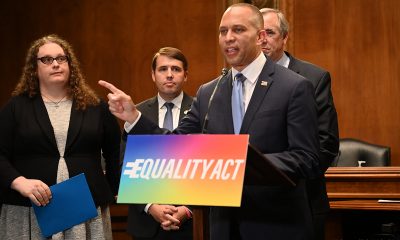
Multiple members of Congress released a joint statement condemning the agency’s decision to minimize worker protections, including U.S. Reps. Teresa Leger Fernández (D-N.M.), Grace Meng (D-N.Y.), Mark Takano (D-Calif.), Adriano Espaillat (D-N.Y.), and Yvette Clarke (D-N.Y.) The rescission follows the EEOC’s failure to respond to or engage with a November letter from Democratic Caucus leaders urging the agency to retain the guidance and protect women and vulnerable workers.
“The Equal Employment Opportunity Commission is supposed to protect vulnerable workers, including women, people of color, and LGBTQI+ workers, from discrimination on the job. Yet, since the start of her tenure, the EEOC chair has consistently undermined protections for women, people of color, and LGBTQI+ workers. Now, she is taking away guidance intended to protect workers from harassment on the job, including instructions on anti-harassment policies, training, and complaint processes — and doing so outside of the established rule-making process. When workers are sexually harassed, called racist slurs, or discriminated against at work, it harms our workforce and ultimately our economy. Workers can’t afford this — especially at a time of high costs, chaotic tariffs, and economic uncertainty. Women and vulnerable workers deserve so much better.”
Minnesota
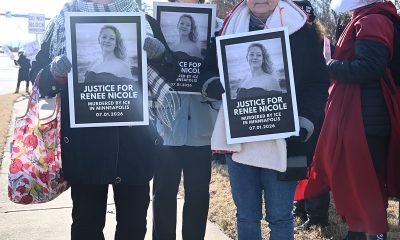
Lawyer representing Renee Good’s family speaks out
Antonio Romanucci condemned White House comments over Jan. 7 shooting
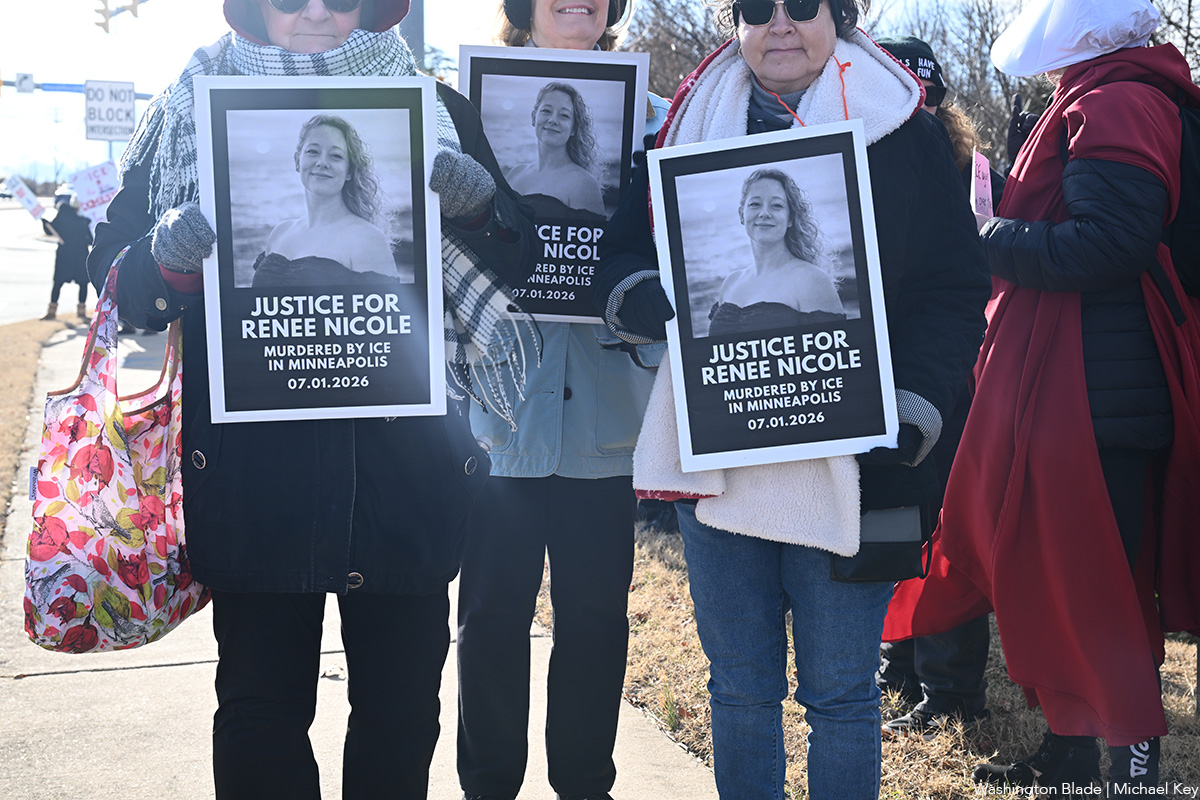
A U.S. Immigration and Customs Enforcement agent shot and killed Renee Good in Minneapolis on Jan. 7 as she attempted to drive away from law enforcement during a protest.
Since Good’s killing, ICE has faced national backlash over the excessive use of deadly force, prompting the Trump-Vance administration to double down on escalating enforcement measures in cities across the country.
The Washington Blade spoke with Antonio Romanucci, the attorney representing Good’s family following her death.
Romanucci said that Jonathan Ross — the ICE agent seen on video shooting Good — acted in an antagonizing manner, escalated the encounter in violation of ICE directives, and has not been held accountable as ICE and other federal agents continue to “ramp up” operations in Minnesota.
A day before the fatal shooting, the Department of Homeland Security began what it described as the largest immigration enforcement operation ever carried out by the agency, according to DHS’s own X post.
That escalation, Romanucci said, is critical context in understanding how Good was shot and why, so far, the agent who killed her has faced no consequences for killing a queer mother as she attempted to disengage from a confrontation.
“You have to look at this in the totality of the circumstances … One of the first things we need to look at is what was the mission here to begin with — with ICE coming into Minneapolis,” Romanucci told the Blade. “We knew the mission was to get the worst of the worst, and that was defined as finding illegal immigrants who had felony convictions. When you look at what happened on Jan. 7 with Renee and Rebecca [Good, Renee’s wife], certainly that was far from their mission, wasn’t it? What they really did was they killed a good woman — someone who was a mother, a daughter, a sister, a committed companion, an animal lover.”
Romanucci said finding and charging those responsible for Good’s death is now the focus of his work with her family.
“What our mission is now is to ensure that we achieve transparency, accountability, and justice … We aim to get it in front of, hopefully, a judge or a jury one day to make that determination.”
Those are three things Homeland Security Secretary Kristi Noem and DHS has outright rejected while smearing Good in the official record — including accusing her of being a “domestic terrorist” without evidence and standing by Ross, who Noem said acted in self-defense.
The version of events advanced by Noem and ICE has been widely contradicted by the volume of video footage of the shooting circulating online. Multiple angles show Good’s Honda Pilot parked diagonally in the street alongside other protesters attempting to block ICE agents from entering Richard E. Green Central Park Elementary School.
The videos show ICE officers approaching Good’s vehicle and ordering her to “get out of the car.” She then puts the car in reverse, backs up briefly, shifts into drive, and steers to the right — away from the officers.
The abundance of video evidence directly contradicts statements made by President Donald Trump, Noem, and other administration officials in interviews following Good’s death.
“The video shows that Renee told Jonathan Ross that ‘I’m not mad at you,’ so we know that her state of mind was one of peace,” Romanucci said. “She steered the car away from where he was standing, and we know that he was standing in front of the car. Reasonable police practices say that you do not stand in front of the car when there’s a driver behind the wheel. When you leave yourself with only the ability to use deadly force as an option to escape, that is not a reasonable police practice.”
An autopsy commissioned by Good’s family further supports that account, finding that her injuries were consistent with being shot from the direction of someone driving away.
The autopsy found three gunshot wounds: one to Good’s left forearm, one that struck her right breast without piercing major organs, and a third that entered the left side of her head near the temple and exited on the right side.
Romanucci said Ross not only placed himself directly in harm’s way, but then used deadly force after creating the conditions he claimed justified it — a move that violates DHS and ICE policy, according to former Assistant Homeland Security Secretary Juliette Kayyem.
“As a general rule, police officers and law enforcement do not shoot into moving cars, do not put themselves in front of cars, because those are things that are easily de-escalated,” Kayyem told PBS in a Jan. 8 interview.
“When he put himself in a situation of danger, the only way that he could get out of danger is by shooting her, because he felt himself in peril,” Romanucci said. “That is not a reasonable police practice when you leave yourself with only the ability to use deadly force as an option. That’s what happened here. That’s why we believe, based on what we’ve seen, that this case is unlawful and unconstitutional.”
Romanucci said he was appalled by how Trump and Noem described Good following her death.
“I will never use those words in describing our client and a loved one,” he said. “Those words, in my opinion, certainly do not apply to her, and they never should apply to her. I think the words, when they were used to describe her, were nearly slanderous … Renee Good driving her SUV at two miles per hour away from an ICE agent to move down the street is not an act of domestic terrorism at all.”
He added that his office has taken steps to preserve evidence in anticipation of potential civil litigation, even as the Justice Department has declined to open an investigation.
“We did issue a letter of preservation to the Department of Justice, Department of Homeland Security, and other agencies to ensure that any evidence that’s in their possession be not destroyed or altered or modified,” Romanucci said. “We’ve heard Todd Blanche say just in the last couple of days that they don’t believe that they need to investigate at all. So we’re going to be demanding that the car be returned to its rightful owner, because if there’s no investigation, then we want our property back.”
The lack of accountability for Ross — and the continued expansion of ICE operations — has fueled nationwide protests against federal law enforcement under the Trump-Vance administration.
“The response we’ve seen since Renee’s killing has been that ICE has ramped up its efforts even more,” Romanucci said. “There are now over 3,000 ICE agents in a city where there are only 600 police officers, which, in my opinion, is defined as an invasion of federal law enforcement officers into a city … When you see the government ramping up its efforts in the face of constitutional assembly, I think we need to be concerned.”
As of now, Romanucci said, there appears to be no meaningful accountability mechanism preventing ICE agents from continuing to patrol — and, in some cases, terrorize — the Minneapolis community.
“What we know is that none of these officers are getting disciplined for any of their wrongdoings,” he said. “The government is saying that none of their officers have acted in a wrongful manner, but that’s not what the courts are saying … Until they get disciplined for their wrongdoings, they will continue to act with impunity.”
When asked what the public should remember about Good, Romanucci emphasized that she was a real person — a mother, a wife, and a community member whose life was cut short. Her wife lost her partner, and three children lost a parent.
“I’d like the public to remember Renee about is the stories that Rebecca has to tell — how the two of them would share road trips together, how they loved to share home-cooked meals together, what a good mother she was, and what a community member she was trying to make herself into,” Romanucci said. “They were new to Minneapolis and were really trying to make themselves a home there because they thought they could have a better life. Given all of that, along with her personality of being one of peace and one of love and care, I think that’s what needs to be remembered about Renee.”
The White House
Trump-Vance administration ‘has dismantled’ US foreign policy infrastructure
Current White House took office on Jan. 20, 2025

Jessica Stern, the former special U.S. envoy for the promotion of LGBTQ and intersex rights, on the eve of the first anniversary of the Trump-Vance administration said its foreign policy has “hurt people” around the world.
“The changes that they are making will take a long time to overturn and recover from,” she said on Jan. 14 during a virtual press conference the Alliance for Diplomacy and Justice, a group she co-founded, co-organized.
Amnesty International USA National Director of Government Relations and Advocacy Amanda Klasing, Human Rights Watch Deputy Washington Director Nicole Widdersheim, Human Rights First President Uzra Zeya, PEN America’s Jonathan Friedman, and Center for Reproductive Rights Senior Federal Policy Council Liz McCaman Taylor also participated in the press conference.
The Trump-Vance administration took office on Jan. 20, 2025.
The White House proceeded to dismantle the U.S. Agency for International Development, which funded LGBTQ and intersex rights organizations around the world.
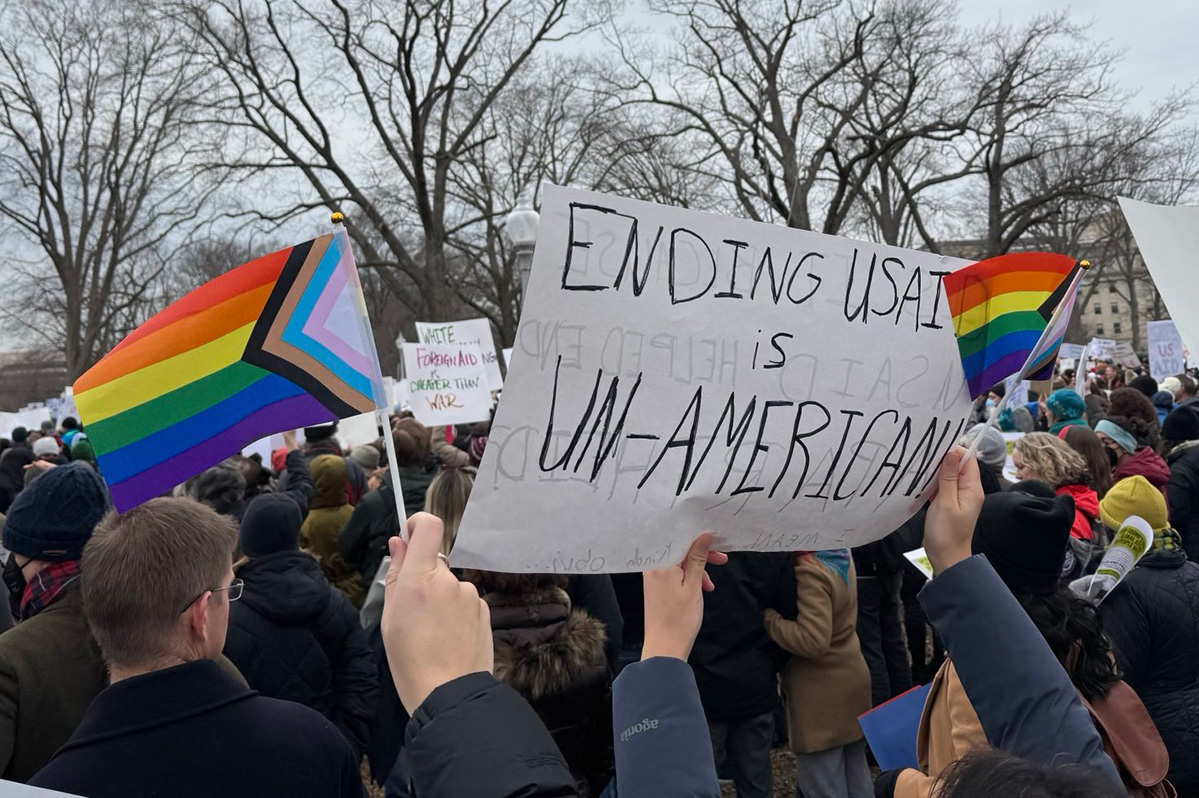
Secretary of State Marco Rubio last March announced the State Department would administer the 17 percent of USAID contracts that had not been cancelled. Rubio issued a waiver that allowed PEPFAR and other “life-saving humanitarian assistance” programs to continue to operate during the U.S. foreign aid freeze the White House announced shortly after it took office.
The global LGBTQ and intersex rights movement has lost more than an estimated $50 million in funding because of the cuts. The Washington Blade has previously reported PEPFAR-funded programs in Kenya and other African countries have been forced to suspend services and even shut down.
Stern noted the State Department “has dismantled key parts of foreign policy infrastructure that enabled the United States to support democracy and human rights abroad” and its Bureau of Democracy, Human Rights, and Labor “has effectively been dismantled.” She also pointed out her former position and others — the Special Representative for Racial Equity and Justice, the Ambassador-at-Large for Global Women’s Issues, and the Ambassador-at-Large for Global Criminal Justice — “have all been eliminated.”
President Donald Trump on Jan. 7 issued a memorandum that said the U.S. will withdraw from the U.N. Entity for Gender Equality and the Empowerment of Women and more than 60 other U.N. and international entities.
Rubio in a Jan. 10 Substack post said UN Women failed “to define what a woman is.”
“At a time when we desperately need to support women — all women — this is yet another example of the weaponization of transgender people by the Trump administration,” said Stern.
US ‘conducting enforced disappearances’
The Jan. 14 press conference took place a week after a U.S. Immigration and Customs Enforcement agent killed Renee Good, a 37-year-old woman who left behind her wife and three children, in Minneapolis. American forces on Jan. 3 seized now former Venezuelan President Nicolás Maduro and his wife, Cilia Flores, at their home in Caracas, the Venezuelan capital, during an overnight operation. Trump also continues to insist the U.S. needs to gain control of Greenland.
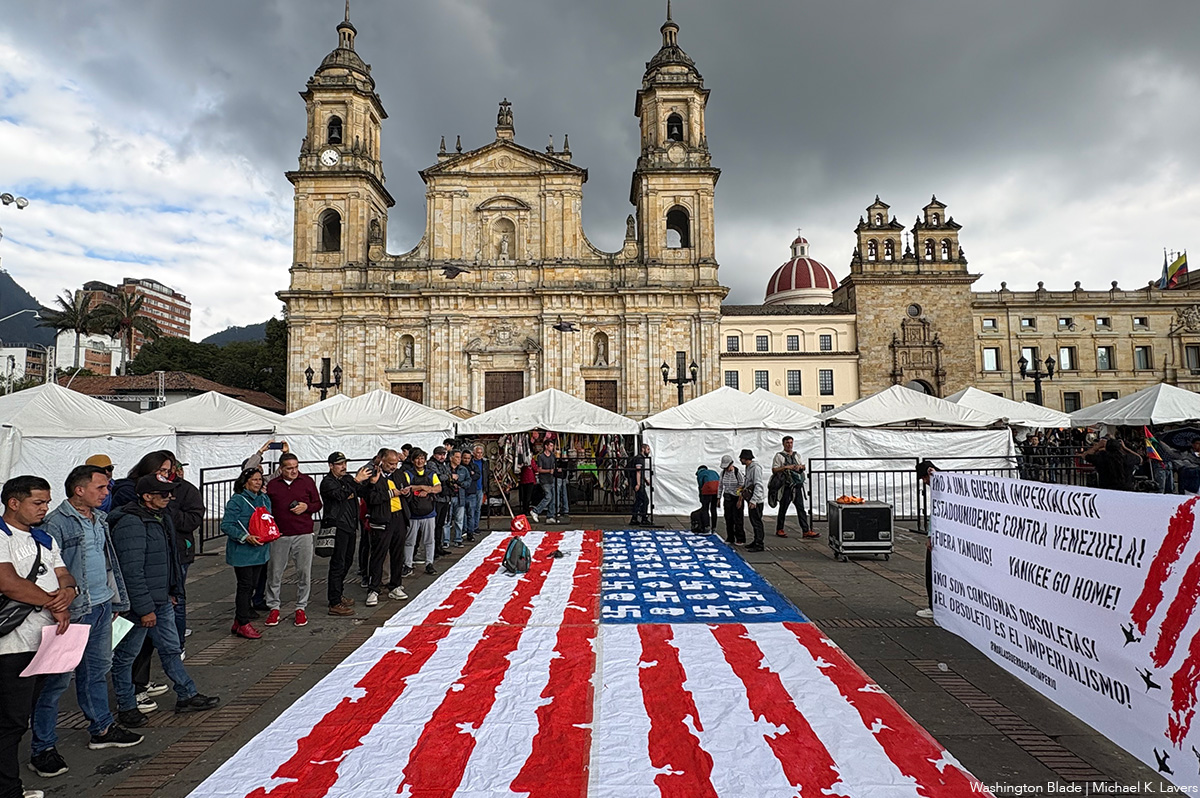
Widdersheim during the press conference noted the Trump-Vance administration last March sent 252 Venezuelans to El Salvador’s Terrorism Confinement Center, a maximum-security prison known by the Spanish acronym CECOT.
One of them, Andry Hernández Romero, is a gay asylum seeker who the White House claimed was a member of Tren de Aragua, a Venezuelan gang the Trump-Vance administration has designated as an “international terrorist organization.” Hernández upon his return to Venezuela last July said he suffered physical, sexual, and psychological abuse while at CECOT.
“In 2025 … the United States is conducting enforced disappearances,” said Widdersheim.
Zeya, who was Under Secretary of State for Civilian Security, Democracy, and Human Rights from 2021-2025, in response to the Blade’s question during the press conference said her group and other advocacy organizations have “got to keep doubling down in defense of the rule of law, to hold this administration to account.”

Russia designates ILGA World an ‘undesirable’ group

‘The Director’ highlights film director who collaborated with Hitler

ICE agents murder another American citizen in Minneapolis

Corte IDH reconoce a Thalía Rodríguez como familia social de Leonela Zelaya

Eleanor Holmes Norton ends 2026 reelection campaign

Companies participate in ‘Pride on the Promenade’ at World Economic Forum

Few openly queer nominees land Oscar nominations

Lawyer representing Renee Good’s family speaks out

Judge denies D.C. request to dismiss gay police captain’s anti-bias lawsuit

Calendar: January 23-29
-

 World5 days ago
Companies participate in ‘Pride on the Promenade’ at World Economic Forum
-
Movies5 days ago
Few openly queer nominees land Oscar nominations
-
Minnesota4 days ago
Lawyer representing Renee Good’s family speaks out
-
District of Columbia4 days ago
Judge denies D.C. request to dismiss gay police captain’s anti-bias lawsuit