National
Push for LGBT bills continues during recess
Activities planned in local districts while Congress takes break
Advocacy groups are planning to take advantage of this month’s congressional recess by stepping up efforts with district offices to build support for pro-LGBT initiatives while lawmakers are at home.
One joint effort between the Human Rights Campaign and Servicemembers Legal Defense Network, for example, is geared toward influencing senators to support repealing “Don’t Ask, Don’t Tell” when the issue comes before the Senate, possibly in September.
As part of this same effort, HRC is also working on building support for bringing the Employment Non-Discrimination Act to a House vote.
Meanwhile, grassroots LGBT group GetEqual is considering ways to expand its direct action work outside the Capital Beltway to reach lawmakers in their home districts.
HRC and SLDN last week announced their effort, called Countdown 2010, which aims to mobilize new grassroots efforts to build support in part toward ending “Don’t Ask, Don’t Tell” in the Senate.
Marty Rouse, HRC’s national field director, said the effort consists of engagement from the organization’s field team as well as encouraging HRC members to reach out to key lawmakers.
“We can’t just talk to our legislators and members of Congress inside the Beltway,” Rouse said. “We have to talk to them in the district so that they see that there’s interest and concern back home.”
Aubrey Sarvis, SLDN’s executive director, said the effort will last until lawmakers return from their August recess and vote on the fiscal year 2011 defense authorization bill, the legislative vehicle to which the Senate Armed Services Committee in May attached a provision that would lead to “Don’t Ask, Don’t Tell” repeal.
“We’ll be down in the targeted states with veterans, former clients of SLDN, friends and family of veterans — hopefully to visit with senators and their key staffers to urge senators to support, one, the [Defense Department] bill and, secondly, to support the provisions in the bill as it came out of the Senate Armed Services Committee,” Sarvis said.
The “Don’t Ask, Don’t Tell” portion of the Countdown 2010 effort is focused on influencing senators in 10 states — Arkansas, Indiana, Montana, Nebraska, Nevada, New Hampshire, North Dakota, Ohio, South Dakota and Virginia — where HRC and SLDN feel they don’t have a firm commitment from senators on the issue.
Rouse said the senators in the states on which HRC is focusing its efforts are Blanche Lincoln (D-Ark.), Mark Pryor (D-Ark.), Richard Lugar (R-Ind.), Jon Tester (D-Mont.), Max Baucus (D-Mont.), Mike Johanns (R-Neb.), John Ensign (R-Nev.), Judd Gregg (R-N.H.), Byron Dorgan (D-N.D.), Kent Conrad (D-N.D.), George Voinovich (R-Ohio), Tim Johnson (D-S.D.) and Mark Warner (D-Va.).
Although Rouse said HRC’s field team is engaged in nearly all of these states throughout the country as part of this effort, he added efforts aren’t yet underway in Montana because of priority and efficiency reasons.
“Montana is a big state, and it’s hard to cover and hard to get to,” Rouse said. “There’s no one in Montana right now, but there will be.”
One of the senators on the list has already publicly indicated his position on “Don’t Ask, Don’t Tell” in the defense authorization bill. Last month, Lugar told the Blade he wouldn’t support removing the “Don’t Ask, Don’t Tell” language from legislation and is unlikely to support a filibuster of the main bill.
Sarvis said SLDN feels Indiana should nonetheless be among the states on which efforts are focused.
“With Sen. Lugar, the commitment is not as firm and unequivocal as we would like, so we hope to engage him back home,” Sarvis said. “But, yes, we are somewhat encouraged by what Sen. Lugar has said to date. But, again, it’s not done until all the votes are cast.”
Also as part of Countdown 2010, HRC is working to influence senators in the targeted states on ENDA while engaging House members in North Carolina, Pennsylvania and Texas to build support for the bill. Rouse said urging senators to support ENDA in these three additional states is less of a priority.
“We really focused on the House and we need to do significant [work] in House districts throughout the country before we even can think of the Senate,” Rouse said. “Our focus right now in the field is making sure that we target these House members. That’s most important.”
Paul Guequierre, an HRC spokesperson, said the efforts in North Carolina, Pennsylvania and Texas are geared toward influencing House Democratic members in these states that aren’t ENDA co-sponsors.
Five of eight House Democrats from North Carolina, five of 12 House Democrats from Pennsylvania and five of 12 House Democrats from Texas aren’t co-sponsors, Guequierre said.
Sarvis said the shared work between HRC and SLDN in this effort would complement the strength of each organization. He noted that HRC has more field organizers and thus would provide more field workers to the effort while SLDN would bring more service members and veterans.
“Whether it’s working with field organizers in place or SLDN veterans, clients, it’ll be a matter of sharing resources and bringing that [all] together over the next six to eight weeks in the most efficient way possible,” Sarvis said.
Rouse said HRC would look at local media to determine whether efforts in these states are making progress and noted that efforts in many states have already produced results.
“We’ve already seen letters to the editor printed, op-eds printed and meetings with the Senate staff have already taken place,” he said. “None of this would have happened were it not for HRC’s staff being on the ground, mobilizing and reaching out to people.”
But for SLDN, evaluating the progress of Countdown 2010 would depend on the results of the meetings with senators and their staffers in these states.
“But the bottom line is you won’t know until the votes have been cast,” Sarvis said. “In some cases, we may get affirmative answers over the next several weeks, but I suspect that in many cases, we won’t get a definitive answer until the senators’ votes.”
GetEqual plans district actions
Meanwhile, GetEqual is planning efforts to draw more attention to ENDA as lawmakers return from break. The efforts are intended to build off previous protests last month in Las Vegas and at the U.S. Capitol.
Robin McGehee, co-founder of GetEqual, said her group has been talking with local organizers about working collaboratively on direct action throughout the country on ENDA and “Don’t Ask, Don’t Tell.”
“We’re trying to work to set up some in-district actions,” she said. “At this moment, we don’t have any targets that we’ll release only because we’re trying to figure out where is the weakest link and what we feel like is going to be strategically the best one to plan most of our attention.”
McGehee said GetEqual will be sending out instructions on ways people can engage in the political process as lawmakers work in their home district.
“It may be some people planning actions; it may be just giving them avenues of engagement that can just get them to engage their legislator around ‘Don’t Ask, Don’t Tell’ or ENDA,” she said.
McGehee said GetEqual is looking at lawmakers’ speaking engagements, town halls, fundraisers and office times as possible opportunities for action.
Wherever the actions take place, McGehee said GetEqual is in part learning from the tactics that conservative protesters used in interrupting town hall meetings last year over health care reform.
“Obviously, you don’t want to be compared to someone who has a conservative platform,” she said. “But, in my opinion, one of the things that we did learn from watching that was the squeaky wheel was getting the grease.”
In the past month, GetEqual asked supporters which of four lawmakers should be targeted for direct action over ENDA: U.S. House Speaker Nancy Pelosi (D-Calif.), Senate Majority Leader Harry Reid (D-Nev.), Rep. Barney Frank (D-Mass.) or Rep. George Miller (D-Calif.).
According to GetEqual, Pelosi won 46.5 percent of the vote, Reid won 18.5 percent, Miller took 17.6 percent and Frank took 17.4 percent. The organization declined to make public the total number of votes.
McGehee said the first and second place rankings of Pelosi and Reid were behind a protest last month in Las Vegas, which was directed against Reid, and another protest in the U.S. Capitol, which targeted Pelosi.
But whether GetEqual continues to target Pelosi and Reid during their August break remains to be seen.
“I don’t know for sure that we’ll go back to those targets,” McGehee said. “Honestly, for us, it’s just looking at where you have local organizers that also want to be involved, and finding out from the advocacy groups that really have the inside strategy where do they feel like the hold up is actually happening.”




National
White House orders warning signs at Smithsonian over gender identity exhibits
Administration criticizes National Museum of American History
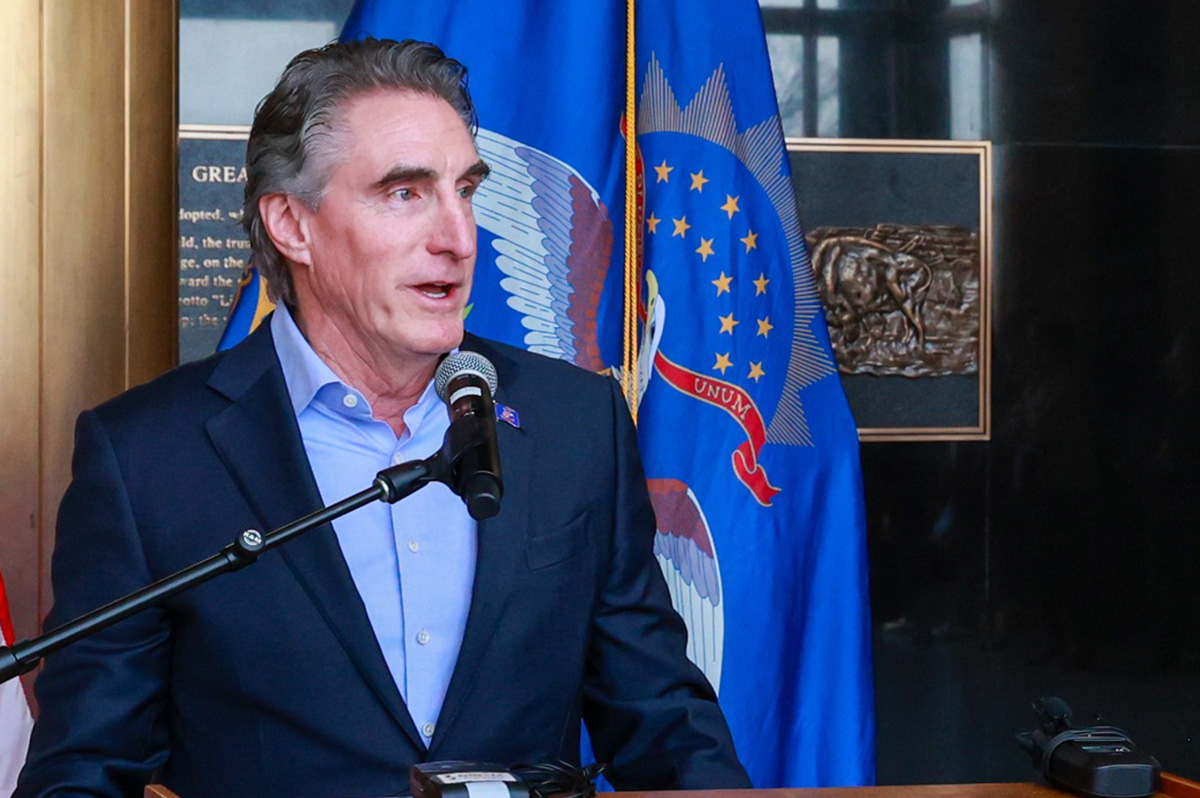
The Trump administration will install temporary warning signs outside the Smithsonian’s National Museum of American History after releasing a report accusing the museum of promoting what it calls “radical” gender ideology and other politically biased content.
According to the Executive Order, “For purposes of policy formulation under EO 14253, this review of the National Museum of American History concludes that NMAH, by the intention and at the direction of current Museum and Smithsonian leadership, has become subject to institutional capture by a radical, activist ideology that is fundamentally opposed to telling the noble, honest story of the great country we know and love.”
Executive Order 14253 refers to what the White House has deemed the “Restoring Truth and Sanity to American History” order. Therefore, the Trump administration has said it will take all available steps to ensure that the issues in the report are addressed and rectified.
Without specifying, the White House has stated that warnings will be posted along NMAH to alert visitors to sections of the museum it has deemed are in violation according to the report.
“The Secretary of the Interior, acting through the Director of the National Park Service (NPS) and in coordination with the Assistant to the President for Domestic Policy, shall install temporary signage along the NPS-maintained sidewalks and walkways used by the public to access the Museum, informing visitors of the findings of the Report and of the policy set forth in section 1 of this order,” the Executive Order states.
The warnings were raised in a 162-page report issued by the Domestic Policy Council. The report detailed ways in which the National Museum of American History (NMAH) has “poorly” portrayed American history and insufficiently highlighted the founding story during America 250th celebrations.
The report outlined key findings of the NMAH. One of these findings was the Center for Restorative History within the museum, which has stated its purpose is to “encourage systemic change” by highlighting diverse groups. However, the report states that it highlights every group of Americans except for straight and white Americans.
The Domestic Policy Council accused the museum of engaging in “transgender activism.” According to the report, examples include referring to “biological men” as women or girls, displaying what it describes as sexually suggestive content, and incorporating discussions of gender fluidity, gender identity, and gender nonconformity into the museum’s educational curriculum, “Becoming US.”
The report also criticizes the curriculum for using the term “transgender” when discussing gender-nonconforming people and encouraging individuals to ask a person’s pronouns when meeting them. It further objects to exhibits stating that “transgender, nonbinary, and cisgender female athletes” continue to struggle for and demand equality.
It also condemns what it refers to as explicit content in an exhibition, “Girlhood (It’s Complicated)”, such as chest binders, questioning gender testing in women’s sports, and referring to biological females as “people inhabiting female bodies.”
Additionally, the report accuses the museum of no longer participating in flag-celebrating ceremonies because it was “too busy” preparing for June Pride and WorldPride events. It states, “As Director Hartig explained in a June 2024 presentation, all her attention was focused on flying the Smithsonian Pride Alliance’s ‘intersexual pride flag during June’ in 2023 and 2024.”
On July 9, the American Historical Association issued a statement rejecting the report’s findings.
In regard to the report, it states, “Its anonymous authors overlook a central lesson of the nation’s founding: the United States was forged by finding common purpose amid intense divisions, conflicts, and disagreements.” They argue that only “honest history” can tell the true history of the nation.
House Republicans led a subcommittee hearing that questioned Smithsonian Director Hartig extensively. A main focus of the questions was on the exhibits related to gender identity and whether they were appropriate. In the hearing, Rep. Nancy Mace asked: “When was your gender revealed to you, Dr. Hartig?”
In response to questioning, Hartig stated that the institution is nonpartisan and does not push a specific agenda.
Hartig published a two-page statement ahead of her hearing outlining her thoughts on the situation. In the report, she states that the institution is always open to criticism and will continue to look for ways to improve, but she sees the report as misleading.
“I can attest that the report does not fairly characterize the full body of work at this museum. I am familiar with the depth and breadth of our collections, exhibits, and programming. And while I recognize there is always room for improvement, I also know the beauty, inspiration, and expertise that exists in our museum,” Hartig wrote.
Democrats created their own 16-page report as a rebuttal to the Domestic Policy Council’s report. It argued that the attacks by the current Trump administration are another example of its attempt to rewrite history. Additionally, the report states that no policy changes were included in the Executive Order, as that is beyond the President’s role. “The Report recommends nothing. That is no accident. To recommend an action, the Report would need to identify who is legally empowered to take it, and its own opening chapter concedes the President’s only power is to ‘urge’,” House Democrats wrote.
It is still unclear when the temporary warnings will be installed or what form they will take beyond the requirements outlined in the executive order.
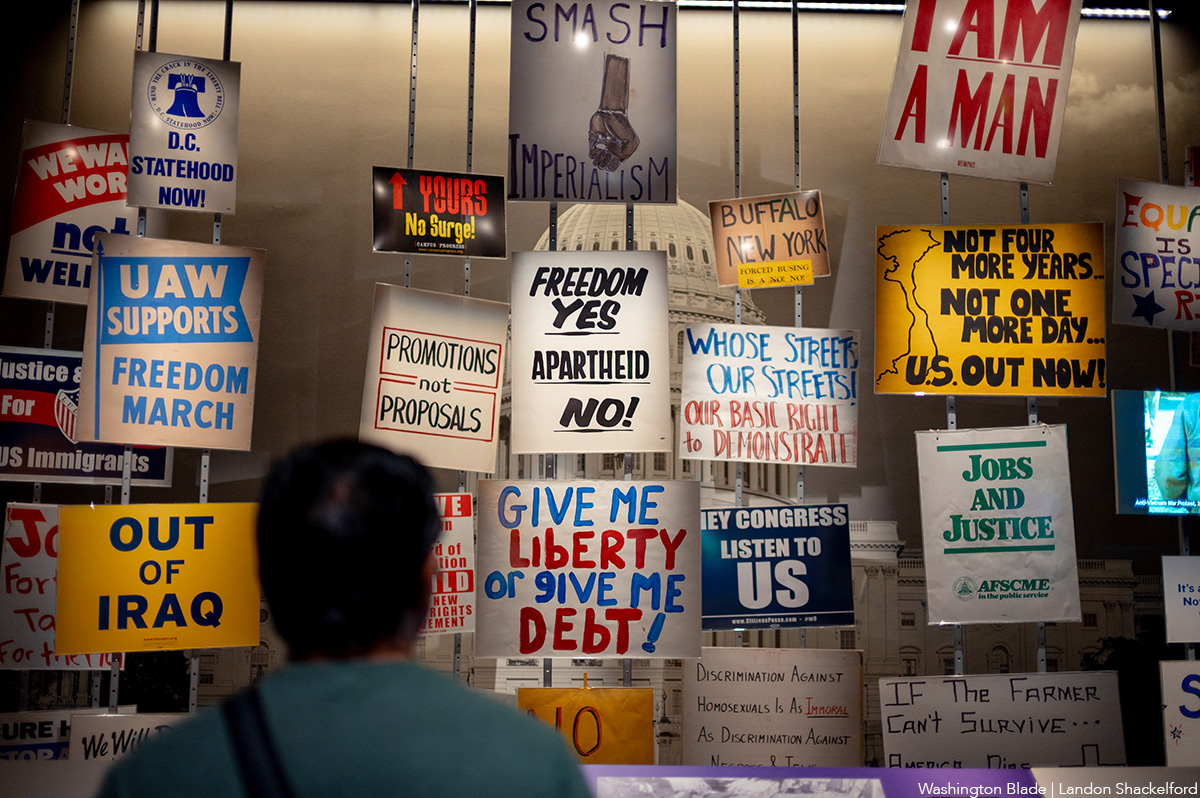
An exhibit at the Smithsonian. (Washington Blade photo by Landon Shackelford)
National
Trump ends direct HIV prevention funding to community groups
Advocates say transfer of funds to states may disrupt local programs

A decision by the U.S. Office of Management and Budget (OMB) at the request of the Trump administration to discontinue direct federal funding of community-based organizations and clinics that provide HIV prevention services has raised concern among community health advocates, including LGBTQ advocates.
News surfaced earlier this month that the OMB informed the U.S. Centers for Disease Control and Prevention that it would not renew $46 million in funding for 96 community-based organizations that provide HIV testing, referrals to medical care, and arrangements for obtaining pre-exposure HIV prevention medication known as PrEP that has been shown to be 99 percent effective in preventing HIV infection.
Under the new policy arranged by OMB, the funds will be redirected to the states to be allocated to state and local health departments. The policy calls for states to encourage but not require their respective state and local health departments to allocate some of those funds for community-based organizations. Under the new policy, the funding is scheduled to last until May of 2027, before a renewal decision is made.
Some political observers have speculated that the decision to end direct federal funding to community-based organizations could be motivated by the Trump administration’s hostility to diversity, equity, and inclusion or DEI programs and organizations that promote those programs, with the belief that some of the groups receiving the federal HIV prevention funds are promoting DEI.
Carl Schmid, executive director of the D.C.-based HIV+ Hepatitis Policy Institute, is among the leaders of many AIDS advocacy organizations expressing strong opposition to the OMB action. Schmid said that in places like D.C. and some states, local officials will be willing to redirect the federal funds to local community-based organizations.
A list of the 96 community-based organizations across the country that are currently receiving the federal AIDS funds includes the D.C.-based Whitman-Walker Health, which has a long history of healthcare support for the LGBTQ community, and La Clinica del Pueblo, which reaches out to the Latino community.
Schmid said Whitman-Walker and La Clinica del Pueblo have longstanding good relationships with the local D.C. government.
“But other states and jurisdictions don’t have that relationship with the community-based organizations,” Schmid said. “It depends on the state,” he said, adding, “Not all states send their money to the communities that really need it most. And not all states are fast in getting money to the community-based organizations.”
Spokespersons for Whitman-Walker and La Clinica del Pueblo couldn’t immediately be reached for comment on whether they think the Trump administration’s latest action related to funding will adversely impact their respective organizations.
Schmid said under the current federal grant program slated to be discontinued, which has been in effect for at least five years, HIV-related health organizations receiving the federal grant funds were eligible for an existing federal policy enabling them to purchase HIV-related medication, including the PrEP prevention medication, at a significant discount from pharmaceutical companies. With the ending of the direct federal HIV funds to community-based organizations, Schmid said it was unclear whether problems may surface in obtaining drug discounts.
“They could still qualify as a sub-grantee from a state,” Schmid said. “But what if they don’t get that grant again? They would not be able to qualify to obtain the drugs” at the discounted price, he said.
Among the organizations expressing strong concern over the decision to discontinue the direct HIV prevention funding to community-based organizations has been the Federal AIDS Policy Institute and its subgroup called the HIV Prevention Action Coalition.
In a July 22 letter bearing the names of 71 community-based organizations from throughout the country sent to U.S. Department of Health and Human Services Secretary Robert F. Kennedy Jr. and Centers for Disease Control and Prevention Acting Director Jay Bhattacharya, the group called for the Trump administration to “reconsider” ending the current funding policy.
“Ending this program without a clear plan for what comes next would dismantle prevention infrastructure that has taken more than three decades of federal investment to build and do so just as that long record of measurable returns is accelerating,” the letter states.
It says the initiative by President Trump in his first term as president to end the HIV epidemic and reduce new HIV infections by 90 percent by 2030 was moving ahead by the funding program for community-based organizations that the administration now wants to end.
“Discontinuing this program would also cost far more than it saves,” the letter says. “Every HIV transmission prevented avoids an estimated lifetime treatment cost of roughly half a million dollars per person to the healthcare system – costs that fall heavily on taxpayer-funded programs, including Medicaid, Medicare, and the Ryan White HIV/AIDS program,” the letter continues.
“The choice before the administration is straightforward: a modest, targeted investment in prevention now, or far greater public expense for treatment later,” the letter concludes.
Spokespersons for the OMB and the Department of Health and Human Services, which oversees the CDC, have not immediately responded to news media requests for comment on the opposition to the funding change policy.
National
At Alliance Defending Freedom’s summit, church and state are one
House Speaker Mike Johnson (R-La.) among speakers

Uncloseted Media published this article on July 23.
By SPENCER MACNAUGHTON | Earlier this month, hundreds of people filled a conference room in San Diego. These included Speaker of the House Mike Johnson, Assistant Secretary of Health Admiral Brian Christine, OpenAI executive Dean Ball, and the attorneys general of West Virginia and Idaho.
They all came together for Alliance Defending Freedom’s 2026 Summit. The Christian legal group, also a Southern Poverty Law Center-designated anti-LGBTQ hate group, described the event as a “gathering of leaders from many different spheres, including law, public policy, media, business, education, and Christian leadership.”
Johnson — who has said that “homosexual relationships are inherently unnatural and … society cannot give its stamp of approval to such a dangerous lifestyle” — was a featured speaker.
In his speech, he seemed unconcerned with the separation of church and state: “It is so encouraging to Kelly and I to be among friends and fellow warriors for this cause and people who understand that God is not done with America yet. … ADF’s on the very tip of the spear, front line, defending those very truths and keeping the door open for the spread of the Gospel. This is our moment. I’m telling you, I believe the next season … is going to be the greatest season of this ministry since its inception.”
That ministry is one that has espoused aggressively anti-LGBTQ views since its inception in the early 1990s. It was co-founded by a group of evangelical men, including Alan Sears, who co-authored a book called “The Homosexual Agenda: Exposing the Principal Threat to Religious Freedom Today.” Since then, ADF has opposed gay marriage and supported bans on gay sex and on gender-affirming care for minors.
After helping overturn Roe v. Wade, ADF lawyers have led key victories at the Supreme Court. In 303 Creative v. Elenis, SCOTUS ruled that a website designer could refuse service to gay weddings. And this year they convinced the Court to overturn Colorado’s ban on conversion therapy and to uphold state laws in West Virginia and Idaho that ban trans girls from playing on girls’ sports teams.
At the summit, ADF President Kristen Waggoner, who has promoted conversion therapists and consistently misgenders trans people, interviewed these states’ attorneys general.
“The lawyers who were defending women’s sports were among the best I’ve ever seen in my entire life,” West Virginia Attorney General JB McCuskey told Waggoner.
Similar to Johnson, Trump’s Assistant Secretary of Health Christine showed his commitment to governing based on conservative Christianity. He gave a Bible-thumping speech against gender transition and trans healthcare, saying that it “contradicts … the deeper moral order that is woven into creation itself. For Genesis 1:27 informs us that God created man in his own image. … Male and female” He also said the “complementary relationship between man and woman is divine” and advocated for youth with gender dysphoria to receive care from a pastor.
All of these remarks from politicians made me think of the interview I published earlier this week with Pete Hegseth’s pastor, Doug Wilson. He wants a Christian theocracy in America and told me that: both the perpetrator and the victim should be disciplined in some cases of marital rape; that transgender people are “sad;” that execution is justifiable for certain homosexual acts; and that gay sex should be illegal.
The ADF Summit is glossy and polished. And while its messaging may be less explicit than Pastor Wilson’s, the track record of the organizations shows they have the exact same desires. They’re just deeply strategic in what they say and when and how they say it.
I believe the political power players who attended this year’s summit know this. They know they are endorsing an organization whose members have essentially called for the illegalization of most — if not all ‚ forms of queer behavior and presentation.
In the last few years, these perspectives have become increasingly embedded in the highest rooms of the federal government and they have been effective in stripping away LGBTQ rights. Wilson, who just installed a full-time pastor in Washington to lead services, says there are 10 to 20 government officials who align with his church’s ideology.
It is vital for Americans to keep their eyes wide open to the ultimate goal of groups like ADF: to create a United States that leaves LGBTQ people without rights and that pushes us back in the closet.

PHOTOS: Petal Release Party

Madonna headlines World Pride Music Festival in Amsterdam

Reggie White relishing first season as artistic director of Woolly Mammoth

PHOTOS: Amsterdam Pride Canal Parade

Amsterdam Pride Canal Parade draws hundreds of thousands

Madonna to perform at World Pride in Amsterdam

BLADE ENDORSEMENT: Susan Stewart for mayor of Rehoboth Beach

PHOTOS: Lambda Legal in the Pines

Calendar: July 31-August 6