National
Will Obama appeal DOMA court rulings?
Justice Dept. has until Oct. 12 to decide
President Obama’s commitment to repealing the Defense of Marriage Act is likely to come under enhanced scrutiny next week when the U.S. Justice Department announces its decision on whether or not it will appeal federal court rulings against the statute.
Legal experts across the board are expecting the administration to appeal the decisions as many LGBT advocates grumble that the defense of DOMA in court undermines Obama’s campaign pledge to advocate for same-sex couples.
Richard Socarides, a gay New York attorney and former adviser to President Clinton, said he expects the Justice Department to appeal the cases because he believes the administration hasn’t shown any signs of changing its position after defending DOMA at the district court level.
“I think that they’re going to continue to battle the gay rights movement in the courts,” Socarides said. “I think it continues to be one of the most unfortunate decisions of the president’s entire first two years in office and really something that is perhaps the most troubling part of these first two years of his presidency.”
Socarides said he doesn’t think the administration is compelled to appeal the decisions to the U.S. First Circuit Court of Appeals even as he acknowledged that debate has taken place over whether the president can decide against upholding a federal statute.
“I think that it’s clear now that the president has the option of declining to defend laws that he believes are not constitutional,” Socarides said. “This law has now been declared unconstitutional, so he could agree with the federal district court … and choose not to defend it.”
Evan Wolfson, executive director of Freedom to Marry, also predicted the administration will appeal the decisions made in the DOMA cases because he believes Justice Department officials think they’re required to do so.
Still, Wolfson said the extent to which the Justice Department defends DOMA at the U.S. First Circuit Court of Appeals would be an appropriate gauge to determine the Obama administration’s commitment to supporting LGBT people.
“I think the Justice Department can argue they have to appeal, but they should not be trying to win at all costs, and they should urge the court to adopt a presumption of unconstitutionality for the cruel exclusion from marriage that they themselves admit is discrimination,” Wolfson said.
On July 8, U.S. District Court Judge Joseph Tauro ruled in two separate cases — Gill v. U.S. Office of Personnel Management and Commonwealth of Massachusetts v. U.S. Department of Health & Human Services — that the part of DOMA prohibiting federal recognition of same-sex marriage is unconstitutional.
The Obama administration defended DOMA when both those cases came before the U.S. District Court of Massachusetts.
In response to a query on the whether the administration would appeal the rulings, the White House deferred comment to the Justice Department, which didn’t respond.
The deadline for making a decision in the Commonwealth case — filed by Massachusetts Attorney General Martha Coakley — is Oct. 12.
The Justice Department doesn’t have to appeal the decision in the Gill case, filed by Gay & Lesbian Advocates & Defenders, until Oct. 18 because the court didn’t enter judgment in the case until later.
Still, Lee Swislow, GLAD’s executive director, said her organization is anticipating the Obama administration will announce its decision for both cases at the same time.
“From an efficiency point of view, the cases are clearly connected and it would make sense for the government to appeal both of them on the same day,” she said.
Announcing a decision to appeal both cases at the same time would also limit the amount of negative press the White House would receive to one day as opposed to stringing out criticism over a series of days.
Swislow said she’s expecting the administration to appeal both lawsuits and said doing so means the Justice Department is doing its duty of defending federal laws.
“I don’t think you can read much into it in terms of the administration’s support in general of LGBT rights,” she said. “From a legal point of view, they have to defend the law or write an official letter to Congress on why they’re not appealing.”
After the Justice Department appeals the decisions to the First Circuit, Swislow said she expects a series of briefs will be filed to the appellate court on both sides, including friend-of-the-court briefs from supporters and opponents of DOMA.
Once oral arguments take place, those involved with the litigation will await the decision of the court.
“We could have a decision anywhere from a year from now to a year-and-a-half from now if they follow their average, and that’s all we have to go on is how long it usually takes at the First Circuit court,” Swislow said.
Once the First Circuit has made its rulings, Swislow said deciding whether or not to appeal the case further to the U.S. Supreme Court would be different for the Obama administration.
Swislow said Justice Department officials could say they’ve “done their job” and not challenge the ruling further — even as she acknowledged her organization would love a win for the cases at the Supreme Court.
“If we win at the First Circuit Court of Appeals, the question of whether to take it to the Supreme Court or not, I think, is a different calculation,” she said.
Even as many LGBT rights supporters bemoan the administration’s defense of DOMA, others say continued support for the law in court could have some advantages.
Defenders of the Obama administration have said defending anti-gay laws such as DOMA sets a precedent that would prevent future administrations from allowing litigation against pro-laws to go unchallenged.
In an article about the future of litigation against “Don’t Ask, Don’t Tell,” Aubrey Sarvis, executive director of the Servicemembers Legal Defense Network, was quoted last week in Politico as suggesting the administration’s defense of the law in court would allow the federal hate crimes law to stay on the books.
“What happens when there’s a legal challenge to, say, hate crimes [law] in a next administration, a possible Republican administration?” Sarvis reportedly said. “Will they defend the federal statute?”
Swislow expressed similar beliefs that defending DOMA would set a precedent for subsequent administrations that could be hostile to LGBT rights.
“We expect them to defend this case and we’re not mad at them for defending this case, and, yes, the process of the Justice Department — that mandate, really — to defend the law can help us,” she said.
But Socarides scoffed at the notion that defending laws like DOMA would keep pro-gay laws safe under future administrations.
“I know that a lot of people make it in defense of the administration, but to me, it’s an entirely ludicrous argument,” Socarides said. “That argument turns all logic on its head. We’re not going to defend civil rights because some day the Republicans may choose not to defend civil rights.”
In another respect, appealing the lawsuits to the First Circuit could be beneficial to same-sex couples throughout New England because the higher court has jurisdiction over more states.
A favorable ruling at the First Circuit could invalidate part of DOMA for not just married same-sex couples in Massachusetts, but also couples living in Connecticut, Vermont and New Hampshire.
Swislow said an appeal of the DOMA cases is “really in our interest” because a victory only at the district court level would “only affect our particular plaintiffs” and not anyone else.
“It’s much better, in fact, to have the case appealed so that the victory in the appellate court … affects the First Circuit [and] a victory in the Supreme Court affects the whole country,” she said.
Doug NeJaime, a gay law professor at Loyola Law School, also said an appeal in the GLAD case could be beneficial to married same-sex couples across the nation because of the strong case made by plaintiffs.
“This is a very carefully and limited challenge seeking some federal recognition of married same-sex couples, but only affecting states where couples are allowed to actually enter into marriages that are recognized,” NeJaime said. “So, I think this would actually be a good issue to have work its way up the appellate chain.”
Still, Socarides said the Obama administration shouldn’t be considered a friend to the LGBT community for appealing the lawsuits because the president hasn’t said he’s appealing them for the purpose of having a stronger ruling.
“If the United States came back and said we believe this is unconstitutional, but we’re going to appeal it because we want a ruling from a court of appeals declaring it unconstitutional, that would be terrific, but they don’t say that, do they?” he said.
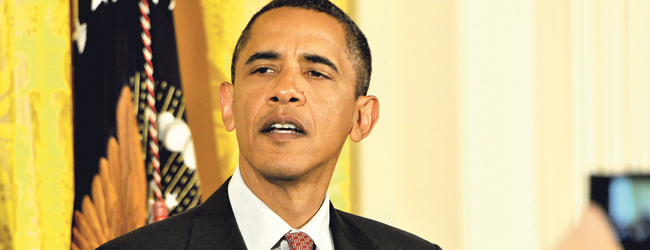
(Obama photo is a Blade file photo by Michael Key)





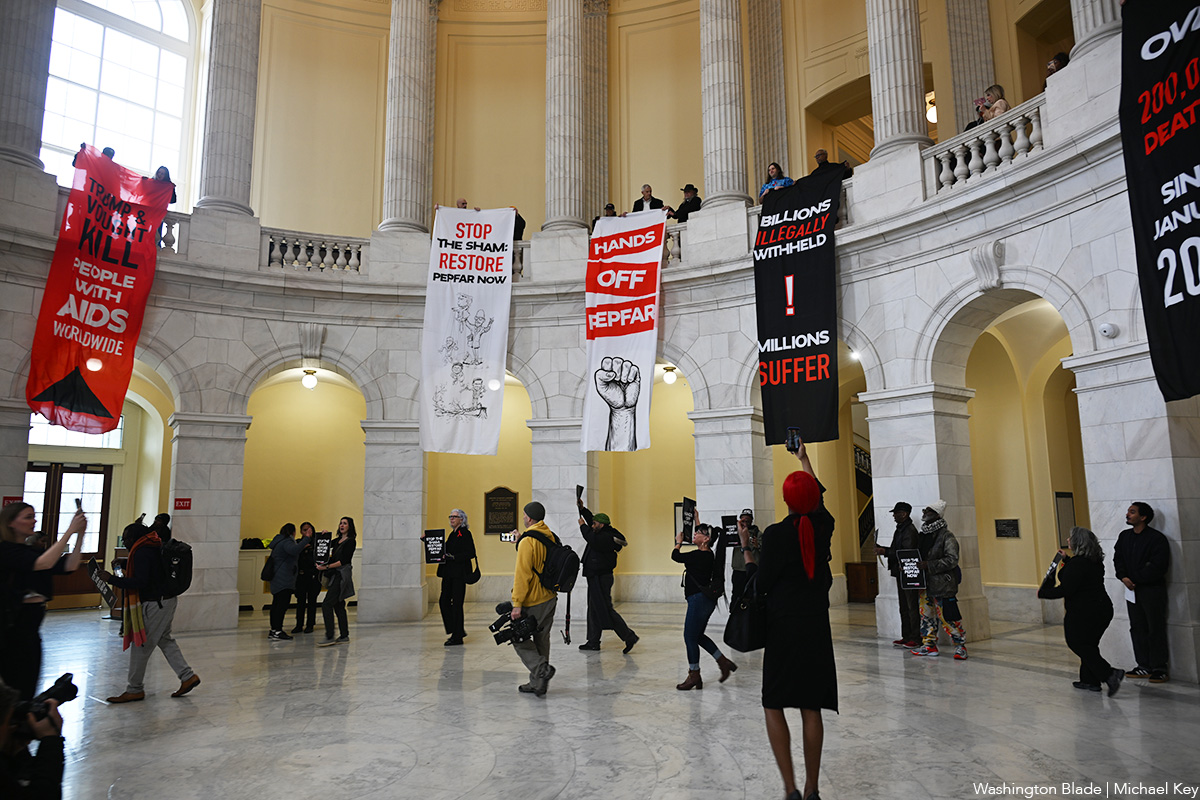
U.S. Capitol Police on Thursday arrested 13 HIV/AIDS activists in the Cannon House Office Building Rotunda.
The activists — members of Housing Works, Health GAP, and the Treatment Action Group — joined former PEPFAR staffers in demanding full funding of the program that President George W. Bush created in 2003. They chanted “AIDS cuts kill, PEPFAR now!” and unfurled banners from the Rotunda’s second floor that read “Trump and (Office of Management and Budget Director Russell) Vought kill people with AIDS worldwide,” “Over 200,000 deaths since January 2025,” and “Hands off PEPFAR” before their arrest.
(Washington Blade video by Michael K. Lavers)
This protest is the latest against the Trump-Vance administration’s HIV/AIDS policies since it took office.
Secretary of State Marco Rubio on Jan. 28, 2025, issued a waiver that allowed PEPFAR and other “life-saving humanitarian assistance” programs to continue to operate during a freeze on nearly all U.S. foreign aid spending. HIV/AIDS service providers around the world with whom the Washington Blade has spoken say PEPFAR cuts and the loss of funding from the U.S. Agency for International Development, which officially closed on July 1, 2025, has severely impacted their work.
The State Department last September announced PEPFAR will distribute lenacapavir in countries with high prevalence rates. Zambia is among the nations in which the breakthrough HIV prevention drug has arrived.
The New York Times last summer reported Vought “apportioned” only $2.9 billion of $6 billion that Congress set aside for PEPFAR for fiscal year 2025. (PEPFAR in the coming fiscal year will use funds allocated in fiscal year 2024.)
Bipartisan opposition in the U.S. Senate prompted the Trump-Vance administration last July withdraw a proposal to cut $400 million from PEPFAR’s budget. Vought on Aug. 29, 2025, said he would use a “pocket rescission” to cancel $4.9 billion for HIV/AIDS prevention and global health programs and other foreign aid assistance initiatives that Congress had already approved.
The White House in January announced an expansion of the global gag rule to ban U.S. foreign aid for groups that promote “gender ideology.” President Ronald Reagan in 1985 implemented the original regulation, also known as the “Mexico City” policy, which bans U.S. foreign aid for groups that support abortion and/or offer abortion-related services. The Council for Global Equality and other groups say the expanded rule will adversely impact HIV prevention efforts around the world.
A press release that Housing Works and Health GAP issued on Thursday notes more than $977 million “in appropriated PEPFAR funding for HIV prevention and treatment was unspent by the end of fiscal year (FY) 2025 — triple amount unspent at the end of FY 2024.”
“Activists predict this backlog will worsen rapidly in FY 2026 unless Congress immediately reasserts its Constitutionally-mandated oversight authority,” notes the press release.
The press release also indicates funding for the Centers for Disease Control and Prevention’s PEPFAR programs “will run out” by April 1 because “only 45 percent of their FY26 funding has been transferred from the State Department.
“Unless funding is transferred immediately, CDC’s global HIV programs across sub-Saharan Africa, Asia and the Caribbean will grind to a halt,” notes the press release.
The activists demanded Trump, Vought, Rubio, and Congress do the following:
- Activists are calling for full obligation of appropriated PEPFAR funds and rejection of growing political interference in global and domestic HIV programs
- Immediately release already-appropriated, unobligated PEPFAR funds
- Break the blackout on PEPFAR data, so Congress and people with HIV know how funding is being spent and can program based on data
- Activists are calling for full obligation of appropriated PEPFAR funds and rejection of growing political interference in global and domestic HIV programs.
“PEPFAR has saved more than 26 million lives and changed the trajectory of an epidemic,” said Housing Works CEO Charles King. “However, the Trump administration’s decision, over the objection of Republicans in Congress, to freeze PEPFAR funding has caused decades of progress to come undone and has been a death sentence for people with HIV relying on life-saving treatment. The U.S. must immediately restore PEPFAR funding and regain our standing in the global fight against HIV.”
King is among the activists who were arrested.
(Washington Blade video by Michael K. Lavers)
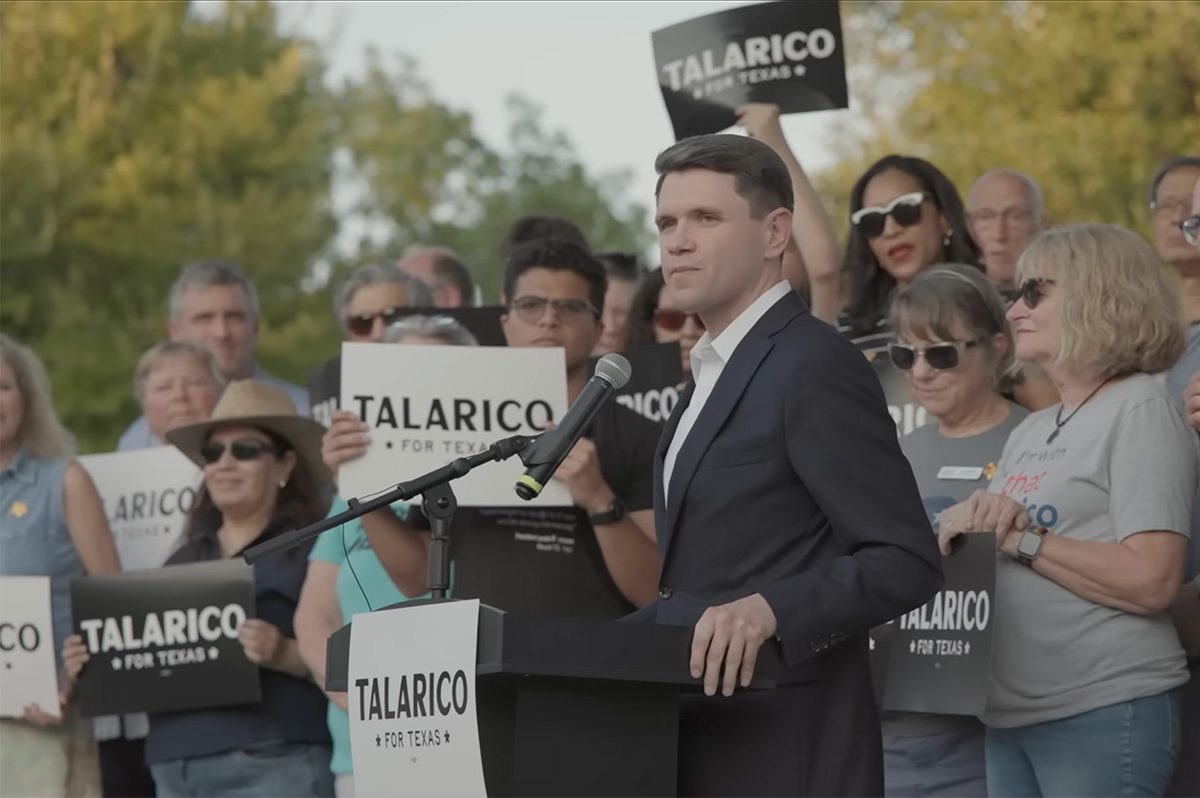
Texas state Rep. James Talarico won a hard-fought primary Tuesday to become the state’s Democratic nominee for U.S. Senate, defeating U.S. Rep. Jasmine Crockett in one of the year’s most closely watched and competitive Democratic contests.
Talarico, a Presbyterian seminarian and three-term lawmaker from Round Rock, was declared the winner by the Associated Press early Wednesday morning after a closely tracked vote count that drew national attention.
“Tonight, the people of our state gave this country a little bit of hope,” Talarico told the AP. “And a little bit of hope is a dangerous thing.”
With 52.8% of the vote to Crockett’s 45.9%, Talarico secured the nomination outright, avoiding a runoff and capping months of sharp contrasts between the two candidates over strategy, messaging, and how best to compete statewide in Texas. Democrats hope the competitive primary — and the relatively narrow margin — signals growing momentum in a state that has not elected a Democrat to the U.S. Senate since 1988.
Talarico has long expressed support for the LGBTQ community, a position he highlights prominently on his campaign website. Under the “Issues” section, he directly addresses assumptions that might arise from his faith and background as a seminarian in a deeply conservative state.
“My faith in Jesus leads me to reject Christian Nationalism and commit myself to the project of democracy,” his website reads. “Because that’s the promise of America: a democracy where every person and every family — regardless of religion, race, gender, sexual orientation, or any other difference between us — can truly be free and live up to their full potential.”
Crockett struck a conciliatory tone following her defeat, emphasizing party unity ahead of November.
“This morning I called James and congratulated him on becoming the Senate nominee,” Crockett told Politico. “Texas is primed to turn blue and we must remain united because this is bigger than any one person. This is about the future of all 30 million Texans and getting America back on track.”
Talarico also drew national attention earlier in the race when “Late Show” host Stephen Colbert said he was initially unable to air an interview with the state legislator due to potential FCC concerns involving CBS. The episode sparked a broader political debate.
Brendan Carr, chair of the Federal Communications Commission, appointed by President Donald Trump, told reporters the controversy was a “hoax,” though he also acknowledged Talarico’s ability to harness the moment to build support as an underdog candidate. The interview was later released online and garnered millions of views, boosting Talarico’s national profile.
In November, Talarico will face the winner of the Republican primary between incumbent Sen. John Cornyn and Texas Attorney General Ken Paxton, who have been locked in a bruising GOP contest. Rep. Wesley Hunt was also in the Republican primary field. The GOP race is expected to head to a May runoff.
In a joint statement, Senate Minority Leader Chuck Schumer and Democratic Senatorial Campaign Committee Chair Kirsten Gillibrand praised Talarico’s victory and framed him as a candidate capable of broad appeal.
“As an eighth-generation Texan, former middle school teacher, and Presbyterian seminarian, James will be a fighter for Texans from all walks of life and of all political stripes,” they said. “In November, Texans will elect a champion for working people: James Talarico.”
National
Peter Thiel’s expanding power — and his overlap with Jeffrey Epstein
Gay billionaire’s name appears 2,200 times in files, but no criminality alleged
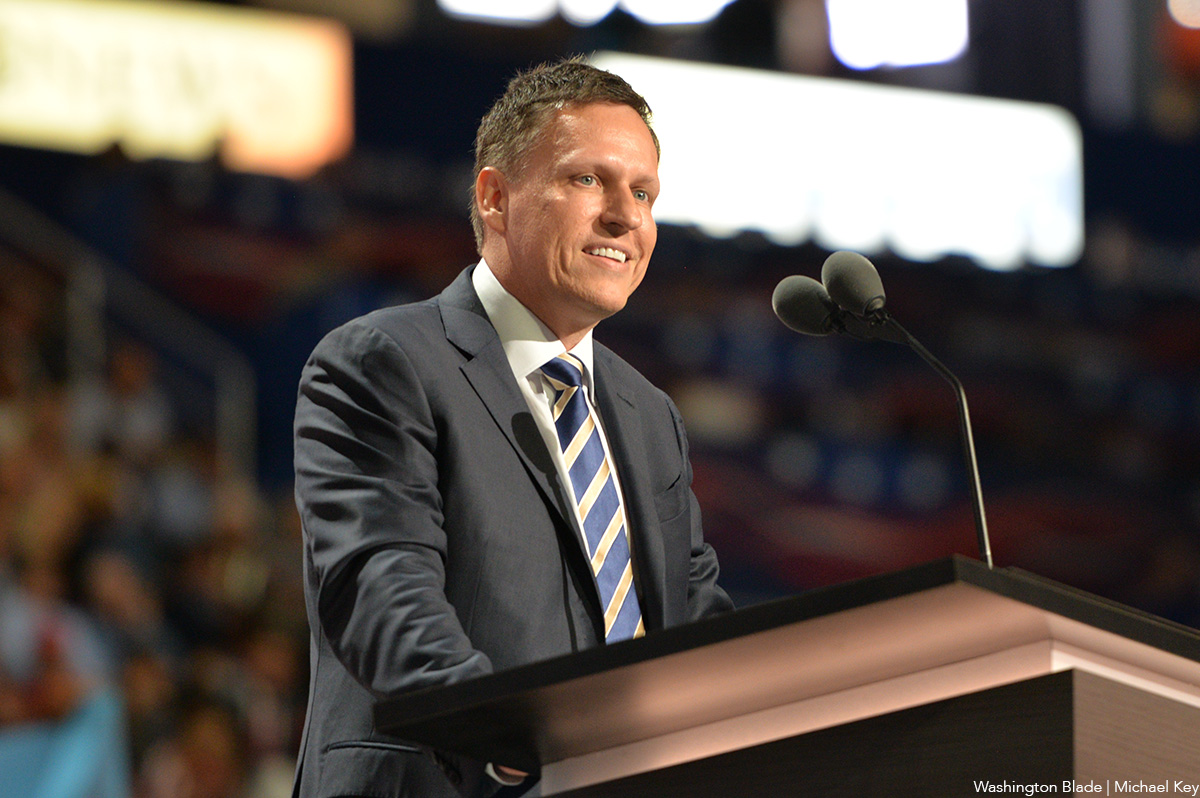
There are few figures in modern politics whose reach extends across Silicon Valley, Wall Street, and Washington, D.C., as Peter Thiel’s.
A billionaire venture capitalist, Thiel built his fortune at the dawn of the internet age and has since positioned himself at the highest levels of U.S. technology, finance, and national defense infrastructure. He is best known as a co-founder of PayPal, an early investor in Facebook, and the co-founder of Palantir Technologies — a data analytics firm that maintains significant contracts with U.S., U.K., and Israeli defense and intelligence agencies.
Over the last two decades, Thiel has also built an interconnected network of investment vehicles — Clarium Capital, Founders Fund, Thiel Capital, Valar Ventures, and Mithril Capital — giving him influence over emerging technologies, political candidates, and ideological movements aligned with his worldview. Through these firms, Thiel has backed companies in artificial intelligence, defense technology, biotech, cryptocurrency, and financial services, often positioning himself early in sectors that later became central to public policy debates.
Born in Frankfurt, West Germany, in 1967, Thiel immigrated to the United States as an infant. He later attended Stanford University, earning a degree in philosophy before graduating from Stanford Law School in 1992. As an undergraduate, he founded The Stanford Review, a conservative student publication that opposed what it described as campus “political correctness.” The paper became a platform for combative and contrarian arguments that previewed themes Thiel would revisit in later essays and speeches about elite institutions, democracy, and technological stagnation.
Thiel’s professional ascent coincided with the explosive growth of the dot-com era. In 1998, he co-founded PayPal, helping pioneer digital payment systems that would become foundational to online commerce. When the company was sold to eBay in 2002 for $1.5 billion, Thiel emerged a multimillionaire and part of what would later be known as the “PayPal Mafia” — a loose but influential network of founders and early employees who went on to launch or invest in some of Silicon Valley’s most dominant firms.
In 2004, Thiel made one of the most consequential investments of his career, providing $500,000 in seed funding to Facebook, then a fledgling social network founded by Mark Zuckerberg. He became the company’s first outside investor and later served on its board. That early bet proved extraordinarily lucrative and cemented Thiel’s status as a major venture capitalist with a reputation for identifying transformative platforms before they reached scale.
The same year, he co-founded Palantir Technologies. Initially backed in part by In-Q-Tel, the CIA’s venture capital arm, Palantir developed software — including its Gotham platform — designed to help defense, intelligence, and law enforcement agencies integrate and analyze massive datasets. The company’s tools allow users to map relationships, identify patterns, and visualize complex networks across financial records, communications data, and other digital trails.
Over time, Palantir secured billions of dollars in public-sector contracts. It has worked with the U.S. Department of Defense, Immigration and Customs Enforcement, the Centers for Disease Control and Prevention, and allied governments abroad. Public reporting has documented that its global government contracts exceed $1.9 billion, including agreements with Israeli defense entities — relationships that reportedly expanded following the Oct. 7 attacks in Israel. Critics have raised concerns about civil liberties and surveillance, while supporters argue the company provides essential national security tools.
By the mid-2000s, Thiel was no longer simply a wealthy entrepreneur. He was a financier operating at the intersection of capital, advanced technology, and government — with investments embedded in some of the country’s most sensitive security systems. His political giving would later extend that influence further, including support for candidates aligned with his populist and nationalist leanings– notably Donald Trump in 2016.
As his wealth and influence expanded, so too did his proximity to other powerful — and, in some cases, controversial — figures in global finance.
Among them was Jeffrey Epstein.
Thiel’s name appears more than 2,200 times in documents released so far by the U.S. Department of Justice related to Epstein. A name appearing in legal filings does not, by itself, indicate wrongdoing. However, the extensive references illustrate that Epstein’s social and financial network intersected with elite figures in technology, academia, politics, and finance — including individuals connected to Thiel’s business and philanthropic circles.
Epstein’s legal troubles became public in 2005, when police in Palm Beach, Fla., investigated allegations that he had sexually abused a minor. In 2008, he pleaded guilty in state court to soliciting prostitution from a minor under a plea agreement that was widely criticized as unusually lenient. He served 13 months in county jail with work-release privileges and was required to register as a sex offender. Comparable federal charges can carry significantly longer sentences.
Despite that conviction, Epstein continued to maintain relationships with prominent business and political figures for years. The extent to which members of elite networks remained in contact with him after his guilty plea has been the subject of extensive scrutiny.
Documents released by the Justice Department indicate that individuals connected to Thiel’s philanthropic and investment circles communicated with Epstein after his conviction. One document shows an invitation, sent on behalf of the Thiel Foundation, for Epstein to attend a technology event in San Francisco. Additional financial records and reporting indicate that between 2015 and 2016, Epstein invested approximately $40 million in funds managed by Valar Ventures, one of Thiel’s firms. Other records reflect meetings and correspondence, at times arranged through intermediaries. Epstein also extended invitations to his Caribbean residence.
There is no evidence that Thiel was involved in Epstein’s criminal conduct. The documented interactions do, however, show numerous planned meetings between the two both in the Caribbean (where Epstein’s infamous island is located) and across the world, while also raising questions about why business relationships continued after Epstein had pleaded guilty to a sex offense involving a minor and was a registered sex offender. For critics, that continued engagement speaks to the insular nature of elite finance, where access to capital and networks can override reputational risk.
Palantir represents another overlap. In emails made public through Justice Department releases, Epstein referenced Palantir in correspondence with Ehud Barak, the former Israeli prime minister who also maintained ties to Epstein. The emails do not indicate that Epstein had operational involvement in Palantir or access to its systems, however, they show that he discussed one of Thiel’s most strategically significant companies — a firm deeply integrated into Western defense and intelligence systems — with senior political figures abroad.
Separately, Thiel’s long-running dispute with Gawker Media offers additional insight into how he has exercised power outside traditional political channels.
After Gawker published an article in 2007 that publicly identified Thiel as gay, he later secretly funded litigation brought by professional wrestler Hulk Hogan over the outlet’s publication of a sex tape. The lawsuit resulted in a $140 million judgment against Gawker, which ultimately filed for bankruptcy. Thiel later confirmed his financial backing of the case, framing it as a defense of privacy and a response to what he considered reckless media behavior.
The episode demonstrated Thiel’s willingness to deploy substantial financial resources strategically and, at times, discreetly. It also illustrated how wealth can be used to influence institutions — whether through venture capital, political donations, or litigation.
Taken together, the record does not establish criminal liability for Thiel in connection with Epstein. It does, however, situate him within a dense web of elite finance, national security contracting, political influence, and reputation management. As additional documents related to Epstein continue to emerge, that web — and the decisions made within it — remains a subject of public interest and ongoing scrutiny.

13 HIV/AIDS activists arrested on Capitol Hill

PHOTOS: Sydney Gay and Lesbian Mardi Gras Parade

An undeclared war of distraction by the felon

Talarico beats Crockett in Texas primary

35 years after ‘Truth or Dare,’ Slam is still dancing

Out actor Kevin Cahoon on starring role in ‘Chez Joey’

PHOTOS: Pride Reveal

Love or fear flying you’ll devour ‘Why Fly’

Arlington LGBTQ bar Freddie’s celebrates 25th anniversary