
Theater
Quick change artist
Smith embodies interviewees in tour de force health care survey
‘Let Me Down Easy’
Through Feb. 13
1101 Sixth Street, S.W.
$40-$85
202-554-9066
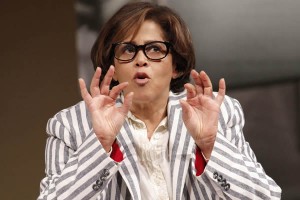
Anna Deavere Smith in Second Stage's production of 'Let Me Down Easy,' directed by Leonard Foglia. (Photo by Joan Marcus; courtesy of Second Stage)
With her solo show “Let Me Down Easy,” Anna Deavere Smith again holds up mirrors. This time, they’re on health care.
The topic of discussion isn’t as laser focused as Smith’s previous forays into the one-woman arena (“Fire in the Mirror” and “Twilight: Los Angeles,” about the riots in Crown Heights and South Central, respectively), but the touring show’s message is still pretty clear: neither illness nor U.S. health care are fair. Through a selection of 20 disparate, engrossing testimonials, Smith, who declines to disclose her sexual orientation, gradually makes her point.
As with her earlier works, Smith extracts her monologues verbatim from interviews she conducted. A consummate mimic, she brilliantly trots a cross-section of America (including a boxer, bull rider, doctor, Buddhist monk, professor) onto the stage of Arena’s intimate Kreeger Theatre, seamlessly morphing from one person to the next. As she takes on their physicality, voice and demeanor without ever entirely losing her own formidable presence in the enthralling process, Smith allows us to meet her interviewees (each of whom is identified by a projected name and title) and to seemingly learn their stories firsthand.
Longtime model Lauren Hutton, never one to be deterred by the velvet rope, brags about gaining entrée to New York’s best health care professionals. It’s all about connections. Seven-time Tour de France winner Lance Armstrong discusses how his intensely competitive nature helped him to beat cancer and eventually return to his sport. Lesbian choreographer Elizabeth Streb remembers lighting herself on fire as she performed a fire dance for her girlfriend. Not all of Smith’s subjects are well known. Her aunt, retired Baltimore school teacher Lorraine Coleman, hilariously recalls the last words her dying sister said to her: “You still got that big ass!”
During her 100-minute performance, Smith goes beyond the usual health care arguments. Yes, Brent Williams, a repeatedly banged-up bull rider, clearly expresses his distrust of doctors and a medical school dean suggests that patients and doctors might consider discussing the extent of end-of-life care (a notion notoriously referred to as “death panels” by opponents of health care reform), but for the most part, Smith relies on the personal experiences of patients and caregivers alike.
In the particularly poignant and uncanny portrayals of feisty Texas governor Ann Richards and TV movie critic Joel Siegel, Smith reveals the enduring humor and resilient spirits of two strong individuals at different stages in their ultimately losing battles with cancer.
One of the show’s more gripping contributions comes from Kiersta Kurtz-Burke, a physician at Charity Hospital in New Orleans. The doctor forcefully shares her dismay when she discovered during Hurricane Katrina that despite her previous beliefs, she was unable to offer her underserved patients services on par with private hospitals. Kurtz-Burke describes the heroic behavior of the African-American nurses, orderlies and patients who tirelessly braved the storm under primitive conditions, taking in stride what for them was just another instance of the government letting them down (not so easily in their case).
Staged by Broadway’s Leonard Foglia, Smith does her thing on a round stage backed, appropriately, by five huge mirrors. She wears a tailored white shirt and dark pinstriped pants to which she adds and subtracts jackets, a tie or lab coat depending on the character. By show’s end the stage is littered with tea trays, garments and coffee cups, visual reminders of those who have and have not added their thoughts to the discussion.
After the 20 vivid tales completely unfold, Smith seems to intentionally leave us with a discouraging, sometimes hopeful, but ultimately unfinished picture of life, death and health care in America.




Theater
‘Amm(i)gone’ explores family, queerness, and faith
A ‘fully autobiographical’ work from out artist Adil Mansoor

‘Amm(i)gone’
Thorough May 12
Woolly Mammoth Theatre
641 D St., N.W.
$60-$70
Woollymammoth.net
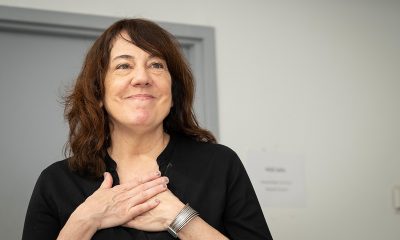
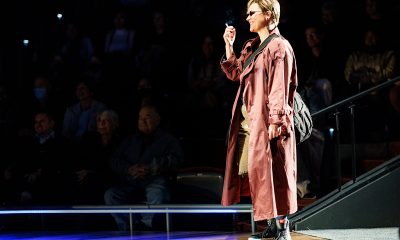
“Fully and utterly autobiographical.” That’s how Adil Mansoor describes “Amm(i)gone,” his one-man work currently playing at Woolly Mammoth Theatre.
Both created and performed by out artist Mansoor, it’s his story about inviting his Pakistani mother to translate Sophocles’s Greek tragedy “Antigone” into Urdu. Throughout the journey, there’s an exploration of family, queerness, and faith,as well as references to teachings from the Quran, and audio conversations with his Muslim mother.
Mansoor, 38, grew up in the suburbs of Chicago and is now based in Pittsburgh where he’s a busy theater maker. He’s also the founding member of Pittsburgh’s Hatch Arts Collective and the former artistic director of Dreams of Hope, an LGBTQ youth arts organization.
WASHINGTON BLADE: What spurred you to create “Amm(i)gone”?
ADIL MANSOOR: I was reading a translation of “Antigone” a few years back and found myself emotionally overwhelmed. A Theban princess buries her brother knowing it will cost her, her own life. It’s about a person for whom all aspirations are in the afterlife. And what does that do to the living when all of your hopes and dreams have to be reserved for the afterlife?
I found grant funding to pay my mom to do the translation. I wanted to engage in learning. I wanted to share theater but especially this ancient tragedy. My mother appreciated the characters were struggling between loving one another and their beliefs.
BLADE: Are you more director than actor?
MANSOOR: I’m primarily a director with an MFA in directing from Carnegie Mellon. I wrote, directed, and performed in this show, and had been working on it for four years. I’ve done different versions including Zoom. Woolly’s is a new production with the same team who’ve been involved since the beginning.
I love solo performance. I’ve produced and now teach solo performance and believe in its power. And I definitely lean toward “performance” and I haven’t “acted” since I was in college. I feel good on stage. I was a tour guide and do a lot of public speaking. I enjoy the attention.
BLADE: Describe your mom.
MANSOOR: My mom is a wonderfully devout Muslim, single mother, social worker who discovered my queerness on Google. And she prays for me.
She and I are similar, the way we look at things, the way we laugh. But different too. And those are among the questions I ask in this show. Our relationship is both beautiful and complicated.
BLADE: So, you weren’t exactly hiding your sexuality?
MANSOOR: In my mid-20s, I took time to talk with friends about our being queer with relation to our careers. My sexuality is essential to the work. As the artistic director at Dreams of Hope, part of the work was to model what it means to be public. If I’m in a room with queer and trans teenagers, part of what I’m doing is modeling queer adulthood. The way they see me in the world is part of what I’m putting out there. And I want that to be expansive and full.
So much of my work involves fundraising and being a face in schools. Being out is about making safe space for queer young folks.
BLADE: Have you encountered much Islamophobia?
MANSOOR: When 9/11 happened, I was a sophomore in high school, so yes. I faced a lot then and now. I’ve been egged on the street in the last four months. I see it in the classroom. It shows up in all sorts of ways.
BLADE: What prompted you to lead your creative life in Pittsburgh?
MANSOOR: I’ve been here for 14 years. I breathe with ease in Pittsburgh. The hills and the valleys and the rust of the city do something to me. It’s beautiful, it’ affordable, and there is support for local artists. There’s a lot of opportunity.
Still, the plan was to move to New York in September of 2020 but that was cancelled. Then the pandemic showed me that I could live in Pittsburgh and still have a nationally viable career.
BLADE: What are you trying to achieve with “Amm(i)gone”?
MANSOOR: What I’m sharing in the show is so very specific but I hear people from other backgrounds say I totally see my mom in that. My partner is Catholic and we share so much in relation to this.
I hope the work is embracing the fullness of queerness and how means so many things. And I hope the show makes audiences want to call their parents or squeeze their partners.
Theater
Jessica Phillips shines in ‘Penelope,’ a ‘pandemic parable’
Alex Bechtel was inspired to write about loneliness, waiting, separation
‘Penelope’
Thorough April 28
Signature Theatre, the Ark
4200 Campbell Ave, Arlington
$40-$99
Sigtheatre.org
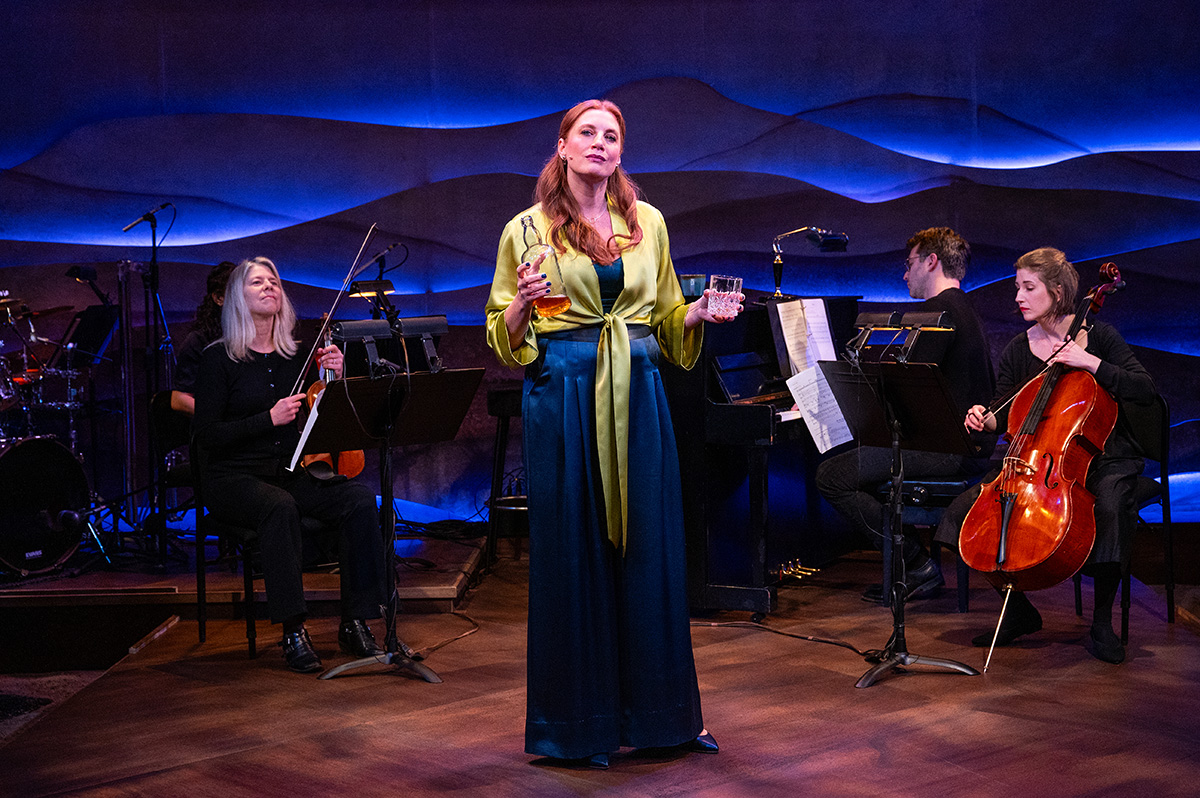
In the new musical “Penelope,” Broadway’s Jessica Phillips gives an unforgettable take on the title role torn from the pages of Homer’s “Odyssey” — more or less. Fortified by bourbon and backed by a Greek chorus of musicians, the character uncharacteristically steps out from the background to share her story surrounding two decades waiting on the island kingdom of Ithica for the return of her absent husband Odysseus.
Sometimes described as a “pandemic parable,” the 70-minute work is based on composer/playwright Alex Bechtel’s personal experience. While separated from his partner during COVID, he was inspired to write about loneliness, waiting, and separation, a subject Phillips was eager to tackle.
An accomplished Broadway actor and mother of two, Phillips, 52, is best known for memorable turns in “Dear Evan Hansen,” “The Scarlet Pimpernel,” “Next to Normal,” and “Priscilla Queen of the Desert.”
Two years ago, she made news for coming out as queer after having long been identified as straight. Parts of the theater scene were caught a bit off guard, but only momentarily. Now, she lives in New York with her partner Chelsea Nachman, a theatrical publicist.“We share the same professional community but in very different roles. I think that makes life easier for us.”
Currently enjoying an extended run at Signature in Arlington where the trees are in bloom, she spares time for a phone interview, starting off with“Perfect timing. I’ve just finished the last song on Beyonce’s ‘Cowboy Carter.’ Let’s talk.”
WASHINGTON BLADE: Increasingly, I hear artists report having been deeply changed by the pandemic. Did that have anything to do with your coming out in 2022?
PHILLIPS: Definitely. During the pandemic, those of us in the arts were in deep crisis, because our industry had collapsed in almost every way. At the same time, that space allowed us to be contemplative about where we were. For me, that period of time gave me the space to both come to terms with and confront those fears about saying who I was, out loud and publicly.
BLADE: Did you have professional concerns?
PHILLIPS: Oh yeah, I was specifically worried about perception. Not so much about being queer but more what it meant to have come out relatively late in life. I had some fear around whether people would take me less seriously.
At the same time, I was nervous about being fully transparent and worried about my privacy and being vulnerable. Like other women I knew, I was more comfortable dealing with traditional societal expectations in America. I grew up with those cultural expectations and thought of myself in those terms for a long time.
BLADE: What changed?
PHILLIPS: What’s been so freeing for me, I can confront how I took on those expectations and say I’m not going to let those determine how I live my life. I get to decide.
BLADE: There’s a lot of wonderful storytelling in “Penelope.” What’s been your way into that?
PHILLIPS: My way of moving through the show is allowing this character to experience all five stages of grief. Humor, slapstick comedy, bargaining, denial. And ultimately acceptance and deep grief.
When an audience is alive and invested, it’s palpable and elevates the storytelling. When an audience is having a thinking rather feeling experience that changes the tone of my storytelling and not in a bad way.
It’s interesting how much they’re a part of everything. It’s really intimate. The audience is just six feet away. It’s a unique experience and we’re on this ride together. And I find this to be a really beautiful and satisfying experience that I’ve not had before.
BLADE: After Signature, what’s next for “Penelope”?
PHILLIPS: That’s the million-dollar question. Hopefully we’ll take it forward to New York or tour it, but that requires willingness and money. I do think there’s a broad audience for this. It’s beautiful, unique, artistic, really emotional, and at the same time possesses an intellectual quality that’s missing from a lot of commercial theater these days.
BLADE: And what’s next for theater?
Phillips: I think one good thing that came out of the pandemic is that people like Alex Bechtel had an opportunity to create. In the next decade we’re going to see the results of that. I think we have some extraordinary things to look forward to. If a work like “Penelope” is any indication, we’re all in for something really good.
Theater
‘Nancy,’ soaked in ‘80s nostalgia, is ‘queer AF’
Mosaic production led by out director Ken-Matt Martin
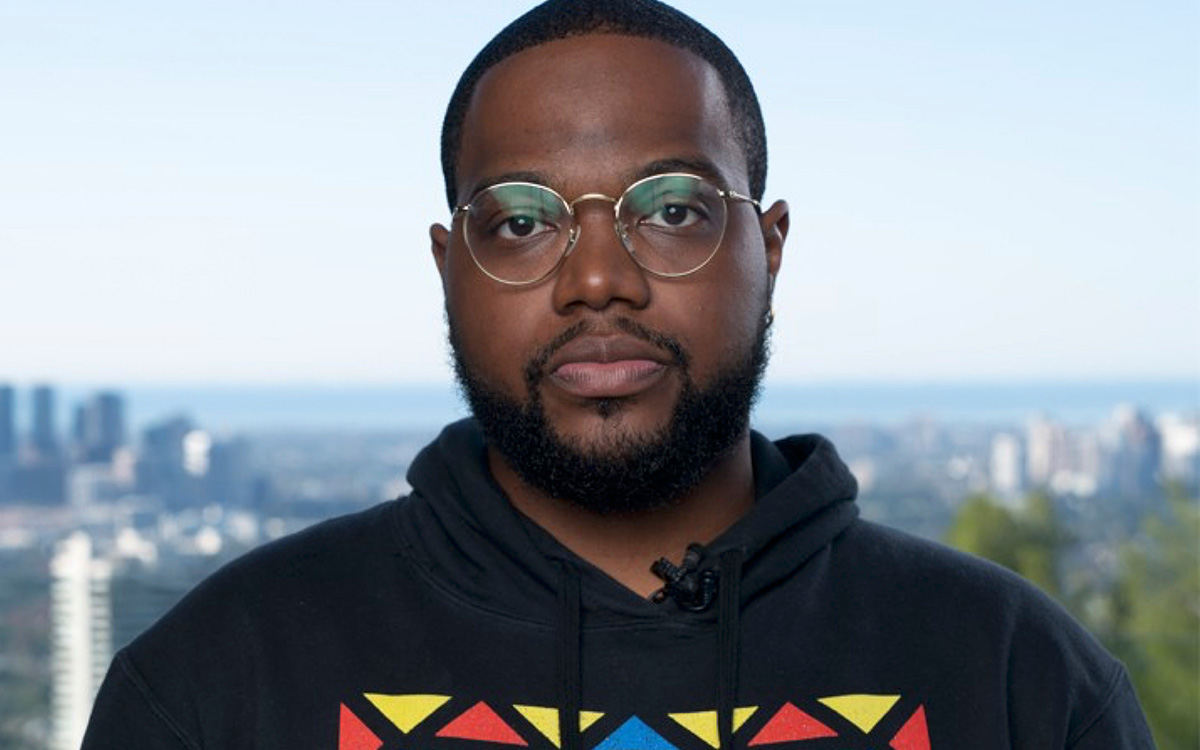
‘Nancy’
Through April 21
Mosaic Theater Company at Atlas Performing Arts Center
1333 H St., N.E.
$53-$70
Mosaictheater.org
Set in 1985, smack dab in the middle of the Reagan years, Rhiana Yazzie’s “Nancy” is totally soaked in nostalgia: shoulder pads, high hair, Van Halen, etc. For some theatergoers, it jogs the memory and for others serves as an introduction to an alien era.
Out director Ken-Matt Martin describes the production (now at Mosaic Theater) as “queer AF.” He continues, “But that’s true with everything I touch. My aesthetics and interests are unapologetically queer. When you first walk into theater, you see a big ass picture of Nancy’s face. The whole play is kind of set on her face.”
Martin, who puts his age as “somewhere over 30,” gives a brief rundown via telephone: “‘Nancy’ places two women on parallel tracks and we get to watch them on a collision course. Esmeralda [Anaseini Katoa], a Navajo mother and advocate determined to improve the condition of her family and reservation. Her story is juxtaposed to that of Nancy Reagan [Lynn Hawley] who’s busy at the White House consulting with society astrologer Joan Quigley to help guide Reagan [Michael Kevin Darnall] and his administration. The women’s worlds come together over Nancy’s direct ancestral connection to Pocahontas.”
The busy storyline also includes a moment surrounding Rock Hudson’s final days, a moment when well-coiffed, clothes-crazy Nancy was presented with the opportunity to make a difference but chose not to.
“And the work doesn’t let Nancy off the hook,” adds Martin. “It’s a full meal of a play.”
Produced in partnership with New Native Theatre based in the Twin Cities, Mosaic’s epic offering, a very D.C. play about ancestry and ambition, almost looks at Ron and Nancy as cartoon characters but isn’t without empathy.
Martin and Yazzie both love satire and absurdity; they enjoy comedy and things that are funny until they’re not. So, the evening shifts in tone as it moves into more serious areas, particularly an exploration of how the ‘80s and Reagan’s failed trickle-down agenda set the stage for many of today’s problems.
The director’s way into theater was as a child actor. After successfully begging his mother to drive him from their native Little Rock, Ark., to a regional Atlanta audition, he booked an appearance on Nickelodeon’s landmark series “All That” and snagged an agent in the process. He continued to act for a time before becoming interested in other facets of showbiz.
After graduating with an MFA in directing from Brown University/Trinity Repertory Company, Martin embarked on a terrifically busy schedule. In addition to freelance directing, he has helmed and helms various prestigious companies as artistic director and managing producer (Pyramid Theatre Company in Des Moines, IA, Victory Gardens Theater in Chicago, and was recently appointed Interim Artistic Director of Baltimore Center Stage and Arkansas Repertory Theatre.)
Currently an itinerant professional (Martin gave up his place in Chicago and hops from job to job where they house him), he says, “It can get a little old, but overall, not bad at all.”
Next up, Martin is directing Olney Theatre’s production “Long Way Down,” the adaptation of a Young Adult novel by DMV native Jason Reynolds. “It’s a big regional tryout that after a limited engagement in Olney leaves for the Apollo Theatre in New York. I’m excited.”
Martin is at home with plays that are tricky to stage, making him a good fit for “Nancy” with its multiple locations, scope, and scale. He’s enjoyed the challenge of the work’s collapsing time lines and the playwright’s tough, complicated, smart, and fast-moving language.
“Perhaps most importantly,” he adds. “Rhiana has entrusted me with the opportunity to tell this very unique story, a story that can resonate with Native people and Native audiences. This part is very new to me as a director.”

Calendar: April 26-May 2

‘Housekeeping for Beginners’ embraces true meaning of family

Should I divorce my husband for the hot new guy in our building?

Mexican Senate approves bill to ban conversion therapy

Four states to ignore new Title IX rules protecting transgender students

State Department releases annual human rights report

Joe Vogel campaign holds ‘Big Gay Canvass Kickoff’

Smithsonian staff concerned about future of LGBTQ programming amid GOP scrutiny

Catching up with the asexuals and aromantics of D.C.

Argentina government dismisses transgender public sector employees
-
 State Department3 days ago
State Department releases annual human rights report
-
 Maryland5 days ago
Joe Vogel campaign holds ‘Big Gay Canvass Kickoff’
-
 Politics4 days ago
Smithsonian staff concerned about future of LGBTQ programming amid GOP scrutiny
-
 District of Columbia1 day ago
Catching up with the asexuals and aromantics of D.C.