National
Stark introduces adoption anti-discrimination bill
Calif. lawmaker wants Obama to endorse measure ‘wholeheartedly’

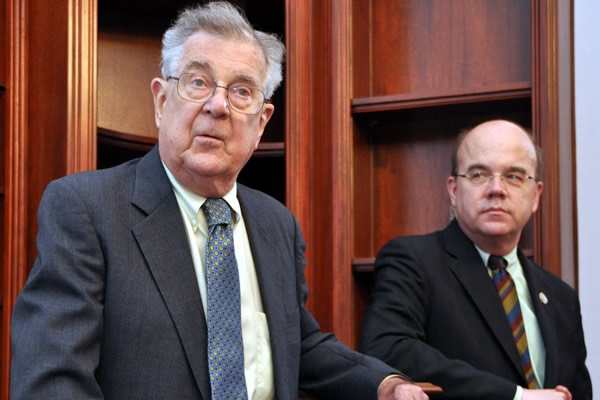
Reps. Pete Stark (left) and Jim McGovern on Tuesday introduced the Every Child Deserves a Family Act (Blade photo by Michael Key)
A U.S. House member from California on Tuesday introduced legislation that would bar discrimination against LGBT people in adoption cases while calling on President Obama to endorse the bill “wholeheartedly.”
During a news conference, Rep. Pete Stark (D-Calif.), the sponsor of the legislation, known as the Every Child Deserves a Family Act, said he wants the White House to support his bill fully in response to a question from the Washington Blade on what he’d like to see from the administration on the issue.
“I’d like to see the administration support our position more definitively,” Stark said. “I’ve had some troubles often determining where the administration is on issues, and I think it’s time that President Obama steps up to the bar and makes this — supports it wholeheartedly.”
Shin Inouye, a White House spokesperson, said in a statement that Obama believes that adoption rights should be afforded to all Americans and supports the goals of the legislation, but stopped short of offering an explicit endorsement of Stark’s bill. The lack of outright support is unlike the president’s position on other pro-LGBT initiatives, such as the Employment Non-Discrimination Act or “Don’t Ask, Don’t Tell” repeal.
“The president has long believed that we must ensure adoption rights for all couples and individuals, regardless of their sexual orientation,” Inouye said. “He recognizes that adoptive families come in many forms, and that we must do all we can to break down barriers to ensure that all qualified caregivers have the ability to serve as adoptive families. While we have not reviewed this specific legislation, we share its goals to expand adoption rights and move the dialogue forward on this issue.”
The Every Child Deserves a Family Act, which has 33 original co-sponsors, would restrict federal funds for states that allow discrimination in adoption or foster care placement based on the sexual orientation, marital status or gender identity of potential parents — as well as LGBT children seeking homes. Sen. Kirsten Gillibrand (D-N.Y.) is expected to introduce companion legislation in June in the Senate.
Some states recently have taken steps to inhibit potential LGBT parents from adopting. Last month, Arizona Gov. Jan Brewer (R) signed legislation that would give primary consideration in adoptive placement to opposite-sex married couples. Additionally, Virginia’s State Board of Social Services recently rejected adding protections against discrimination in adoption cases on the basis of sexual orientation as well as other statuses.
At the news conference, Stark billed the legislation as a means to ensure children living in the foster care system have access to a greater number of adoptive families — including households with single parents or same-sex parents.
“What’s in the child’s best interest is what the bill is trying to promote,” Stark said. “There is no information that shows that children raised by a single parent or gay or lesbian parent households have any more or less problems than all other children.”
According to Stark’s office, the U.S. government spends more than $7 billion each year on a foster care system against potential single and LGBT parents and allows around 25,000 children age out annually. More than 500,000 children are in foster care and 120,000 of them available for adoption.
Rep. Jim McGovern (D-Mass.), an original co-sponsor for the bill, said the Every Child Deserves a Family Act is necessary to eliminate discrimination against potential LGBT parents and to iron out the differences in adoption policy throughout the country.
“Automatically disqualifying LGBT parents from adoption just because of sexual orientation is wrong,” McGovern said. “It makes no sense, especially when so many children are in foster care waiting to be adopted. The current patchwork of unfair state laws and policies … is denying multiple kids to permanent safe and stable homes.”
The issue of LGBT adoption has already emerged as an issue for a Republican who could be considering a run in the 2012 presidential campaign. According to Think Progress, former U.S. Sen. Rick Santorum, who’s widely expected to be eyeing a White House bid, said in a speech Monday before the FAMiLY Leader in Iowa that adoption is a “privilege” to which LGBT people aren’t entitled.
“A lesbian woman walked up to me and said, ‘Why are you denying me my right?’” Santorum said. “I said, ‘Well, because it’s not a right.’ It’s a privilege. It’s a privilege that society recognizes because society sees intrinsic value to that relationship over any other relationship.”
During the news conference, Stark blasted Santorum for his anti-gay comments and said the former senator’s opinion is no longer relevant because he was voted out in 2006.
“Rick who?” Stark said. “There was a guy in Congress years ago named Santorum, but I think he left. He lost, but [has been] following that path ever since. I think that’s nonsense.”
Organizations that work on LGBT advocacy and child welfare — including the Family Equality Council and Parents, Families & Friends of Lesbians & Gays — praised Stark for introducing the legislation as means to end discrimination and allow more children to find homes.
Linda Spears, vice president of policy and public affairs for the Child Welfare League of America, said passage of the Every Child Deserves a Family Act would help ensure children who are waiting in foster care can find homes.
“We must recognize that statutory frameworks are absolutely essential in order to get this job done,” Spears said. “We cannot have policies in which kids are systemically disadvantaged by state law and by state policy. We cannot have policies that disadvantage and allow children to linger in foster care, those who categorically exclude certain families and put other kids in legal limbo because second parents are not allowed to adopt.”
Jennifer Chrisler, executive director of the Family Equality Council, similarly said the legislation is needed to counter what she called “despicable” attempts at the state level aimed at impairing the right to adopt for LGBT people.
“These efforts are divisive, there are despicable, and they push a political agenda at the expense who some of those children who are most vulnerable — the thousands of kids who are living in foster care, [excluding them] from loving, permanent homes,” Chrisler said.
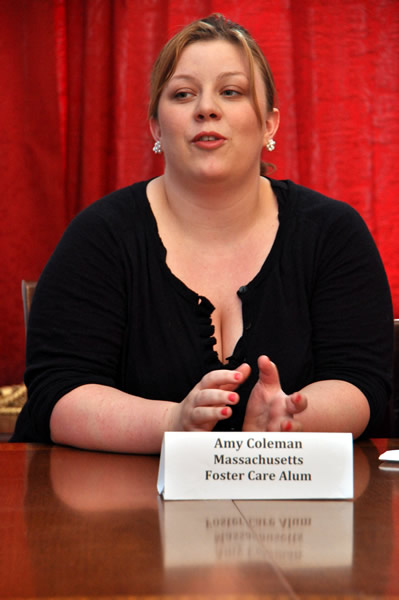
Amy Coleman, a Massachusetts foster care alum (Blade photo by Michael Key)
Amy Coleman, a Massachusetts foster care alum who was adopted at age 16 by lesbian parents, pressed for legislation allowing full adoption rights for LGBT families by recalling the story of her own adoption.
“My moms have been loving, wonderful parents and will continue to be loving, wonderful parents,” Coleman said. “I just felt it was important to come down and share that so that other foster kids know that there are homes out there for them that might not be traditional, but are definitely wanting to take them in, so they don’t have to spend their rest of their time in foster care wondering if there is someone who can, or will, adopt them.”
Moving the legislation will be challenging in the Republican-controlled House, where the bill will likely be assigned to the House Ways & Means Committee. The office of the committee chair, Rep. Dave Camp (R-Mich.), didn’t respond on short notice to the Blade’s request to comment on the measure.
Stark said he hasn’t spoken with Camp about the Every Child Deserves a Family Act, but added the adoption issue could come before the House Ways & Means Committee in some capacity.
“I suppose that we’ll have a hearing on this at some point — one way or the other,” Stark said. “The press will require it or the Republicans will in opposition to it. The hearings may not be favorable, but there may very well be hearings on it.”
As of Tuesday, the legislation had no Republican co-sponsors, although Stark suggested that the bill may gain GOP support because he’s spoken to a Republican lawmaker who has indicated interest. Stark didn’t identify the U.S. House member.
The list of original co-sponsors for the legislation notably lacks the names of Democratic lawmakers who usually sign on to pro-LGBT legislation — including House Minority Leader Nancy Pelosi (D-Calif.) as well as gay Reps. Barney Frank (D-Mass.) and David Cicilline (D-R.I.).
Drew Hammill, a Pelosi spokesperson, said the Democratic leader will sign on as co-sponsor.
Harry Gural, a Frank spokesperson, said his boss wasn’t asked to support the Every Child Deserves a Family Act.
“Congressman Frank considers co-sponsoring a bill when he is asked by the member introducing the bill, when one of that member’s staff makes a request via our staff, or when he gets a request from a constituent,” Gural said. “In this case, none of those took place.”
Jessica Kershaw, a Cicilline spokesperson, said the legislation is on her boss’ radar and he’s reviewing it.
Despite the lack of outright support from the White House, one LGBT rights organization maintained the Obama administration is already working to address adoption discrimination through administrative means.
Fred Sainz, the Human Rights Campaign’s vice president of communications, said the Department of Health & Human Services is “doing a substantial amount of work” as part of HRC’s “All Children All Families” initiative, an agency by agency approach to preventing LGBT discrimination in adoption cases, which aims for the same results as Stark’s legislation.
“At the same time, HRC is working with the HHS to provide greater incentives to states, tribes and territories which receive federal funds to establish more inclusive practices,” Sainz said. “The Informational Memorandum on LGBT youth and families which went out two weeks ago, and was largely a result of our advocacy, is a good example of that ongoing work.”
Sainz was referring to an April 6 memo from HHS encouraging child welfare agencies to serve better the needs of LGBT youth in the foster care system. The memo states agencies should avail themselves of federal funds for training staff on serving LGBT children and called LGBT potential parents an untapped resource for providing homes for LGBT youth.



Kansas
ACLU sues Kansas over law invalidating trans residents’ IDs
A new Kansas bill requires transgender residents to have their driver’s licenses reflect their sex assigned at birth, invalidating current licenses.
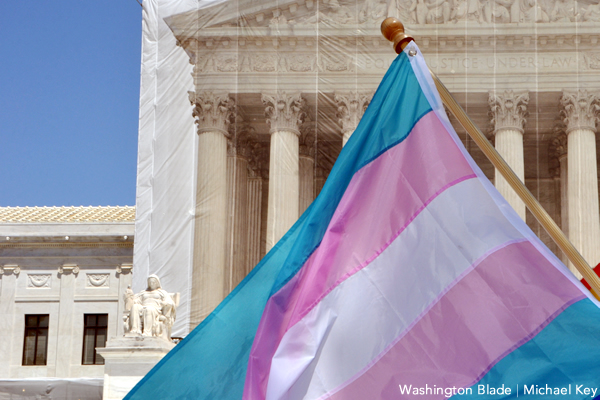
Transgender people across Kansas received letters in the mail on Wednesday demanding the immediate surrender of their driver’s licenses following passage of one of the harshest transgender bathroom bans in the nation. Now the American Civil Liberties Union is filing a lawsuit to block the ban and protect transgender residents from what advocates describe as “sweeping” and “punitive” consequences.
Independent journalist Erin Reed broke the story Wednesday after lawmakers approved House Substitute for Senate Bill 244. In her reporting, Reed included a photo of the letter sent to transgender Kansans, requiring them to obtain a driver’s license that reflects their sex assigned at birth rather than the gender with which they identify.
According to the reporting, transgender Kansans must surrender their driver’s licenses and that their current credentials — regardless of expiration date — will be considered invalid upon the law’s publication. The move effectively nullifies previously issued identification documents, creating immediate uncertainty for those impacted.
House Substitute for Senate Bill 244 also stipulates that any transgender person caught driving without a valid license could face a class B misdemeanor, punishable by up to six months in jail and a $1,000 fine. That potential penalty adds a criminal dimension to what began as an administrative action. It also compounds the legal risks for transgender Kansans, as the state already requires county jails to house inmates according to sex assigned at birth — a policy that advocates say can place transgender detainees at heightened risk.
Beyond identification issues, SB 244 not only bans transgender people from using restrooms that match their gender identity in government buildings — including libraries, courthouses, state parks, hospitals, and interstate rest stops — with the possibility for criminal penalties, but also allows for what critics have described as a “bathroom bounty hunter” provision. The measure permits anyone who encounters a transgender person in a restroom — including potentially in private businesses — to sue them for large sums of money, dramatically expanding the scope of enforcement beyond government authorities.
The lawsuit challenging SB 244 was filed today in the District Court of Douglas County on behalf of anonymous plaintiffs Daniel Doe and Matthew Moe by the American Civil Liberties Union, the ACLU of Kansas, and Ballard Spahr LLP. The complaint argues that SB 244 violates the Kansas Constitution’s protections for personal autonomy, privacy, equality under the law, due process, and freedom of speech.
Additionally, the American Civil Liberties Union filed a temporary restraining order on behalf of the anonymous plaintiffs, arguing that the order — followed by a temporary injunction — is necessary to prevent the “irreparable harm” that would result from SB 244.
State Rep. Abi Boatman, a Wichita Democrat and the only transgender member of the Kansas Legislature, told the Kansas City Star on Wednesday that “persecution is the point.”
“This legislation is a direct attack on the dignity and humanity of transgender Kansans,” said Monica Bennett, legal director of the ACLU of Kansas. “It undermines our state’s strong constitutional protections against government overreach and persecution.”
“SB 244 is a cruel and craven threat to public safety all in the name of fostering fear, division, and paranoia,” said Harper Seldin, senior staff attorney for the ACLU’s LGBTQ & HIV Rights Project. “The invalidation of state-issued IDs threatens to out transgender people against their will every time they apply for a job, rent an apartment, or interact with police. Taken as a whole, SB 244 is a transparent attempt to deny transgender people autonomy over their own identities and push them out of public life altogether.”
“SB 244 presents a state-sanctioned attack on transgender people aimed at silencing, dehumanizing, and alienating Kansans whose gender identity does not conform to the state legislature’s preferences,” said Heather St. Clair, a Ballard Spahr litigator working on the case. “Ballard Spahr is committed to standing with the ACLU and the plaintiffs in fighting on behalf of transgender Kansans for a remedy against the injustices presented by SB 244, and is dedicated to protecting the constitutional rights jeopardized by this new law.”
National
After layoffs at Advocate, parent company acquires ‘Them’ from Conde Nast
Top editorial staff let go last week
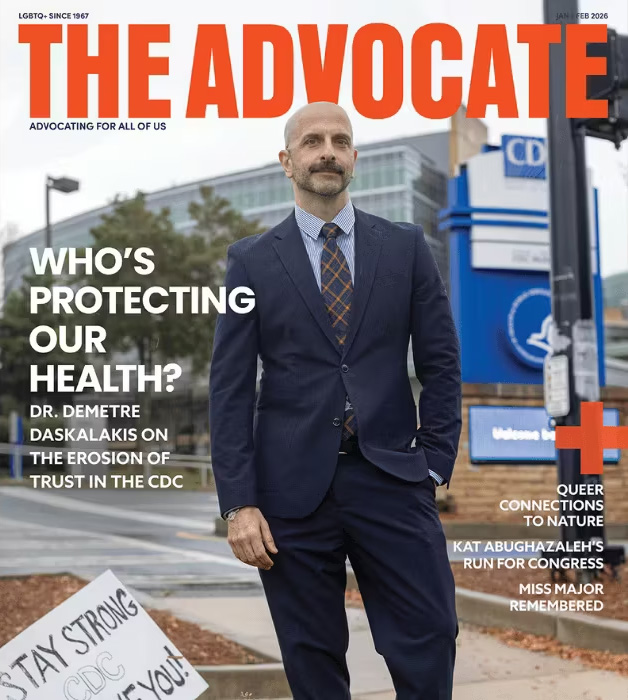
Former staff members at the Advocate and Out magazines revealed that parent company Equalpride laid off a number of employees late last week.
Those let go included Advocate editor-in-chief Alex Cooper, Pride.com editor-in-chief Rachel Shatto, brand partnerships manager Erin Manley, community editor Marie-Adélina de la Ferriére, and Out magazine staff writers Moises Mendez and Bernardo Sim, according to a report in Hollywood Reporter.
Cooper, who joined the company in 2021, posted to social media that, “Few people have had the privilege of leading this legendary LGBTQ+ news outlet, and I’m deeply honored to have been one of them. To my team: thank you for the last four years. You’ve been the best. For those also affected today, please let me know how I can support you.”
The Advocate’s PR firm when reached by the Blade said it no longer represents the company. Emails to the Advocate went unanswered.
Equalpride on Friday announced it acquired “Them,” a digital LGBTQ outlet founded in 2017 by Conde Nast.
“Equalpride exists to elevate, celebrate and protect LGBTQ+ storytelling at scale,” Equalpride CEO Mark Berryhill said according to Hollywood Reporter. “By combining the strengths of our brands with this respected digital platform, we’re creating a unified ecosystem that delivers even more impact for our audiences, advertisers, and community partners.”
It’s not clear if “Them” staff would take over editorial responsibilities for the Advocate and Out.
Federal Government
Two very different views of the State of the Union
As Trump delivered his SOTU address inside the Capitol, Democratic lawmakers gathered outside in protest, condemning the administration’s harmful policies.

As President Donald Trump delivered his State of the Union address inside the U.S. Capitol — touting his achievements and targeting political enemies — progressive members of Congress gathered just outside in protest.
Their message was blunt: For many Americans, particularly LGBTQ people, the country is not better off.
Each year, as required by Article II, Section 3 of the Constitution, the president must “give to the Congress Information of the State of the Union.” The annual address is meant to outline accomplishments and preview the year ahead. This year, Trump delivered the longest State of the Union in U.S. history, clocking in at one hour and 48 minutes. He spoke about immigration, his “law and order” domestic agenda, his “peace through strength” foreign policy doctrine, and what he framed as the left’s ‘culture wars’ — especially those involving transgender youth and Christian values.
But one year into what he has called the “Trump 2.0” era, the picture painted outside the Capitol stood in stark contrast to the one described inside.
Transgender youth
In one of the most pointed moments of his speech, Trump spotlighted Sage Blair, using her story to portray gender-affirming care as coercive and dangerous. Framing the issue as one of parental rights and government overreach, he told lawmakers and viewers:
“In the gallery tonight are Sage Blair and her mother, Michelle. In 2021, Sage was 14 when school officials in Virginia sought to socially transition her to a new gender, treating her as a boy and hiding it from her parents. Hard to believe, isn’t it? Before long, a confused Sage ran away from home.
“After she was found in a horrific situation in Maryland, a left-wing judge refused to return Sage to her parents because they did not immediately state that their daughter was their son. Sage was thrown into an all-boys state home and suffered terribly for a long time. But today, all of that is behind them because Sage is a proud and wonderful young woman with a full ride scholarship to Liberty University.
“Sage and Michelle, please stand up. And thank you for your great bravery and who can believe that we’re even speaking about things like this. Fifteen years ago, if somebody was up here and said that, they’d say, what’s wrong with him? But now we have to say it because it’s going on all over, numerous states, without even telling the parents.
“But surely, we can all agree no state can be allowed to rip children from their parents’ arms and transition them to a new gender against the parents’ will. Who would believe that we’ve been talking about that? We must ban it and we must ban it immediately. Look, nobody stands up. These people are crazy. I’m telling you, they’re crazy.”
The story, presented as encapsulation of a national crisis, became the foundation for Trump’s renewed call to ban gender-affirming care. LGBTQ advocates — and those familiar with Blair’s story — argue that the situation was far more complex than described and that using a single anecdote to justify sweeping federal restrictions places transgender people, particularly youth, at greater risk.
Equality Virginia said the president’s remarks were part of a broader effort to strip transgender Americans of access to care. In a statement to the Blade, the group said:
“Tonight, the president is choosing to double down on efforts to disrupt access to evidence-based, lifesaving care.
“Rather than allowing families and doctors to navigate deeply personal medical decisions free from federal interference — or allowing schools to respond with nuance and compassion without putting marginalized children at risk — the president is instead advocating for reckless, one-size-fits-all political control.
“At a time when Virginians are worried about rising costs, economic uncertainty, and aggressive immigration enforcement actions disrupting communities and families, attacking transgender young people is a blatant political distraction from the real challenges facing our nation. Virginia families and health care providers do not need Donald Trump telling them what care they do or do not need.”
For many in the LGBTQ community, the rhetoric inside the chamber echoed actions already taken by the administration.
Earlier this month, the Pride flag was removed from the Stonewall National Monument under a National Park Service directive that came from the top. Community members returned to the site, raised the flag again, and filed suit, arguing the removal violated federal law. To advocates, the move was symbolic — a signal that even the legacy of LGBTQ resistance was not immune.
Immigration and fear
Immigration dominated both events as well.
Inside the chamber, Trump boasted about the hundreds of thousands of immigrants detained in makeshift facilities. Outside, Democratic lawmakers described those same facilities as concentration camps and detailed what they characterized as the human toll of the administration’s enforcement policies.
Sen. Ed Markey (D-Mass.), speaking to the crowd, painted a grim picture of communities living in fear:
“People are vanishing into thin air. Quiet mornings are punctuated by jarring violence. Students are assaulted by ICE agents sitting outside the high school, hard working residents are torn from their vehicles in front of their children. Families, hopelessly search for signs of their loved ones who have stopped answering their phones, stop replying to text… This is un-American, it is illegal, it is unconstitutional, and the people are going to rise up and fight for Gladys Vega and all of those poor people who today need to know that the people’s State of the Union is the beginning of a long fight that is going to result in the end of Republican control of the House of Representatives and the Senate in the United States of America in 2026.”
Speakers emphasized that LGBTQ immigrants are often especially vulnerable — fleeing persecution abroad only to face detention and uncertainty in the United States. For them, the immigration crackdown and the attacks on transgender health care are not separate battles but intertwined fronts in a broader cultural and political war.
Queer leadership
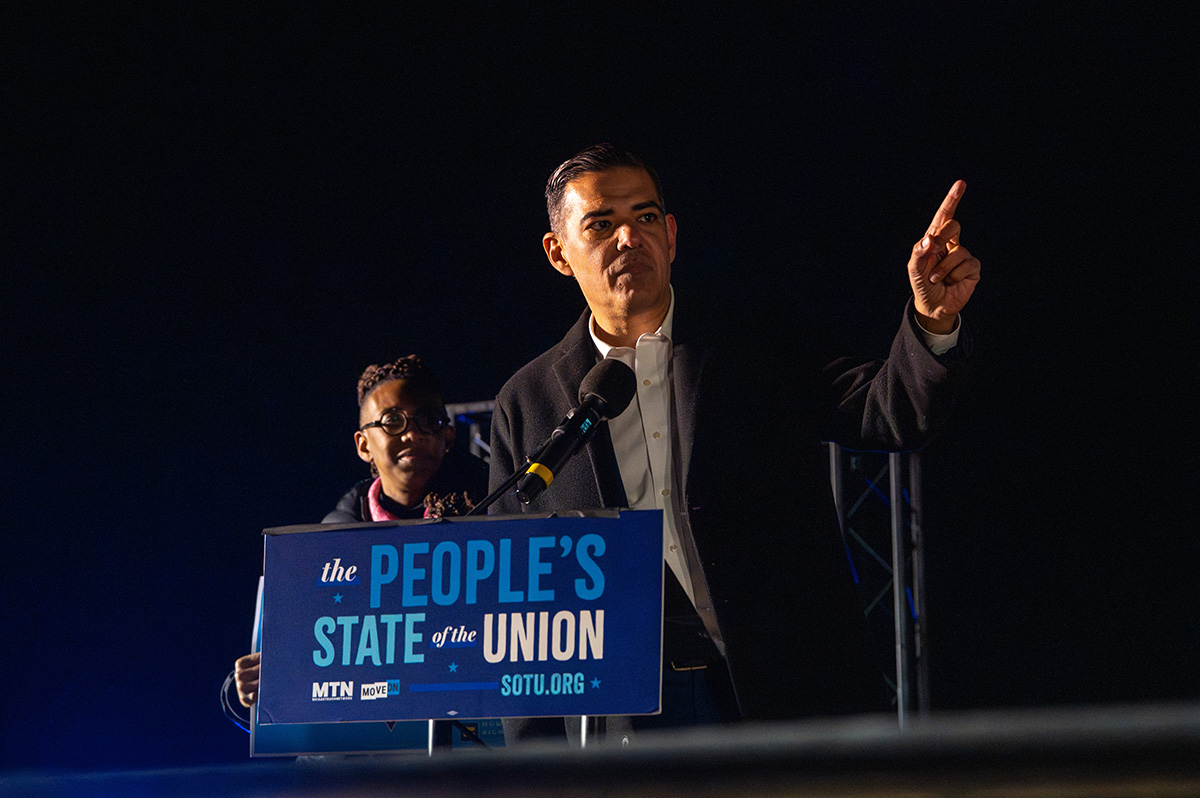
After delivering remarks alongside Robert Garcia, Kelley Robinson, president of the Human Rights Campaign, took the stage and transformed the freezing crowd’s anger into resolve.
Garcia later told the Blade that visibility matters in moments like this — especially when LGBTQ rights are under direct attack.
“We should be crystal clear about right now what is happening in our country,” Garcia said. “We have a president who is leading the single largest government cover up in modern history, we have the single largest sex trafficking ring in modern history right now being covered up by Donald Trump and Pam Bondi In the Department of Justice. Why are we protecting powerful, wealthy men who have abused and raped women and children in this country? Why is our government protecting these men at this very moment? In my place at the Capitol is a woman named Annie farmer. Annie and her sister Maria, both endured horrific abuse by Jeffrey Epstein and Ghislaine Maxwell. As we move forward in this investigation, always center the survivors; we are going to get justice for the survivors. And Donald Trump may call this investigation a hoax. He may try to deflect our work, but our message to him is very clear that our investigation is just getting started, and we will we will get justice for these survivors.”
He told the Blade afterwards that having queer leaders front and center is itself an act of resistance.
“I obviously was very honored to speak with Kelley,” the California representative said. Kelley is doing a great job…it’s important that there are queer voices, trans voices, gay voices, in protest, and I think she’s a great example of that. It’s important to remind the country that the rights of our community continue to be attacked, and then we’ve got to stand up. Got to stand up for this as well.”
Robinson echoed that call, urging LGBTQ Americans — especially young people — not to lose hope despite the administration’s escalating rhetoric.
“There are hundreds of thousands of people that are standing up for you every single day that will not relent and will not give an inch until every member of our community is protected, especially our kids, especially our trans and queer kids. I just hope that the power of millions of voices drowns out that one loud one, because that’s really what I want folks to see at HRC. We’ve got 3.6 million members that are mobilizing to support our community every single day, 75 million equality voters, people that decide who they’re going to vote for based on issues related to our community. Our job is to make sure that all those people stand up so that those kids can see us and hear our voices, because we’re going to be what stands in the way.”
A boycott — and a warning
The list of Democratic lawmakers who boycotted the State of the Union included Sens. Ruben Gallego, Ed Markey, Jeff Merkley, Chris Murphy, Adam Schiff, Tina Smith, and Chris Van Hollen, along with dozens of House members.
For those gathered outside — and for viewers watching the livestream hosted by MoveOn — the counter-programming was not merely symbolic. It was a warning.
While the president spoke of strength and success inside the chamber, LGBTQ Americans — particularly transgender youth — were once again cast as political targets. And outside the Capitol, lawmakers and advocates made clear that the fight over their rights is far from over.

ACLU sues Kansas over law invalidating trans residents’ IDs

After layoffs at Advocate, parent company acquires ‘Them’ from Conde Nast

Spring into sold

Plan your wedding the LGBTQ way

Calendar: February 27-March 5

Rob Jetten becomes first gay Dutch prime minister

More than a dozen LGBTQ athletes medal at Olympics

New book profiles LGBTQ Ukrainians, documents war experiences

PHOTOS: Queen of Hearts