National
AIDS 2012: Sebelius unveils public-private collaborations to fight disease
HHS to work with MAC AIDS Fund, Walgreens, others
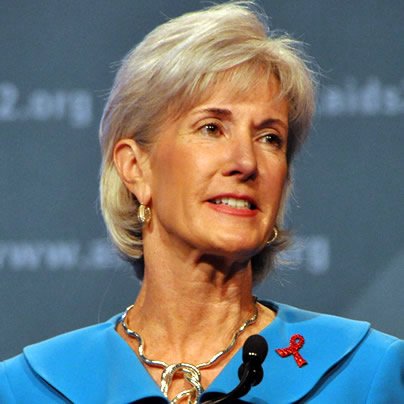
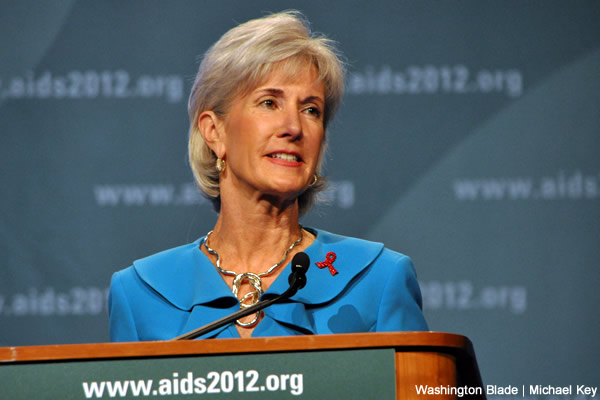
Secretary of Health & Human Services Kathleen Sebelius announced four HIV/AIDS private-public initiatives Sunday. (Blade photo by Michael Key)
Health & Human Services Secretary Kathleen Sebelius announced four new public-private initiatives on Sunday night aimed at removing barriers that cause some living with HIV/AIDS within the United States to fall out of care.
Sebelius announced the projects — including a new $4.5 million multi-year project with the MAC AIDS Fund called the Care for Life Initiative — during remarks she delivered as the final speaker on the opening night of the 19th International AIDS Conference, which is being held in the United States for the first time since 1990. An estimated 25,000 are in attendance for the week-long conference in D.C.
“Perhaps the most important principle in our national strategy is one we’ve been reminded of over and over again in our response to HIV/AIDS: none of us can do this alone,” Sebelius said. “That’s why we’re making a new effort to reach to community-based organizations, businesses, foundations, NGOs, faith organizations and more.”
The Care for Life Initiative is a collaboration of the MAC AIDS fund, which was established in 1994 to support people who are living with HIV/AIDS across the world, and has three arms that aim to keep people with HIV/AIDS within care, according to a statement from the organization:
- A $4 million partnership with AIDS United over the next three years to create an innovation fund on the both the national and regional levels to improve retention in care and treatment adherence. Geographic focuses will be determined based on need and capacity of the local providers to address that need. It will also involve an open call for proposals.
- Working with the Health Resources and Services Administration, or HRSA, for a pilot launch of UCARE4LIFE, an evidence-based program that will employ mobile texting to improve care retention and medication adherence. With a focus on Southern states, the two-year project consists of developing a message library for delivering phone text notifications to HIV-positive individuals — in English and Spanish — regarding medical appointment reminders and taking medications.
- MAC AIDS Fund will work with HHS and the President’s Emergency Plan for AIDS Relief to convene a meeting of international leaders in fall 2012 on leveraging global lessons on HIV care. This forum is expected to explore lessons from PEPFAR that can be applied to the United States for best practices on treatment and retention.
According to the MAC AIDS Fund, under the current system, one in two people living with HIV/AIDS in the United States falls out of care.
Nancy Mahon, global executive director of the MAC AIDS Funds, said the Care for Life Initiative is important because it uses new technologies and ideas in its outreach to people with HIV/AIDS.
“We cannot end the epidemic without breakthrough approaches that support and empower those living with HIV/AIDS to stay connected to the care and life-saving treatment they deserve,” Mahon said.
Besides the Care for Life Initiative, Sebelius also hit on the other three initiatives during her remarks. With the pharmaceutical retailer Walgreens, she announced a three-year partnership with the Centers for Disease Control to explore ways in which pharmacies can help patients stay on their medications. According to a news statement, Walgreens is supplying nearly $1 million in in-kind services for this initiative.
With Medscape, a leading provider of online continuing education for U.S. clinicians, Sebelius unveiled partnership training programs with the Centers for Medicare & Medicaid to help clinicians better understand and address HIV patients’ needs. According to a news statement, three new training modules have already been created for physicians, nurses and other medical professionals.
Finally, Sebelius announced that HHS is partnering with the eight largest AIDS drug companies — Abbot Laboratories, Boehringer Ingelheim, Bristol Myers Squibb, Gilead, Genentech, Johnson & Johnson, Merck and ViiV — to create a single application form for AIDS medications offered through their patient assistance programs.
“I want to thank all of these partners for stepping up,” Sebelius said. “And we will continue to seek out new public-private collaborations that will help us beat this disease.”
In addition to announcing the new public-private partnerships, Sebelius also revealed that the Food & Drug Administration would announce this week that more than 150 antiretroviral drugs are now available through PEPFAR.
The secretary also enumerated earlier initiatives of the Obama administration, including last week’s decision to distribute nearly $80 million to the states “to allow them to fully clear” wait lists for AIDS Drug Assistance Programs, which provide HIV/AIDS drugs to low-income people. An estimated 2,000 people nationwide had been awaiting drugs through programs.
According to a statement from HHS, around $69 million will be sent to 25 states and territories and, based on estimates provided by the states, will eliminate any waiting lists. The remaining $10 million — a portion of which was allocated by the Affordable Care Act — will be distributed to community-based health clinics nationwide to expand access for 14,000 new HIV/AIDS patients for medical and support services.
Other initiatives against HIV/AIDS under the Obama administration that Sebelius touted were recent FDA approval of an at-home HIV test and using Truvada to prevent HIV infection. Sebelius also credited the Bush administration, calling PEPFAR, which was established under the previous administration, one of “the great health success stories of the 21st century.”
“Our task now is to make it even stronger,” Sebelius said.
“Under President Obama, we’re on pace to achieve an ambitious goal of reaching an additional two million people around the world with life-saving treatment by the end of 2013. At the same time, we’re putting a renewed focus on the key ‘combination prevention’ interventions that have proven most effective in combating HIV.”
The secretary’s mention of PEPFAR received among the most applause of anything discussed that evening before an audience that included many HIV/AIDS advocates from overseas. Obama’s fiscal year 2013 budget request cuts the program by half a billion dollars, but the White House has said PEPFAR is an example of a program that is doing more with less because of the reduced cost of drugs.
Sebelius wasn’t the only public official representing the United States on the stage during the opening night of the conference. Rep. Barbara Lee (D-Calif.), a renowned LGBT and HIV/AIDS advocate, also spoke on stage to call for an end to the epidemic, observing it has had a particularly devastating impact on black Americans.
“Although AIDS has made the transition from a death sentence to a chronic disease, new infections unfortunately continue at alarming rates,” Lee said. “HIV/AIDS disproportionately affects no group of people in our country more than African Americans. Of the 1.4 million people in the United States living with HIV, nearly half are black men and women, even though blacks make up 14 percent of the population.”
Last week, Lee announced that had introduced into the U.S. House legislation called the “Ending the HIV/AIDS Epidemic Act.” The bill has 26 co-sponsors who are all Democrats and aims to establish a policy and financing framework to eliminate AIDS domestically and abroad.
The bill aims to fight HIV/AIDS by providing additional funds for programs such as the AIDS Drug Assistance Programs; addressing policy barriers to accessing prevention and care, such as encouraging condom use in prisons; and calling for a more advanced strategy overseas to end the global AIDS epidemic.
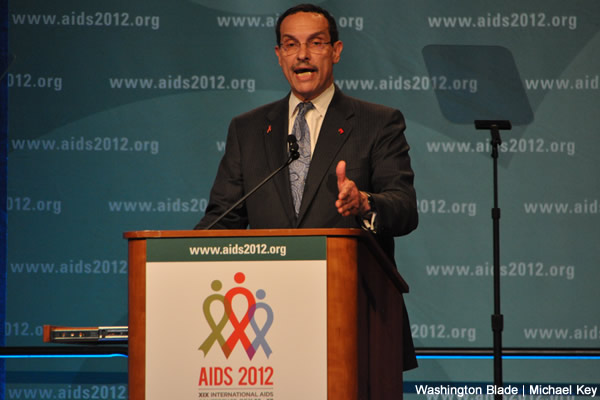
D.C. Mayor Vincent Gray (Washington Blade photo by Michael Key)
D.C. Mayor Vincent Gray also took to the stage to welcome international attendees to D.C. and talk about how HIV/AIDS has impacted the city.
“HIV/AIDS has crossed all racial, ethnic, religious and socio-economic borders,” Gray said. “It is a disease that knows no boundaries.”
According to Gray, an estimated 20,000 people in D.C. have been infected with HIV/AIDS, and 10,000 residents have died as a result of the disease.
Other speakers on Sunday were Annah Sango, a Zimbabwe advocate living with HIV who seeks visibility for female patients, World Bank President Jim Yong Kim, who said he was the first World Bank president to the address the international conference, UNAIDS Executive Director Michel Sidibé, South African Deputy President Kgalema Motlanthe and Mark Dybul, global AIDS coordinator for President George W. Bush who touted that administration’s achievements in the global AIDS fight.
The co-chairs of the conference, Elly Katabira, a Ugandan activist and president of the International AIDS Society, and Diane Havlir, chief of HIV/AIDS Division at the University of California, San Francisco, welcomed attendees to the conference. U.N. Secretary General Ban Ki-Moon prepared a video message for attendees.
Also on Sunday, the White House unveiled a video message from Obama welcoming the international attendees to the conference. The video message was prepared in lieu of a live appearance by Obama at the conference.
In the video, Obama talks about HIV/AIDS advocates’ commitment to fighting the disease and a voice-over talks about discovery of the disease in the 1980s as well as activism and scientific advances to thwart it.
Watch the video below:





Federal Government
Todd Blanche’s record on LGBTQ issues comes under scrutiny as he takes over DOJ
Blanche was confirmed by the Republican controlled Senate 50-49.
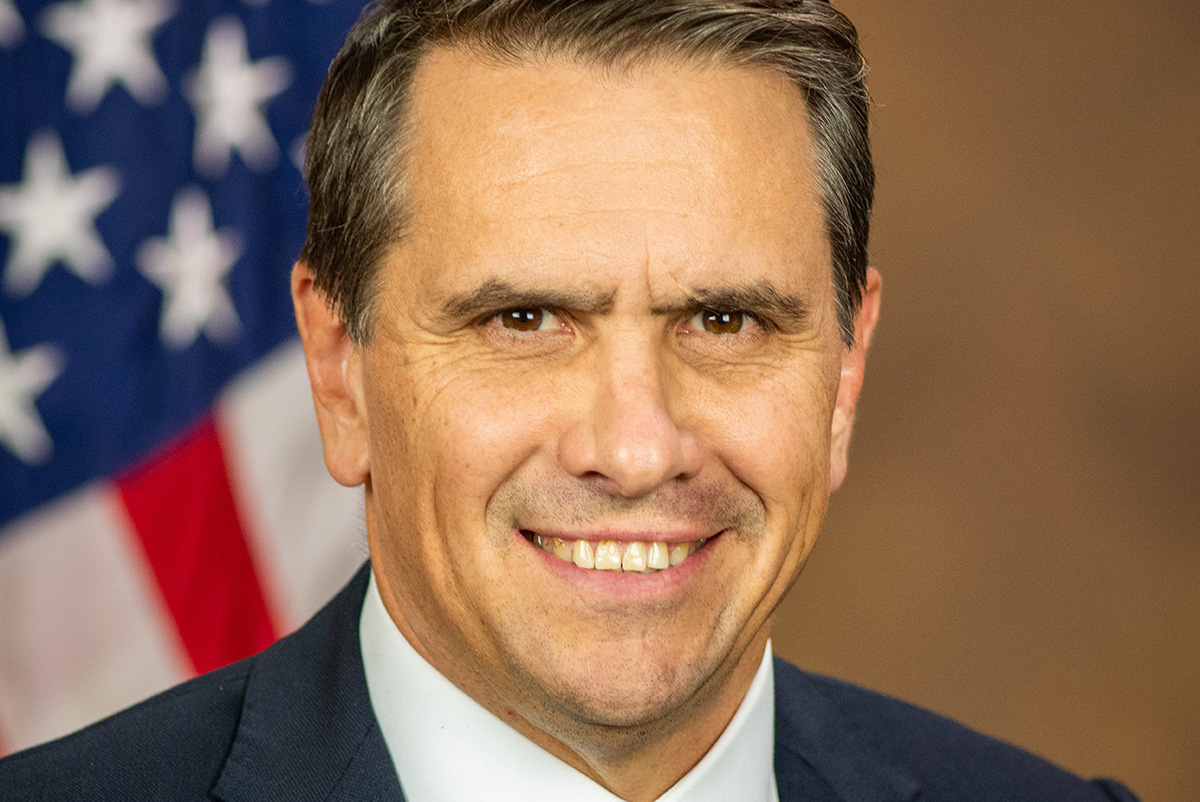
Todd Blanche, President Trump’s former personal lawyer, was sworn in as attorney general of the United States on Monday.
Blanche secured the position as the country’s 88th chief law enforcement officer on Sunday night after a contentious Senate confirmation process, ultimately ending with a 50-49 vote in his favor. All Democrats, as well as Republican Sens. Susan Collins and Lisa Murkowski, voted against him.
The confirmation hearing — and subsequent vote — brought questions surrounding Blanche’s credibility and integrity, as well as concerns about Trump’s ethical dilemmas surrounding cronyism, to the forefront.
The attorney general acts as the head of the Department of Justice, responsible for enforcing federal laws, representing the U.S. in court, and advising the president.
Blanche has a long history in Washington, beginning when he attended American University for his undergraduate education, like fellow former Trump attorney Michael Cohen. He began his legal career as an intern in the U.S. Attorney’s Office in Washington, which eventually became a full-time position.
That job eventually led him to work as a paralegal in the U.S. Attorney’s Office for the Southern District of New York while attending Brooklyn Law School at night. Blanche graduated cum laude in 2003.
Blanche left the public sector in 2014, taking a job in the Manhattan office of the law firm WilmerHale. In September 2017, he moved to Cadwalader, Wickersham & Taft LLP, where he was a partner in the White Collar Defense and Investigations practice.
There, Blanche represented several figures associated with President Donald Trump, including former New York City Mayor Rudy Giuliani and Trump’s former campaign manager Paul Manafort.
In 2024, Blanche switched from Democrat to Republican and moved from New York City to Palm Beach, Fla., where he would be closer to Trump’s primary legal residence at Mar-a-Lago.
He then served as Trump’s personal defense attorney in the New York state case that led to Trump’s 2024 conviction on 34 felony counts of falsifying business records to cover up hush-money payments to adult film star Stormy Daniels.
While serving as acting head of the Department of Justice before his official confirmation, Blanche played a central role in overseeing the department and was involved in leadership decisions tied to several controversial actions affecting LGBTQ people.
One of the first issues was transgender rights and gender-affirming care, particularly for minors — an issue the White House and Republican Party have made a key part of their broader cultural agenda and federal policy efforts.
In a letter to New York Attorney General Letitia James, Blanche declared that the Justice Department “will not sit idly by while you attempt to use your office to force harmful procedures on our most vulnerable population.”
The letter came before NYU Langone ended its gender-affirming care at the behest of the president, forcing the hospital system to stop prescribing puberty blockers and hormones to minors.
The hospital’s change in policy came after the Trump-Vance administration threatened to pull all federal funding if it continued providing the care.
Blanche wrote that “the Justice Department believes the law is clear, and anti-discrimination laws cannot be used to force NYU Langone to perform sex-rejecting procedures on children.”
“As just one example, your office’s position would require a hospital to prescribe certain medications for certain diagnoses, regardless of the hospital’s or its doctors’ independent medical determination about the propriety of such treatment,” he continued in the letter.
In addition to his anti-transgender positions, Blanche also echoed his predecessor, Pam Bondi, in taking a public stance on limiting LGBTQ-related protections at the federal level.
He aligned with Bondi’s sentiments in June 2025 regarding the U.S. Supreme Court’s 6–3 decision that restricted LGBTQ history lessons in schools and limited lower federal courts from issuing nationwide injunctions — rulings that have often blocked Trump administration policies.
Blanche called it “another great decision that came down today,” arguing the ruling “restores parents’ rights to decide their child’s education.”
“It took the Supreme Court to set the record straight, and we thank them for that,” he said. “Now that ruling allows parents to opt out of dangerous trans ideology and make the decisions for their children that they believe is correct.”
In December 2025, a Justice Department memo stated that, “effective immediately,” prisons and jails would no longer be held responsible for violations of standards meant to protect LGBTQ people from harassment, abuse and rape under the Prison Rape Elimination Act.
The law, passed unanimously by Congress in 2003, requires that incarcerated people be screened for their risk of sexual assault, including consideration of LGBTQ status, and applies to all correctional facilities.
Additionally, when the Justice Department, under Blanche’s deputy leadership and at Trump’s behest, attempted to force Children’s National Hospital in D.C. to turn over medical records related to gender-affirming care, U.S. District Judge Julie R. Rubin ruled that the effort “appears to have no purpose other than to intimidate and harass.”
Blanche also faced scrutiny over a slew of other issues surrounding his leadership during his tenure as acting AG.
The Justice Connection, a watchdog organization that works to protect current and former civil servants working in the U.S. Department of Justice, called his work so far “devastating.”
The organization said Blanche “harmed the department’s workforce, advanced the politicization of the department, undermined the rule of law, and threatened public safety.”
The group cited several issues, including what it described as Blanche minimizing the violent reality of the January 6 insurrection led by Trump supporters; investigating and attempting to prosecute President Trump’s perceived political enemies; the botched release of the Epstein Files to Congress and the public, including the release of victim and witness details and censorship surrounding the scope of Trump’s relationship with the convicted sex trafficker and pedophile; and the expansion of federal immigration enforcement in Minnesota which lead to the death of two U.S. citizens by federal officials.
Sharon McGowan, senior vice president of Policy & Litigation at the Human Rights Campaign, the largest LGBTQ advocacy group in the country, provided a statement to the Blade about Blanche’s confirmation calling it “chilling.”
“The last thing Todd Blanche deserves is a promotion,” McGowan said via email. “For months, Blanche has used his position as Acting Attorney General to advance President Trump’s personal and financial interests and to weaponize the Justice Department against the President’s enemies, whether they be transgender kids or civil rights organizations trying to help people vote. His notion of justice is warped and dangerous, and LGBTQ+ Americans deserve better.”
National
HRC condemns DoE removal of LGBTQ bullying data from federal survey
Organization cites rise in homophobic, transphobic policies, worse mental health outcomes

The Human Rights Campaign is slamming the White House — and the Department of Education — following their removal of some LGBTQ bullying data from federal data collection.
The Civil Rights Data Collection is a mandated survey of all public school districts that collects figures on a wide variety of statistics about students — including demographics that include race, ethnicity, sex, disability status, and English learner status; course-level enrollment data, such as how many students are enrolled in advanced placement or honors classes; and school climate information, such as rates of bullying, harassment, suspensions, and expulsions.
That data collection has been ongoing since 1968 — nearly six decades — but now has a major change in what questions are being asked, or not asked, that advocates are largely attributing to the Trump-Vance administration’s culture war fight on LGBTQ children in the country.
Changes to the 2025-2026 survey questions — approved by the Office of Budget and Management in July — eliminated a space for schools to report how many students identify as nonbinary, how often those students are victims of harassment and bullying, and whether school districts have policies prohibiting gender identity-based incidents.
K-12 Dive, a publication that focuses its reporting on news related to K-12 education, first published a list of these data collection changes from 2024-2025 to 2025-2026.
These questions, as well as others that included LGBTQ student topics on treatment in schools, were added to the CRDC under the Biden-Harris administration. By including these questions, policymakers hoped this would lead to increased investigations into discrimination complaints, initiate compliance reviews, and provide policy guidance to districts, according to Education Department documents.
The CRDC also eliminated the mention of “gender identity” from the definition of rape and sexual assault. The prior collection of data (before the Trump-Vance administration changed it) defined rape as something that could be done to “all students, regardless of sex, or sexual orientation, or gender identity.” Now, the new data collection questions say, “All students, regardless of sex, or sexual orientation can be victims of rape,” removing “gender identity” from the new definition.
By removing and changing definitions, this could have a real-world impact on some of the school’s most vulnerable students. According to CRDC data from 2021-2022, more than 1,800 school districts reported enrolling one or more nonbinary students.
Additional data also shows that the changes to data collection is harming public school students. U.S. Sen. Bernie Sanders (I-Vt.), the ranking member of the Senate Health, Education, Labor, and Pensions Committee released a report in April finding that the Trump-Vance administration’s efforts to all but close the Department of Education Office for Civil Rights has left students facing discrimination and harassment throughout the country without the federal recourse they are entitled to under federal law.
The Williams Institute, a think tank that collects data and conducts research on issues related to sexual orientation and gender identity, has data indicating the true number of nonbinary and transgender children is much higher — they estimate that for children ages 13 to 17, nearly 724,000 identify as nonbinary or trans.
This is in line with a slew of policies pushed by the Trump-Vance administration since their federal takeover. Within his first day in office, President Donald Trump signed Executive Order 14168, titled “Defending Women from Gender Ideology Extremism and Restoring Biological Truth to the Federal Government.” This directive attempts to make the federal definition of gender unchangeable, determined by sex assigned at birth alone.
Within his first month of his second term, Trump issued Executive Order 14187, titled “Protecting Children from Chemical and Surgical Mutilation.” The order directs federal agencies to restrict gender-affirming medical care — including puberty blockers, hormone therapy, and surgeries — for individuals under the age of 19.
He also pushed multiple anti-trans executive orders, including Executive Order 14201, “Keeping Men Out of Women’s Sports,” and Executive Order 14183, “Prioritizing Military Excellence and Readiness,” targeting trans athletes and military members, respectively.
These policies have a real-world impact on trans people.
The Trevor Project, a nonprofit dedicated to crisis and suicide prevention for LGBTQ people under 25, reported that, for the seventh year in a row, LGBTQ youth are at higher risk for suicide as a result of mistreatment and stigmatization.
Trevor Project data showed that nearly 60 percent of LGBTQ young people ages 13-17 said they were bullied in the past year, and that 36 percent of LGBTQ youth seriously considered suicide in the last year. The data shows a bigger discrepancy for trans youth, with that number hovering around 40 percent considering suicide.
HRC President Kelley Robinson issued a statement following the approval of the new data collection questions that leaves LGBTQ students’ bullying statistics under — if not completely unreported.
“If there was even a shadow of a doubt, this latest move by the Trump administration makes it abundantly clear they do not care about the safety of LGBTQ+ students, and trans students in particular,” Robinson said. “These are adults who should be protecting our kids. And instead, they are making sure bullying and harassment are not tracked. If they are not tracked, bullying and harassment cannot be prevented or stopped — which is exactly what the Trump administration wants. Parents deserve to know their kids are safe at school, and every single young person deserves dignity and safety at school. Anything less is plain evil.”
HRC has a “Welcoming Schools” initiative that they say is the “most comprehensive” bias-based bullying prevention program in the nation. The program includes LGBTQ and gender-inclusive resources for schools, help navigating special education and disability resources for LGBTQ-identifying students, and other tools to help schools become more inclusive.
This program has been in effect for nearly two decades and, according to HRC, reaches nearly 750,000 students.
The Washington Blade reached out to both the Department of Education and Office of Management and Budget for comment but did not receive a response by publication time.
Michigan
Progressives score victory as El-Sayed wins Mich. Senate primary
Democratic newcomer will face Rogers in November
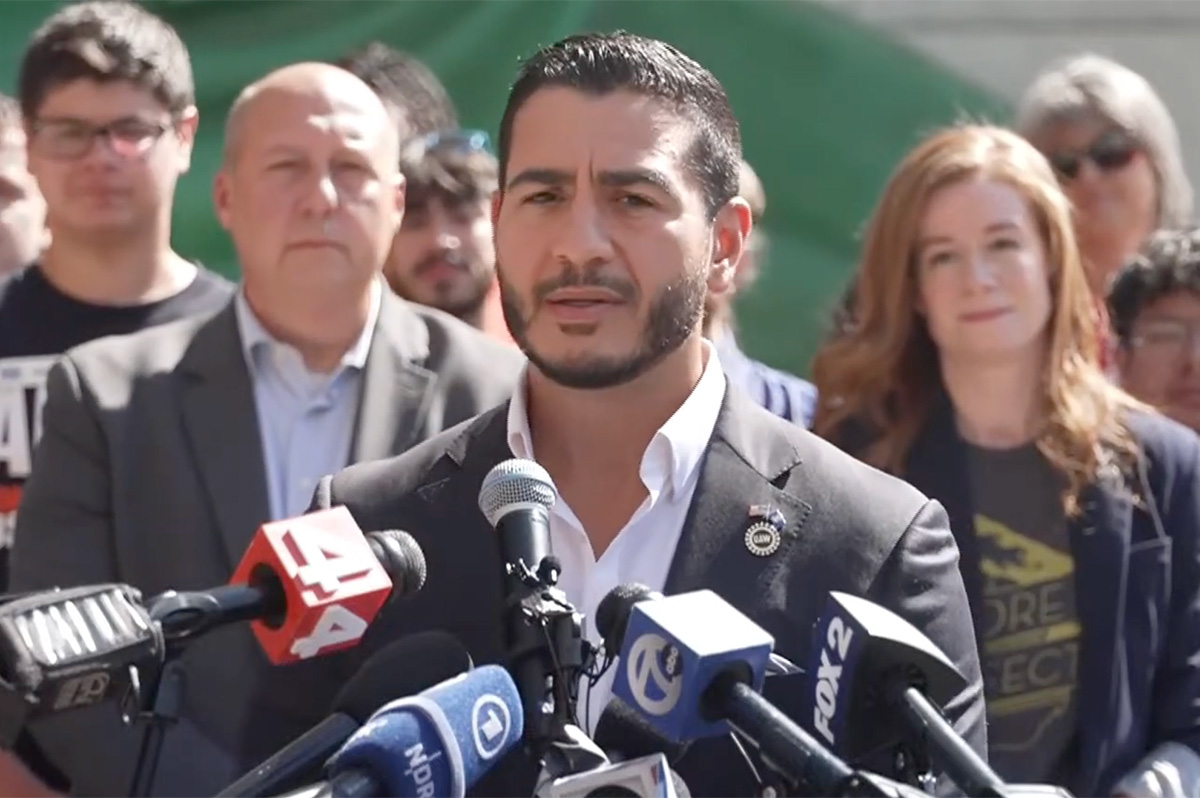
Michigan held its primary on Tuesday, allowing the two major political parties to select their nominees to go head-to-head for the state’s U.S. Senate seat.
NBC News called the Democratic race early, giving the victory to physician Abdul El-Sayed over incumbent U.S. Rep. Haley Stevens (D-Mich.) in an extremely close primary. El-Sayed won 48.5 percent of the primary vote, with Stevens trailing by just one percentage point at 47.5 percent.
Both candidates have campagined on supporting the LGBTQ community through different avenues— for El-Sayed he focused on his past promoting HIV and PrEP funding and research. Stevens focused on her legislative history working to support transgender rights in the state.
This is a major win for progressive Democrats, who have been bearing the brunt of political attacks from President Donald Trump, the Republican Party, and centrist Democrats.
El-Sayed, a former health director in Detroit, ran his campaign largely on making life in the Great Lakes State more affordable amid rising costs. His policies include promoting “Medicare for All,” pushing health policy that targets the regressive efforts of the Trump-Vance administration that rolls back funding for both Women and LGBTQ people, minimizing the growing amount of money in politics, and he was very vocal in his criticism of Stevens for supporting aid to Israel. He was endorsed by two major progressives — U.S. Sen. Bernie Sanders (I-Vt.) and U.S. Rep. Alexandria Ocasio Cortez (D-N.Y.).
Stevens, the four-term congresswoman, is much closer to establishment Democrats on policy than El-Sayed.
During her time in the federal government, she has consistently supported the Equality Act, which would add sexual orientation and gender identity as protected classes under the Civil Rights Act of 1964. She has also emphasized supporting local manufacturing and lowering housing costs in the state.
She was named to Advocates for Trans Equality’s 118th Congressional Champions list for her pro-trans policies and was endorsed by establishment heavy hitters Michigan Gov. Gretchen Whitmer and Senate Minority Leader Chuck Schumer (D-N.Y.).
The contentious race boiled down not only to Michigan affairs but also extended to international conflicts — namely Palestine. (South Africa has filed a case in the International Court of Justice in The Hague that accuses Israel of committing genocide in the Gaza Strip after Oct. 7.) This primary also acted as one of the first major races that pushed back against AIPAC, a lobbying group that works to promote pro-Israel candidates in U.S. elections. The group has been involved in domestic politics since 1954.
AIPAC devoted a massive amount of money to this race.
The Associated Press reported that the pro-Israel lobbying group spent more than $30 million on ads against El-Sayed because of his vocal denunciation of Israel and his continued criticism of its policies towards Palestine.
Michigan has a large Muslim and Arab American population, which could, in part, explain how El-Sayed was able to win.
The Republican side was far less competitive. Former U.S. Rep. Mike Rogers (R-Mich.) ran unopposed and clinched the GOP nomination. He has consistently held anti-LGBTQ positions, going as far as voting multiple times for a federal constitutional amendment to ban same-sex marriage, voting against repealing the military’s “Don’t Ask, Don’t Tell” policy, and supporting efforts to directly target the attempted expansion of Title IX protections to include trans people.
El-Sayed will face off against Rogers in November for Michigan’s Senate seat — one that could have lasting impacts not only on the state’s politics but also on the Republicans’ narrow Senate majority and Trump’s political agenda.

Gay ANC commissioner sues D.C. over police ‘failure’ to pay reward money

New LGBTQ visitor center slated for Wilmington, Del.

Jason DePuy on coping with homophobia in ‘Big Brother’ house

2 former NBA players launch cheap anti-trans stunt to exploit WNBA rules

Same-sex couples challenges India income tax law

HRC files class action over federal ban on gender-affirming care coverage

HRC condemns DoE removal of LGBTQ bullying data from federal survey

Dutch PM: More needs to be done to defend trans rights

New book chronicles gay man’s life in hippie commune

PHOTOS: Daddy Issues at Kiki
-

 The White House5 days ago
HRC files class action over federal ban on gender-affirming care coverage
-
National5 days ago
HRC condemns DoE removal of LGBTQ bullying data from federal survey
-
Netherlands5 days ago
Dutch PM: More needs to be done to defend trans rights
-
Books4 days ago
New book chronicles gay man’s life in hippie commune