Local
4 marriage ballot fights and 4 big wins
Advocates confident of sweep in Md., Maine, Minn., Wash. battles
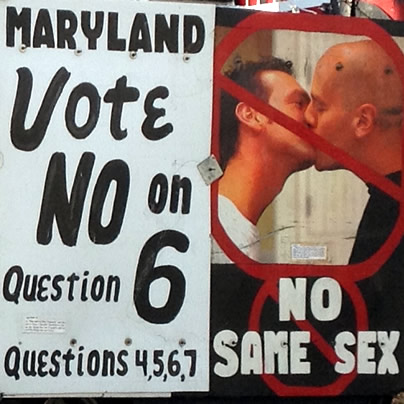
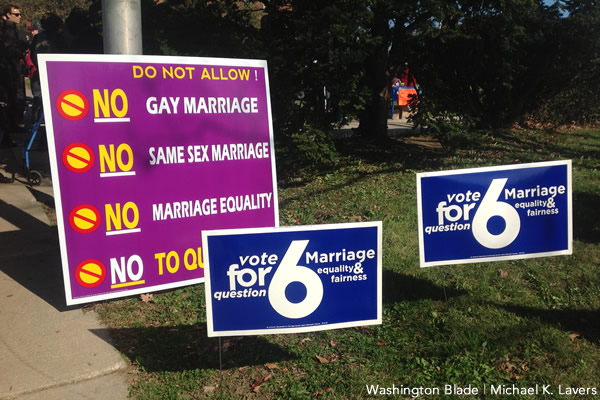
Question 6 supporters and opponents placed signs outside a polling place at Northwood Elementary School in Baltimore on Nov. 6. (Washington Blade photo by Michael K. Lavers)
Advocacy groups across the country on Tuesday celebrated the passage of two state same-sex marriage referenda and the defeat of a proposed constitutional amendment that would have banned nuptials for gays and lesbians in another.
Maryland voters supported Question 6 by a 52-48 percent margin, while Maine’s Question 1 that will allow gays and lesbians to legally marry in the state passed with 52 percent of the vote. Washington’s Referendum 74 that would uphold the state’s same-sex marriage law remains ahead by a 52-48 percent margin with what Washington United for Marriage estimates as 60 percent of the ballots counted as of deadline.
Minnesotans narrowly defeated a proposed state constitutional amendment that would have defined marriage as between a man and a woman by a 51-48 percent margin.
“Years from now we’ll remember this Election Day as the most important and the most historic in the history of the LGBT movement,” said Chad Griffin, president of the Human Rights Campaign, in a video message. He noted HRC contributed $20 million over the last two years to the four statewide same-sex marriage campaigns. “We’ve won a landslide victory at the ballot box. We’ve secured the first ever electoral victory for marriage equality in Maine, Maryland and Minnesota. And we’re optimistic about the results still to come in Washington state.”
Freedom to Marry gave $4.6 million to the four statewide same-sex marriage campaigns. It helped raise another $2.4 million to support public education campaigns in Maine, Maryland, Minnesota and Washington.
Evan Wolfson, president of Freedom to Marry, categorized the election results to the Washington Blade as “irrefutable momentum in favor of the freedom to marry” that will give “enormous confidence” to lawmakers and others to support nuptials for gays and lesbians. Casey Pick of Log Cabin Republicans further described the election results as a “turning point.”
“It is something the nation will take notice of,” she told the Blade from Maine where she had been working with Mainers United for Marriage in support of Question 1 for the last two weeks. “Never again will opponents of marriage equality be able to say that every time the people vote on the issue they favor marriage as one man and one woman because that’s no longer true.”
LGBT advocates in other states where voters did not consider same-sex marriage ballot measures also noted the historic results.
“For all of the families in Maine and Maryland, where voters upheld the rights of same-sex couples to wed, MassEquality is pleased that they will soon experience what we have celebrated for eight years now in Massachusetts: families that are stronger and communities that are healthier because LGBTQ individuals and their families are treated with dignity and fairness,” said Kara Suffredini, executive director of MassEquality, in a statement. She noted nearly 20,000 gay and lesbian couples have married in Massachusetts since the commonwealth’s same-sex marriage law took effect in May 2004. “Our rights should never be determined by a majority vote. But the wins in Maine and Maryland, as well as the defeat of a proposed anti-marriage Constitutional amendment in Minnesota, are definitive proof that there is a growing majority in America that supports our rights, and that equality wins, including at the ballot box.”
Equality Illinois CEO Bernard Cherkasov also noted the historic election results after Maine’s Question 1 passed.
“The ballot box victory is the latest evidence that the tide has turned and that momentum is on the side of full LGBT equality,” he said. “We now have a president who ran on support for marriage equality, a Democratic Party that included a marriage plank in the party platform, seven states, including Maine, and also the District of Columbia where same-sex couples can marry.”
Minneapolis resident Kirsten Olson and her partner of 18 years, Karen Hogan, a librarian at Quatrefoil Library in nearby St. Paul, waited for the Amendment 1 results at home. She awoke both Hogan and their 11-year-old daughter around 1:45 a.m. when she finally heard the proposal had failed.
“Public radio went to the victory speech that I didn’t think I would hear uttered,” said Olson as she became emotional. “It was just completely surreal and then on Minnesota Public Radio they were also talking about how the Minnesota House and the Minnesota Senate have both gone Democratic and that our governor, Mark Dayton, had on his agenda to legalize same-sex marriage. So in the span of 12 hours we went from the very real possibility of a constitutional amendment to a very real possibility of legalization.”
An ABC News/Washington Post poll conducted after President Obama endorsed marriage rights for same-sex couples in May found 53 percent of Americans supported nuptials for gays and lesbians, compared to only 36 percent in 2006. Even among social conservatives, the issue seems to have less resonance.
Only 19 percent of those who took part in a straw poll at the annual Conservative Political Action Committee conference in D.C. in February cited the promotion of “traditional values” as the most important issue going into the election. Only one percent who took part in the 2011 CPAC straw poll said stopping same-sex marriage was their top priority.
“Obviously we are very disappointed in losing four tough election battles by narrow margins,” said National Organization for Marriage President Brian Brown in a statement.
NOM contributed more than $5.5 million to oppose same-sex marriage referenda in Maine, Maryland and Washington and support Minnesota’s proposed constitutional amendment to ban nuptials for gays and lesbians. Brown conceded supporters and opponents of these respective ballot measures outspent those who opposed marriage rights for same-sex couples by at least a four-to-one margin.
He also downplayed the idea the election results are what he described as a “changing point in how Americans view gay marriage.”
“Though we are disappointed over these losses, we remain faithful to our mission and committed to the cause of preserving marriage as God designed it,” said Brown. “Marriage is a true and just cause, and we will never abandon the field of battle just because we experienced a setback. There is much work to do, and we begin that process now.”
Wolfson dismissed the remarks.
“It’s been clear for some time that they lost the argument,” he told the Blade. “All they have is scare tactics, diversions and some raw power in being able to throw money and mobilize some people — a dwindling number. They’re going to keep at it. That’s where their livelihood is. They know they’re losing. They know they’re on the wrong side of history. The opposition will continue, but we are winning.”
Pick said she feels the election results send a message to GOP lawmakers who continue to oppose marriage rights for same-sex couples.
“Log Cabin Republicans have been saying for a long time that the tide is turning on this issue,” she said. “For our party it is incumbent upon us to recognize that inclusion is the way of the future. And to be victorious and to win future elections with voters who are taking their place as the majority of the populace today, marriage equality has to be a part of that formula.”
Back in Maryland, there was a palpable sense among those awaiting the Question 6 results at a Baltimore concert hall the Free State was about to make history as the first state to approve same-sex marriage at the ballot.
Lesbian state Del. Heather Mizeur told the Blade before Marylanders for Marriage Equality announced the referendum had passed she feels Obama’s support of same-sex marriage had a tremendous impact in Maryland.
“While we already felt very confident where we were headed in this campaign, he stood up and did something no president has ever done for our community and help make it okay for all of our allies to be comfortable with being public about what their position was about equality,” she said. “We started to see the numbers very strongly in our direction after he came out in favor of it. And that’s why we’re hoping for a double win tonight and celebrating our marriage equality and also sending this courageous president back for another four year term.”
Olson said most of her friends, family and neighbors understand Minnesota voters made history by striking down the proposed amendment.
“People totally understand that, totally feel that,” she said. “There are obviously 49 percent of the population — or 48 percent I guess is what it finally came out to be who think otherwise, but they’re not 50 percent plus one.
Shaun Knittel, executive director of the pro-Referendum 74 group Social Outreach Seattle, told the Blade he feels this sense of history prompted a lot of young first-time voters to go to the polls and support the law.
“Nov. 6, 2012, is going to be a historic day for the gay community, the LGBTQ community because this is the time we stopped the bigots,” he said. “It’s the first time it has happened in this way and it was such a big statement. It wasn’t just one state or one group that just seemingly got lucky. It was four states involved in this.”

The Comings & Goings column is about sharing the professional successes of our community. We want to recognize those landing new jobs, new clients for their business, joining boards of organizations and other achievements. Please share your successes with us at [email protected].
The Comings & Goings column also invites LGBTQ+ college students to share their successes with us. If you have been elected to a student government position, gotten an exciting internship, or are graduating and beginning your career with a great job, let us know so we can share your success.
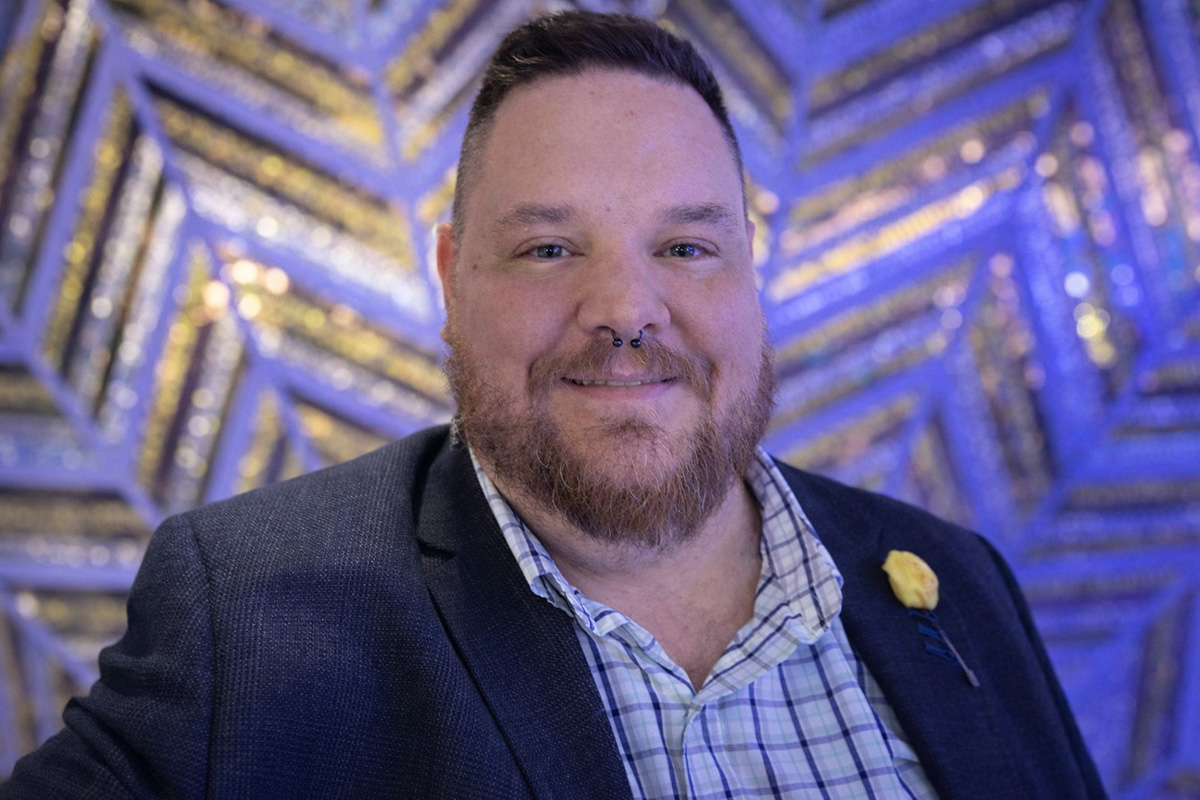
Congratulations to R. Warren Gill III, M.Div., M.A. on being appointed as the development manager at HIPS. Upon his appointment, Gill said, “For as long as I’ve lived in Washington, D.C., I’ve followed and admired the life-saving work HIPS does in our communities. I’m proud to join the staff and help strengthen the financial support that sustains this work.”
Gill will lead fundraising strategy, donor engagement, and institutional partnerships. HIPS promotes the health, rights, and dignity of individuals and communities impacted by sexual exchange and/or drug use due to choice, coercion, or circumstance. HIPS provides compassionate harm reduction services, advocacy, and community engagement that is respectful, non-judgmental, and affirms and honors individual power and agency.
Gill has built a career at the intersection of progressive politics, advocacy, and nonprofit leadership. Previously he served as director of communications at AIDS United, supporting national efforts to end the HIV epidemic. Prior to that he had roles including; being press secretary for Sen. Bernie Sanders during the 2016 presidential primary, and working with the General Board of Church and Society, the United Methodist Church, the denomination’s social justice and advocacy arm.
Gill earned his bachelor’s degree in philosophy and religious studies, Jewish Studies, Stockton University; his master’s degree in political communication from American University, where his graduate research focused on values-based messaging and cognitive linguistics; and his master of Divinity degree from the Pacific School of Religion.
District of Columbia
Judge denies D.C. request to dismiss gay police captain’s anti-bias lawsuit
MPD accused of illegally demoting officer for taking family leave to care for newborn child
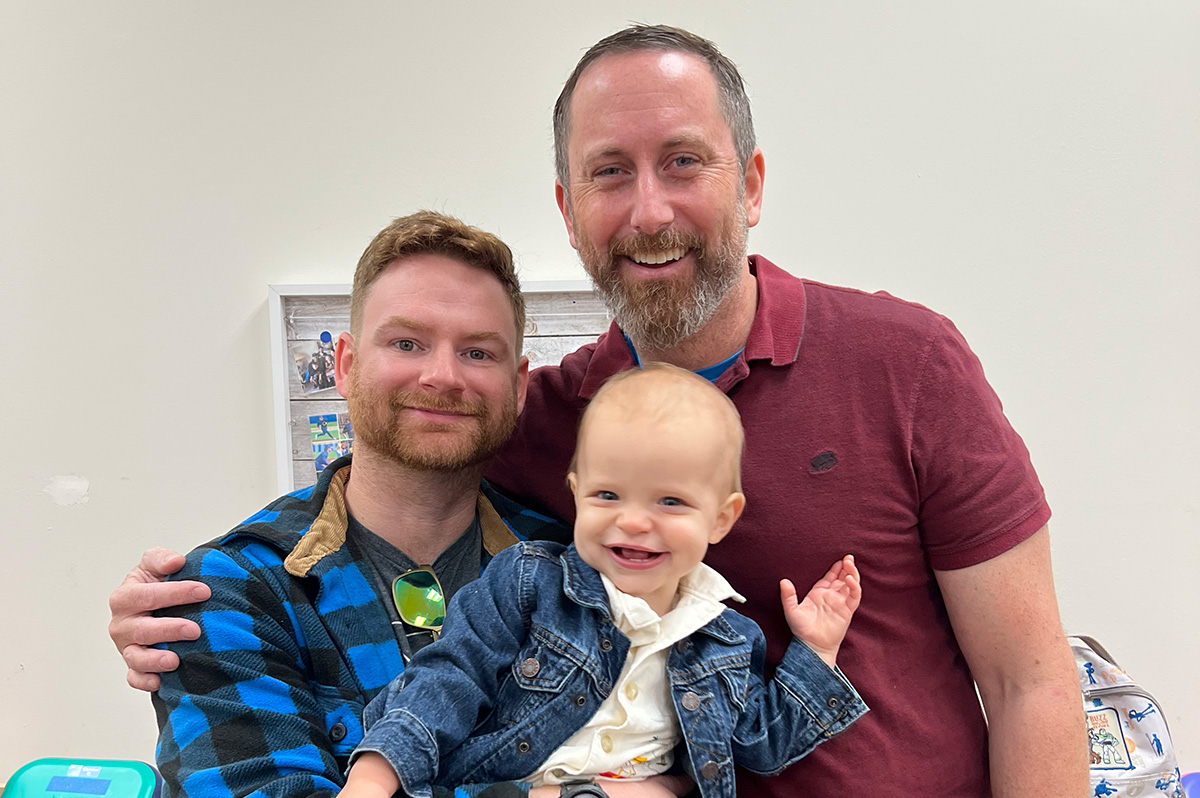
A U.S. District Court judge on Jan. 21 denied a request by attorneys representing the D.C. Metropolitan Police Department to dismiss a lawsuit filed by a gay captain accusing police officials of illegally demoting him for taking parental leave to join his husband in caring for their newborn son.
The lawsuit filed by Capt. Paul Hrebenak charges that police officials violated the U.S. Family and Medical Leave Act, a similar D.C. family leave law, and the Constitution’s Equal Protection Clause by refusing to allow him to return to his position as director of the department’s School Safety Division upon his return from parental leave.
It says police officials transferred Hrebenak to another police division against his wishes, which was a far less desirable job and was the equivalent of a demotion, even though it had the same pay grade as his earlier job.
In response to a motion filed by attorneys with the Office of the D.C. Attorney General, which represents and defends D.C. government agencies against lawsuits, Judge Randolph D. Moss agreed to dismiss seven of the lawsuit’s 14 counts or claims but left in place six counts.
Scott Lempert, the attorney representing Hrebenak, said he and Hrebenak agreed to drop one of the 14 counts prior to the Jan. 21 court hearing.
“He did not dismiss the essential claims in this case,” Lempert told the Washington Blade. “So, we won is the short answer. We defeated the motion to dismiss the case.”
Gabriel Shoglow, a spokesperson for the Office of the D.C. Attorney General, said the office has a policy of not commenting on pending litigation and it would not comment on the judge’s ruling upholding six of the lawsuit’s initial 14 counts.
In issuing his ruling from the bench, Moss gave Lempert the option of filing an amended complaint by March 6 to seek the reinstatement of the counts he dismissed. He gave attorneys for the D.C. attorney general’s office a deadline of March 20 to file a response to an amended complaint.
Lempert told the Blade he and Hrebenak have yet to decide whether to file an amended complaint or whether to ask the judge to move the case ahead to a jury trial, which they initially requested.
In its 26-page motion calling for dismissal of the case, filed on May 30, 2025, D.C. Office of the Attorney General attorneys argue that the police department has legal authority to transfer its officers, including captains, to a different job. It says that Hrebenak’s transfer to a position of watch commander at the department’s First District was fully equivalent in status to his job as director of the School Safety Division.
“The Watch Commander position is not alleged to have changed plaintiff’s rank of captain or his benefits or pay, and thus plaintiff has not plausibly alleged that he was put in a non-equivalent position,” the motion to dismiss states.
“Thus, his reassignment is not a demotion,” it says. “And the fact that his shift changed does not mean that the position is not equivalent to his prior position. The law does not require that every single aspect of the positions be the same.”
Hrebenak’s lawsuit states that “straight” police officers have routinely taken similar family and parental leave to care for a newborn child and have not been transferred to a different job. According to the lawsuit, the School Safety Division assignment allowed him to work a day shift, a needed shift for his recognized disability of Crohn’s Disease, which the lawsuit says is exacerbated by working late hours at night.
The lawsuit points out that Hrebenak disclosed he had Crohn’s Disease at the time he applied for his police job, and it was determined he could carry out his duties as an officer despite this ailment, which was listed as a disability.
Among other things, the lawsuit notes that Hrebenak had a designated reserved parking space for his earlier job and lost the parking space for the job to which he was transferred.
“Plaintiff’s removal as director at MPD’s School Safety Division was a targeted, premeditated punishment for his taking statutorily protected leave as a gay man,” the lawsuit states. “There was no operational need by MPD to remove plaintiff as director of MPD’s School Safety Division, a position in which plaintiff very successfully served for years,” it says.
In another action to strengthen Hrebenak’s opposition to the city’s motion to dismiss the case, Lempert filed with the court on Jan. 15 a “Notice of Supplemental Authority” that included two controversial reports that Lempert said showed that former D.C. Police Chief Pamela Smith put in place a policy of involuntary police transfers “to effectively demote and end careers of personnel who had displeased Chief Smith and or others in MPD leadership.”
One of the reports was prepared by the Republican members of the House Oversight and Government Reform Committee and the other was prepared by the office of Jeanine Pirro, the U.S. attorney for D.C. appointed by President Donald Trump.
Both reports allege that Smith, who resigned from her position as chief effective Dec. 31, pressured police officials to change crime reporting data to make it appear that the number of violent crimes was significantly lower than it actually was by threatening to transfer them to undesirable positions in the department. Smith has denied those claims.
“These findings support plaintiff’s arguments that it was the policy or custom of MPD to inflect involuntary transfers on MPD personnel as retaliation for doing or saying something in which leadership disapproved,” Lempert says in his court filing submitting the two reports.
“As shown, many officers suffered under this pervasive custom, including Capt. Hrebenak,” he stated. “Accordingly, by definition, transferred positions were not equivalent to officers’ previous positions,” he added.
Virginia
LGBTQ rights at forefront of 2026 legislative session in Va.
Repeal of state’s marriage amendment a top priority

With 2026 ramping up, LGBTQ rights are at the forefront of Virginia politics.
The repeal of Virginia’s constitutional amendment that defines marriage as between a man and a woman is a top legislative priority for activists and advocacy groups.
The Virginia Senate on Jan. 17 by a 26-13 vote margin approved outgoing state Sen. Adam Ebbin (D-Alexandria)’s resolution that would repeal the Marshall-Newman Amendment. The Virginia House of Delegates earlier this month passed it.
Two successive legislatures must approve the resolution before it can go to the ballot.
The resolution passed in 2025. Voters are expected to consider repealing the amendment on Nov. 3.
The Virginia General Assembly opened with an introduction of a two-year budget — Virginia’s budget runs biannually.
In 2024 some funding was allocated to LGBTQ causes, and others were passed over. This year’s proposed budget leaves room for funding for a host of LGBTQ opportunities. One specific priority that Equality Virginia is promoting would ensure the state budget expands healthcare for LGBTQ individuals and extending gender affirming care.
Equality Virginia Communications Director Reed Williams told the Washington Blade the organization is also focused on passing three main budget amendments, and ensuring “LGBTQ+ students and their teachers have resources to navigate and address mental health challenges in K-12 schools.”
Along with ensuring school training, the organization wants funding in hopes of “establishing enhanced competency training for Virginia’s 988 Lifeline counselors and support staff to provide affirming care for LGBTQ+ youth.” This comes after the Trump-Vance administration shut down the specific hotline for LGBTQ young people that callers could previously reach if they called 988.
On a federal level, protections and health care access for LGBTQ people has taken a hit, as the Trump-Vance administration has continued to issue executive orders affecting the health care system. LGBTQ people no longer have federal legal health care protections, so local and state politics has become even more important for LGBTQ rights groups.
Equality Virginia has urged its supporters to call their local senators and stress the importance of voting to expand health care protections for LGBTQ people. The organization also plans to hold information sessions and a lobby day on Feb. 2.
Equality Virginia is tracking bills on its website.

Queer liberation is your liberation

A ‘Battle’ we can’t avoid

LGBTQ Ugandans targeted ahead of country’s elections

Trump-appointed EEOC leadership rescinds LGBTQ worker guidance

‘Heated Rivalry’ stars to participate in Olympic torch relay

A full year of Trump and LGBTQ rights: all that’s been lost

CVS Health agrees to cover new HIV prevention drug

Trump-Vance administration ‘has dismantled’ US foreign policy infrastructure

Sold-out crowd turns out for 10th annual Caps Pride night

HRC warns LGBTQ progress faltering as Trump enters second year
-

 The White House5 days ago
A full year of Trump and LGBTQ rights: all that’s been lost
-
Health5 days ago
CVS Health agrees to cover new HIV prevention drug
-
The White House5 days ago
Trump-Vance administration ‘has dismantled’ US foreign policy infrastructure
-
District of Columbia5 days ago
Sold-out crowd turns out for 10th annual Caps Pride night