National
Supreme Court set to hear oral arguments on marriage
Attorneys in Prop 8, DOMA cases prepare for next week’s showdown
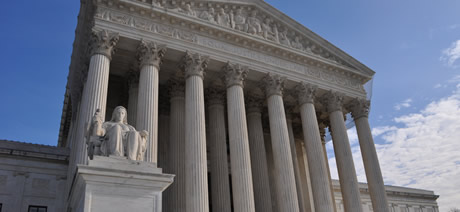
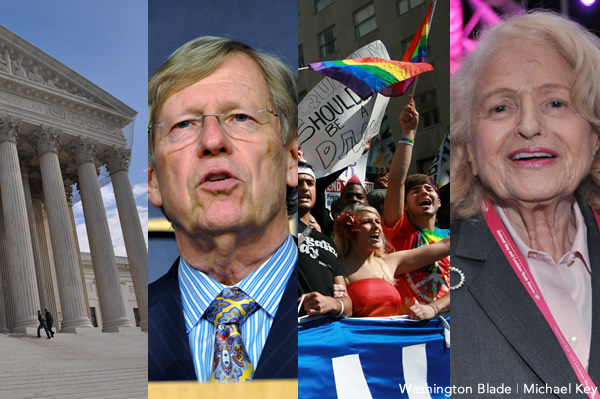
All eyes will be on the Supreme Court next week when it hears arguments in the Prop 8 and DOMA cases. (Washington Blade photos by Michael Key)
At a time of intense national debate, the U.S. Supreme Court for the first time ever will hear oral arguments next week on whether marriage rights for gay couples are protected under the U.S. Constitution.
Attorneys on both sides will make their arguments in two separate cases, on two separate days and regarding two separate anti-gay measures, but the state of marriage equality across the country could be altered depending on the rulings in either of the cases.
On Tuesday, the court will hear arguments on Proposition 8, a ballot measure approved by California voters in 2008 that stripped away existing marriage rights in the state for same-sex couples. The next day, the court will listen to arguments on the federal Defense of Marriage Act, which prohibits federal recognition of same-sex marriage.
Chris Stoll, a senior staff attorney at the National Center for Lesbian Rights, said the oral arguments provide an opportunity for observers to glean what justices are thinking based on their line of questioning.
“It’s true that appellate courts, I would say, mostly base their decisions on the written submissions on the briefs,” Stoll said. “The main purpose of oral argument is to let the justices have questions that they have answered by the lawyers, and so, what the lawyers come in to say isn’t really the focus; it’s really what the justices want to have answered.”
Mary Bonauto, civil rights director for Gay & Lesbian Advocates & Defenders, said oral arguments are a “filtering process” that provide justices the opportunity to explore possible outcomes of their rulings and persuade each other.
“That’s part of why they’re so active,” Bonauto said. “They’re trying to influence each other’s votes and perspectives on it, and, effectively, argue the case themselves. If you ever read a Supreme Court transcript, it’s usually very difficult to read because there are so many interruptions.”
In the Prop 8 case, known as Hollingsworth v. Perry, Ted Olson, a former solicitor general under President George W. Bush, will argue against the constitutionality of the measure on behalf of the American Foundation for Equal Rights. Based on the legal brief he filed, Olson will likely argue against the merits of Prop 8 on the basis that it violates due process and equal protection of gay plaintiff couples under the U.S. Constitution.
The ban on same-sex marriage will be defended by anti-gay groups, such as ProtectMarriage.com, because California state officials have declined to defend the marriage ban. The lawyer arguing on behalf of the anti-gay measure will likely be private attorney Charles Cooper, who defended Prop 8 during the district court trial in 2010.
Depending on the scope, a ruling in the Prop 8 case in favor of the plaintiffs could be a jackpot for same-sex couples. Justices could affirm the limited ruling from the U.S. Ninth Circuit Court of Appeals, which affected only California; determine that the nine states, including California, that offer domestic partnerships must offer same-sex marriage; or issue a sweeping ruling that brings marriage equality to all 50 states.
In the DOMA case, known as Windsor v. United States, Roberta Kaplan, a New York-based attorney, is set to argue against the constitutionality of the anti-gay law in a coordinated effort with the American Civil Liberties Union. Kaplan’s client is Edith Windsor, an 83-year-old lesbian who was forced to pay $363,000 in estate taxes upon the death in 2009 of her spouse, Thea Spyer, because of DOMA.
James Esseks, director of the ACLU’s LGBT Project, said preparations have been underway for oral arguments, including moot courts where individuals impersonate justices to ask possible questions that the real ones may pose.
“People do that for Supreme Court arguments, people do that for appeals court arguments, people do that for trial court arguments — we’ve done that all along,” Esseks said. “It’s just the normal thing that people do.”
On the other side of the DOMA case will be Paul Clement, another former U.S. solicitor general from the Bush administration. He was hired at a rate of $520 an hour by the House Republican-led Bipartisan Legal Advisory Group to defend DOMA in court.
The stakes in the DOMA case are high as well. A ruling striking down DOMA would have multiple impacts on married gay couples. Among other things, they’d have access to medical leave if their spouses need attention because they’re gravely ill or injured and Social Security survivor benefits would become available.
A ruling that strikes down DOMA would also remove a barrier for gay service members seeking spousal benefits in the wake of “Don’t Ask, Don’t Tell” repeal. According to a report published last month from the Center for American Progress and OutServe-SLDN, the average gay military family pays $5,615 out-of-pocket each year for health care insurance because they aren’t eligible for military coverage known as TRICARE.
Both oral arguments will share a common participant: U.S. Solicitor General Donald Verrilli. Since the Obama administration stopped defending DOMA in court, it has participated in litigation against DOMA and will have speaking time in arguments before the Supreme Court. Similarly, in the wake of filing a friend-of-the-court brief against Prop 8, the Justice Department will also have speaking time to argue against it thanks to a request.
In either or both cases, the Supreme Court could determine as part of its ruling that laws related to sexual orientation should be subject to heightened scrutiny, or a greater assumption they’re unconstitutional. That’s the view the Justice Department has articulated in legal briefs against DOMA and Prop 8.
Such a decision would also have a sweeping impact because it would create a precedent that guides other courts when evaluating the constitutionality of anti-gay laws, such as bans on same-sex marriage.
But the merits issue — the question of whether Prop 8 and DOMA are constitutional — will only form part of the discussion in the cases as other issues such as standing and jurisdiction must be addressed. These issues may ultimately form the basis of the court’s rulings.
In the Prop 8 case, the question is whether proponents of the measure have standing to defend the measure in court. It’s possible — as Olson and his team have argued — the court would rule they lack standing because they aren’t harmed by Prop 8. Such a ruling would leave unanswered questions about the constitutionality of same-sex marriage in California, but likely restore same-sex marriage in that state.
The questions about standing and jurisdiction in the DOMA case are more complex. The court asked attorneys when taking up the case whether BLAG has standing to participate and whether the Obama administration’s agreement with lower courts that DOMA is unconstitutional deprives the Supreme Court of jurisdiction. It’s unclear what the fate of DOMA would be if the court decides to rule on those grounds.
GLAD’s Bonauto said she thinks the stronger argument is the court has jurisdiction to consider DOMA and will decide on the merits — but noted “they asked the question for a reason” and questions emerge if the court decides to rule on DOMA on the basis of standing.
“Most people think the Second Circuit decision goes away, then the question is what happens to the district court ruling,” Bonauto said. “Does Edie get her money back, or is there an argument that the district court ruling goes away because the U.S. switched positions in the district court. I’d like to think, at a minimum, Edie would get her money back.”
Vicki Jackson, a Harvard law professor hired by the court, will argue BLAG doesn’t have standing in the lawsuit and the court doesn’t have jurisdiction to hear the case. Deputy Solicitor General Sri Srinavasan is set to address the standing issue on behalf of the Justice Department. BLAG also has been allocated time to assert it has standing in the case, but Windsor’s attorneys weren’t granted time to talk about jurisdiction or standing.
NCLR’s Stoll said any decision from justices that would extend rights to gay couples — whether on the merits or through issues of standing — would be a “milestone” for the LGBT community.
“We have already been seeing tremendous changes in society and the level of acceptance for gay and lesbian people and for legal recognition of them through marriage,” Stoll said. “I think that if the Supreme Court ruled in whatever way in favor of the plaintiffs in these cases, that it would be a real milestone and landmark moment for our movement.”


South Carolina
Man faces first S.C. ‘hate intimidation’ charge
Timothy Truett allegedly shot at gay club in Myrtle Beach on April 1

A South Carolina man remains in custody on a more than $300,000 bond after he allegedly opened fire at a Myrtle Beach nightclub on April 1, according to WMBF.
Reports say 37-year-old Timothy James Truett Jr., of Clover, S.C., was detained by the Myrtle Beach Police Department after the April 1 incident outside Pulse Ultra Club. He was later arrested and charged with possession of a weapon during a violent crime, discharging a firearm into a dwelling, discharging a firearm within city limits, malicious injury to real property valued over $5,000, and assault or intimidation due to political opinions or the exercise of civil rights.
At 10:57 a.m. on April 1, officers responded to a call about a possible shooting at Pulse Ultra Club, located in the 2700 block of South Kings Highway.
In an affidavit released later, the club’s owner, Ken Phillips, said he was doing paperwork that morning when he heard “five or six” gunshots. He went outside and found a window and the windshield of his SUV shattered by bullets. An SUV with blue plastic covering one window was left at the scene.
Police later reviewed footage that showed a silver vehicle stopping in the middle of the road. The video appeared to capture muzzle flashes coming from the passenger-side window.
According to the affidavit, an officer later pulled over a vehicle driven by Truett and found spent shell casings in the back seat, along with a gun.
Documents do not detail why Truett was ultimately charged under the state law covering assault or intimidation tied to political opinions or the exercise of civil rights.
As of April 1, records show Truett is being held in Horry County on a combined bond of more than $312,000.
WMBF spoke with Phillips after the incident and asked whether there was any prior conflict that might have led to the shooting.
“I don’t know if it’s personal, I don’t know if it’s related to being gay, I don’t know if it’s related to the bar issues,” Phillips told WMBF. “Anybody with a mindset of pulling out a weapon in broad daylight is not right.”
“My primary concern has and always will be the safety of my community and my customers,” he added. “It’s given me great concern … as to how far people will go.”
WMBF also spoke with Adam Hayes, vice chair of Myrtle Beach’s Human Rights Coalition, who was involved in pushing for the ordinance. He said that while the incident itself is troubling, it shows the policy is being put to use.
The ordinance is intended to deter “crimes that are motivated by bias or hate towards any person or persons, in whole or in part, because of the actual or perceived” identity, in the absence of a statewide hate crime law.
“It’s nice to see that something we put into policy is not just a piece of paper, that it’s actually being used,” said Hayes.
He said the shooting underscores the need for a statewide hate crime law in South Carolina and added that the incident has left the local LGBTQ community shaken.
South Carolina and Wyoming are the only two states in the U.S. without a comprehensive statewide hate crime law.
Truett remains in jail as of publication.
The White House
Trump budget would codify expanded global gag rule
Funding for LGBTQ health programs around the world would also be cut

The Trump-Vance administration’s fiscal year 2027 budget would codify the expanded global gag rule and eliminate funding for LGBTQ-specific programs in global health initiatives.
“The budget would ensure no funding supports abortion, unfettered access to birth control, and also eliminates funding for circumcision and lesbian, gay, bisexual, transgender, and queer services to better focus funds on life-saving assistance,” reads the proposed budget the White House released on April 3. “The United States should not pay for the world’s birth control and therapy.”
The proposed budget includes four examples of “eliminated activities.”
- In the last administration, PEPFAR funded health workers who performed over 21 abortions in Mozambique
- Promoting reproductive health education and access to birth control and other harmful programs couched under ‘family planning’ in Ghana
- A supply chain “control tower” to provide a “holistic commercial of the shelf solution” on the Office of Population and Reproductive Health (PRH)
- Promoting health equity and providing condoms and contraception in Kenya.
President Ronald Reagan in 1985 implemented the global gag rule, also known as the “Mexico City” policy, which bans U.S. foreign aid for groups that support abortion and/or offer abortion-related services.
Trump reinstated the rule during his first administration. The Biden-Harris administration shortly after it took office in January 2021 rescinded it.
The Trump-Vance White House earlier this year expanded the global gag rule to ban U.S. foreign aid for groups that promote “gender ideology.” The expansion took effect on Feb. 26.
US funding cuts have devastated global LGBTQ rights movement
The Trump-Vance administration after it took office in January 2025 moved to dismantle the U.S. Agency for International Development, which funded LGBTQ and intersex rights groups around the world. USAID officially shut down on July 1, 2025.
Secretary of State Marco Rubio in March 2025 announced the State Department would administer the 17 percent of USAID contracts that had not been cancelled. Rubio issued a waiver that allowed PEPFAR and other “life-saving humanitarian assistance” programs to continue to operate during the U.S. foreign aid freeze the White House announced shortly after it took office.
The global LGBTQ and intersex rights movement has lost more than an estimated $50 million in funding because of these cuts. The Washington Blade has previously reported PEPFAR-funded programs in Kenya and other African countries have been forced to suspend services and even shut down.
The Trump-Vance administration has signed healthcare-specific agreements with Kenya, Uganda, and other African countries through its American First Global Health Strategy. Advocacy groups with whom the Blade has spoken have expressed concern these partnerships will result in further exclusion and government-sanctioned discrimination based on sexual orientation or gender identity.
The proposed fiscal year 2027 budget includes $5.1 billion for “global health to end the previous administration’s abuse of these programs and to execute (the State Department’s) newly released America First Global Health Strategy.” This figure represents a $4.3 billion cut from the previous year.
“The president’s new vision of bilateral health assistance eliminates bloated Beltway Bandit contracts, does more with fewer dollars, and transitions recipient countries to self-reliance,” reads the proposed budget. “The budget would also eliminate disease-specific accounts and provide the department crucial agility to address the actual needs of each recipient country — across HIV/AIDS and other infectious diseases such as malaria, tuberculosis, and polio — to strengthen global health security and protect Americans from disease.”
“The budget would focus on new compacts that unify funding, achieving economies of scale in both implementation and oversight,” it adds. “Under the prior administration, only about 40 percent of PEPFAR funds supported actual service delivery, including medications, testing, commodities, and health workers, with the remaining 60 percent wasted on duplicative administrative costs, unwieldy supply chains, and layers of endless bureaucracy. The new AFGHS (America First Global Health Strategy) compacts would improve efficiency, cut red tape, and dismantle the bloated ecosystem of foreign assistance profiteers.”
The Council for Global Equality on April 3 reiterated its criticism of the expanded global gag rule, and urged Congress to reject the proposed budget.
“We won’t mince words: people are dying because of this policy,” said the Council for Global Equality in a statement. “Making this policy permanent will only ensure that U.S. foreign assistance discriminates against those who need services the most, all while forcing people around the world to adhere to the Trump administration’s extremist, ideological agenda that denies the very existence of transgender, nonbinary, and intersex persons.”
“We will not be silent as Trump threatens to upend decades of bipartisan foreign assistance programs to appease his extremist base,” added the group. “We call on Congress to immediately reject this budget and block implementation of the expanded global gag rules.”
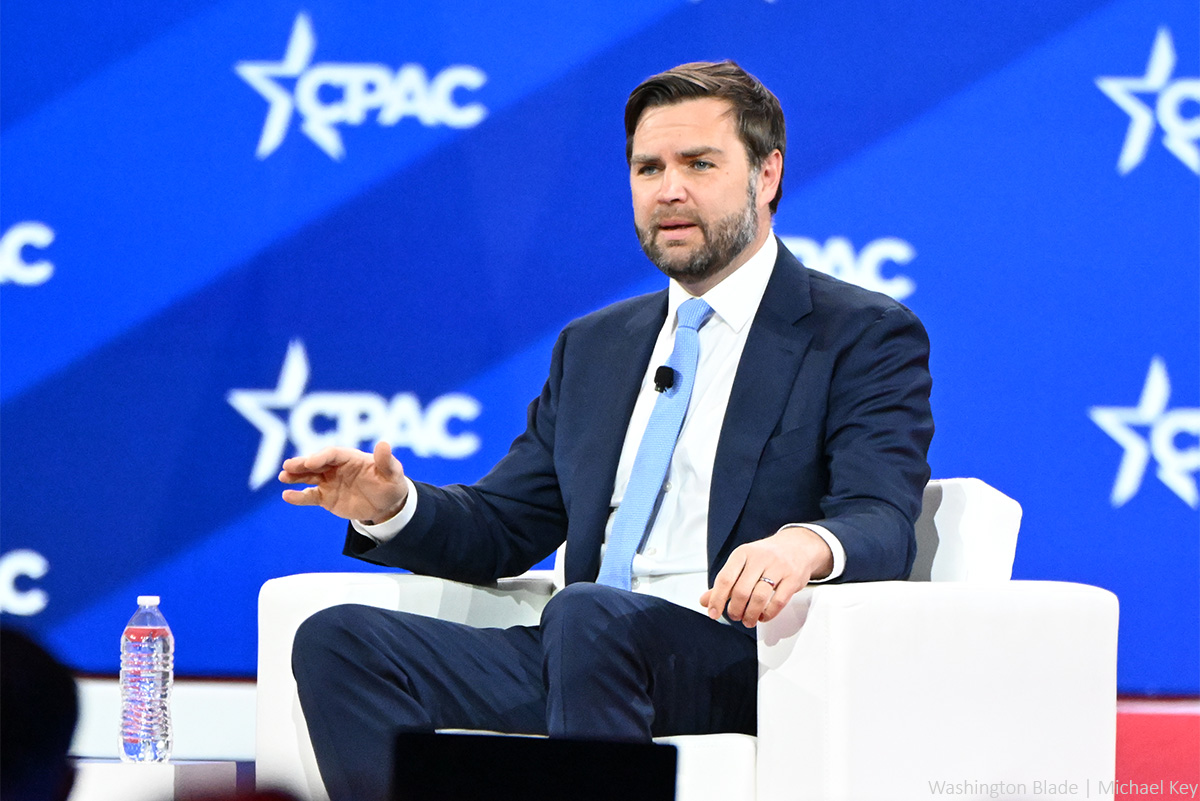
Vice President JD Vance and his wife, second lady Usha Vance, will visit Hungary next week.
An announcement the White House released on Thursday said the Vances will be in Budapest, the Hungarian capital, from April 7-8.
JD Vance “will hold bilateral meetings with” Hungarian Prime Minister Viktor Orbán. The announcement further indicates the vice president “will also deliver remarks on the rich partnership between the United States and Hungary.”
The Vances will travel to Hungary less than a week before the country’s parliamentary elections take place on April 12.
Orbán, who has been in office since 2010, and his Fidesz-KDNP coalition government have faced widespread criticism over its anti-LGBTQ crackdown.
The Associated Press notes polls indicate Orbán is trailing Péter Magyar and his center-right Tisza party.

Amendments to India’s transgender rights law criticized

Cuba under pressure and without answers

Police mental health struggles gain growing attention

Man faces first S.C. ‘hate intimidation’ charge

Trump budget would codify expanded global gag rule

Pam Bondi ousted as attorney general

JD Vance to travel to Hungary next week

Mayor Bowser signs bill requiring insurers to cover PrEP

Belarusian lawmakers approve bill to crackdown on LGBTQ rights