News
What’s next for gay couples after court decisions on marriage?
Immigration rights, expanded partner benefits and maybe another lawsuit

Jeff Zarillo speaking to the press following the Supreme Court’s ruling on DOMA and Proposition 8. (Washington Blade photo by Michael Key)
The Supreme Court rulings against the Defense of Marriage Act and California’s Proposition 8 are providing new momentum to the LGBT rights movement as advocates are pushing for officials to interpret the decisions as broadly as possible.
The court ruling against DOMA is complex because it means that new benefits will be available to same-sex couples if they’re married. But there still is an issue with some of these benefits even with DOMA gone.
Some of these benefits, like Social Security survivor benefits and tax benefits, are in question because federal law governing these issues looks at a state where a couple lives as opposed to whether they were legally married. That means a gay couple that marries in a state like New York, but moves to Florida, won’t be able to apply for these benefits while living there.
James Esseks, director of the American Civil Liberties Union LGBT Project, said while explaining the decision that the Obama administration can interpret the rulings in a broad manner to ensure all federal benefits flow to married same-sex couples regardless of the state in which they live.
“In almost all contexts, the Obama administration has the ability and the flexibility to move to a rule where they look to the law of the state in which you got married, not the state in which you live,” Esseks said. “So we expect and hope that the federal government is going to update those rules … and that would mean that once you get married, you’re married for federal purposes forever. That’s what we think the right rule is, and that’s the rule we think the administration can get to.”
Esseks added there “are a small number of contexts” in which the administration can’t do it alone and Congress has a statute prohibiting certain benefits from flowing to married same-sex couples so passage of the Respect for Marriage Act is necessary to address those issues.
That legislation was introduced later in the day after the Supreme Court rulings by Rep. Jerrold Nadler (D-N.Y.) in the House and Sen. Dianne Feinstein (D-Calif.) in the Senate. The legislation has 161 original sponsors in the House and 41 original sponsors in the Senate.
But the sentiment that the Obama administration can make changes was expressed by Human Rights Campaign President Chad Griffin, who in a statement called on the administration to interpret the DOMA ruling broadly.
“Federal recognition for lesbian and gay couples is a massive turning point for equality, but it is not enough until every family is guaranteed complete access to the protections they need regardless of state borders,” Griffin said. “The administration must take every possible step to ensure this landmark ruling treats every lawfully married couple across the country with the equality our Constitution guarantees.”
Following the court decision against DOMA, Holder issued a statement saying he’ll “work expeditiously with other Executive Branch agencies” to ensure they comply with the court decision. President Obama issued a statement earlier in the day indicating he had given Holder this task.
“As we move forward in a manner consistent with the Court’s ruling, the Department of Justice is committed to continuing this work, and using every tool and legal authority available to us to combat discrimination and to safeguard the rights of all Americans,” Holder said.
In a subsequent statement, Griffin said he spoke with Holder over the phone about the DOMA decision and was told the administration would go through a thoughtful and deliberative process to implement the ruling.
A White House official, speaking on condition of anonymity, said Obama himself also held a call on Wednesday with “a group of marriage equality advocates, faith leaders, elected officials, and allies” on the rulings in the DOMA and Prop 8 cases.
With the court ruling, one change is certain. Bi-national same-sex couples will now be able to apply for visas through the I-130 marriage-based green card application. Immigration law looks to the state in which a couple was married as opposed to the state in which a couple lives in determining whether a couple is eligible for a visa.
Rachel Tiven, executive director of Immigration Equality, said in a statement praising the court ruling that no barrier remains precluding the granting of visas to ensure bi-national same-sex couples can remain together in the United States.
“At long last, we can now tell our families that yes, they are eligible to apply for green cards,” Tiven said. “Many of our families have waited years, and in some cases decades, for the green card they need to keep their families together. Couples forced into exile will be coming home soon. Americans separated from their spouses are now able to prepare for their reunion.”
Secretary of the Department of Homeland Security Janet Napolitano applauded the ruling.
“This discriminatory law denied thousands of legally married same-sex couples many important federal benefits, including immigration benefits,” she said. “ … Working with our federal partners, including the Department of Justice, we will implement today’s decision so that all married couples will be treated equally and fairly in the administration of our immigration laws.”
The ruling also means the issue of whether bi-national same-sex couples should be included as part of comprehensive immigration reform pending before the Senate is off the table. Senate Judiciary Committee Patrick Leahy (D-Vt.) had filed the amendment in the event of a Supreme Court ruling against same-sex couples in the DOMA case.
Calling the Supreme Court ruling against DOMA “a major step toward full equality,” Leahy announced that he would no longer pursue the amendment for bi-national same-sex couples.
“With the Supreme Court’s decision today, however, it appears that the anti-discrimination principle that I have long advocated will apply to our immigration laws and binational couples and their families can now be united under the law,” Leahy said. “As a result of this welcome decision, I will not be seeking a floor vote on my amendment.”
Also expected to come to an end is the preclusion of major benefits — such as health and pension benefits — from flowing to gay employees with same-sex spouses.
Defense Secretary Chuck Hagel said in a statement following the court decisions that the Pentagon “welcomes” the ruling on DOMA and is prepared to offer these benefits to troops with same-sex partners.
“The department will immediately begin the process of implementing the Supreme Court’s decision in consultation with the Department of Justice and other executive branch agencies,” Hagel said. “The Department of Defense intends to make the same benefits available to all military spouses — regardless of sexual orientation — as soon as possible. That is now the law and it is the right thing to do.”
The Pentagon was already in the process of granting additional spousal benefits to gay troops available under current law, such as military IDs, which was expected to come to an end this year. It remains to be seen what impact the court decision will have on this process.
Elaine Kaplan, a lesbian and acting director of the U.S. Office of Personnel Management, said her agency is beginning to examine the issue of benefits that will be afforded to federal employees for same-sex couples, but additional waiting time is necessary.
“While we recognize that our married gay and lesbian employees have already waited too long for this day, we ask for their continued patience as we take the steps necessary to review the Supreme Court’s decision and implement it,” Kaplan said.
The situation resulting from the ruling in the Proposition 8 case is less complex because it only involves whether the State of California can resume granting marriage licenses to same-sex couples. But California officials say they’re prepared to recognize marriage equality in the state.
California Gov. Jerry Brown (D-Calif.) said in a statement he’s prepared to allow clerks to distribute marriage licenses to same-sex couples as soon as the U.S. Ninth Circuit Court of Appeals lifts its stay.
“After years of struggle, the U.S. Supreme Court today has made same-sex marriage a reality in California,” Brown said. “In light of the decision, I have directed the California Department of Public Health to advise the state’s counties that they must begin issuing marriage licenses to same-sex couples in California as soon as the Ninth Circuit confirms the stay is lifted.”
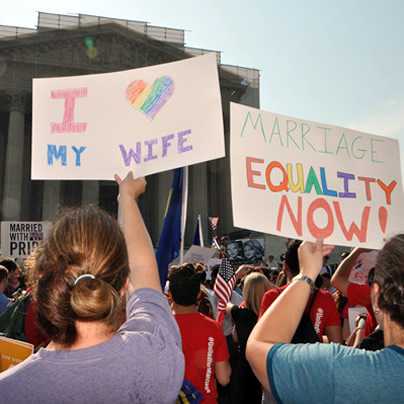
Both rulings have stirred calls for the expansion of marriage equality into additional states. Speaking before the Supreme Court, HRC President Chad Griffin cried out those who came to celebrate, “Let’s set a new goal: within five years, we will bring marriage equality to all 50 states in the U.S.”
Considering some states would need at least four years to lift their bans on same-sex marriage through the legislative process, Griffin’s call would likely require another lawsuit that would spread marriage equality throughout the country much like the 1967 case of Loving v. Virginia brought to an end all state bans on interracial marriage.
ACLU’s Esseks said the ruling in the case against DOMA might have an impact on new litigation seeking marriage equality in all 50 states, but said Associate Justice Anthony Kennedy wrote the opinion in a way that was restrictive in its implications.
“It certainly won’t hurt, but Kennedy was careful to write it in a way that doesn’t directly address the broader freedom to marry issue,” Esseks said.
Evan Wolfson, president of Freedom to Marry, said he thinks the decisions would make an additional lawsuit more likely to succeed.
“The best way to win is not ‘just’ to file a lawsuit, it’s to bring that lawsuit on the strength of having won more states and more support, setting the stage for victory,” Wolfson said. “That’s the winning strategy that has brought us this far, and it is the winning Freedom to Marry strategy that will bring us to victory nationwide — if we keep doing the work.”



Maryland
Md. Legislative LGBTQ+ Caucus outlines 2026 priorities
Expanded PrEP access among objectives
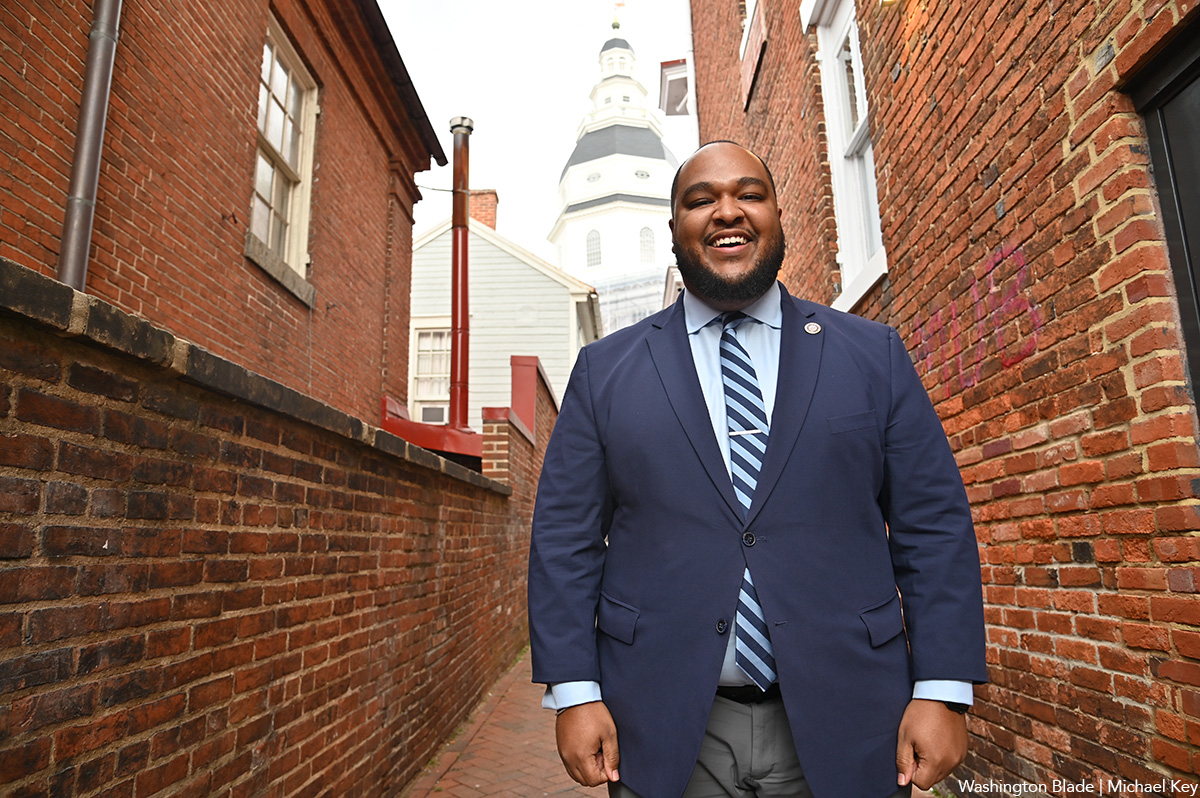
Maryland’s Legislative LGBTQ+ Caucus outlined legislative priorities for the remainder of the General Assembly’s 2026 term during a press conference on March 5.
State Del. Kris Fair (D-Fredrick County) led the press conference. State Del. Ashanti Martinez (D-Prince George’s County) and other caucus members also spoke.
Caucus members are sponsoring 12 bills and supporting four others.
Martinez is sponsoring House Bill 1114, which would expand PrEP access in Maryland.
“PrEP is 99 percent effective in preventing HIV transmission,” he explained, noting PrEP’s cost often turns away potential users.
The bill aims to extend insurance coverage and expand pharmacists’ ability to prescribe PrEP along with other HIV treatments and testing. Martinez is working with state Sen. Clarence Lam (D-Anne Arundel and Howard Counties) and FreeState Justice on the bill.
The House Health Committee had a hearing last week that included HB1114.
“Ending the HIV epidemic is about expanding access and providing these life-saving tools to all persons in Maryland,” Martinez said.
Several other pieces of legislation were highlighted during the press conferences. They included measures focused on youth and education, birth certificate markers, so-called conversion therapy, and hormone medications.
State Sen. Cheryl Kagan (D-Montgomery County) is cosponsoring Senate Bill 950, which would update and strengthen conversion therapy laws. State Del. Bonnie Cullison (D-Montgomery County) has introduced an identical bill that would extend the statute of limitations on individuals who facilitate conversion therapy.
Kagan explained the bill would allow conversion therapy victims to come to terms with their experience undergoing the widely discredited practice that “creates shame and it silences survivors.”
When questioned, Fair explained the press conference happened late into the legislative session because “we [the caucus] are constantly having to respond in real time to what’s happening in Washington” while drafting and considering pieces of legislation.
The Frederick County Democrat described this session’s bills as the “most ambitious list of priorities to date.” Fair also described the caucus’s goals.
“It’s decency, it’s dignity, and its humanity,” he said.
The White House
Trump will refuse to sign voting bill without anti-trans provisions
Measure described as ‘Jim Crow 2.0’
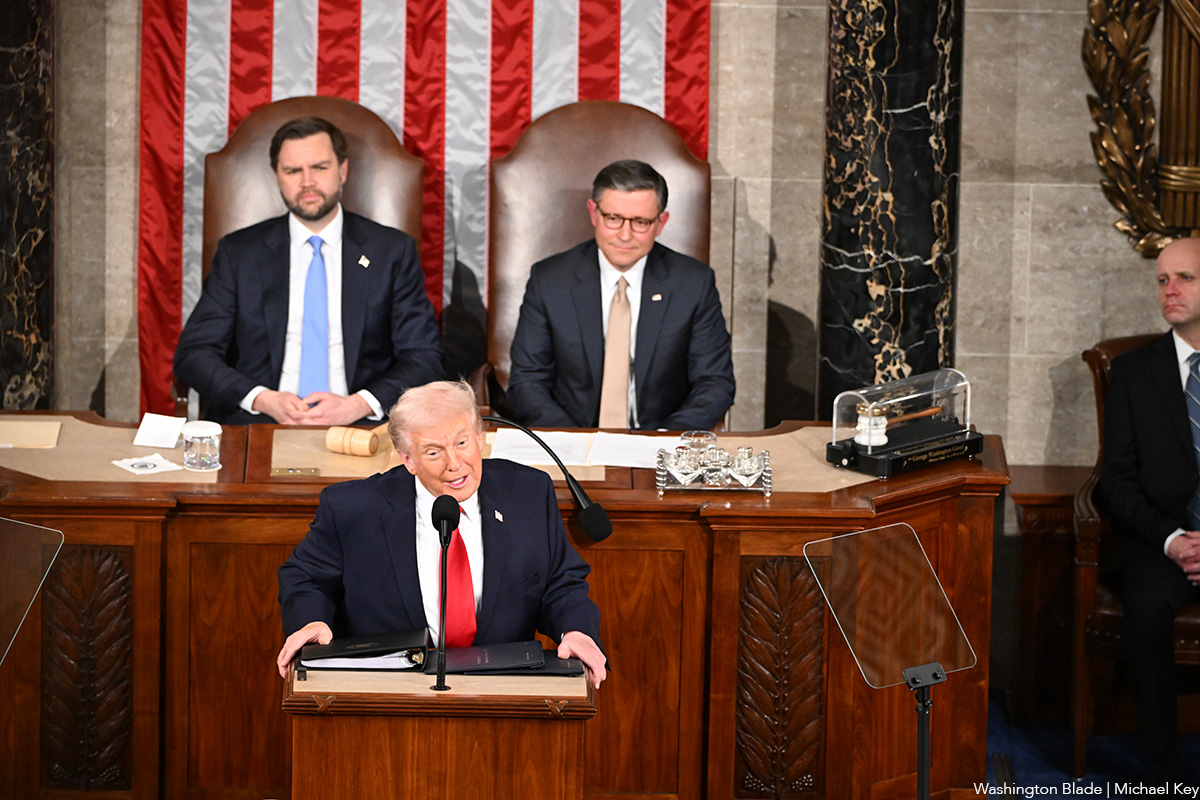
President Donald Trump said he will refuse to sign any legislation into law unless Congress passes the “SAVE Act,” pressuring lawmakers to move forward with the controversial voting bill.
In posts on Truth Social and other social media platforms, the 47th president emphasized the importance of Republican lawmakers pushing the legislation through while also using the opportunity to denounce gender-affirming care.
“I, as President, will not sign other Bills until this is passed, AND NOT THE WATERED DOWN VERSION — GO FOR THE GOLD,” Trump posted. “MUST SHOW VOTER I.D. & PROOF OF CITIZENSHIP: NO MAIL-IN BALLOTS EXCEPT FOR MILITARY — ILLNESS, DISABILITY, TRAVEL: NO MEN IN WOMEN’S SPORTS: NO TRANSGENDER MUTILIZATION FOR CHILDREN! DO NOT FAIL!!!”
The proposed Safeguard American Voter Eligibility (SAVE) Act would amend the National Voter Registration Act of 1993 to require in-person proof of citizenship for anyone seeking to vote in U.S. elections. Trump has also called for the legislation to include a ban on gender-affirming medical care for transgender minors, even with parental consent.
“This is a huge priority for the president. He added on some priorities to the SAVE America Act in recent days, namely, no transgender transition surgeries for minors. We are not gonna tolerate the mutilation of young children in this country. No men in women’s sports,” White House Press Secretary Karoline Leavitt said. “The president putting all of these priorities together speaks to how common sense they are.”
The comments mark the first time the White House has publicly confirmed that Trump is pushing to attach anti-trans policies to the SAVE Act.
The bill would also require the removal of undocumented immigrants from existing voter rolls and allow election officials who fail to enforce the proof-of-citizenship requirement to be sued.
It is already illegal for noncitizens to vote in federal elections. Current safeguards include requirements such as providing a Social Security number when registering to vote, cross-checking voter rolls with federal data and, in some states, requiring identification at the polls.
Trump began pushing for the legislation during his State of the Union address last month, where he singled out Senate Majority Leader John Thune (R-S.D.) by name while criticizing the lack of movement on the bill.
Senate Minority Leader Chuck Schumer (D-N.Y.) has denounced the legislation as “Jim Crow 2.0” and said it has little chance of advancing through the Senate, calling it “dead on arrival.”
In remarks on the Senate floor, Schumer said “the SAVE Act includes such extreme voter registration requirements that, if enacted, could disenfranchise 21 million American citizens.”
Trump has repeatedly used political messaging around trans youth and gender-affirming care as part of broader cultural and policy debates during his presidency — most recently during his State of the Union address, where he cited the case of Sage Blair, a Virginia teenager whose school allegedly encouraged her to transition without her parents’ consent.
LGBTQ advocates — including those familiar with Blair’s story — say the situation was far more complex than described and argue that using a single anecdote to justify sweeping federal restrictions could place trans people, particularly youth, at greater risk.
District of Columbia
Owner of D.C. gay bar Green Lantern John Colameco dies at 79
Beloved businessman preferred to stay ‘behind the scenes’
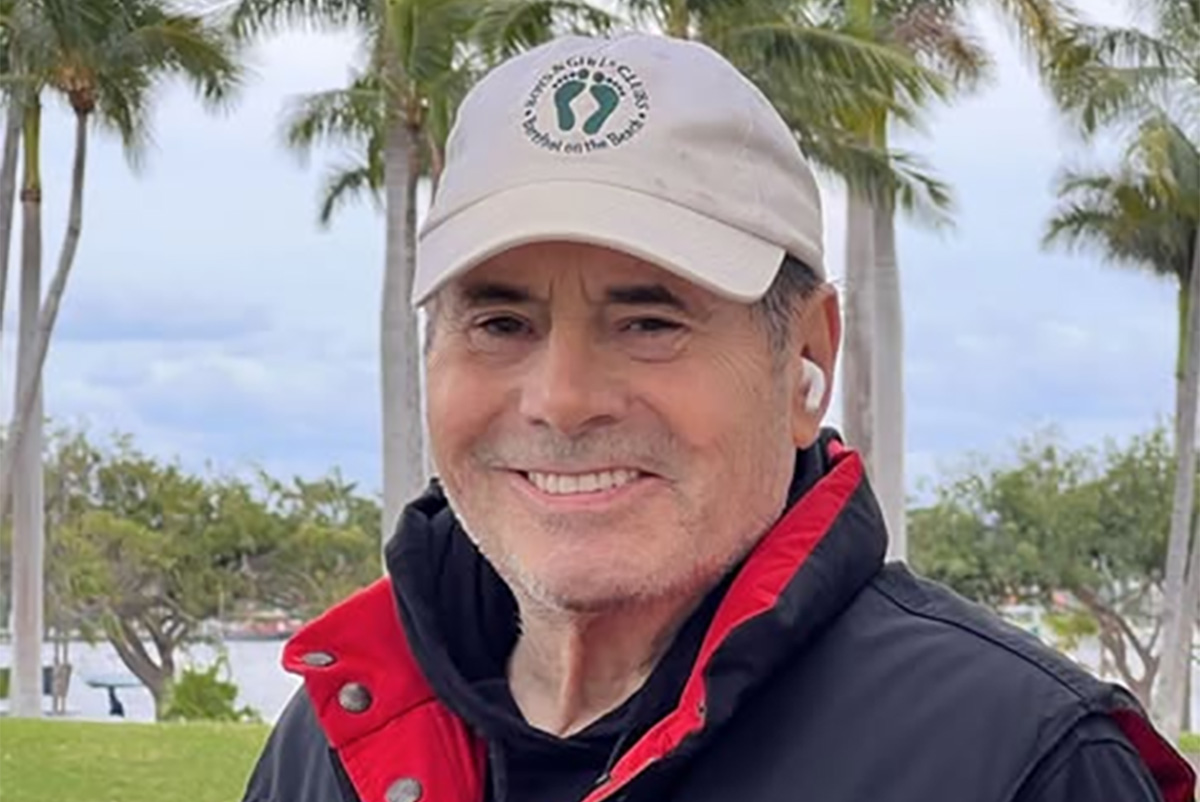
John Colameco, owner of the popular D.C. gay bar Green Lantern, has died, according to a March 7 announcement posted on the bar’s website and Instagram account. The announcement didn’t provide a date of his passing or a cause of death.
Green Lantern manager Howard Hicks said Colameco was 79 at the time of his passing.
“It is with great sadness that Green Lantern announces the death of our beloved owner, John Colameco,” the announcement says. “Most of our patrons might have heard John’s name, but might not have known his face,” it says.
“He was a ‘behind-the-scenes’ kind of guy who avoided the limelight,” the announcement continues. “He preferred to stay in the back of the house with staff and team ensuring everything was running smoothly so that everyone out front was having a good time.”
The announcement adds, “As a veteran and businessman, John wasn’t a member of the LGBTQ + community, but he was one of the best damn allies our community has ever had.”
It says he “long provided spaces for the queer community to come together” since the 1990s when he owned and operated a popular restaurant on 17th Street, N.W. called Peppers.
According to the announcement, Colameco and his then business partner Greg Zehnacker opened the Green Lantern in 2001 in an alley off of 14th Street, N.W., between Thomas Circle and L Street, N.W.
The announcement points out that the Green Lantern first opened in the same location in the early 1990s before it later closed when the original owners decided to purchase and open other bars, one of which was the gay bar Fireplace near Dupont Circle. Colameco and Zehnacker were able to reopen the bar with the Green Lantern name.
“When Greg died unexpectedly in February 2014, John remained steadfastly committed to carrying on their vision and ensuring that Green Lantern remained part of the fabric of D.C.’s queer community,” the announcement says.
“Over the years, through Green Lantern, John has provided support to many community organizations, most notably Stonewall Sports, the Gay Men’s chorus of Washington, and ONYX Mid-Atlantic with Green Lantern serving as a gathering hub for their activities,” it states.
The announcement adds that Colameco’s family was planning a memorial for him in his hometown of Philadelphia.
“His Green Lantern family will celebrate his life by operating the bar as usual and we encourage you to stop by and join us,” it says. “Community coming together and having a good time – it’s exactly what John would want.”

Md. Legislative LGBTQ+ Caucus outlines 2026 priorities

PHOTOS: ‘Defrosted’

Trump will refuse to sign voting bill without anti-trans provisions

Owner of D.C. gay bar Green Lantern John Colameco dies at 79

Man stuck in Lebanon as Iran war escalates

13 HIV/AIDS activists arrested on Capitol Hill

Fla. Senate passes ‘Anti-Diversity’ bill that could repeal local LGBTQ protections

Ugandan activist named Charles F. Kettering Foundation fellow

Liza Minnelli makes surprise appearance at GLAAD Media Awards

Capital Pride must be transparent about sexual misconduct investigation
-

 National5 days ago
13 HIV/AIDS activists arrested on Capitol Hill
-
Florida4 days ago
Fla. Senate passes ‘Anti-Diversity’ bill that could repeal local LGBTQ protections
-
Uganda4 days ago
Ugandan activist named Charles F. Kettering Foundation fellow
-
Celebrity News4 days ago
Liza Minnelli makes surprise appearance at GLAAD Media Awards