Local
Virginia colleges mum on Cuccinelli letter
Public colleges and universities in Virginia were considering their options this week after state Attorney General Ken Cuccinelli declared their policies barring discrimination against gays illegal.
Many student and LGBT groups mobilized against Cuccinelli’s letter March 4 to 40 school presidents, which says the institutions cannot treat sexual orientation, gender identity and gender expression as protected classes in non-discrimination policies. But the schools largely reserved comment.
Only one major institution, Virginia Commonwealth University, released before DC Agenda deadline any official statement, but it said only that students, faculty and staff would be consulted.
Gov. Bob McDonnell (R) seemed to offer the schools a small reprieve earlier this week. A spokesperson affirmed the governor’s view that only the General Assembly can extend anti-discrimination protections to a new class, a view consistent with Cuccinelli’s advice.
But the spokesperson, Tucker Martin, noted executive branch appointments to school boards would not focus on this issue.
“The governor will appoint board members based solely on their ability and on their strong commitment to educational excellence in Virginia. The governor expects that no Virginia college or university, or any other state agency, will engage in discrimination of any kind.”
Equality Virginia CEO Jon Blair called on McDonnell to prove his stance against discrimination by asking the General Assembly to send him a bill adding sexual orientation to the state’s policy.
“Attorney General Cuccinelli’s letter was Gov. McDonnell’s opportunity to prove whether he was the Robert McDonnell who said through his entire campaign that he opposed discrimination or he was the Robert McDonnell who wrote the thesis from 20 years ago,” Blair said, referring to past writings where the governor opposed gay rights. “I think if he fails to act on this, he’s proven exactly which one he is.”
On Tuesday, the state House voted down a motion to force a vote on the bill that would have added sexual orientation to the state’s non-discrimination laws. The measure failed 55-42. The bill previously passed the state Senate, but did not make it out of subcommittee in the House.
One university’s diversity coordinator, who spoke on condition of anonymity, said some schools would defy the request if they could, but they would face significant political pressure to comply with the current administration.
Campus groups, meanwhile, have begun campaigns asking school administrators to ignore Cuccinelli’s directive. University of Virginia’s Queer & Allied Activism group began by uploading to Facebook photos of the attorney general that were doctored to poke fun at him.
Inspired by the grammatically incorrect lolcatz pictures, some photos of Cuccinelli included the words “In ur AG office … hatin’ on ur gays” and “Gays? We don’t have them in my state.”
One group on Facebook that stood against Cuccinelli’s letter, “We Don’t Want Discrimination in Our State Universities and Colleges,” gathered more than 4,000 members within days.
Seth Kaye, a second year engineering student at UVA and member coordinator of Queer & Allied Activism, said he felt hurt by the attorney general’s attack and wanted to know why anyone thought it was acceptable to go after LGBT people.
“I don’t understand how that can pass a rational basis test,” Kaye said. “It seems totally biased.”
UVA was making significant improvements toward offering services to LGBT students, Kaye said, including starting a queer studies minor program and a new gay fraternity.
“I hope the universities all come together and say we’re not going to follow this order,” he said. “Hopefully, if the state sues them, it turns out in our favor and maybe [we] even get sexual orientation as a protected class.”
With most students away from campus on spring break, Kaye said campaigning on the issue has been largely performed online, with a particular focus on Facebook and e-mail. He wondered if the letter’s timing was deliberate to avoid a more robust student backlash.
For his part, Cuccinelli took to local airwaves this week to defend his advice to schools. He said his letter was consistent with opinions of the state’s previous five attorneys general, which included three Democrats.
But on his Twitter profile, Cuccinelli was less cautious: “Still much sound and fury about simply stating what the law is now and has been pretty much forever in Virginia … but on a touchy subject.”
Fears that the Republican would use his office to advance a socially conservative agenda, rather than merely advise on law, were expressed as early as his campaign launch, including from vocal members of the Log Cabin Republicans of Virginia.
“Just as we feared, Mr. Cuccinelli is becoming an embarrassment to the entire state with his extreme views on this issue,” said David Lampo, vice president of the Log Cabin Republican Club of Virginia.
“We call on Virginia’s state colleges and universities to resist this outrageous demand and to continue their policies of hiring and firing on the basis of merit rather than sexual orientation, and we call on Gov. McDonnell to end this legal limbo for gay and lesbian state employees by supporting a bill to outlaw employment discrimination on the basis of sexual orientation.”



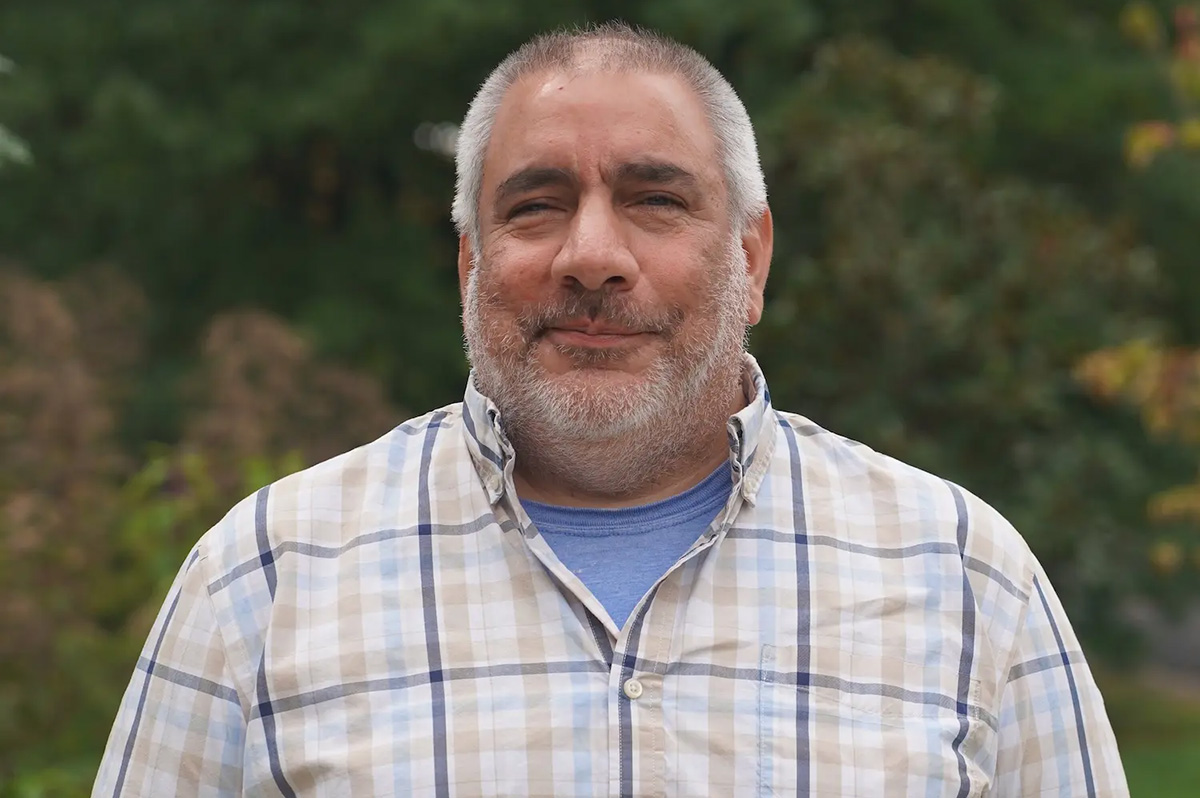
The Comings & Goings column is about sharing the professional successes of our community. We want to recognize those landing new jobs, new clients for their business, joining boards of organizations and other achievements. Please share your successes with us at [email protected].
Congratulations to Paul Marengo who has been appointed the new executive director of the Equality Chamber of Commerce.
The Equality Chamber of Commerce is dedicated to advancing economic opportunities, business growth, and advocacy for LGBTQ+ entrepreneurs, professionals, and allies. Through networking, education, and community engagement, the Chamber works to create a thriving and inclusive business environment for all.
On behalf of the Chamber, Edmund Morris said, “We are thrilled to welcome Paul Marengo as executive director. His passion, vision, and dedication to fostering inclusive business environments make him the ideal leader to guide the Chamber into its next phase of growth and success.”
Marengo has been a nonprofit fundraising executive for more than 30 years. He is the founder and CEO of Promethean Fundraising, a grassroots consulting firm that provides assistance, tools, and empowers emerging nonprofits to become competitive fundraisers. His clients have included The Chamber, Ragtag Film Society, and The Cherry Fund. He has served as a grant reviewer for the Maryland State Arts Commission, Virginia Commission for the Arts, DC Commission on the Arts and Humanities, and the National Endowment for the Arts.
District of Columbia
Nearly 6,000 turn out for Pride Night Out at the Nationals
Gay Men’s Chorus sings National Anthem

“Just shy of” 6,000 people purchased tickets for the Wednesday, June 24, 21st annual Pride Night Out at the Washington Nationals baseball stadium, which the Nationals said is the longest running LGBTQ Pride event in Major League Baseball, according to a Nationals spokesperson.
The event was organized with the Nationals by Team D.C., the local LGBTQ sports group that organizes similar Pride Nights for other professional D.C. area sports teams.
“It was a good time had by all as the Nationals celebrated the LGBTQ+ community during the Nationals 21st Pride Night Out, presented by Team D.C.” the Nationals said in a statement.
Nationals spokesperson Erica George said the overall game attendance was 27,200.
Similar to recent past years, the Gay Men’s Chorus of Washington sung the National Anthem at the start of the game, drawing loud cheers from people throughout the stadium.
The Nationals lost the game to the Philadelphia Phillies by a score of 5-4. Although most of the LGBTQ attendees of the event, held in the right-field mezzanine section of the stadium, were cheering for the Nationals, a sizeable number also cheered for the Phillies.
Miguel Ayala, one of Team D.C.’s lead organizers, said he noticed fans displaying Pride flags and recognized LGBTQ people in all parts of the stadium, indicating significantly more LGBTQ people and their supporters attended the game beyond the close to 6,000 or more who purchased the specific Pride Night Out tickets.
“It was a great excitement last night,” he told the Washington Blade on the day following the event. “I saw a lot of big crowds of our people, I saw everybody I can think of in the community. And it was really great to see the turnout.”
Also, like in previous years, Team D.C. along with the Nationals helped to organize a pre-game show on the large concourse platform area next to the stadium seating area involving a drag show led by local drag performer Shi-Queeta Lee.
“During pregame ceremonies, the Nationals Pride employee resource group was recognized on the field,” the statement released by the Nationals says. “Dr. Demetre Daskalakis, a physician and public health leader who has had a profound impact on the LGBTQ+ community and those living with or vulnerable to HIV, threw out the ceremonial first pitch as the guest of Team D.C.,” the statement says.
It adds that Team D.C.’s scholarship recipient Spencer Doll made the ceremonial call to “Play Ball.”
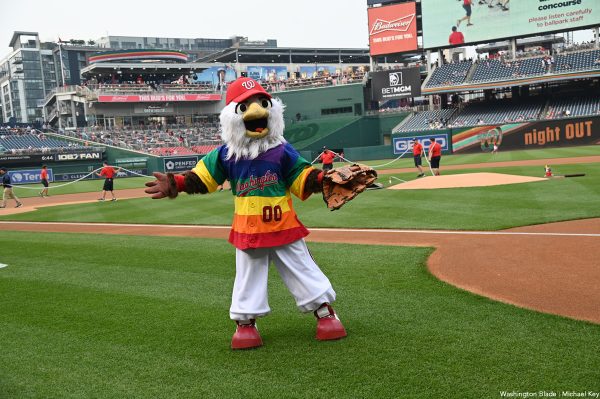
As if all that were not enough, a Nationals employee who entertains during the Nationals pre-game shows on the field dressed as a giant eagle named “Screech” wearing an eagle’s head mask appeared in the seating area where the Pride Night Out crowd was seated and mingled with the LGBTQ fans, many of whom posed for photos with Screech.
District of Columbia
Washington Blade names new publisher
Longtime ad exec Brian Pitts to assume role from Lynne Brown

The Washington Blade announced this week that its longtime publisher, Lynne Brown, who has worked at the publication for nearly 40 years, is retiring from her day-to-day duties.
Blade co-owner and longtime advertising executive Brian Pitts will assume the role of publisher effective June 26.
Pitts, 46, is a native of Fredericksburg, Va. In 2004, he moved to Washington, D.C., from Rehoboth Beach, Del., to work at the Blade as a 24-year-old sales executive. Pitts, along with Brown and Blade Editor Kevin Naff have owned the Blade since 2009. Pitts has served as the Blade’s lead sales executive since then.
“We’ve been through a lot over the last 17 years, including a recession and a pandemic,” said Pitts. “Lynne has been a steady hand throughout and I’m excited to take the reins and help steer the Blade into its next chapter.”
Brown will assume the title of publisher emerita and remain a part owner of the Washington Blade and Los Angeles Blade and contribute to the business via special projects.
As for what’s next, she said, “I will take the summer to regroup. I have one more LGBTQ community project in mind, and a few personal goals to check off the list. I am a Washingtonian. I will continue to live, work, and love here in D.C. Of course every Friday morning, I will grab a cup of coffee and read the Blade.”
Asked what advice she has for Pitts as he takes over the publisher’s job, Brown replied, “Brian is going to be great. He has all the skills needed to run this business. He also has a deep, silent passion for the Blade. My only advice: Slow and steady wins the race.”
Pitts said his primary goal as publisher is to ensure the Blade continues its mission as America’s LGBTQ news source.
“Another goal is to reach a younger audience and to include an educational component,” he added. “Some younger community members may be newer to the Blade and less familiar with LGBTQ history. Recently, we published a special commemorative magazine to coincide with America 250, chronicling LGBTQ history and contributions to U.S. culture. It’s so important not to let our history get erased and to remember where we came from and to work toward where we want to go.”
He described the biggest challenge to queer media as the Trump administration’s attacks on DEI.
“We have companies that have advertised with us for years who are now afraid of the potential consequences,” he said.
Brown joined the Blade in 1987. She was named publisher in 2007 by previous owner Window Media. In 2009, Window Media filed for bankruptcy; shortly after, Brown, Naff, and Pitts acquired the Blade’s assets from the bankruptcy court and relaunched the brand with Brown as publisher.
She said the period after the bankruptcy became her biggest challenge as publisher.
“The crisis that birthed Brown Naff Pitts Omnimedia kept me overly focused on millions of details,” she recalls. “My greatest personal challenge was delegating and letting go of details. Trusting staff with their strengths and skills to do their jobs was slow to come. It has proved to be most rewarding. Building the right team — knowing the people you work with are committed, professional, and honest — is a great thing.”
Pitts described the bankruptcy and rebirth of the Blade in 2009 as his proudest moment with the company.
“Working at the paper has been great, but becoming a co-owner was a dream come true,” he said.
Naff praised both of his colleagues.
“Lynne has been a rock, helping us navigate financial crises and a pandemic. The Blade wouldn’t have survived without her dedication,” he said. “She is the publisher every editor would want. Brian has terrific instincts, a passion for the Blade’s important mission, and an eye on growth. I am proud to call both of them friends and mentors and look forward to the next chapter.”
Asked why LGBTQ media are still relevant, Brown cited the recent erosion of queer rights as evidence that the Blade’s work remains important.
“The Blade helps fight invisibility and isolation,” she said. “We may have rights today, but we have seen rights eroded or erased. The Blade reports on those rights authentically and accurately and serves as a communication tool and a historian for the community.”
Pitts added, “While mainstream media may cover LGBTQ+ issues, no one covers them quite like us. These are our community’s stories and voices and this is your news source.”
The Blade will host a happy hour event later this summer where the community can meet Pitts and thank Brown for her decades of service.

Comings & Goings

‘Leviticus’ demonizes homophobia for gripping queer horror yarn

Calendar: June 26-July 2

Orioles take on Nats for Pride Night

My boyfriend is almost perfect

Abelardo de la Espriella elected Colombia’s next president

Capital Pride draws tens of thousands to D.C.

British Prime Minister Keir Starmer to resign

PHOTOS: Capital Pride Festival and Concert