Politics
High court rules against Wash. anti-gay activists
The U.S. Supreme Court on Thursday ruled against those seeking to keep secret the names of people who last year signed a petition to put an anti-gay referendum on the Washington State ballot.
In the 8-1 decision, the court determined in the case of Doe v. Reed that public disclosure of referendum petitions doesn’t — as a general rule — violate the First Amendment rights of signers.
But the decision left room for anti-gay activists to succeed at a lower court on the more focused question of whether making public the signatures for Referendum 71 specifically runs contrary to the U.S. Constitution.
Writing the majority opinion for the Supreme Court was Chief Justice John Roberts. The sole dissenting voice in ruling came from Associate Justice Clarence Thomas.
The initiative in question, Referendum 71, came before Washington State residents in 2009 and threatened to abrogate the expansion of the state’s domestic partner registry. But 53 percent of the electorate voted in favor of upholding the law, keeping the registry in place.
Concurrent with the campaign against the law, those who put the anti-gay initiative on the ballot — led by Protect Marriage Washington — challenged Washington State’s Public Records Act, which requires public disclosure of the names of petition signers who put referenda on the ballot.
The U.S. District Court of the Western District of Washington issued a preliminary injunction blocking the publication of signatures, and the issue made its way to the Supreme Court.
Plaintiffs argued the law could put those who signed the petition in danger after their names became public. In defense of the statute, Washington State argued disclosure contributes to electoral integrity of the ballot process and allows the public to double-check in case a mistake is made.
Roberts, who wrote the majority opinion of the Supreme Court, affirms the arguments that public disclosure promotes electoral integrity and concludes the disclosure law enables the public to find potential mistakes or instances of forgery.
“Public disclosure thus helps ensure that the only signatures counted are those that should be, and that the only referenda placed on the ballot are those that garner enough valid signatures,” Roberts writes. “Public disclosure also promotes transparency and accountability in the electoral process to an extent other measures cannot.”
Roberts also rejects the assertion from plaintiffs that the court should overturn the disclosure law on the basis that disclosure of the names who signed the Referendum 71 petition would place these signers in danger.
The chief justice says the question before the court isn’t “whether PRA disclosure violates the First Amendment with respect to those who signed the R–71 petition,” but whether this disclosure “in general violates the First Amendment rights of those who sign referendum petitions.”
“The problem for plaintiffs is that their argument rests almost entirely on the specific harm they say would attend disclosure of the information on the R–71 petition, or on similarly controversial ones,” Roberts writes.
Roberts says the court must reject this broad challenge to all disclosure laws, but says this ruling doesn’t necessarily “foreclose a litigant’s success” in a narrower challenge before the district court.
The chief justice recalls how the court previously determined withholding names may be appropriate in some instances with “reasonable probability” that individuals would be harassed.
In a statement, Anne Levinson, chair of Washington Families Standing Together, which fought to maintain the state’s domestic partnership law, praised the high court’s decision.
She said the Supreme Court made clear that public disclosure laws ensure “measures are not put on the ballot by fraudulent means or mistake.”
“Nowhere is the integrity and transparency of elections more important than where the ballot box is being used in an attempt to take away fundamental rights,” she said. “Nowhere is it more important for the public to know that attempts to affect the lives of their fellow citizens by promoting ballot measures are free from fraud and error.”
But Larry Stickney, president of the Washington Values Alliance, said he’s “optimistic” anti-gay activists would be able to keep the petition names secret following action from the district court.
“Likely we’re going to be back in district court and we’ll be able to bring out some of the harassment and intimidation efforts that were made against Protect Marriage Washington,” he said. “We’re happy that that effort will carry on.”
Levinson dismissed the idea that those working on the campaign to overturn the domestic partner registry faced harassment and said there’s “absolutely no evidence of harassment” of signers.
“What the petitioners cite to by way of threats or other harassment, they talk about their campaign manager of other leadership in their campaign,” she said. “Those are the folks like me who were debating on TV or radio or leading a campaign effort, so that’s irrelevent to making any case about petition signers.”
Jon Davidson, legal director for Lambda Legal, said he doesn’t think plaintiffs have a shot keeping the names of petitions signers under wraps in light of the “reasonable probability” standard the Supreme Court established.
“I think they are very unlikely to have any success because the standard that the Supreme Court imposed here is — in a particular case — you can only prevent disclosure if you can show a reasonable probability that disclosure will subject to threats, harassment or reprisal,” he said. “So not the possibility — not that it could happen — but a reasonable probability that it will happen.”





White House
White House press pool pushes back after Trump bars three outlets
As President Trump refuses entry to outlets he deems unreasonable, lawsuits have been filed to regain access to the West Wing
Past the first checkpoint to get into the White House, multiple carts filled with camera equipment sat along a fence. Wagons loaded with tripods, cables, mics, and cameras sat just past where they normally would be working at full power. Today, they were turned off and packed away.
Last week, President Donald Trump decided to bar CNN, MS NOW and POLITICO from the White House following reporting he considers “FAKE NEWS.”
Trump, in a post on Truth Social on Monday morning, described his move as “instituting an assault on the FAKE NEWS,” which he said has “grown like Cancer in our beloved United States of America.”
“It is corrupt, purposeful, pervasive, fully coordinated, and totally out of control,” he wrote on the social media site he owns. “It is a threat to our National Security, and must be stopped, NOW!”
As a result, all of the major television networks that comprise the television press pool — ABC, CBS, NBC, CNN, and Fox News — suspended their White House TV pool coverage. They decided to no longer send camera crews to cover President Donald Trump’s events.
“The public has a vital interest in receiving accurate, independent information about its government,” the five White House TV pool networks said in a joint statement Monday. “No administration should restrict a news organization because it objects to its reporting.”
POLITICO, CNN and MS NOW filed a lawsuit Monday to immediately restore access for their reporters, who had their credentials confiscated by the Secret Service.
In the White House, there was a noticeable shift in the atmosphere. The Washington Blade is the only LGBTQ news outlet that is part of the White House Press Pool, and was acting as the primary print pooler as the situation unfolded on Monday.
Whispers about who might be kicked from the press pool next could be heard both in the press area of the West Wing, as well as outside the part of the White House dedicated to filming the president’s office. The area where TV stations normally film their live shots of the White House while reporting looked less busy than a normal Monday — especially as the president made his way to New York City ahead of the UN General Assembly meeting this week.
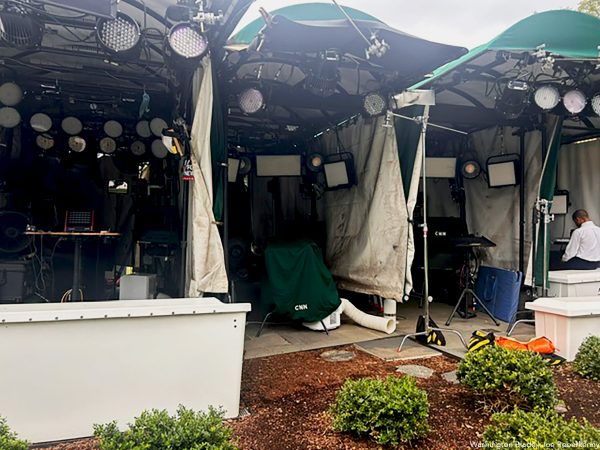
CNN’s outdoor filming area, which is staffed nearly at all times, sat dark with a green cover over the space that normally houses its cameras and political reporters like Kaitlan Collins.
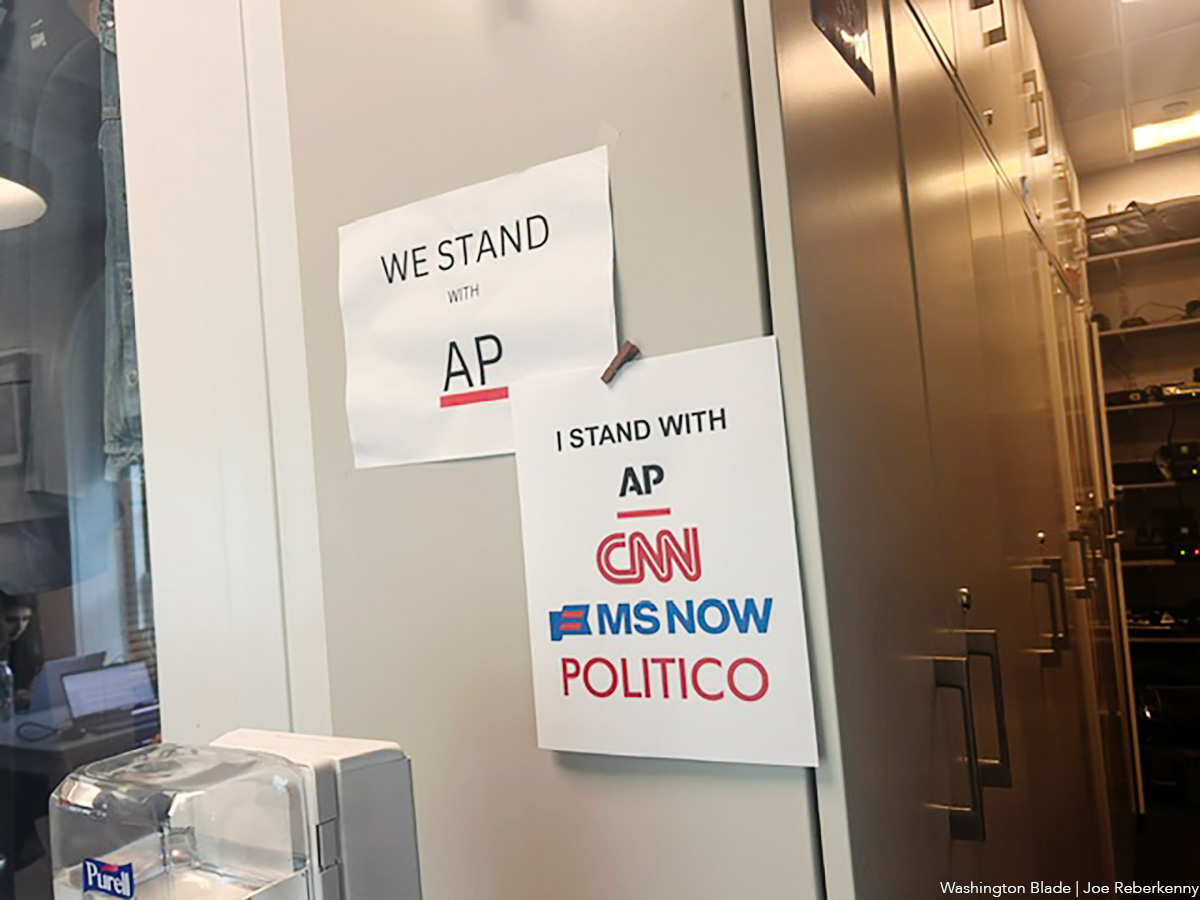
There were small signs of solidarity from other outlets in the press office. A sign that has hung outside one of the news offices in the West Wing was updated. It originally read, “WE STAND WITH AP” following President Trump’s first attempt at removing a news outlet he deemed unfavorable. It now includes “I STAND WITH AP CNN MSNOW POLITICO.”
The change could also be felt as the press pool attempted to cover the president.
There was a ribbon cutting in honor of the $6 million helipad installed at Trump’s behest — which had nearly no audio as a result of fewer microphones in the space following the outlets’ removal on Monday afternoon, and partly because of the loud sound of Marine One.
Vice President JD Vance defended Trump when asked about the changes to TV access at the White House, standing with the president despite this likely being a violation of the First Amendment’s guarantee of a free and fair press.
“He’s not banning media outlets. What he’s doing is saying we’re not going to give you special access to the White House if you engage in what is effectively propaganda,” Vance said, alleging that 92% of the stories from CNN, MS NOW and Politico about Trump are “negative.”
“That’s not representative of the American people. It’s not representative of public opinion,” Vance said.
He pushed back on the notion that this is a hindrance on free speech — claiming access to the president through White House visitation is a privilege — a privilege that in this administration, at least until courts weigh in, could change the landscape of the American media system.
“It’s about basic fairness. They can still report. They still have the access to free speech. They’re just not going to get an office in the White House anymore,” Vance said.
Jacqui Heinrich, the White House Correspondents Association President condemned the president’s actions in restricting media access in a statement sent to WHCA members on Saturday.
“Today’s action revoking access for journalists from CNN, POLITICO, and MSNOW violates the First Amendment. The implications extend beyond these organizations: a standard used to exclude one news outlet because of its coverage could be applied to any outlet in the future.
“The American people, through a free and independent press, must be able to scrutinize those elected to power, regardless of whether government officials view it favorably. That’s why courts have repeatedly held that once the White House provides access to journalists, it cannot deny that access arbitrarily or based on the content of their reporting. The WHCA calls on the administration to immediately restore our colleagues’ access.”
Congress
Jeremy Moss looks to bring LGBTQ advocacy from Lansing to Capitol Hill
Congressional candidate would represent Detroit suburbs if elected
With fall comes swapping out T-shirts for sweaters, raking leaves and, of course, elections. The summer’s primaries have narrowed the playing field in a slew of races, but the big ones — the actual races for seats in federal and local elections — are still to come.
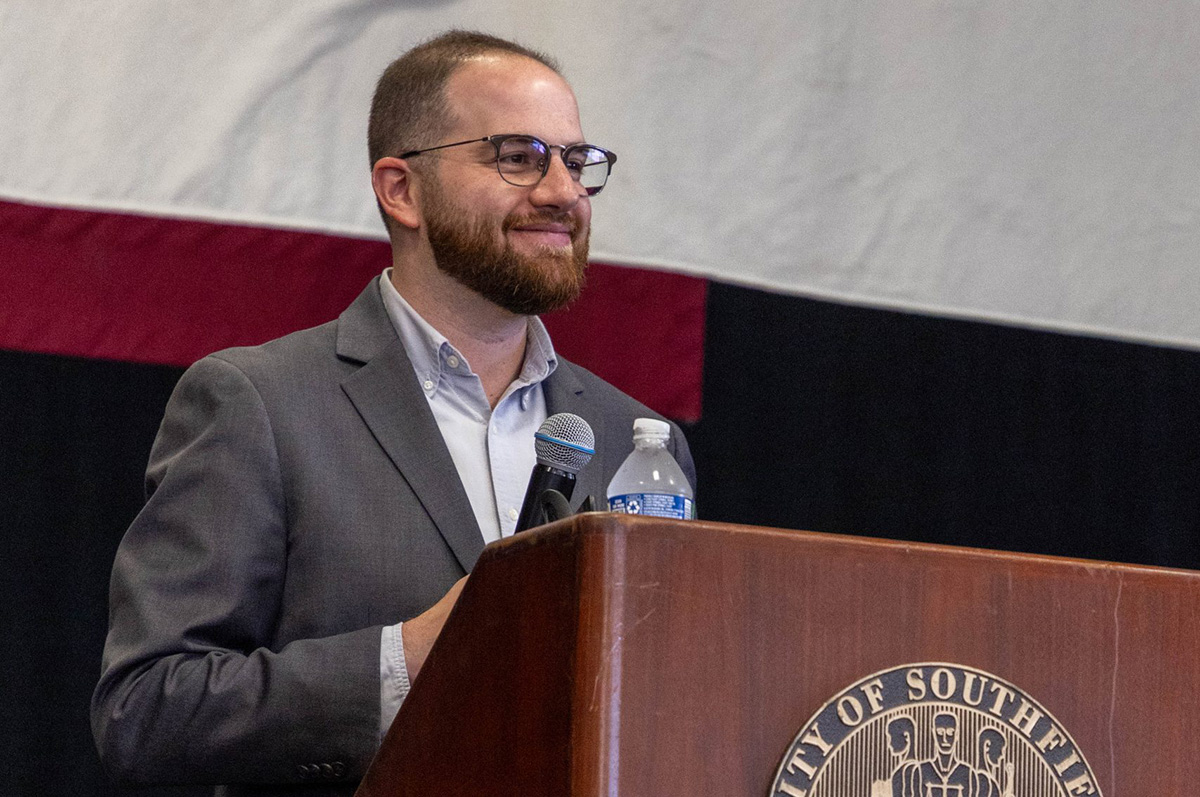
Jeremy Moss is one of those people running for a congressional seat in Michigan. Despite his young age, Moss has quickly learned the ropes of politics in the state, already serving terms in the Great Lakes State’s House of Representatives and Senate.
Moss sat down with the Washington Blade to discuss his history in Michigan politics, his experience as an openly LGBTQ legislator and his vision for a better America as he looks toward Congress.
He currently represents Michigan’s 7th Senate District, but now he is setting his sights beyond Lansing toward Capitol Hill to represent Michigan’s 11th Congressional District, which includes Detroit’s northern suburbs.
Moss earned his bachelor’s degree in journalism from Michigan State University, where just a few years later he made history as the first openly gay person elected to the Michigan Senate and the first to serve as its president pro tempore.
His political experience stretches across multiple offices.
Moss worked in the offices of Southfield Mayor Brenda Lawrence, who also served in the U.S. House of Representatives, and State Rep. Paul Condino.
Moss, at age 25, was elected to the Southfield City Council in 2011, becoming the youngest member elected in the body’s history. He then switched over to the state legislature, representing Michigan’s 35th House of Representatives District in the Michigan House of Representatives from 2014-2018, becoming the second openly gay member elected to the Michigan legislature.
He then moved from Michigan’s House to its Senate in 2018, elected to represent the 11th Michigan Senate District and becoming the Assistant Democratic Leader. Moss started his second term in the Michigan Senate in 2023, this time representing District 7.
He currently has a long list of priorities listed on his campaign website, many of which have become standard for Democrats running across the country, with a particular focus on minimizing — and cleaning up — issues that the Republican-controlled federal government has created under President Donald Trump.
Those goals include lowering healthcare costs, tackling the cost of living crisis, holding U.S. Immigration and Customs Enforcement accountable and fixing the broken immigration system, restoring national voting rights, protecting rights — with a particular focus on abortion access and LGBTQ rights — combating corruption in politics, preventing gun violence and strengthening gun safety, empowering Michigan workers, and preserving the environment.
Why Moss is running for Congress
When asked why he wants to run for Congress, Moss pointed to his lengthy resume in state leadership, with a clear voice arguing that if he can do it in Lansing, he can get it done in Washington.
“I’ve served 12 years in the legislature and have ascended into leadership as president pro tem of the Senate,” Moss explained to the Blade. “We flipped our state legislative chamber to a Democratic majority for the first time in 40 years in 2022, and we passed some big, generational-changing, consequential Democratic wins that had languished for a generation, but had improved people’s lives in our state.
“We’ve passed the first gun safety laws in a generation that are saving lives. We protected the right to vote amidst attacks from Donald Trump and other conspiracies. We pushed forward and finally put LGBTQ rights in our state civil rights law. We provided free school meals and lunches for all public school children in the state of Michigan.
“The problems from Washington, D.C., aren’t getting less severe over time,” he continued. “They’re getting more severe. So this district unexpectedly opened up due to a series of retirements and it was just a great opportunity for me to continue to advocate for big change that we’ve already achieved here in the state legislature.”
“I’m a product of this district. I grew up here. I’ve represented a bulk of the district already in the state legislature, and I knew that I was going to earn grassroots support to be able to wage this campaign. We sought it out, we earned it, including some premier endorsements from Gov. (Gretchen) Whitmer, among many others, and were highly successful in the primary because we were in tune to the needs of this district.”
Moss has been endorsed by a slew of Democratic leaders and organizations, including, as he pointed out, by Whitmer.
Other endorsements include former Gov. Jim Blanchard, Secretary of State Jocelyn Benson, Attorney General Dana Nessel, the Equality PAC, the Human Rights Campaign, the Unity Fund, and the LGBTQ+ Victory Fund.
His political identity and the Democratic Party
Moss described himself as being “on the liberal end of the spectrum,” but argued that the Democratic Party’s internal divisions should not be the central focus.
“I’m certainly on the liberal end of the spectrum, but I don’t even think it necessarily has to be this progressive versus establishment fight that we’ve seen play out,” Moss said when asked about various elements of in-party disagreements. “It has to be between action and, and inaction, fighters versus folders.”
He said that distinction between action and inaction is central to how he would approach Washington.
“At this moment, I think we need to demonstrate that we are ready to take on Donald Trump and MAGA chaos with boldness and effectiveness. I’ve been saying all along our campaign trail, we can no longer be the party that shows up to the knife fight carrying a pie chart, and so I think we have to be showing that we have spine and we have punch, and we’re really ready to be tough fighters for, for Michiganders and the American people.”
“We can’t walk on eggshells anymore. We can’t pull our punches,” he added. “We can’t fear that we’re offending someone, you know, one way or another with how we act. People are expecting a bold party to take on MAGA, and I think that’s exactly what the Democratic Party needs.”
Becoming an LGBTQ legislator
Moss also reminisced with the Blade about his first run for elected office — at a time when Michigan had no openly LGBTQ members serving in the state legislature — and how that experience became deeply connected to his identity and his approach to LGBTQ politics.
In 2014, Michigan was in the pre-marriage equality era, and the state had no openly LGBTQ members serving in the legislature.
“12 years ago in 2014 — this was pre-marriage, the pre-marriage equality era — we had zero people from our community serving in the legislature, and still they were talking about us.
“The big topic then in Michigan was whether or not to expand our civil rights law to include LGBTQ protections, so that people from our community would no longer face discrimination in housing and employment. And they were talking about us regardless of whether or not we were at the table.”
Moss eventually helped lead the effort to expand Michigan’s civil rights protections to include LGBTQ people, a measure that passed with bipartisan support.
He said his experience as an openly gay lawmaker allowed him to make the case for LGBTQ protections in terms that extended beyond LGBTQ issues.
“One thing I definitely aligned with Gov. Whitmer at the time was making the case that discrimination was not only morally wrong, but it was bad for business,” he said. “By not having these protections for our LGBTQ neighbors and family members and friends and community members, we were actually holding back our economy. We were essentially allowing people to be kicked out of Michigan as consumers and workers, because of who they are and how they identified.”
That led to various efforts — including committee hearings and meetings with advocates, businesses and the public — that helped make Michigan what the Movement Advancement Project deems the 16th most LGBTQ-friendly state, solidly above other states due to its robust LGBTQ-related legislation.
“I wanted to meet everybody where they were, including those who may have not been involved with or engaged with the LGBTQ community as legislators, but understood that we couldn’t sustain the economic impact of discriminating against our community,” Moss said. “And as I’ve said all along, discrimination is bad for business. That’s something I think helped broaden the vote and earn some bipartisan support for it.”
Representation and LGBTQ youth
For Moss, the importance of LGBTQ representation also comes from his own experience growing up.
“I think about when I was younger, when I was 18 years old. It was in 2004, and, you know, there are certain things that really shaped me in that time … Michigan had a ballot proposal that passed to have the strictest language banning marriage equality in our state constitution. We didn’t even allow civil unions in that language in our constitution to exist, and there were scandal-plagued LGBTQ politicians.”
“It was the same year that Jim McGreevey was forced to resign as he came out,” he said. “So it really was a signal to me that, you know, you don’t have a future. Not just you don’t have a future in politics; you might not even have a future. Period, and it was pretty defining for me.”
Despite those fears, Moss continued to pursue public office.
“And you can’t be what you can’t see, and so to be able to break the barriers at the state level and at this congressional level, I think is a signal to anybody who is struggling with wondering where their place is?”
“I think that visibility is incredibly important, and it’s something that I needed when I was much younger, and it’s something that I’ve been honored to be able to provide for the, for the next generation of emerging leaders.”
His LGBTQ priorities in Congress
When asked what LGBTQ issues he would prioritize in Congress, Moss emphasized the importance of growing the number of LGBTQ lawmakers while also expanding federal nondiscrimination protections.
“To have a caucus in the legislature has made all the difference because you can, you know, run these issues across the field. You can have somebody take on marriage. You can have somebody take on trans rights. You can have somebody take on LGBTQ youth. You can have somebody take on discrimination protections.”
He sees much of the work he wants to get done on Capitol Hill as a direct follow-up to his work in Lansing — most importantly, the passage of the Equality Act. The legislation has been debated in some form for more than 50 years at the federal level, with the goal of protecting LGBTQ people from discrimination under federal law.
“I think the Equality Act is incredibly important. That’s kind of the, the counterpart to what we’ve done in the state legislature, ensuring discrimination protections for the LGBTQ community,” he said.
“I think housing and, and workplace discrimination is, is everything, you know, to protect our community so that they can have a safe place to call home and earn a living … That’s incredibly important across the board. And I would really want to take a leading role in telling the story of how we were able to do it in Michigan after 50 years since this act was first written — and finally finished the job federally to ensure their federal protections in, in, in, in employment and housing.”
LGBTQ political organizations and Congress
Moss said the LGBTQ political organizations that have supported his political career from its early stages have helped him along the way.
“Obviously, I’ve been affiliated with Victory Fund since I first ran for office, and they were early endorsers, but Equality PAC, which is the political arm of the LGBTQ caucus in Congress, has been an incredible part of my support system. From day one they helped me out.
“I’ve been getting to know a lot of the members of Congress who are LGBTQ, really over the last year of this campaign. So I’m eager to join them. I’m eager to be one of the players on the field here to be able to advocate and advance our issues.”
Voting rights
Voting rights are another major focus for Moss, an issue he said dates back to his experience during the 2004 campaign over marriage equality.
“Something I’m very passionate about is voting rights, and it really does go back to that 2004 campaign where it was very evident that elections can determine your future.
“Elections can determine what rights you do have and don’t have, and so I’ve been very laser focused on increasing access to the ballot box, making sure our democracy remains whole and accessible.”
He explained how Trump’s recent attacks on voting legitimacy and mail-in voting have only made his desire to help that much stronger.
“We went through a real trial of that in 2020 with, with Michigan’s presidential election, with Donald Trump and Rudy Giuliani — as he jetted into Michigan and tried to overturn our valid and accurate election results. We were kind of the spotlight of the nation in that stop this deal movement that led to Jan. 6.”
That, according to Moss, spurred direct action on his end.
“I took the helm as chair of the Senate Elections Committee, and we wrote the law to implement pieces of that ballot proposal, including drafting the law that implemented nine days of early voting here in Michigan, increased access to absentee ballot. We further secured our canvassing and certifications so that nobody could jet in with an alternative slate of electors and send them to Congress on Jan. 6.”
“So I’ve been on the front lines in Michigan on defending our election systems and strengthening protections for both voters to access the ballot box and protections against those who want to overturn our election results.”
Those issues are still present today, he explained.
“He’s pushing for suppressive tactics like the Save Act. The Supreme Court has eroded the federal Voting Rights Act,” Moss said. “I want to really get into Congress as an election expert, we have a Michigan story to tell. I wrote a lot of that story, and, and I think the most urgent thing that we could pass is the John Lewis Voting Rights Act to make sure that there’s no pocket of discrimination anywhere in our country, and that people have the ability to exercise their constitutionally guaranteed right to vote.”
What he would do differently in Washington
Moss also shared that he believes Democrats should communicate differently in Washington, with an emphasis on getting things done.
“Yeah, again, we’ve, we’ve seen politics evolve in this Trump era, and I think that Democrats need to communicate differently.
“He talks so brazenly, and how proud he is that he’s renamed the Gulf of Mexico or Lake Ontario. I put that in the stupid category.
“He’s also done things in the harmful category that he boasts about, like cutting Medicaid and cutting SNAP. And of course, he’s doing things in the dangerous category, but proud of it, like trying to overturn our elections or suppressing the vote.
“What we’re doing is both popular and good for people, whether it’s growing our economy from the middle class outward, whether it’s lowering costs, whether it’s making healthcare more affordable, whether it’s strengthening the core functions of our democracy, we have to be talking about it with the same gusto and confidence that MAGA talks about their agenda.
“I think this is a party that needs more spine and more punch, and really meet this moment because I think that’s what people are looking for, and that’s really what I think a new generation will bring into this next Congress.”
2026 Midterm Elections
LGBTQ issues, attacks on Democrats dominate unusual RNC midterm convention
“Trumpapalooza” emphasized the gains Republicans need to maintain control of the federal government.

The Republican Party held an unusual midterm convention in Dallas last week, where President Donald Trump and other prominent GOP officials spoke in hopes of building enthusiasm and support ahead of the November elections.
The two-day gathering at the American Airlines Center was the first midterm convention of its kind for the Republican Party. Unlike a traditional presidential nominating convention, there was no official party business or nominations. Instead, the event was designed to energize Republican voters and unite the party behind its candidates and broader message heading into the midterm elections.
Trump, who spoke during both nights of the convention, repeatedly emphasized the importance of Republicans turning out to vote in the midterms — elections in which incumbent presidents and the parties in power have historically faced significant challenges.
“I’m asking you to pretend that I’m on the ballot,” the president implored attendees on the first day.
On the second night, Trump delivered another direct appeal to Republican voters.
“You know what happens if you don’t vote? You go to hell,” he said.
Trump also urged attendees at one point to “cheat like hell” to keep Republicans in control of Congress.
The president also used the event to promote Republican candidates, including Texas Attorney General Ken Paxton, the GOP nominee in the state’s closely watched Senate race against outspoken LGBTQ rights supporter James Talarico.
“He may not dress right, he may not talk exactly perfectly, and he may not be the best-looking guy I’ve ever seen, but he’s the greatest attorney general in America and he deserves to be your next senator,” Trump said when talking about Paxton.
Among those in attendance were gay Treasury Secretary Scott Bessent, Rep. Brandon Gill (R-Texas), North Carolina Senate nominee Michael Whatley, and Ohio Republican Sen. Jon Husted.
Both days, there were thousands of empty seats, including almost all of the upper level, despite Trump insisting the arena was “packed” with “thousands” more waiting outside.
The convention’s message frequently emphasized personal and political attacks on Democrats, often over detailed policy discussions. Speakers repeatedly targeted Democratic candidates and progressive figures, with Michigan Democratic Senate nominee Abdul El-Sayed among those mentioned throughout the event.
The first lady was notably absent from the event.
Five RNC officials described the scope of the party’s nationwide “election integrity” effort to Axios. They said strict enforcement of voting laws and preventing noncitizens from registering and voting are top priorities, even as analysts say voter fraud is rare and there is no evidence of any systemic or significant problem.
President Trump also proposed giving American adults $5,000 if Republicans retain control of the House and Senate, a proposal that immediately raised questions about its legality and implementation.
The Republican base has also fractured over several key issues during the last 18 months, including the war in Iran, the handling of the release of the Epstein files, surging gas prices, and rising costs driven by tariffs. The convention was organized as an effort to rally Republicans around the party and motivate turnout despite those divisions and broader concerns heading into the midterms.
A protester carrying a Mexican flag interrupted Vice President JD Vance’s speech on Sept. 10.
“It’s about sending a message to the Democratic Party that if you send your crazies, we’re going to send you packing,” Vance said of the stakes of November’s elections.
More than 100 protesters also marched through downtown Dallas during the RNC Midterm Convention, briefly blocking traffic near the American Airlines Center.
At the convention both nights, an image that can only be described as a thirst trap of Democratic socialist commentator and creator Hassan Piker was shown on the jumbotron, garnering attention on social media.
The social media star posted a video shortly after images of him, abs and all, appeared on the jumbotron, sitting at a desk and completely dumbfounded at the thought that “my meat pic was on the jumbotron at the republican midterm convention.”
Piker has been a frequent target of conservative and Republican figures because of his criticism of the Israel-Palestine war, the war in Iran, and his broader critiques of the establishment and political institutions of both parties. Piker and El-Sayed were two of the most targeted progressive figures during the convention.
Another figure from the other side of the aisle who made an appearance was Democratic Sen. John Fetterman, who in recent months has adopted more conservative positions on some issues and continued to voice strong support for Israel — an issue on which there are divisions within the Democratic Party.
“Yes, I’m a Democrat. Why am I here talking to you today? Because well, I’m a common sense Democrat,” Fetterman said in the prerecorded video that also aired on the American Airlines Center’s jumbotron. “I’m always going to stand with America. I’m always going to reject the extremes and socialism and that anti-American way of life.”
“We’ll work with President Trump to fight and defend the steel way of life right here in the steel valley,” he added.
Fetterman’s prerecorded appearance was a notable moment at an event otherwise dominated by Republican officials and speakers.
Also at the event, accusations began to spread online about alleged Grindr outages in the area of the convention — a juxtaposition with the anti-LGBTQ positions the Republican Party officially reflects and its emphasis on “family values.”
A spokesperson for Grindr told Snopes, “Grindr has not experienced recent outages. Third party sources that often make these claims rely on unreliable data such as self-reporting, while Grindr reports outages directly on its status page.” The status page showed no outages in August or September 2026.
Another person, who goes by the name of Nick Pringle online, garnered over eight million views on an Instagram video in which he claims he was about to start working “undercover as a male escort” at the convention.
In the video, he appears to be in a hotel bathroom and says he will post for the sake of exposing hypocritical Republican lawmakers who have used their power to champion what he described as hateful and divisively anti-LGBTQ legislation.
The Blade reached out to Pringle via Instagram to ask whether he ultimately carried out what he described in the video and whether he had any evidence or additional information to share about his experience at the convention, but did not hear back by the time of publication.

Caso Karlina: Una sentencia histórica contra las terapias de «conversión»

Washington Blade responds to concerns over White House pool duties

Young people should know history of the fight for human rights

Dutch prime minister visits Stonewall Inn

Clavicular charged in alleged rape of teenage influencer

Over 2,000 turn out for Hands Around the Kennedy Center protest

PHOTOS: Wanda Alston Foundation Fall Reception

PHOTOS: Walk and 5K to End HIV

What LGBTQ veterans are building after ‘Don’t Ask, Don’t Tell’