Local
Quick tips for your home search
The internet has a vast array of resources that can help you make intelligent decisions when purchasing real estate


The internet has a vast array of resources that can help you make intelligent decisions when purchasing real estate. (Photo courtesy CreativeCommons)
The quest for a new home can be both an exciting and a daunting task. Location, size, lifestyle, flair, convenience, commute, safety — all important factors to consider when looking for a home and unfortunately, some of these do not come up in a typical home search database.
Of course the best way to determine if a property meets your needs in terms of location, convenience and commute is the old-fashioned way. Go out and walk the neighborhood at different times of day, talk to the neighbors and test out your commute.
If you don’t have the time or are just getting started in your search, don’t worry. There are many websites and tools that can help you make this process easier to navigate. A website called “WalkScore” (walkscore.com) is a great way to see how close a particular address is to key destinations such as shopping, transportation, grocery, restaurants, bars, convenience stores — you name it. It gives you a rating based on the walkability of the neighborhood.
Google Street View is also a way to virtually walk through the neighborhood with real images of the street and surrounding neighborhood. This can help you evaluate the other homes on the block and surrounding streets, as well as show you the proximity to nearby amenities. Any of the Google maps can also show you how long it will take you to walk, bike, take public transportation or drive to any given location.
If safety is a concern, visit your local police website or call your local precinct. If you live in the D.C. city limits, you can also visit crimemap.dc.gov/presentation/query.asp to look up a location and see exactly what type of crimes are committed within different proximities of a given address, within different time frames.
Our firm also just launched a new website with some great search features. We are most excited about the Metro Search at suegoodhart.com which allows you to search for listings based on proximity to any Metro stop. This is new technology which is making the home finding process much easier for Metro commuters throughout our area. Additionally, we have developed a new lifestyle search there too that allows potential purchasers to search for homes in communities that fit their particular desires including arts and culture, shopping, restaurants, pet-friendly neighborhoods, urban versus suburban or rural, health and public services and more.
It’s a great new tool for determining both neighborhoods that fit your needs as well as individual listings. Among many other new types of searches now available on our site are a luxury search, open house search, map search, advanced search, new listing search and new price search. There is also a proximity search that pulls up all listings within a given distance from any location. Visit suegoodhart.com and play around with the different search options.
Though there are many more sites and tools to help you in finding a new home. Of course, feel free to contact us to set up a custom search for you based on your needs and desires or to talk with us about the D.C., Northern Virginia or Maryland real estate market. Please visit our blog (goodhartgroup.wordpress.com) for links to the mentioned sites.
Sue Goodhart is the top-producing agent at McEnearney Associates in Alexandria and is licensed in D.C., Maryland and Virginia. She can be reached at 703-549-9292 or [email protected].






District of Columbia
Judge rescinds stay-away order in Capital Pride anti-stalking case
Evidence hearing to determine if order should be reinstated against Darren Pasha

A D.C. Superior Court judge on April 17 rescinded an anti-stalking order he approved in February at the request of Capital Pride Alliance against local LGBTQ activist Darren Pasha.
In a ruling at a court status hearing, Judge Robert D. Okum agreed with defendant Darren Pasha’s stated concern that the initial order was too broad and did not specify who specifically he must stay at least 100 feet away from, as called for in the order.
Okum ruled on April 17 that the initial order, which he noted was oral rather than written, would be suspended until an evidentiary hearing takes place in which Capital Pride will need to present evidence justifying the need for such an order.
“I’m fine with scheduling a hearing at which the plaintiff can present evidence, and the defendant can present evidence,” Okum said. “But I’m not fine with just continuing this oral TRO [Temporary Restraining Order] that Mr. Pasha really doesn’t even have notice of. That seems unfair,” he said.
After asking both Pasha and Capital Pride Alliance Attorney Nick Harrison when they would be available for the evidence hearing, Okum set the date for April 27 at 11 a.m. in Superior Court.
The case began when Capital Pride Alliance, the D.C.-based LGBTQ group that organizes the city’s annual Pride events, filed a Civil Complaint on Oct. 27, 2025, against Pasha, accusing him of engaging in a year-long effort to harass, intimidate, and stalk Capital Pride’s staff, board members, and volunteers.
The complaint was accompanied by a separate motion seeking a restraining order, preliminary injunction, and anti-stalking order prohibiting Pasha from “any further contact, harassment, intimidation, or interference with the Plaintiff, its staff, board members, volunteers, and affiliates.”
In his initial ruling in February, Okum issued an order requiring Pasha to stay at least 100 feet away from Capital Pride staff, board members, and volunteers until the April 17 status hearing. He reduced the stay-away distance from the 200 yards requested by Capital Pride.
Pasha, who has so far represented himself in court without an attorney, has argued in multiple court filings and motions that the Capital Pride stalking allegations are untrue. In his initial 16-page response to the complaint, Pasha said it appears to be a form of retaliation against him for a dispute he has had with Capital Pride and its former board president, Ashley Smith, who has since resigned from the board.
“It is evident that the document is replete with false, misleading, and unsubstantiated assertions,” Pasha’s court response states.
At the April 17 hearing, Okum also ruled that, as standard procedure for civil complaints such as this one, he has ordered both parties to enter into court-supervised mediation to attempt to reach a settlement rather than go to trial.
In an earlier ruling Okum denied Pasha’s request for a jury trial, stating that civil cases such as this must undergo a trial with the judge determining the verdict under existing civil court statutes.
The April 17 court hearing was held in a courtroom at the courthouse, but as allowed under current court rules, Capital Pride attorney Harrison and Capital Pride official June Crenshaw participated virtually through a video connection. Pasha attended the hearing in the courtroom.
“This matter is proceeding through the court in the normal course,” Capital Pride released in a statement. “We look forward to presenting the relevant evidence at the scheduled hearing. Capital Pride Alliance remains committed to maintaining a safe and respectful environment for our staff, volunteers, and community, and to addressing concerns through appropriate channels.”
“This is clearly a case of retaliation,” Pasha told the Blade after the hearing. “Today the judge removed the stay-away order and asked Capital Pride Alliance to present enough evidence and examples to see if a stay-away order should be granted,” he said. “Because Pride is coming up in June, we need to see where this is going.”
District of Columbia
Gay D.C. police lieutenant arrested on child porn charges
Matthew Mahl once served as head of LGBT Liaison Unit

D.C. police announced on April 14 that they have placed one of their lieutenants, Matthew Mahl, on administrative leave and revoked his police powers after receiving information that he was arrested in Maryland one day earlier.
Although the initial D.C. police announcement doesn’t disclose the reason for the arrest it refers to a statement by the Harford County, Md. Sheriff’s Office that discloses Mahl has been charged with sexual solicitation of a minor and child porn solicitation.
“On Tuesday, the Harford County Sheriff’s Office contacted MPD’s Internal Affairs Division shortly after arresting Lieutenant Matthew Mahl,” the D.C. police statement says.
“The allegations in this case are extremely disturbing, and in direct contrast to the values of the Metropolitan Police Department,” the statement continues. “MPD’s Internal Affairs Division will investigate violations of MPD policy once the criminal investigation concludes,” it says.
“MPD is not involved in the criminal investigation and was not aware of the investigation until yesterday,” the statement adds.
Mahl served as acting supervisor of the MPD’s then Gay & Lesbian Liaison Unit in 2013 when he held the rank of sergeant. D.C. police officials placed him on administrative leave and suspended his police powers that same year while investigating an undisclosed allegation.
A source familiar with the investigation said Mahl was cleared of any wrongdoing a short time later and resumed his police duties. Around the time he was promoted to lieutenant several years later Mahl took on the role as chairman of the D.C. Police Union, becoming the first known openly gay officer to hold that position.
NBC 4 reports that Mahl, 47, has served on the police force for 23 years and most recently was assigned to the department’s Special Operations Division.
Records related to Mahl’s arrest filed in Harford County District Court, show Sheriff’s Department investigators state in charging documents that he allegedly committed the offenses of Sexual Solicitation of a Minor and Child Porn Solicitation on Monday, April 13, one day before he was arrested on April 14.
The court records show he was held without bond during his first appearance in court on April 14. A decision on whether he would be released while awaiting trial or continue to be held without bond was scheduled to be determined during an April 15 bond hearing. The outcome of that hearing could not be immediately determined.
Maryland
Evan Glass is leaning on his record. Is that enough for Montgomery County’s top job?
Gay county executive candidate pushing for equitable pay, safer streets, and cleaner environment
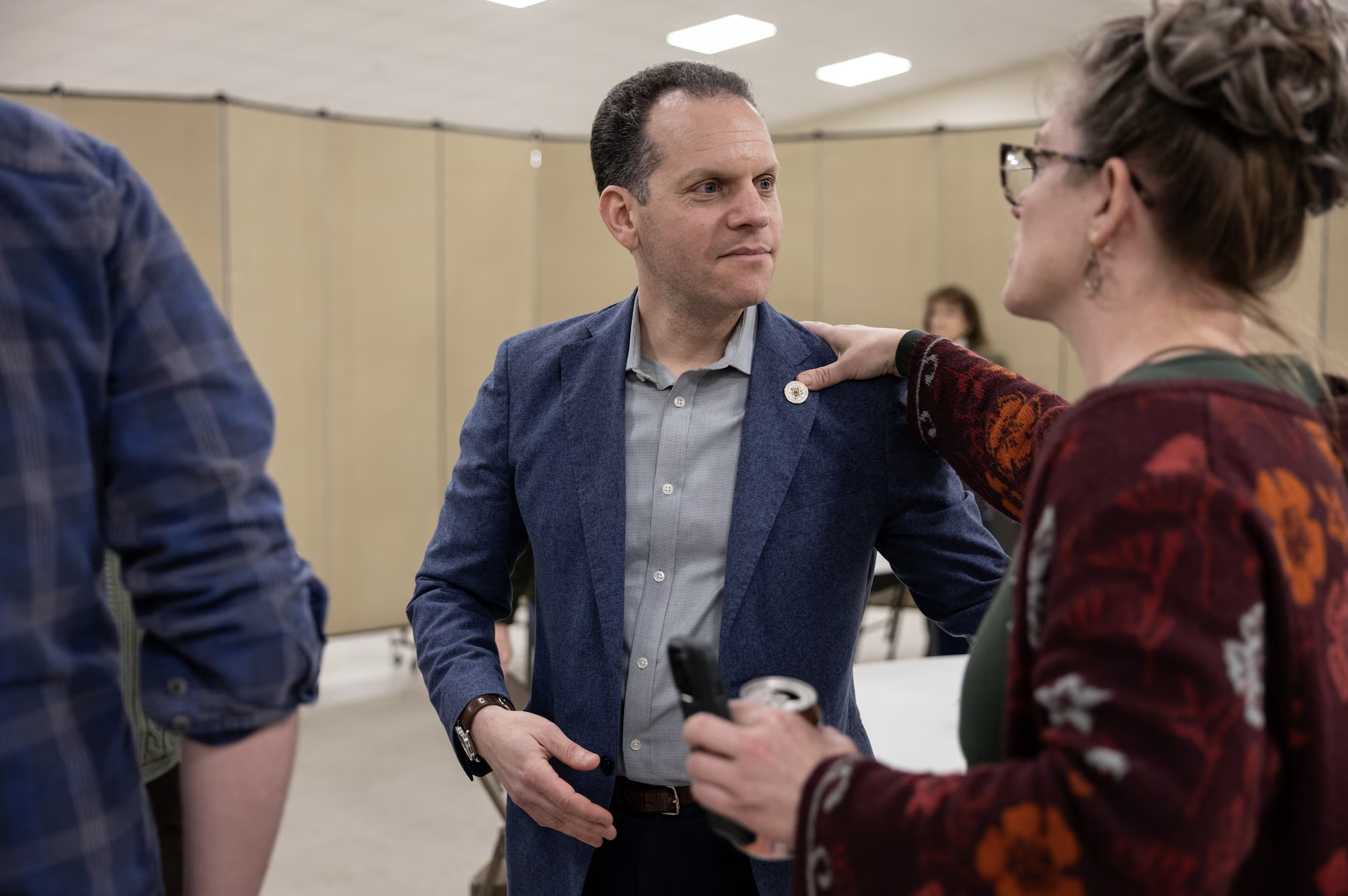
By TALIA RICHMAN | During a meet-and-greet at Poolesville Memorial United Methodist Church, Evan Glass got his loudest applause of the night with a plan he acknowledged was decidedly unsexy.
“Day one, I’ll hire a director of permitting services,” the county executive candidate said.
Doing so, he added, is a step toward easing the regulatory burdens that can stifle small businesses in Montgomery County.
The only problem? At least one of his fiercest competitors is making a similar pledge.
The rest of this article can be read on the Baltimore Banner’s website.

Victory Fund brunch draws top LGBTQ officials, 2028 hopeful Andy Beshear

Inside the lonely world of MAGA gay men

PHOTOS: National Champagne Brunch

PHOTOS: Night of Champions

‘Big Mistakes’ an uneven – but worthy – comedic showcase

Science said stop; the Supreme Court said no

Response to a personal attack against me

Queery: Meet artist, performer John Levengood

Charlie Kirk Act advances in Tenn.