Living
LGBT leaders mourn death of Frank Kameny
Longtime activist coined term ‘gay is good’
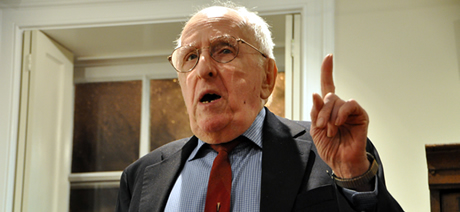
Frank Kameny, May 21, 1925 – October 11, 2011. (Washington Blade file photo by Michael Key)
Several LGBT rights organizations have released statements following the announcement of Frank Kameny’s passing. Many of these groups continue the work that Frank began when he fought back against his termination in 1957 from the Army Map Service. Frank will always be remembered for coining the term “Gay is good” in the 1960s through his work with the Mattachine Society.
Gay and Lesbian Victory Fund:
Frank Kameny, one of the most significant figures in the modern LGBT civil rights movement, has died, according to a report in the Washington Blade tonight.
In 1961 Kameny founded the Mattachine Society of Washington – one of the earliest LGBT rights organizations in the U.S. – pre-dating the Stonewall riots by nearly a decade. Kameny’s activism sprang from his termination from a federal government position because of his sexual orientation. He received an official apology from the federal government after President Barack Obama took office in 2009.
Gay & Lesbian Victory Fund President and CEO Chuck Wolfe issued the following statement tonight:
“We mourn the loss of a hero and a founding father of the fight to end discrimination against LGBT people. Dr. Kameny stood up for this community when doing so was considered unthinkable and even shocking, and he continued to do so throughout his life. He spoke with a clear voice and firm conviction about the humanity and dignity of people who were gay, long before it was safe for him to do so. All of us who today endeavor to complete the work he began a half century ago are indebted to Dr. Kameny and his remarkable bravery and commitment.”
Human Rights Campaign:
Upon the news that LGBT equality pioneer Frank Kameny has died, Human Rights Campaign President Joe Solmonese issued the following statement:
“Frank Kameny led an extraordinary life marked by heroic activism that set a path for the modern LGBT civil rights movement. From his early days fighting institutionalized discrimination in the federal workforce, Dr. Kameny taught us all that ‘Gay is Good.’ As we say goodbye to this trailblazer on National Coming Out Day, we remember the remarkable power we all have to change the world by living our lives like Frank — openly, honestly and authentically.”
The Human Rights Campaign is America’s largest civil rights organization working to achieve lesbian, gay, bisexual and transgender equality. By inspiring and engaging all Americans, HRC strives to end discrimination against LGBT citizens and realize a nation that achieves fundamental fairness and equality for all.
Diego Sanchez, Senior Legislative Advisor to Rep. Barney Frank:
For Frank Kameny to die on National Coming Out Day, Oct. 11, 2011, feels to me like my Dad dying on Veterans Day, Nov. 11, 2000 — when a career-long, victorious warrior went to God on a day that best represents his contribution to our country and American lives everywhere; the day will always represent both the symbol and the man, with honor and hope.
Federal GLOBE: Gay, Lesbian, Bisexual, Transgender Employees of the Federal Government:
An American Hero has passed away.
Frank Kameny died today at 86. Frank served his country his whole life. In the military, in government service, and in making the country a more perfect union when the government he fought for and toiled for fired him. Frank was fired just for being gay. He had done nothing untoward, not been a threat. Rather he was working on important technology which his removal from government service delayed for decades.
But Frank did not get bitter. He did what American’s have done since our founding—he righted the wrong. It did not come quickly or easily. Frank fought his dismissal all of the way to the Supreme Court. Frank fought the Civil Service Commission. Frank fought for the rights of every American to lead a good life. Frank was a leader for the LGBT movement when leaders were hard to find and paid dearly. Frank paid dearly.
Frank was the reason for Federal GLOBE to get started. Frank was our inspiration and was our father. He was our mother. He was our fairy/angel/mentor/pathblazer/blinding light. Frank was our inspiration. His meticulous research and articulation paved the way for LGBT civil rights advancements over the last 25 years.
Gay and Lesbian Alliance Against Defamation:
New York, NY — The Gay & Lesbian Alliance Against Defamation (GLAAD) today issued the following statement following news that LGBT advocacy pioneer Frank Kameny died in his Washington, D.C. home:
“Frank Kameny sparked national change and set the example for gay and lesbian Americans to live their lives openly and proudly,” said Mike Thompson, Acting President of GLAAD. “He taught us the power that our visibility and stories have in changing hearts and minds. Today on National Coming Out Day, we honor Frank’s legacy not only by remembering this pioneer, but by continuing his work to speak out and share our own stories.”
Frank Kameny is recognized as one of the pioneers of the modern LGBT advocacy movement. After being dismissed from the U.S. Civil Service Commission for being gay, he argued the first civil rights claim based on sexual orientation before the United States Supreme Court in 1961. Together with Jack Nichols, he co-founded the Mattachine Society of Washington and launched the first public demonstrations by gay and lesbian Americans at the White House in 1965. Kameny was appointed as the first openly gay member of D.C.’s Human Rights Commission and was a U.S. Army veteran of World War II.
In 2007, the Smithsonian Institution’s National Museum of American History included his picket signs from the White House demonstration. Papers documenting his life were added to the Library of Congress in 2006. In 2009, Kameny received the Theodore Roosevelt Award.
National Center for Lesbian Rights:
San Francisco, CA — One of the most prominent leaders of the lesbian, gay, bisexual, and transgender equality movement—Dr. Frank Kameny—passed away at his Washington D.C.-area home today. He was 86.
In 1957, Kameny was dismissed from his position as an astronomer in the Army Map Service because he was gay, motivating him at the time to become a leading voice in the movement for equality and justice. He protested his firing and appealed his case to the U.S. Supreme Court, becoming the first known gay person to file a gay-related case before the high court.
Although the court denied his petition, the decision prompted Kameny to devote much of his life to LGBT advocacy.
Statement by NCLR Executive Director Kate Kendell, Esq.:
“Frank Kameny is among a small group of brave and uncompromising men and women without whom the modern civil rights movement for LGBT equality would have faltered. At a time when most lesbian, gay, bisexual, and transgender individuals lived deeply shadowed and closeted lives, he stepped into the bright glare of public scrutiny and hostility and demanded respect and cultural evolution. It is fitting that his passing would happen on Coming Out Day. Were it not for his coming out, many of us would still be living a lie.”
American Foundation for Equal Rights:
“Out and Proud, Kameny Was Fighting For Equality Long Before the Rest Of Us Knew We Could”
Los Angeles, CA – Today, America lost a legendary civil rights pioneer. The staff and board of directors at the American Foundation for Equal Rights extend heartfelt condolences to the friends and family of LGBT rights pioneer Franklin E. Kameny, who died of natural causes in his home today at the age of 86.
His passing comes less than a month before the planned celebration of the 50th anniversary of Kameny’s founding of the Mattachine Society of Washington, the first gay rights organization in the nation’s capital.
President of AFER’s board of directors, Chad Griffin, released the following statement about Mr. Kameny and the long legacy of hope and optimism he leaves behind, “America has lost a hero today. Out and proud, Frank Kameny was fighting for equality long before the rest of us knew we could.” He added, “Because there was one Frank Kameny, trailblazing and honest enough to speak out 50 years ago, there are now millions of Americans, coming out, speaking out and fighting for their basic civil rights. His is a legacy of bravery and tremendous impact and will live on in the hearts and minds of every American who values equality and justice.”
In the landmark ruling striking down Proposition 8, the U.S. District Court referenced the efforts of Frank Kameny and the Mattachine Society to chronicle the long and shameful history of state-enforced discrimination against gay and lesbian Americans. In particular, the Court cited the famous 1966 letter from the chairman of the U.S. Civil Service Commission rejecting the Mattachine Society’s request to rescind the policy banning “active homosexuals” from federal employment.
To read the letter cited by the U.S. District Court, visit: https://ecf.cand.uscourts.gov/cand/09cv2292/evidence/PX2566.pdf
National Gay and Lesbian Task Force:
WASHINGTON — The National Gay and Lesbian Task Force mourns the death of Frank Kameny, 86, a pioneering and legendary gay activist and founding board member of the Task Force. Kameny — known for coining the phrase “Gay is Good” — received a “Lifetime Achievement Award” from the Task Force in 2006 for his decades of courageous activism on the front lines of the lesbian, gay, bisexual and transgender (LGBT) liberation movement.
Statement by Rea Carey, Executive Director
National Gay and Lesbian Task Force
“The death of Frank Kameny is a profound loss and he will be greatly missed. No Washington LGBT event or White House meeting was complete without Frank. I always appreciated that he gave the 50-plus-year perspective, the long view. While so many have been impatient about the pace of progress, there was Frank, insisting we recognize that, in the last two years, he was regularly invited as a guest of honor by the very government that fired him simply for being gay. Yet, he never slowed down in demanding what should be, showing us what was possible and pushing for the very equality and liberation we are still fighting for. As the history books are written on the LGBT movement, no doubt Frank’s life will serve as an inspiration to those who will never have the honor of meeting him, but who embody the very future he knew would come true one day. Indeed, Frank, Gay is Good.”
Statement by Sue Hyde, Director, National Gay and Lesbian Task Force’s National Conference on LGBT Equality: Creating Change
“Frank Kameny’s life spanned the baddest old days of the McCarthy-style witch hunts to the elations of winning marriage equality in the District of Columbia and beyond. In 1957, Frank lost his job, but he never lost his fierce fighting spirit, his blunt and witty command of language, or his commitment to eradicating homophobia. Frank was equally confident and strategic on the streets in front of the White House in 1965 as he was attending a White House meeting in 1977 at which he and a dozen other members of our community briefed then-Public Liaison Midge Costanza on much-needed changes in federal laws and policies. As the LGBT movement began to win in legislatures, courtrooms, and in public opinion, Frank’s papers, artifacts and memories gained value. Frank Kameny wasn’t only a keeper of our history, Frank created our history. His life and legacy carry us into our future.”
Servicemembers Legal Defense Network:
(Washington, D.C.) Army Veteran and Servicemembers Legal Defense Network (SLDN) Executive Director Aubrey Sarvis released the following statement regarding the death of legendary LGBT rights advocate, Frank Kameny:
“Our nation and our movement have lost a tireless advocate for LGBT rights. Frank Kameny’s long and hard work laid the foundation for much of the progress we see today, and certainly none more so than the repeal of ‘Don’t Ask, Don’t Tell.’ It was his great wish to see that law relegated to the history books, and we are so proud that he was able to see that day and be a key part of that shared victory. At SLDN, we mourn the loss of our friend and ally, and we rejoice that Frank could join SLDN for special events and provide us with encouragement and wise counsel at critical stages as we followed in his footsteps and lifted posters to lobby Congress, the White House and the Pentagon for recognition and our equality.”
Official Statement of the LGBT Congressional Staff Association:
Washington, DC – Frank Kameny, one of the LGBT community’s most prominent leaders has died at age 86. While saddened by his death, the LGBT Congressional Staff Association remains inspired by his life. The passing of Frank Kameny today, October 11th, 2011, National Coming Out Day is a tribute to his legacy and epitomizes the trailblazing spirit of a man brave enough to speak out for civil rights before many knew they could. Frank Kameny’s legacy will live on in the hearts and minds of all he touched personally and in the achievement of progress years down the road – for a fight inspired by a profound appreciation for heroes who were and how even in death are able to advance the fight for equality by inspiring the heroes to be.
Minority Leader Nancy Pelosi:
Washington, D.C. – Democratic Leader Nancy Pelosi released the following statement today on the passing of Frank Kameny, one of the nation’s most prominent leaders in the fight for LGBT equality and equal rights:
“Frank Kameny’s life is the story of service to his country, to the cause of equality, to the fundamental American ideals of fairness and civil rights. He turned his personal story of discrimination into action, his encounter with prejudice into determination. Through his work, he became a revered figure in the national LGBT movement; through his achievements, America became a more equal, more compassionate nation.
“Today, we see the products of Frank Kameny’s activism, advocacy, and accomplishment in greater progress for millions of LGBT Americans. He was the father of our efforts for equality in Washington, DC, and he lived to see the day when LGBT residents of our nation’s capital could marry and start families with those they love.
“More than half-a-century after losing his job with the U.S. Army map service because he was gay, Kameny – a World War II veteran – was there to watch ‘Don’t Ask, Don’t Tell’ take its place in the dustbin of history, a moment, he said, ‘I didn’t think I’d live to see.’
“Frank Kameny’s lifelong struggle for equality is a tribute to the best of American values. We are all better off for his work and his service. And we hope it is a comfort to his family, his friends, and all who loved and admired him that so many mourn his loss today.”
Office of Personnel Management Director John Berry:
Dr. Frank Kameny was an American hero who transformed our nation’s lesbian, gay, bisexual and transgender community (LGBT). His courage, his brilliance, his force of will led to victory in a decades-long fight for equality. He helped make it possible for countless of patriotic Americans to hold security clearances and high government positions, including me. And in so doing, he showed everyone what was possible for every employer in our country.
He was known for being feisty and combative, but he was also big-hearted. He honored me personally by attending my swearing-in, and showed his ability to forgive by accepting my official apology on behalf of the government for the sad and discredited termination of his federal employment by the U.S. Civil Service Commission, the predecessor of the agency I now head. We presented and he accepted OPM’s highest honor, the Theodore Roosevelt Award, given to those who are courageous in defense of our nation’s Merit Principles.
I am grateful for his life, his service to his nation in WWII, and his passion and persistence in helping build a more perfect union. He was a great man, and I will sorely miss him.
Equality Forum:
“The LGBT civil rights movement stands on the shoulders of Frank Kameny,” stated Malcolm Lazin, Executive Director, Equality Forum and Executive Producer of Gay Pioneers. “Frank Kameny is the father of the LGBT civil rights movement.”
Kameny spearheaded the first organized gay and lesbian demonstrations of activists at Independence Hall and the Liberty Bell each July 4th from 1965 to 1969. The first of the “Annual Reminders” was attended by 40 activists from Washington, New York and Philadelphia. At that time it was the largest gathering for gay rights. It was the first time that demonstrators self-identified as gay and lesbian and openly and proudly demanded equality. The Annual Reminders laid the groundwork for the Stonewall Riots.
Gay Pioneers is a documentary produced by WHYY/PBS and Equality Forum about the Annual Reminders and the start of the LGBT civil rights movement. There is a Historic Marker directly across from Independence Hall and Liberty Bell recognizing the site where the gay and lesbian civil rights movement was launched with Annual Reminders organized by Frank Kameny, Barbara Gittings and other Gay Pioneers.
“When the Annual Reminders took place, gays and lesbians were denied employment by the federal government. Frank Kameny was single-handedly responsible through remarkable intensity and perseverance in having the United States Civil Service Commission end the prohibition of gays and lesbians from government service,” Lazin stated.
“The American Psychiatric Association included homosexuality as a mental disorder. Frank Kameny and Barbara Gittings successfully demonstrated at the 1971 annual meeting of the American Psychiatric Association. At the 1972 annual meeting, Kameny and Gittings presented a program with Dr. No, a gay psychiatrist, who was disguised to avoid recognition. With Dr. No, they explained why pervasive homophobia was the cause of emotional problems, not being gay. A committee was formed to study the issue. On December 15, 1973, homosexuality was removed as a mental illness,” said Lazin.
“I traveled across the nation with Frank Kameny at screenings of Gay Pioneers and at other events,” said Lazin. “Frank had a Ph.D. from Harvard, a computer-like mind and even into his 80’s was a feisty, lovable and committed activist for human rights. American history will remember Frank Kameny as an iconic civil rights leader.”
National Stonewall Democrats Executive Director, Michael Mitchel:
Last night, we lost a hero and a champion for LGBT rights. Dr. Frank Kameny was a courageous and undeniable force in our movement. In 1957, he was fired from his US Government job for being gay. The peaceful demonstrations he spearheaded predated the Stonewall Riots by several years, and no doubt opened a door to wider acceptance that allowed the fateful nights of 1969 to grab hold. He lived his life as an example of what it is to be tenacious and fearless.
In 2009, John Berry, on behalf of the US Government, apologized to Dr. Kameny for his firing and awarded him the Office of Personell Management’s highest honor for his service. National Stonewall Democrats honored him as one of our Capital Champions as well — In 2010 — on the day before his 85th birthday. His body was frail, but his voice was powerful as he contextualized how far we’ve come as a movement in his lifetime.
I am saddened beyond words at the loss of this courageous pioneer. He holds a very special place in our hearts not only as a long-time activist, but also as a co-founder of the Gertrude Stein Democratic Club, which is a member of the Stonewall Democrats family. Frank Kameny’s legacy lives on in the hearts of the many and diverse activists who continue in our collective fight for equality every day. He is already missed, but I am grateful for the time he spent with us.
Blade Features Editor, Joey DiGuglielmo remembers his time in Washington with Kameny.





One of the biggest headaches of the new home process is the actual moving part. By the time someone is buying a home, most people are beyond the “I just need a pickup truck, a pizza and a case of beer for my friends.”
If that is still someone’s preferred way to move, that’s great. However, many people find they need a much more robust plan. It can also trigger a lot of feelings about items one owns, what to do with them, do they have too much, should I keep this memento that I never use? Etc.
Moving is a chance for a person to “clean house” literally, figuratively, spiritually and energetically. A person can figure out which items they want to keep, and which need to go. As someone who recently moved across the country, I can speak to this experience. It’s also time for what people call “the fresh start effect.” This phenomenon, according to psychologists, can happen in little moments (like the start of a new work week) and bigger moments (such as moving from one home to the next).
The fresh start effect offers these benefits often mentioned by psychologists:
- Mental Accounting: Dates act as chapter breaks, letting you put past failures into a previous period.
- Psychological Distance: You separate your flawed past self from your aspirational future self (“That was the old me”).
- Optimism Boost: New beginnings clear mental clutter and increase your sense of agency and control
Does this mean that “the new you” will be the perfect version you envisioned? Probably not. We are humans. But it might mean you get a chance to “leave some of the old you behind” within the walls you used to live in, and now have a chance to have a new layout, a new décor, a new color pattern, new wallpaper, donate old furniture and books or magazines, throw out clothes you no longer use or fit in, and enjoy the opportunity to literally use the, “Does this spark joy?” method that was made so popular by Marie Kondo in her Netflix series.
So, for all its hassle and headache, moving is a chance to shake off the “old you” and try on the new you, to incorporate the items you would like to keep and use more of, and shed the items, habits, and ways of thinking that you feel no longer serve you.
I can speak to the experiences that several of my clients had when they moved from a previous residence to a newer one. It usually coincided with a change in relationship status, a change in employment, a change in family size, but sometimes it just seemed to correlate to a new attitude and perspective that the client was really hoping for.
I have literally had clients come to me after the fact, in tears, that they were so happy they made the decision to move out of a situation that no longer served them, and move into one that felt like a much better fit.
Change can be annoying and overwhelming at times, but usually most people come out the other side, not wanting to return to the way they were before.
Joseph Hudson is a referral agent with RLAH. Reach him at 703-587-0597 or [email protected].

Despite a U.S. political climate that has made electric vehicles about as welcome as a vegan at a Texas barbecue, automakers haven’t gotten the memo. The 2027 BMW iX3 and Rivian R2—in showrooms soon—prove the point. But think of them as distant cousins: one arrives impeccably dressed; the other probably has a kayak strapped to the roof.
BMW iX3
$62,000
Range: Up to 434 miles
0 to 60 mph: 4.7 seconds
Cargo space: 30.4 cu. ft.
PROS: Huge driving range. Distinctive styling. Cutting-edge interior.
CONS: Quirky digital controls. Only one U.S. trim level. Pricey options.
WHAT’S NEW: This is BMW’s first production model on its state-of-the-art Neue Klasse platform, radically changing the technology, cabin and electric drivetrain.
The iX3 arrives on our shores in one trim level, the iX3 50 xDrive. Load it up with options and you can sail well past $80,000.
Depending on configuration, this luxe EV delivers an astonishing range before recharging. And a dual-motor, all-wheel-drive system produces 463 horsepower, which allows you to tootle around as fast as a Porsche 718 sportster.
The new “Panoramic iDrive” spreads information across the base of the windshield, supplemented by a central display and steering-wheel controls. An available 3D head-up display adds even more info. It’s futuristic, busy and unmistakably BMW—like someone decided the dashboard needed its own coming-out party.
Then there’s the “Heart of Joy” computer, which coordinates the motors, braking and steering for sharper responses and smoother control. The name may sound like something from a self-help retreat, but the innovation makes the iX3 seriously entertaining to drive.
You also can charge the iX3 from 10 percent to 80 percent in just 21 minutes. Nice.
This isn’t merely an electric X3 with the gasoline bits removed. It’s a tech reset for BMW. Compared with the R2, the iX3 is more polished, more luxurious…but, alas, considerably pricier.
RIVIAN R2

$45,000
Range: Up to 345 miles
0 to 60 mph: 5.9 seconds
Cargo space: 28.7 cu. ft.
PROS: Affordable luxury. Rugged looks. Clever storage.
CONS: No smartphone integration. No glass-roof shade. Touchy touchscreen.
WHAT’S NEW: Everything—the R2 is Rivian’s all-new, smaller electric SUV, and it brings the brand’s adventure-first attitude to a price point far below the larger R1S.
If the BMW iX3 is wearing a beautifully tailored jacket, the Rivian R2 has its sleeves rolled up.
With edgy styling, this is no anonymous crossover wearing an EV costume. Chunky details. Upright proportions. Distinctive lighting all give off an outdoorsy vibe without turning the R2 into a rolling REI catalog.
There are four configurations, with pricing from $45,000 to $58,000. That’s a big difference from the BMW—and potentially the R2’s biggest weapon.
The stats aren’t shabby, either. Driving range is from 275 to 345 miles. The dual-motor, all-wheel-drive setup produces between 350 horsepower and a frankly bonkers 656 horsepower. And the high-performance model lets you zip from 0-to-60 mph in just 3.6 seconds.
Drag-racing credentials? Absolutely!
Inside, there is lots of clever packaging, with flexible seating and generous storage. This EV is designed to carry actual stuff, not merely impress your neighbors.
Yes, there are quirks. Rivian skips Apple CarPlay and Android Auto, while everyday controls—some of which are less than intuitive—live on the touchscreen. And the panoramic glass roof lacks a conventional shade. Huh?
For some owners, those will be minor annoyances. For others, they’ll become daily reminders that Rivian marches to its own beat.
Perhaps that’s not a bad thing, though. The R2 feels less buttoned-up, more mischievous. It’s the automotive equivalent of Billy Porter ignoring the dress code and somehow looking better than everyone who followed it.
Advice
We’re getting married but our parents object
Will their disapproval and shortcomings derail our hopes for a happy life?

Dear Michael,
My girlfriend and I are getting married! We’re really excited, but we’ve got some big concerns as well.
All of our parents have had multiple marriages. I think 10 between the four of them. So we don’t have much in the way of role models for a successful marriage.
Also, we don’t have any parental support. Except for one of my ex-stepmothers whom I’m close to, none of our parents are happy that their daughter is getting married to another woman. That’s an understatement. Religious objections, moral objections, being angry that we’re “embarrassing them,” these are some of the things we’ve been told.
We do have some supportive siblings and step-siblings, which is great, although they’re getting pushback from parents about attending our wedding.
Given all this, what suggestions do you have for how we can make a go of our marriage? The divorce rate is over 50 percent for everyone. With all this baggage, we’re worried that we have even less of a chance. Thank you.
Michael replies:
First, congratulations!
Regarding your lack of family support: I’m sorry that you both have to deal with so much criticism, disdain, and judgment. Please don’t let your parents’ negativity influence your own views of yourselves and your relationship. Focus instead on the love and caring you will get from friends, community and the family who are present on your big day (I hope your siblings are brave enough to make it!). Being the recipients of that support is one of the sweetest parts of getting married.
Don’t worry about the high divorce rate. While some couples really shouldn’t stay married, lots of people get divorced because they don’t know what is required to have a good marriage, or don’t put in the effort to do so. That does not have to be your fate.
Similarly, your parents’ terrible track record doesn’t mean you have to repeat their marital histories. The skills to have a strong marriage are learnable.
To that end, here are the best tips I can offer the two of you:
- If you want a loving marriage, be a loving partner. Don’t snipe, sulk, or do the silent treatment when you’re mad. Unconditional love is largely a myth. Even our dogs won’t love us if we are mean to them.
- Don’t spend much time or effort focusing on what your spouse is doing wrong or how she is letting you down. Doing so leads to resentment and feeling like you’re a powerless victim. Instead, ask yourself what your own contribution is to the problem, and what you can do to make things better. You don’t have much power over your partner, but you have a lot of power over yourself.
You can certainly ask your spouse for what you’d like from her, but don’t expect to always get it. And don’t base your own wellbeing or good behavior on what your partner does or doesn’t do.
- Because any two people are always different in some important ways, there is no way that you both can always want the same things, or think the same way, or have the same priorities. Accept this! There has to be room for each of you to be an individual, not only part of a couple.
- Be generous as often as you can be, and have a boundary when it’s important for you to have one.
- When your spouse states that she has a boundary, respect it. Do not push her to back off from something that is important to her.
- Don’t keep score, including how much more you do or how often you don’t get your way. Instead, work together to have a collaborative marriage where you work together to make decisions and get things done.
- Strive not to weigh the relationship down with neediness. Once we’re grownups, it’s mainly our own job to soothe ourselves. You don’t want to burn out your partner’s empathy.
Of course you can ask for a hug, love, reassurance, support, advice, and a shoulder to cry on when you’re down. Just aim be the first person you turn to when you’re upset, and do your best to keep your own mood steady.
- Do not wait for your significant other to go first. Not on planning a date, not on apologizing, not on loading the dishwasher or cleaning the bathroom. If you wait for her to make the first move, you will have a resentful relationship where nothing good ever happens.
Keeping these principles part of your operating system, even — and especially — at those moments when your spouse isn’t doing her best, will go a long way toward helping you build and maintain a loving and happy marriage.
Michael Radkowsky, Psy.D. is a licensed psychologist who works with couples and individuals in D.C., Maryland, Virginia, New York, and all PSYPACT states. He can be found online at michaelradkowsky.com. All identifying information has been changed for reasons of confidentiality. Have a question? Send it to [email protected].

Clavicular charged in alleged rape of teenage influencer

Gov. Whitmer to serve as keynote speaker for Saturday’s HRC National Dinner

Capital Pride chair resigns from board after just 10 months

Spike in HIV cases prompts Fiji to declare national emergency

United States Conference on HIV/AIDS grapples with federal budget cuts

Activists protest outside Turkish Embassy in D.C.

A roundup of fall events not to be missed

Over 2,000 turn out for Hands Around the Kennedy Center protest

Furries take over the Metro