Local
The rest of the year’s top local stories
Md. marriage fight, trans shootings dominate headlines

Frank Kameny’s death is our pick for the top local news story of 2011. Here are the rest of the top 10 local news stories of the year.
#2 Md. marriage bill killed, resurrected
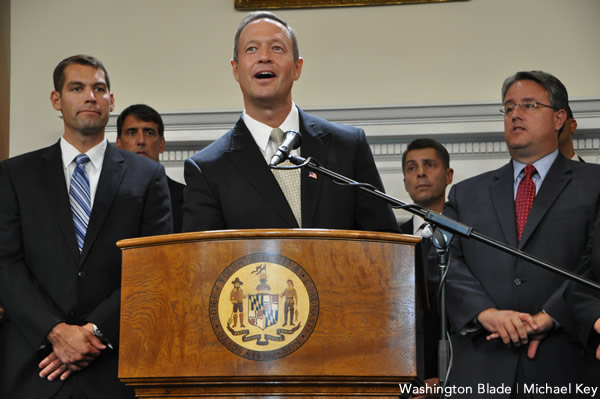
Maryland Gov. Martin O’Malley announced he would sponsor a 2012 bill to legalize same-sex marriage after the measure died in 2011. (Blade photo by Michael Key)
A bill to legalize same-sex marriage in Maryland died in the state legislature in March following a controversial behind-the-scenes decision by supportive lawmakers and leaders of LGBT rights groups to cancel a final vote on the bill on grounds that they lacked enough votes to pass it.
The action to pull the bill took place March 11 when the Maryland House of Delegates approved a motion by voice vote to recommit the bill to committee following an emotional two-and-a-half-hour debate over the measure on the House floor. The withdrawal of the bill came less than a month after the Maryland Senate passed the measure, the Civil Marriage Protection Act, by a vote of 25-21.
A little over a month after the bill’s demise, the board of directors of Equality Maryland, the state LGBT advocacy group that led lobbying efforts for the bill, fired its executive director Morgan Meneses-Sheets. The firing prompted the group’s development director, Matthew Thorn, to resign in protest, worsening the group’s existing financial problems and leading to a major shakeup of the board and staff.
Meanwhile, Maryland Gov. Martin O’Malley, who backed the bill but didn’t aggressively lobby for it, promised later in the year to take a lead role in pushing the measure in the legislature’s 2012 session, which convenes in January. Supporters are hopeful the bill will pass this time around but are uncertain whether it could survive an expected voter referendum.
#3 Rash of anti-trans violence in D.C.
More than a dozen reported violent attacks against transgender women in D.C. in 2011, including two murders, prompted transgender activist Ruby Corado to declare that the transgender community of D.C. was in crisis.
D.C. police, who made arrests in some of the assaults but not for the two murders, said they have no evidence to indicate a single perpetrator is responsible for the attacks.
In August, an unidentified male suspect shot 23-year-old transgender woman Lashai Mclean to death on Dix St., N.E., near the D.C.-Maryland line. Eleven days later a male suspect fired a gun at another transgender woman just a block from where Mclean was killed. The woman was not hit, but police expressed concern that trans women might have been targeted in that area, which is known as a location where transgender prostitutes congregate.
In September, aerospace engineer Gaurav “Gigi” Gopalan, 35, was found dead on a sidewalk in a residential section of the city’s Columbia Heights neighborhood. Most of his friends said he identified as a gay man, but he was dressed in women’s clothes when found unconscious by police, who said the cause of death was blunt force trauma to the head. No suspects have been identified in the case.
The string of attacks and two murders of victims believed to be targeted because of their gender identity prompted at least two protests by trans activists, who called on police to devote more resources to investigate the mostly unsolved cases of anti-trans violence.
#4 Beating of Md. trans woman caught on video
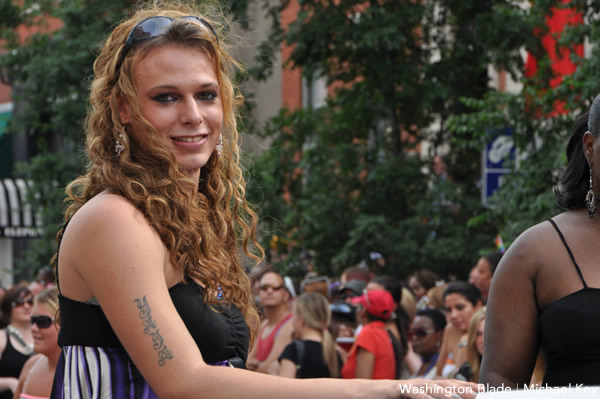
The attack of Chrissy Lee Polis in a Baltimore-area McDonald’s was captured in a video that went viral online. (Blade photo by Michael Key)
The beating of 23-year-old transgender woman Chrissy Lee Polis at a McDonald’s restaurant outside Baltimore in April created a national sensation when a video of the attack went viral over the Internet.
The video, made by a McDonald’s employee, showed two teenage girls punching and kicking Polis as she was sprawled on the floor covering her face and head with her arms. At one point, the video showed one of the female attackers dragging Polis across the floor by her hair.
Polis, who suffered non-life threatening injuries, became a human face for what transgender activists say is the longstanding prejudice, misunderstanding and hate-related violence experienced by the transgender community. Public officials, including Maryland Gov. Martin O’Malley, promised in the wake of the Polis attack to redouble efforts to pass a transgender non-discrimination bill in the Maryland Legislature in 2012.
The two women who attacked Polis, a 19-year-old and a 14-year-old, pleaded guilty to assault and hate crime charges. The 19-year-old was sentenced to five years in prison. Authorities said the 14-year-old was given an undisclosed sentence in the state’s juvenile justice system.
PHOTO: Adam Ebbin
CAPTION: Notoriously anti-gay Virginia elected its first openly gay state senator, Adam Ebbin, who has served in the House of Delegates since 2004.
#5 Adam Ebbin elected first gay Va. state senator
Gay Democrat Adam Ebbin, who has served in the Virginia House of Delegates since 2004, won election in November to the Virginia Senate, becoming the state’s first openly gay senator.
Ebbin defeated Republican challenger and political newcomer Timothy McGhee by a margin of 64 percent to 35 percent. He ran in a district in Northern Virginia with a solid Democratic majority that includes parts of the City of Alexandria and Arlington and Fairfax Counties.
He emerged as an outspoken advocate for LGBT equality during his tenure as the state’s only out gay member of the House of Delegates. He said one of his top priorities in the Senate will be to push legislation to ban job discrimination against state government employees based on their sexual orientation or gender identity.
“I am honored by the trust the voters have shown in me,” Ebbin said following his election to the Senate. “During the campaign I listened to the voters’ concerns and will work on behalf of the values we all share: improving our public schools, expanding our transit system and cleaning up Virginia’s environment.”
#6 Ganymede, D.C. Cowboys, Apex say goodbye
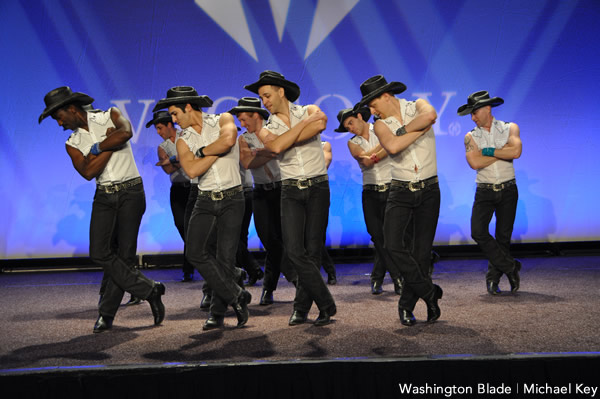
The D.C. Cowboys announced it would disband after 18 years of memorable performances on local, national and even international stages. (Blade photo by Michael Key)
Two popular gay arts and entertainment groups announced plans in 2011 to disband and a third venue, the Dupont Circle gay nightclub Apex, closed its doors for good in July.
Ganymede Arts, D.C.’s only gay-specific theater and arts company, announced in April it was closing after a four-year run that included Broadway-style productions of shows such as “Naked Boys Singing” and “Falsettos.”
Members of the company’s board, including director Jeffrey Johnson, cited financial difficulties as the main reason for their decision to close the company.
“Artistically it’s always been very successful,” Johnson said. “But there’s never been anything left over after each production.”
The D.C. Cowboys, a local dance troupe for gay men, also announced its closing, in this case in 2012, after 18 years of performances at clubs, gay rodeos, and the city’s annual LGBT Pride parade and festival.
The group, which some considered a gay Chippendale troupe geared to country-western music, has been praised for the dance talent of its members who sometimes perform bare-chested.
Apex surprised many of its loyal customers when it closed in July without advance notice. Owner Glen Thompson, who also owns the nearby gay bar Omega, sold Apex to Alan Carroll, the owner of the D.C. gay clubs Ziegfelds-Secrets and the lesbian club Phase One. Carroll said he plans to open a new club in the Apex building at 22nd and P St., N.W., that will cater to a mostly lesbian clientele.
#7 New Md. trans group forms after bill dies
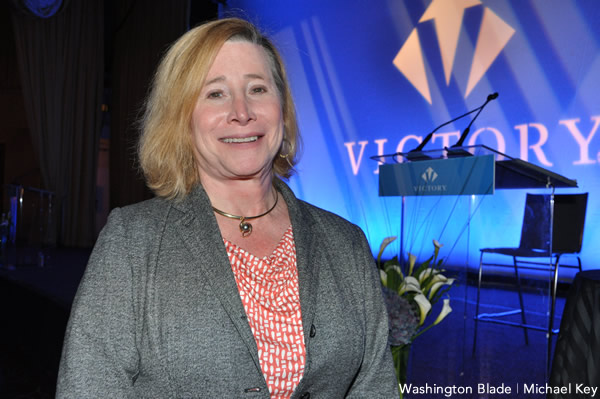
Transgender advocate Dana Beyer co-founded the group Gender Rights Maryland in 2011. (Blade photo by Michael Key)
A transgender non-discrimination bill died in the Maryland Legislature in April after the State Senate startled supporters by voting 27 to 20 to send the Gender Identity Non-Discrimination Act back to committee.
LGBT advocates lobbying for the bill, including officials with the state LGBT group Equality Maryland, said at least seven Democratic senators who promised to vote for the bill changed their positions and indicated they would vote no if the measure came up for a vote.
The Senate action came one month after the House of Delegates voted 86 to 52 to approve a compromise version of the bill that included protections against discrimination in employment and housing but did not include a prohibition against public accommodations discrimination. Supporters of the bill in the House, including its lead sponsor, said they didn’t have the votes needed to pass the bill if it included a public accommodations provision, which would cover public bathrooms and locker rooms in facilities such as health clubs and gyms.
The bill’s demise prompted transgender activists in the state to launch Gender Rights Maryland, the state’s first statewide transgender advocacy organization. Transgender activist Dana Beyer of Montgomery County, one of the group’s co-founders, said Gender Rights Maryland would coordinate efforts to pass a transgender rights bill in the legislature’s 2012 session.
#8 Delaware approves civil unions

Year In Review: 2011
The Delaware Legislature in April approved a civil unions bill that provides same-sex couples with all of the rights and benefits of marriage under Delaware law.
The measure cleared the Delaware House of Representatives by a vote of 26-15 and cleared the State Senate by a vote of 13-6. Gov. Jack Markell, a Democrat, signed the bill.
Lisa Goodman, president of the board of Equality Delaware, a statewide LGBT group coordinating lobbying efforts for the bill, said the group and other LGBT organizations and advocates determined they didn’t have the political support in the state to pass a same-sex marriage bill.
Goodman, an attorney, said the civil unions law would provide same-sex couples and their families, including children, with crucial legal protections that they would not have without the civil unions measure.
#9 Local groups celebrate milestones
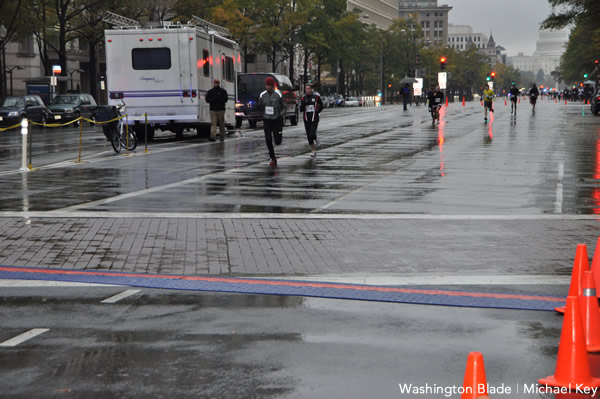
D.C.’s AIDS Walk, organized by Whitman-Walker Health, turned 25 in 2011. (Blade photo by Michael Key)
The D.C. Gay and Lesbian Activists Alliance, the city’s oldest continuously operating LGBT rights group, celebrated its 40th anniversary in 2011.
And Whitman-Walker Health, the city’s largest private clinic treating people with HIV and AIDS, organized its 25th annual Washington AIDS Walk, the group’s main fundraising event.
Nov. 15 marked the 50th anniversary of the founding by the Mattachine Society of Washington, the city’s first gay rights advocacy organization. That milestone became less of a celebration than had been expected due to the death a few weeks earlier of Frank Kameny, the group’s co-founder and leader.
Mattachine Society of Washington ceased operating as an organization in the early 1970s, when Kameny and other leaders of the group shifted their efforts to the then newly formed Gay Activists Alliance, which later became the Gay and Lesbian Activists Alliance. But activists familiar with the city’s gay movement history say Mattachine Society of Washington left an important legacy as a groundbreaking gay advocacy group.
#10 Wone case settlement
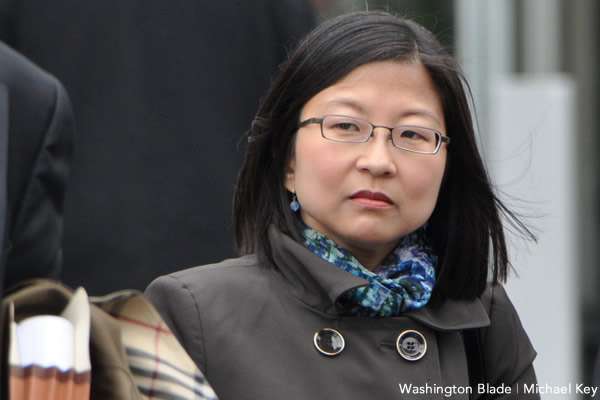
Robert Wone was murdered in 2006. His widow, Kathy Wone, pursued a wrongful death lawsuit against three gay men in connection with the case. (Blade photo by Michael Key)
Three gay men named as defendants in a $20 million wrongful death lawsuit over the 2006 murder of attorney Robert Wone inside their Dupont Circle area townhouse agreed in August to an out-of-court settlement in the case with Wone’s widow, who filed the lawsuit.
A statement released Aug. 3 by attorneys representing Kathy Wone said defendants Joseph Price, Victor Zaborsky, and Dylan Ward “have agreed to a monetary settlement, including payments to the Robert E. Wone Memorial Trust.”
The statement didn’t disclose the amount of money the defendants agreed to pay Mrs. Wone. It said she would use some of the money to advance the causes her husband believed in, including college scholarships and free legal services to people in need.
The three gay defendants were found not-guilty at a criminal trial in which they were charged with obstruction of justice, conspiracy to obstruct justice and evidence tampering in connection with Wone’s murder. Authorities haven’t charged anyone with the murder. D.C. police and the U.S. Attorney’s office say the case remains open and they continue to seek more evidence to charge someone with Wone’s murder.
Price, Zaborsky, and Ward and their attorneys didn’t respond to requests for comment.


District of Columbia
Blade contributor, husband exchange vows in D.C.
Yariel Valdés and Kevin Vega held ceremony at Jefferson Memorial on March 23

Washington Blade contributor Yariel Valdés and his husband, Kevin Vega, exchanged vows at the Jefferson Memorial on March 23.
The couple married in Fort Lauderdale, Fla., on Nov. 24, 2025. The Jefferson Memorial ceremony — which Blade International News Editor Michael K. Lavers and Samy Nemir Olivares officiated — coincided with the third anniversary of Yariel and Kevin’s first date.
Yariel in 2019 asked for asylum in the U.S. because of the persecution he suffered as a journalist in his native Cuba. He spent nearly a year in U.S. Immigration and Customs Enforcement custody before his release on March 4, 2020.
Yariel wrote a series of articles about his time in ICE custody that the Blade published. The series was nominated for a GLAAD Media Award in 2022.
Yariel and Kevin live in South Florida.
District of Columbia
‘Out for McDuffie’ event held at D.C. gay bar
Mayoral candidate cites record of longtime support for LGBTQ rights
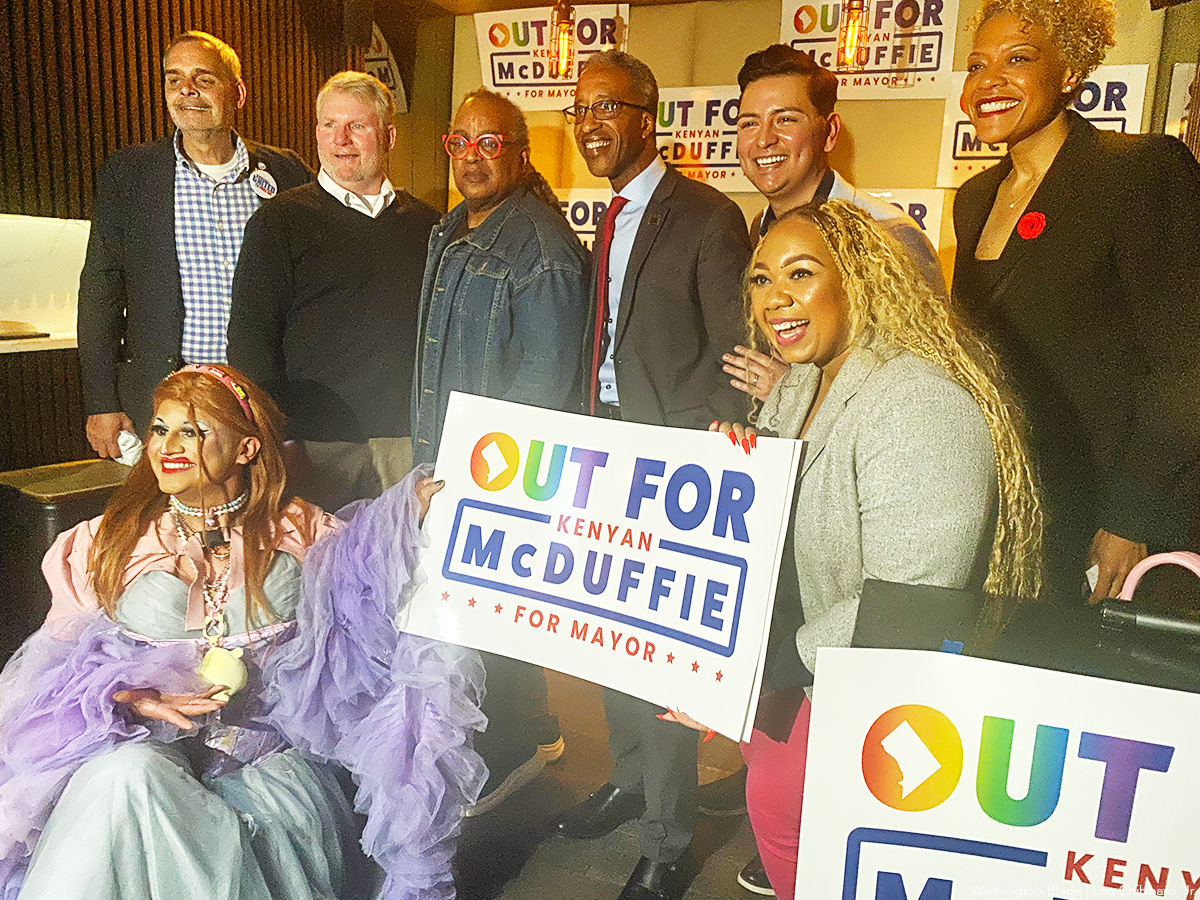
More than 100 people filled the upstairs room of the D.C. gay bar Number 9 on Thursday night, March 26, to listen to D.C. mayoral candidate Kenyan McDuffie at an event promoted as an “Out for McDuffie” meet and greet session.
Several local LGBTQ activists who attended the event said they support McDuffie, a former D.C. Council member, in his run for mayor while others said they had not yet decided whom to vote for in the June 16 D.C. Democratic primary election.
As of March 27, eight other Democrats were competing against McDuffy in the June 16 primary, including D.C. Council member Janeese Lewis George (D-Ward 4), considered McDuffie’s lead opponent. Lewis George also has a record of strong support on LGBTQ issues.
Most political observers consider McDuffie and Lewis George the two lead candidates in the race, with the others having far less name recognition.
The two lead organizers of the Out for McDuffie event were LGBTQ rights advocates Courtney Snowden, a former D.C. deputy mayor in the administration of Mayor Muriel Bowser, and Cesar Toledo, a local LGBTQ youth housing services advocate.
“I’m a candidate for mayor of Washington, D.C. and I’m running for mayor because I love this city,” McDuffie told the gathering after being introduced by Snowden. “And now more than ever we need leadership to take us to the future,” he said, adding that he and his administration would “stand up and fight” against President Donald Trump’s efforts to intervene in local D.C. affairs.
“Our strength is in the 700,000 beautifully diverse residents of Washington, D.C.” he told the gathering. “And as Courtney said, I didn’t just show up and run for mayor and then start saying that I’m going to be an ally for the queer community, for the LGBTQ+ community,” he said, “I’ve lived my entire professional life fighting for justice and fighting for fairness.”
Following his speech, McDuffie told the Washington Blade, “We’re going to fight to protect our LGBTQ+ community every single day. That’s what I’ve spent my career doing, making sure we have a beautifully diverse and inclusive city.”
He remained at Number 9, located at 1435 P St., N.W., for nearly an hour after he spoke, chatting with attendees.
District of Columbia
‘No Kings’ protests set for D.C.
Anti-Trump demonstrations to take place across country on Saturday

As President Donald Trump and his administration escalate rhetoric targeting transgender youth and student athletes, push efforts to restrict voting access for millions of Americans, and pursue foreign policy decisions that critics say bypass congressional authority, organizers across the country are once again mobilizing in protest.
For many LGBTQ advocates, the moment feels especially urgent.
In recent months, activists have pointed to a surge in anti-trans legislation, attacks on gender-affirming care, and efforts to roll back nondiscrimination protections as direct threats to the safety and visibility of queer and trans communities. Organizers say the demonstrations are not just about policy, but about defending the right of LGBTQ people — particularly trans youth and people of color — to live openly and safely.
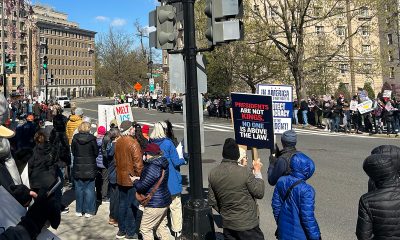
Thousands of “No Kings” protests are planned nationwide, with multiple demonstrations set to take place in D.C.
One of the primary events, “No Kings Washington,” will be held in Anacostia, an overwhelmingly Black area of D.C. that is often at the center of conversations around racial justice, policing, and access to resources in the nation’s capital.
The protest in Anacostia is focused on what organizers describe as the “power behind the throne,” specifically Stephen Miller, the White House Deputy Chief of Staff for Policy and Homeland Security Advisor. Miller has been closely associated with the administration’s “zero tolerance” immigration policy, including the family separation practice that resulted in thousands of children being separated from their parents at the Southern border.
Activists have also linked immigration enforcement policies to broader concerns about LGBTQ migrants, including queer asylum seekers who often face heightened risks of violence and discrimination both in their home countries and within detention systems.
Anacostia protest details:
Participants are asked to gather starting at 1:30 p.m. on the southeast side of the Frederick Douglass Bridge. The closest Metro station is Anacostia on the Green Line, about an 8-minute walk from the starting point. Organizers strongly encourage attendees to use public transportation, as street parking is limited.
The march will proceed past Fort McNair and conclude near the Waterfront Metro station.
D.C. icon and LGBTQ activist Rayceen Pendarvis is set to speak at the protest around 2 p.m.
Kalorama protest details:
A separate protest will take place earlier in the day in Kalorama, a neighborhood long associated with political power and home to presidents, cabinet officials, and foreign ambassadors. Demonstrators are expected to gather at 10 a.m., with a march running until approximately noon near the intersection of Connecticut Avenue and Kalorama Road.
Arlington/National Mall protest details:
Another group is expected to assemble at Memorial Circle near Arlington National Cemetery at 10 a.m. before crossing the Memorial Bridge into D.C., passing the Lincoln Memorial and continuing on to the Washington Monument. Organizers say the march is intended to defend “American democracy, the rule of law, and a healthy planet.”
Unlike last June — when organizers discouraged large-scale demonstrations in D.C. due Trump’s military/birthday parade — activists are now explicitly calling on people to show up in the nation’s capital and surrounding areas.
The protests also coincide with Transgender Day of Visibility weekend, which includes additional gatherings and celebrations on the National Mall. At the same time, peak bloom for the National Cherry Blossom Festival is expected to draw large crowds to the city. With multiple major events happening simultaneously, officials and organizers anticipate significant congestion, increased traffic, and crowded public transit throughout the weekend.
Organizers are urging participants to plan ahead and come prepared.
“Bring your signs, noisemakers, music, and creative ideas, and gather in joyful, nonviolent protest,” they said. “Children are very welcome.”
For more information, visit nokings.org.

Thousands attend ‘No Kings’ protests in D.C.

Blade contributor, husband exchange vows in D.C.

Ghanaian president welcomed to Philadelphia amid backlash over anti-LGBTQ bill

PHOTOS: ‘No Kings’ rally and march

‘Out for McDuffie’ event held at D.C. gay bar

Pa. House passes bill to codify marriage equality in state law

Introducing the Torchbearers Awards honoring queer, trans women and nonbinary people

New IOC policy bans trans women from Olympics

‘No Kings’ protests set for D.C.

Border to border: modern slavery and human trafficking in refugee movements across East Africa
-

 Pennsylvania5 days ago
Pa. House passes bill to codify marriage equality in state law
-
a&e features5 days ago
Introducing the Torchbearers Awards honoring queer, trans women and nonbinary people
-
Sports5 days ago
New IOC policy bans trans women from Olympics
-
District of Columbia5 days ago
‘No Kings’ protests set for D.C.