Sports
Once paralyzed, gay rower eyes London
Former D.C. resident training for Paralympic Games
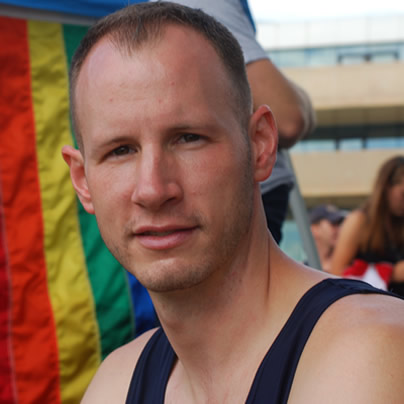
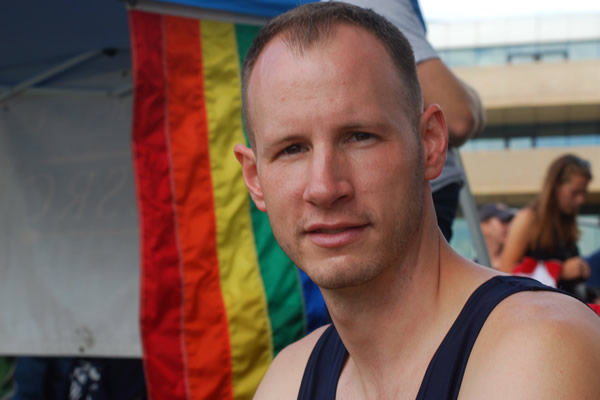
Jason Beagle was paralyzed from the waist after a 1994 car accident. (Photo by M.V. Jantzen)
In 1994, Jason Beagle was in a car accident that left him with shattered vertebrae, paralyzed from the waist down. Spinal fusion and many months of therapy enabled Beagle to regain the use of his legs.
Eventually, he was able to walk without a cane but still had to deal with physical limitations and some paralysis. After moving to D.C. to pursue work as a director at the Shakespeare Theatre, Beagle decided to test his body and joined the LGBT sports team, Chesapeake and Potomac Softball (CAPS).
“I wanted to try a sport that I had played before the accident,” said Beagle. “It turned out that softball was a little bit beyond my limits.”
In 2007, he joined another LGBT sports team, the DC Strokes Rowing Club (DCSRC) and entered the “Learn to Row” program. Beagle ended up falling in love with the sport and went on to compete in rowing regattas with the team and eventually became president of the club.
With the encouragement of DCSRC Coach Patrick Johnson, Beagle joined Capital Adaptive which was a new program offered by the Capital Rowing Club. Capital Adaptive was formed to introduce the Washington area’s population of disabled military veterans and civilians to the sport of rowing.
“I wanted to see what it was like to row with other athletes with disabilities,” says Beagle. “I was classified as an adaptive rower with functional use of his legs, trunk and arms (LTA).”
At the start of 2011, Beagle received an email from U.S. Rowing Coach, Karen Lewis, inviting him to a development camp at the Oklahoma City National High Performance Center (OKC-NHPC). At the conclusion of the development camp, he was invited to the international selection camp for adaptive rowers to be contested in June 2011.
With only 10 weeks to train, and along with help from the DC Strokes and Capital Adaptive, Beagle adopted a high performance training program that consisted of four hours of rowing a day along with his 45-hour work week.
Beagle ended up losing his seat race at the selection camp and returned to D.C. disappointed, but committed to the sport of rowing. He continued racing with the DC Strokes and competed in several adaptive rowing sprint races.
In July 2011, Beagle received another invitation from Coach Karen Lewis. This one was an invitation to consider moving to Oklahoma City and applying for residency at the OKC-NHPC. After several weeks of consideration and a trip to Oklahoma City for the U.S. Master’s National Championships, Beagle decided to take the plunge and his application for residency was accepted.
In December 2011, Beagle quit his job in D.C., packed up his car and moved to Oklahoma City. He is now in residence with more than 20 high performance rowers at the OKC-NHPC, which includes adaptive rowers and able-bodied rowers.
At the 2008 Beijing Paralympics, rowing was added to the sports lineup for the first time. As designated by FISA, the international rowing federation, there are three categories in Paralympic rowing. Arms only (A), Trunk and Arms (TA) and Legs, Trunk and Arms (LTA).
Beagle is now in heavy training for a chance to compete for the USA at the 2012 London Paralympics. A typical day for Beagle consists of 12 miles of rowing in the Oklahoma River, six hours of work at Chesapeake Energy and another 12 miles on the river in the evening.
Somewhere in the course of a week he also fits in ergometer training, weight training, biking, light running and time in the indoor high propulsion rowing tank.
All the hard training has given Beagle some incredible results. “My time for 1,000 meters has improved by 35 seconds,” says Beagle. “That currently ranks me second in the United States in the LTA category.”
The selection camp for the 2012 London Paralympics will be contested in Charlottesville, Va., beginning on May 25 on the Rivanna River. The United States prequalified a boat for London in the LTA category, which is a four-person mixed sweep boat (4+) at the 2011 World Championships in Bled, Slovenia.
During the course of the two-week selection camp, four men and four women will be selected to compete in seat racing. Over the course of several days, the eight rowers will rotate spots in the four-person sweep boat looking for the combination that will result in the fastest time. The final selection will consist of the fastest two men and two women.
Getting into the mindset of an elite athlete has been an interesting challenge for Beagle. “Sometimes, because of my theater background, I feel like I am training for opening night of a play,” he says. “I have never pushed my body this hard and am looking forward to what challenges lie ahead.”
Regardless of the outcome in Charlottesville next month, Beagle will remain at the OKC-NHPC through the 2016 Paralympic Games in Rio de Janeiro. “I am enjoying it in Oklahoma City,” says Beagle. “The LGBT community here is quite social and the various cliques seem to be very accepting of each other.”
Everyone here in D.C. will be rooting for Jason as he rows his way to London for a shot at the gold medal.
Information on local rowing is at dcstrokes.org and capitalrowing.org. Information on U.S. Rowing is at okc-nhpc.org.





Iran and Egypt on Friday faced off during the World Cup’s “Pride Match” in Seattle.
Iran is among the handful of countries in which consensual same-sex sexual relations remain punishable by death. Discrimination and persecution based on sexual orientation and gender identity is commonplace in Egypt.
Friday’s match coincided with Pride weekend in Seattle. The Egyptian Football Association and the Football Federation Islamic Republic of Iran both objected to playing in the “Pride Match.”
Egypt and Iran tied 1-1.
FIFA, for its part, allowed Pride flags inside the stadium during the match.
“The FIFA World Cup 2026 is an inclusive event that welcomes people from all backgrounds,” a FIFA spokesperson told the Washington Blade in a statement. “Fans of all sexual orientations and gender identities are welcome at matches and events. General statements of human rights, including rainbow flags and other flags representing sexual orientation and gender identity, are permitted under the FIFA World Cup 2026™ Stadium Code of Conduct and may be displayed inside stadiums provided they are used in a manner consistent with the code.”
Human Rights Watch welcomed FIFA’s decision to allow Pride flags inside the stadium. Outright International, a global LGBTQ and intersex rights group, distributed Pride flags in Seattle on Friday, which was Pride Match Day.
“Visibility matters,” said Outright International Executive Director Maria Sjödin. “Pride is now being celebrated in more than 100 countries, including this weekend in Seattle. For many LGBTIQ people, seeing a Pride flag in public is a reminder that they are not alone, and that their rights and dignity are recognized.”
FIFA President Gianni Infantino earlier this year told Die Weltwoche, a Swiss magazine, that “there will be no ‘Pride Match’ at the (FIFA) World Cup.”
“There will be a FIFA World Cup match in Seattle, and on the same day, events organized by external organizations will be taking place in the city,” said Infantino. “But that has nothing to do with the match itself.”
Peter Tatchell, a long-time LGBTQ activist from the U.K. who is director of the Peter Tatchell Foundation, was among those who traveled to Seattle for Friday’s match. Tatchell accused FIFA of not vetting World Cup teams — specifically Iran, Egypt, Saudi Arabia, Ghana, Senegal, Qatar, Tunisia, Morocco, Iraq, Uzbekistan, and Algeria — over whether they would allow gay players.
“FIFA is protecting LGBT+ visibility in the stands while failing to protect LGBT+ players on the pitch,” said Tatchell.
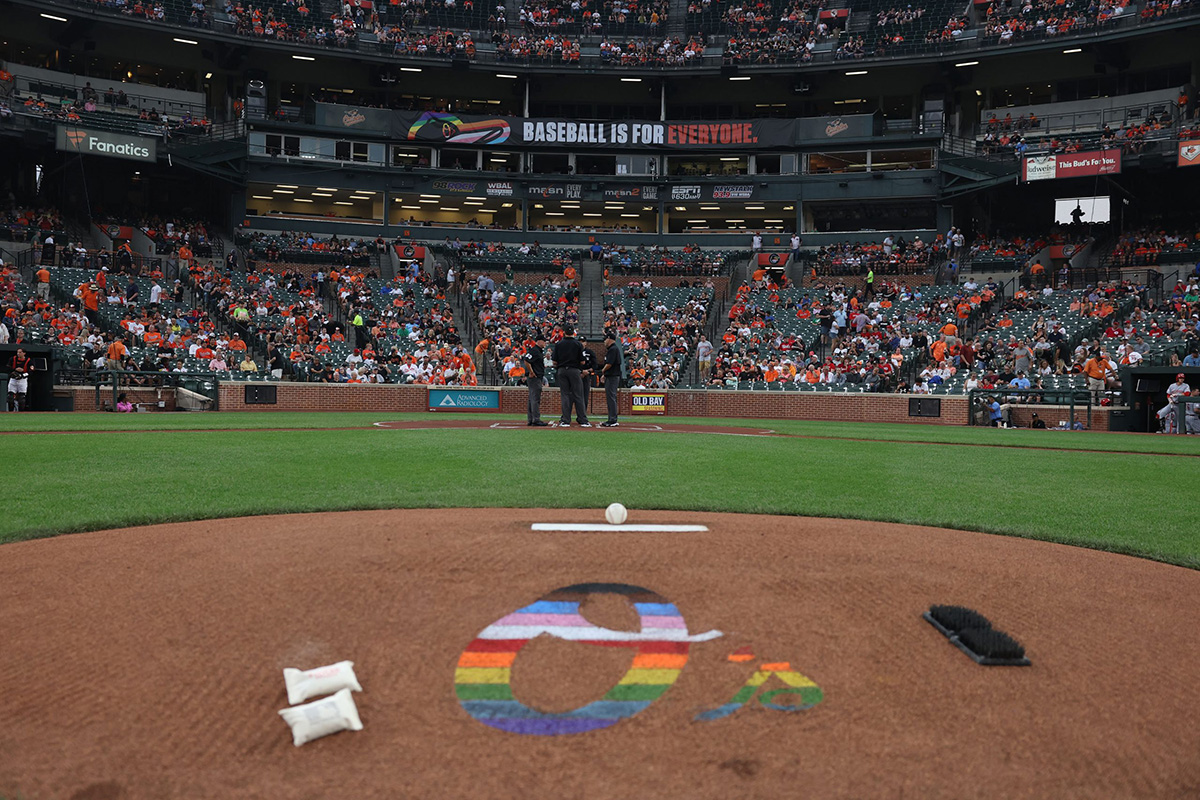
The Baltimore Orioles will take on the Washington Nationals on Friday, June 26 at 7 p.m. for Pride Night at Oriole Park.
The first 15,000 fans will receive an exclusive Pride Night Orioles jersey. The Washington Blade is a media sponsor of this event.
To purchase tickets, visit Orioles.com/Tickets.
Sports
Minor league team in York, Pa., forfeits Pride Night game after some players refuse to wear special jersey
City is roughly 20 miles north of Md. border
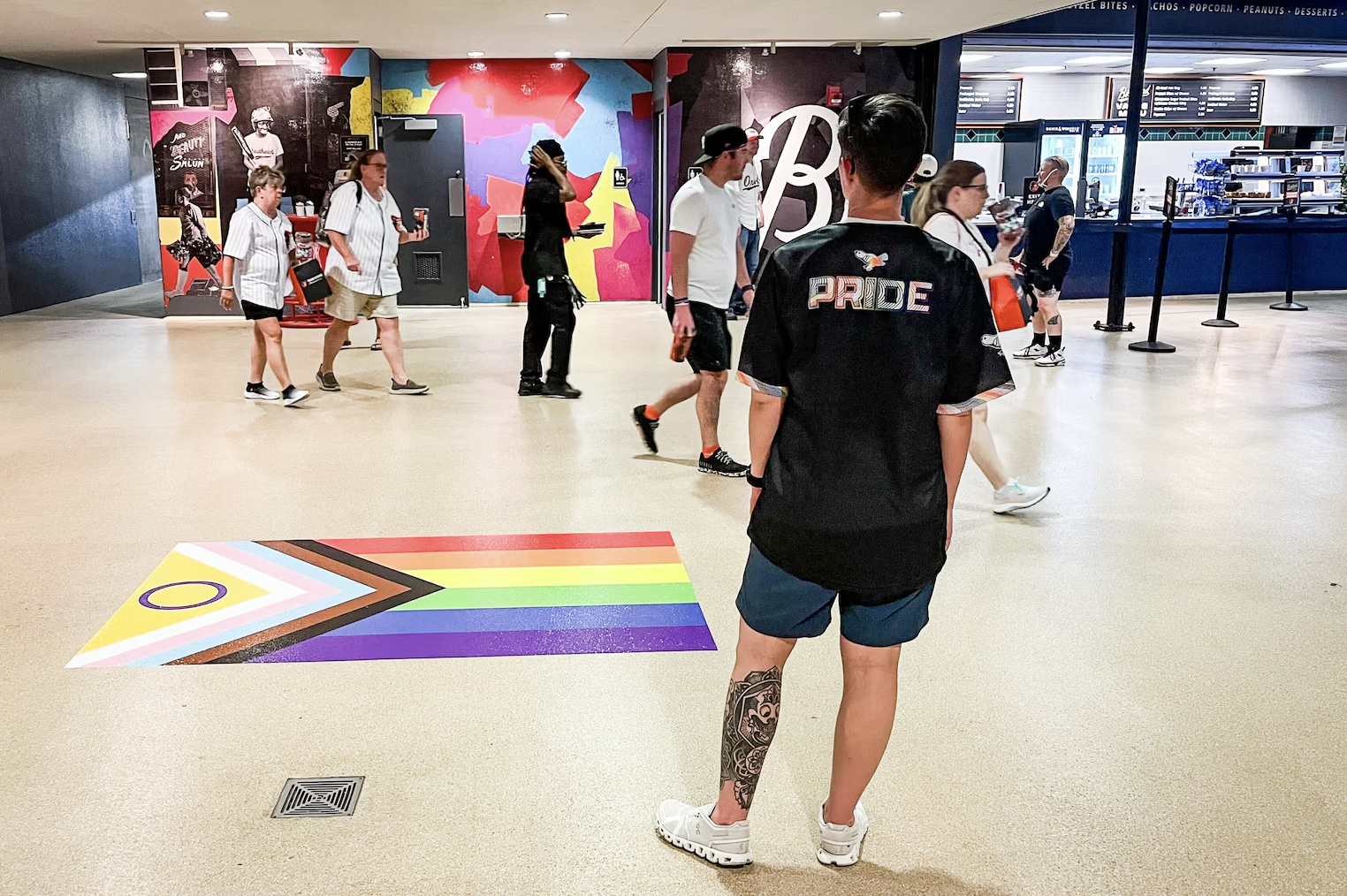
An independent minor league baseball team says it is forfeiting a game because some of its players refused to wear a special Pride Night jersey.
The Atlantic League Pro Baseball’s York Revolution were planning to hold their 11th annual Pride Night event Thursday for a game against the Southern Maryland Blue Crabs.
But the Revolution announced the day of the game that it wouldn’t be played. York is about 20 miles north of the Maryland line. The Blue Crabs play in Waldorf.
The rest of this article can be found on the Baltimore Banner’s website.

New book reveals what we can learn from animal sex

Who might replace Lindsey Graham? The contenders and their LGBTQ records

PHOTOS: Westminster Pride

Un terremoto también se vive desde el exilio

PHOTOS: Emerald City Pride

Mr. Henry’s celebrates 60 years of proud inclusivity

It’s good to see some justices standing up to Trump

Queer media dominates 2026 Emmy nominations

Egyptian authorities refuse to allow gay cruise to dock in country