National
BREAKING: Boehner appeals DOMA cases to Supreme Court
Appeals court found anti-gay law unconstitutional

House Speaker John Boehner’s (R-Ohio) attorneys on Friday formally appealed to the U.S. Supreme Court an appeals court decision determining the Defense of Marriage Act was unconstitutional.
Drew Hammill, spokesperson for House Minority Leader Nancy Pelosi (D-Calif.), told the Washington Blade on Friday afternoon Republicans had notified Democratic leadership that House counsel filed an appeal to the Supreme Court.
The court ruling that was appealed was the First Circuit Court of Appeals decision in the cases of Gill v. Office of Personnel Management, which was filed by Gay & Lesbian Advocates & Defenders, and Commonwealth of Massachusetts v. Department of Health & Human Services. On May 31, the appellate court issued a decision that Section 3 of DOMA, which prohibits federal recognition of same-sex marriage, was unconstitutional as a result of both cases.
In a statement, Pelosi slammed Boehner for continuing to assert the constitutionality of DOMA, saying the appeal is a decision that will “waste more taxpayer funds to advance a position rejected by four different courts and to defend discrimination and inequality before the highest court in the land.”
“Democrats have rejected the Republican assault on equal rights, in the courts and in Congress,” Pelosi said. “We believe there is no federal interest in denying LGBT couples the same rights and responsibilities afforded to all couples married under state law. And we are confident that the Supreme Court, if it considers the case, will declare DOMA unconstitutional and relegate it to the dustbin of history once and for all.”
Boehner’s office didn’t immediately respond to a request to comment on the appeal.
In the filing, Boehner’s attorneys present two questions to the Supreme Court: (1) Whether Section 3 of the Defense of Marriage Act violates the equal protection component of the Due Process Clause of the Fifth Amendment; and (2) Whether the court below erred by inventing and applying to Section 3 of the Defense of Marriage Act a previously unknown standard of equal protection review.
“As the First Circuit recognized, this case calls out for this Court’s review,” the filing states. “The court of appeals has invalidated a duly-enacted Act of Congress and done so even though it acknowledged both that DOMA satisfies ordinary rational basis review and does not implicate heightened scrutiny. In the established world of equal protection law that result should have been impossible.”
The filing also cites a separation of powers issue as the result of the Obama administration no longer defending DOMA in court as it continues to enforce it and leaves the House to defend the law.
“Only this Court can settle this matter definitively,” the filing states. “Unless and until this Court decides the question, the executive branch will continue to attack DOMA in the courts, while continuing to enforce it, thus creating more potential litigation for the House to defend. This Court and this Court alone has the power to settle this question and redirect controversy over this important national question to the democratic process.”
Additionally, the filing argues the First Circuit ruling conflicts with Baker v. Nelson, a case related to same-sex marriage that the Supreme Court declined to hear in 1972.
Now that Boehner’s attorneys have filed an appeal, there will be 30 days for plaintiffs to file an opposition to the motion. It would then be left to the court to decide whether to grant cert, or hear the case. There isn’t a timeline for that, but it won’t happen while the court is in summer recess.
LGBT advocates also had harsh words for Boehner over his continued defense of DOMA.
Evan Wolfson, president of Freedom to Marry, called Boehner’s appeal “shameful” and said it’s time for him to “respect basic American values of equal protection under the law.”
“Same-sex couples have waited long enough for the federal government to treat their lawful marriages with the respect and fairness every American wants and deserves, especially in tough economic times,” Wolfson said. “Judges appointed by Presidents Nixon, Reagan, Clinton, ‘Bush 1,’ and ‘Bush 2,’ among others, have all agreed that there should be no ‘gay exception’ to the normal practice of the federal government honoring the marriages celebrated in the states, and providing the 1138-plus federal protections and responsibilities accorded all other married couples.”
In February 2011, the Obama administration announced it would no longer defend DOMA in court. After the decision, Boehner convened the House Bipartisan Legal Advisory Group, which voted 3-2 on a party-line basis to take up defense of DOMA in the administration’s stead.
To assist House general counsel Kerry Kircher in defending DOMA, Boehner hired Paul Clement, a former U.S. solicitor general under President George W. Bush. The cost cap to pay for House expenses in defending the law was set at $1.5 million.
Meanwhile, the Justice Department has filed legal briefs in favor of lawsuits against DOMA and sent Stuart Delery, who’s gay and the Justice Department’s acting assistant attorney general for the civil division, to make the case against the law in oral arguments.
Six federal courts have found that DOMA is unconstitutional as a result of cases filed by LGBT advocates. The ruling against DOMA in the First Circuit was the highest court to date to weigh in against the anti-gay law.
A White House spokesperson deferred comment to the Justice Department, which declined to comment.
NOTE: This article has been updated




The White House
Trump tells Fox News he won the ‘gay vote’ — but polls tell a different story
Trump falsely claims LGBTQ support on Fox despite polling showing overwhelming opposition.
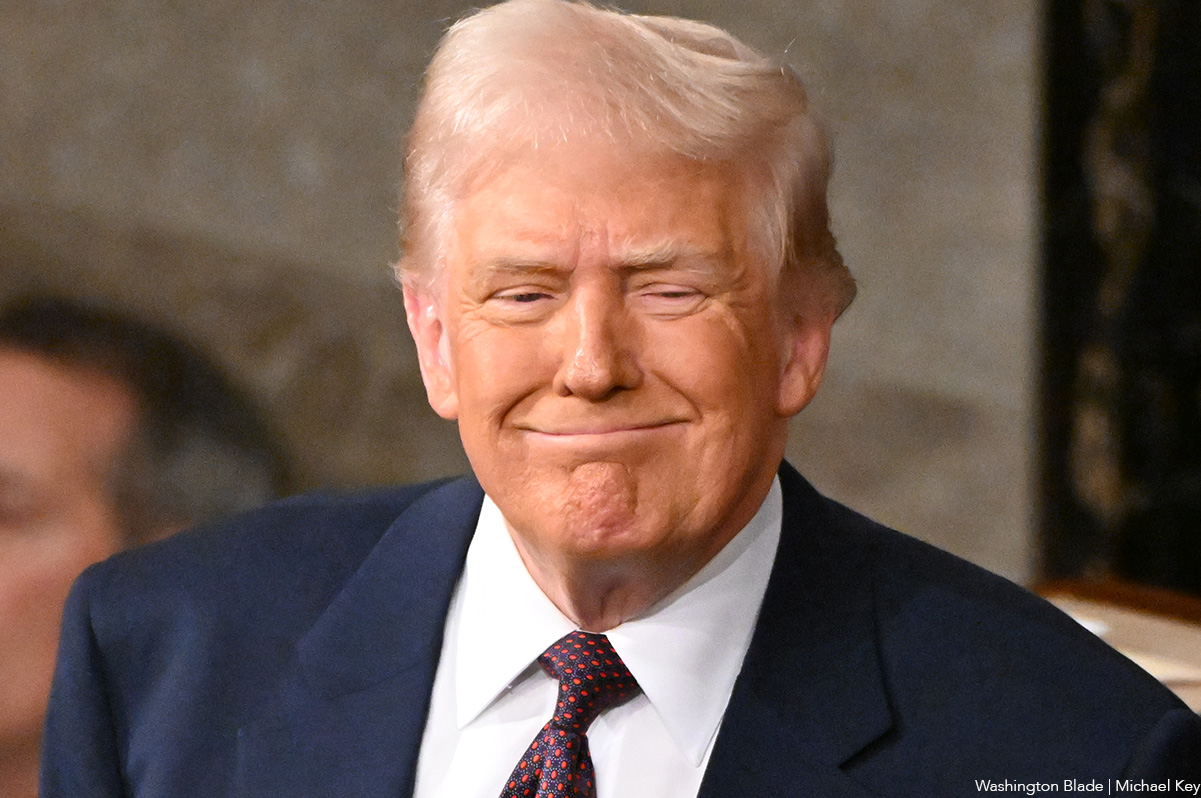
President Donald Trump claimed he won the “gay vote” in 2024, despite evidence showing otherwise.
While appearing by phone on Fox News’s panel show “The Five” on Thursday, Trump falsely claimed he performed particularly well among gay voters while discussing the ongoing war in Iran — a conflict he initiated without formal congressional approval.
“Now I think I did very well with the gay vote, OK? I even played the gay national anthem as my walk-off, OK?” Trump said on air.
“And I think it probably helped me. But I did great. No Republican’s ever gotten the gay vote like I did and I’m very proud of it, I think it’s great. Perhaps it’s because I’m from New York City, I don’t know…”
His claim contradicts 2024 polling from NBC News, which found that the GOP presidential ticket captured fewer than 1 in 5 LGBTQ male voters — a figure that may also include bisexual and transgender men. Trump’s support among LGBTQ female voters was even lower, at just 8%.
White LGBTQ voters favored Vice President Kamala Harris over Trump by a margin of 82% to 16%, while LGBTQ voters of color backed Harris by an even wider 91% to 5%.
Trump also used the appearance to criticize “Gays for Palestine,” saying: “Look at ‘Gays for Palestine’… they kill gays, they kill them instantly, they throw them off buildings, and I’m saying, ‘Who are the gays for Palestine?’”
He further pointed to his campaign’s use of the song “Y.M.C.A.” by the Village People — which he has repeatedly described as a “gay national anthem” — noting that it was frequently used as a walk-off song at rallies, as an indication that he and his campaign were supported by the gay community. The track, long associated with camp and hyper-masculine gay imagery, became a staple of Trump campaign events.
The Village People were later booked to perform at Turning Point USA’s inaugural ball celebrating Trump’s second inauguration. Lead singer Victor Willis previously criticized Trump’s use of the song dating back to 2020 and considered legal action to block it, but ultimately said there was “not much he can do about it.” He later acknowledged the renewed exposure was “beneficial” and “good for business,” boosting the song’s popularity and chart performance.
Despite Trump’s claims of strong support from gay voters, polling has consistently shown otherwise — even as several prominent gay men have held roles in or around his orbit, sometimes dubbed the “A-gays.” These include Richard Grenell, former executive director of the Kennedy Center and Special Presidential Envoy for Special Missions; Treasury Secretary Scott Bessent; Under Secretary of State Jacob Helberg; Department of Energy official Charles T. Moran; and longtime supporter Peter Thiel, co-founder and CEO of Palantir.
His efforts to portray himself as aligned with the gay community stand in conflict with policies advanced under his leadership. These include removing LGBTQ-related data from State Department reports, attempting to narrowly redefine gender identity in federal policy, restricting access to gender-affirming health care, and rolling back anti-discrimination protections. His administration also rescinded initiatives focused on LGBTQ health equity, data collection, and nondiscrimination in health care and education — moves advocates say contribute to stigma and worsen mental health outcomes.
Additionally, some HIV programs and community health centers have lost funding from the federal government after supporting initiatives inclusive of transgender people as a direct result of Trump-Vance policies.
National
Anti-trans visa ruling echoes Nazi regime destroying trans documents
Trump administration escalates attacks on queer community

The Lemkin Institute for Genocide Prevention and Human Security earlier this month released its third Red Flag Alert for the United States about the Trump administration’s anti-trans legislation. As the Lemkin Institute shared in the press release, “the Administration has moved from identifying transgender people as as threat to the family and to the nation’s military prowess to claiming that transgender people constitute a cosmic threat to the spiritual health of the nation and the great direct threat to the US national security in the world.”
The news came the same day that the State Department issued a new rule, “Enhancing Vetting and Combatting Fraud in the Immigrant Visa Program.” Under this new guidance, all visa applicants are required to disclose their “biological sex at birth” during all stages of the process, “even if that differs from the sex listed on the applicant’s foreign passport or identifying documentation.”
This rule also orders that applicants to the green card lottery program share their passport information, so in knowingly collecting passport information that the agency knows will not match a person’s biological sex at birth, it’s creating grounds to deny trans peoples’ biases on the basis of “fraud,” Aleksandra Vaca of Transitics explains.
As is written in the new ruling, “the Department is replacing ‘gender’ with ‘sex’ in accordance with E.O. 14168, Defending Women From Gender Ideology Extremism and Restoring Biological Truth to the Federal Government, which provides that the term ‘sex’ shall refer to an individual’s sex at birth. Only male and female sex options are available for entrants completing the Diversity Visa entry form.”
Along with outright denying the existence of nonbinary, genderqueer and gender expansive people, this policy creates a precedence for trans people to be stripped of their visas and deported because under 8 U.S.C. § 1182(a)(6)(C)(i), any foreigner found to have obtained or possess a visa “by fraud or willfully misrepresenting a material fact” will have their visa revoked and face deportation.
By requesting information on “biological sex at birth,” the State Department is forcing a mismatch between documents and enabling officials to accuse trans, nonbinary, and gender expansive immigrants of fraud. Thus, trans and nonbinary immigrants can have their visas revoked and can be deported, and information gathered from immigrants during the visa request process can be added to federal databases and used by immigration authorities, including ICE agents.
With the Supreme Court’s decision this past year allowing ICE officers to use racial profiling, Vaca argues that “now, The Trump administration has given ICE the reason it needs. Under this rule, ICE agents now have the enforcement rationale to assert that trans people–especially those belonging to racial minority groups–are more likely than cis people to have ‘misrepresented’ themselves during the visa process, and therefore, are more likely to enter the country ‘unlawfully.’”
This would enable ICE agents to target trans individuals specifically for being trans. If the goal of this were unclear, a day later the Trump administration released its statement for Women’s History Month 2026, writing that “we are keeping men out of women’s sports, enforcing Title IX as it was originally written and ensuring colleges preserve–and, where possible, expand–scholarships and roster opportunities for female athletes. We are restoring public safety and upholding the rule of law in every city so women, children, and families can feel safe and secure.”
And this is not the first time that ICE has targeted and harmed trans and nonbinary immigrants. Last June, Vera reported that ICE is not including trans people in detection in their public reports, and back in 2020, AFSC reported that trans people held in ICE detention faced “dreadful, ugly” conditions.
While it seems like a new development in Trump’s anti-trans escalation, it echoes a deeply upsetting history of denying and destroying transgender people’s documents following members of the Nazi party seizing power in 1933.
In the early 20th century, Weimar, Germany was an epicenter for gender affirming care with Maganus Hirschfeld’s Institute for Sexual Science. One of the first book burnings of the rising Nazi regime destroyed the Institute’s extensive clinical records and library on trans health and history by Nazi students and stormtroopers. In doing so, the Nazis effectively destroyed the world’s first trans health clinic and one of the richest and most comprehensive collective of information about trans healthcare.
Similarly, the Nazi government invalidated or refused to recognize what was called “transvestite passes,” or passing certificates that allowed trans people to avoid arrest under Paragraph 175 which prohibited cross-dressing. During the Weimar Republic — the regime that preceded the Third Reich — recognized and affirmed the identities of trans people (in limited ways) with specific documentation that helped prevent them from arrest. Invalidating and disregarding these passes allowed police and Nazi officials to target trans people and harass, extort and arrest them, and the record of passes themselves helped officials target trans people.
The changes to visa guidelines — alongside Kansas’s move to revoke trans drivers’ licenses last month — is reflective of this escalation of violence against trans people during the Nazi’s rise to power, which scholars like Dr. Laurie Marhoefer is just beginning to uncover. And along with the revocation of identification documents this past week, a recent Fourth Circuit Court ruled that states can deny Medicaid coverage for gender-affirming surgery.
The Fourth Circuit Court decision affirmed the Supreme Court’s decision in Skrmetti, which ruled that bans on gender affirming healthcare for young people are constitutional. This ruling extends this ban to include adult healthcare bans, allowing West Virginia’s exclusion of Medicaid coverage for adult gender affirming healthcare to take full effect. Even more upsetting was what the ruling itself said, calling gender affirming healthcare “dangerous.”
As was written in the Fourth Circuit Opinion, “it’s not irrational for a legislature to encourage citizens ‘to appreciate their sex’ and not ‘become disdainful of their sex’ by refusing to fund experimental procedures that may have the opposite effect.”
In reality, what this ruling and the opinion reflect, is the next step in government regulation and oversight over marginalized peoples’ bodies. From the overturn of Roe v. Wade, which removed federal protection of access to abortion, this next step represents the denial of people’s access to vital, lifesaving care–and to be clear, gender affirming care is not just for trans, nonbinary, and intersex people. It’s a dangerous escalation and one that echoes previous violence against trans people under fascist regimes; the Lemkin Institute is right to raise concern.
Pennsylvania
Pa. House passes bill to codify marriage equality in state law
Governor supports gay state Rep. Malcolm Kenyatta’s measure
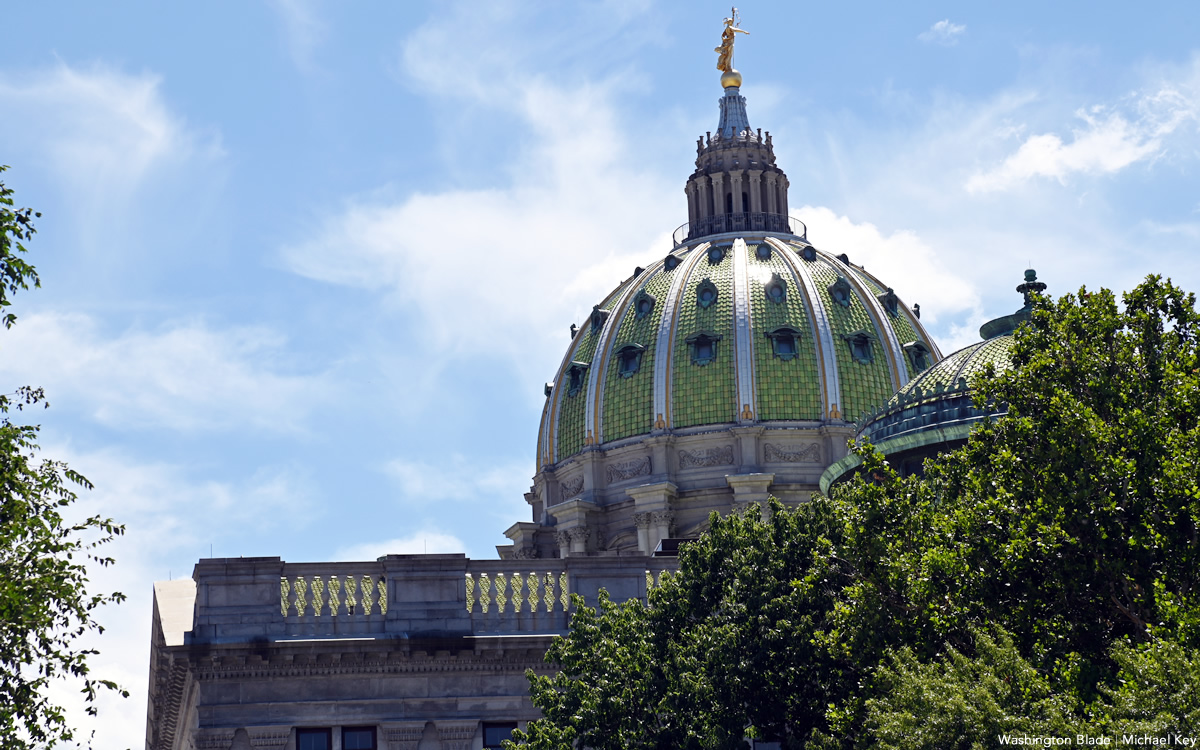
The Pennsylvania House of Representatives on Wednesday passed a bill that would codify marriage equality in state law.
House Bill 1800 passed by a 127-72 vote margin. Twenty-six Republicans voted for the measure.
The Republican-controlled Pennsylvania Senate will now consider the bill that state Rep. Malcolm Kenyatta (D-Philadelphia), who is the first openly gay person of color elected to the state’s General Assembly, introduced. Democratic Gov. Josh Shapiro supports the measure.
“Here in Pennsylvania, we believe in your freedom to marry who you love,” said Shapiro on Wednesday. “Today, the House has stepped up to protect that right.”
BREAKING: The Pennsylvania House just passed @RepKenyatta's bill to codify marriage equality into law in PA — and they did it with broad bipartisan support.
— Governor Josh Shapiro (@GovernorShapiro) March 25, 2026
Here in Pennsylvania, we believe in your freedom to marry who you love. Today, the House has stepped up to protect that…

Trump tells Fox News he won the ‘gay vote’ — but polls tell a different story

Anti-trans visa ruling echoes Nazi regime destroying trans documents

Japanese Supreme Court to consider marriage equality

The outrage economy is not the LGBTQ community

Calendar: March 27-April 2

Markwayne Mullin confirmed as next DHS secretary

D.C. goes gaga for Gaga

Menaka Guruswamy celebrated as India’s first openly LGBTQ MP

HRC to host National Rainbow Seder