National
DNC 2012: Gay speakers, issues pervade convention
Delegates approve platform backing marriage equality
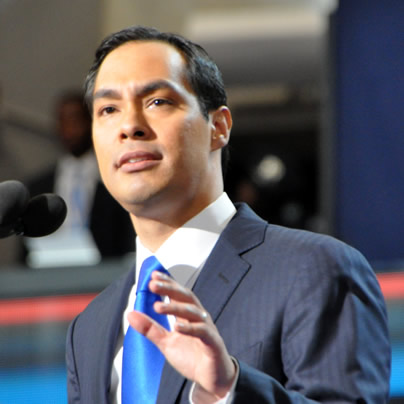
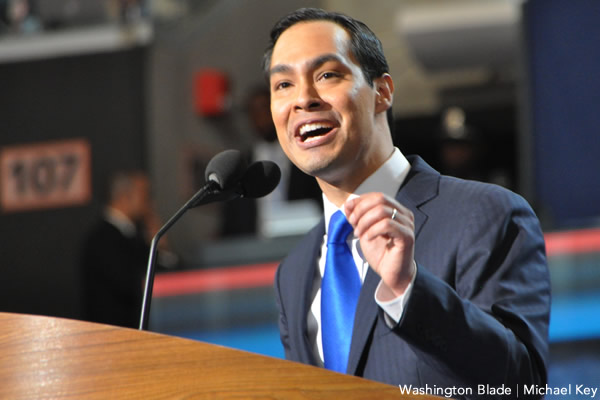
San Antonio Mayor Julian Castro dinged Mitt Romney at the Democratic National Convention for his opposition to marriage equality (Blade photo by Michael Key)
CHARLOTTE, N.C. — The first official day of the Democratic National Convention showcased the party’s solidarity with the LGBT community as speakers — including several openly gay Democrats — took to the podium to voice support and delegates approved for the first time a platform that endorses marriage equality.
Capping off the evening were high-profile speeches from San Antonio Mayor Julian Castro, who’s considered a rising star in the Democratic Party and possibly a contender for the next governor of Texas, and first lady Michelle Obama. Both mentioned LGBT rights in their speeches to attendees at the Time Warner Cable Arena.
Castro made a reference to marriage equality when reciting a list of issues supported by Democrats, but opposed by Republican presidential nominee Mitt Romney. The GOP candidate is against same-sex marriage and has endorsed a Federal Marriage Amendment.
“When it comes to getting the middle class back to work, Mitt Romney says, ‘No,'” Castro said. “When it comes to respecting women’s rights, Mitt Romney says, ‘No.’ When it comes to letting people marry whomever they love, Mitt Romney says, ‘No.'”
Castro continued that Romney also says “no” to expanding access to health care for all Americans, but noted Romney originally said “yes” to that — an allusion to the health care reform Romney helped pass into law as the Massachusetts governor. Castro added, “Gov. Romney has undergone an extreme makeover, and it ain’t pretty.”
The San Antonio mayor’s speech was a hit among attendees at the convention, who held up signs reading “Opportunity” and “Oportunidad” as he spoke.
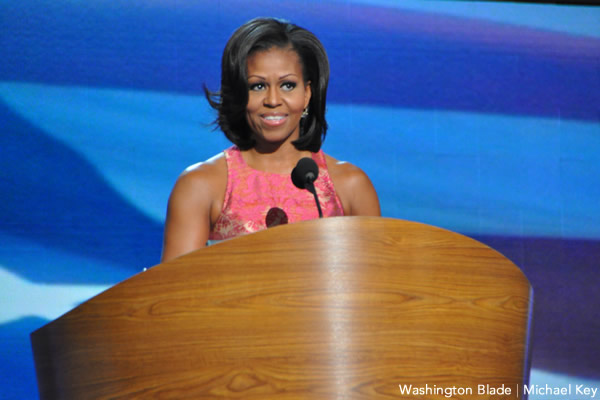
First Lady Michelle Obama (Blade photo by Michael Key)
Michelle Obama delivered a speech that was more personal, emphasizing her husband’s commitment to his family despite her concerns upon taking office about the sacrifices about what being president meant for their two daughters.
“But today, I have none of those worries from four years ago about whether Barack and I were doing what’s best for our girls,” Michelle Obama said. “Because today, I know from experience that if I truly want to leave a better world for my daughters, and all our sons and daughters … then we must work like never before, and we must once again come together and stand together for the man we can trust to keep moving this great country forward, my husband, our president, President Barack Obama.”
Michelle Obama also hit on her husband’s support for LGBT rights during her remarks when she spoke of his commitment to the people of diverse backgrounds, saying “Barack knows the American Dream because he’s lived it — and he wants everyone in this country to have that same opportunity, no matter who we are, or where we’re from, or what we look like, or who we love.”
The first lady’s speech was widely seen as successful. Attendees at the convention held up slim, vertical signs reading, “We love Michelle Obama” and cheered as she spoke.
Jerame Davis, executive director of the National Stonewall Democrats, noted Michelle Obama’s speech when talking about how Tuesday night at the Democratic convention strongly contrasted with “last week’s Republican hate-fest” in Tampa.
“First Lady Michelle Obama was inspirational and gave us a glimpse of the love she has for her family,” Davis said. “She is the heart and soul of the first family and that was on full display tonight.”
In a historic development, the 5,963 delegates to the convention approved a Democratic platform that for the first time includes a plank supporting marriage equality. Language in the platform also rejects the Defense of Marriage Act and affirms support for the Employment Non-Discrimination Act.
New Jersey Mayor Cory Booker, a co-chair of the platform committee, said prior to the final approval the manifesto embodies the principles of the Democratic Party, including the notion that individuals should be able to pursue the American dream regardless of, among other factors, whom they love.
“This platform of big and practical ideas sets forth an emboldened pathway toward the historic hope which has driven generations of Americans forward,” Booker said. “It is our most fundamental national aspiration—that no matter who you are, no matter what your color, creed, how you choose to pray or who you choose to love, that if you are an American — first generation or fifth — one who is willing to work hard, play by the rules and apply your God-given talents—that you should be able to find a job that pays the bills.”
Delegates approved the platform by a loud voice vote when Democratic National Committee Chair and Los Angeles Mayor Antonio Villaraigosa asked for “yays” and “nays” to accept the manifesto. No one was heard voicing objection to the platform when Villaraigosa asked for the “nays.”
In addition to the high-profile speeches at the end of the evening, at least four openly gay speakers were among those delivering remarks from the podium. Democratic National Committee Treasurer Andrew Tobias, Democratic National Convention Committee CEO Stephen Kerrigan and Service Employees International Union Mary Kay Henry and U.S. Rep. Jared Polis (D-Colo.) delivered remarks.
A primetime speaking slot was awarded to Polis, who is slated to become the most senior openly gay member in the lower chamber of Congress upon the start of next year after Reps. Barney Frank (D-Mass.) and Tammy Baldwin (D-Wis.) finish their final terms as U.S. House members.
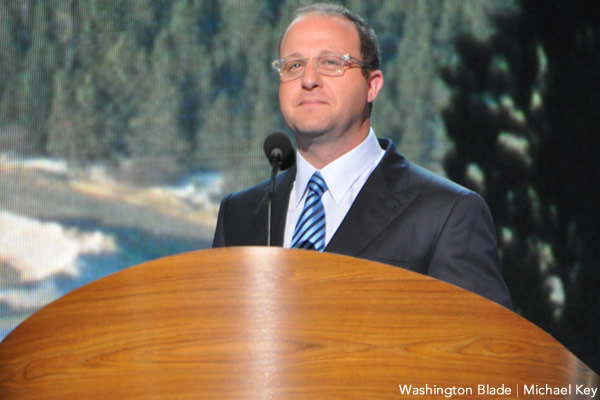
Rep. Jared Polis (D-Colo.) (Blade photo by Michael Key)
Polis wasn’t shy about talking about his sexual orientation during his speech. He declared he was gay among other things upon taking the stage, saying, “My name is Jared Polis. My great-grandparents were immigrants. I am Jewish. I am gay. I am a father. I am a son. I am an entrepreneur. I am a congressman from Colorado. I am always an optimist. But first and foremost, I am an American.”
The first openly gay parent to serve in Congress, Polis mentioned his partner, Marlon Reis, by name while emphasizing respect for diversity — for people who may identify as LGBT and others who hold views that are either conservative or progressive.
“So tonight, I don’t just ask my fellow Americans to respect my relationship with my partner Marlon and my role as a father to our son,” Polis said. “I also ask them to respect the Christian family concerned about decaying moral values and crass commercialism. I ask them to respect the difficult decision of a single mother to bring a child into this world, because of her heartfelt beliefs.”
Polis mentioned some of Obama’s pro-LGBT initiatives that he said demonstrates the president’s understanding that progress can only be achieved by working together.
“It is why he repealed ‘Don’t Ask, Don’t Tell,’ so that no person is prevented from serving the country they love because of whom they love,” Polis said. “And it is why Barack Obama became the first sitting president in American history to show his personal support for same-sex marriage.”
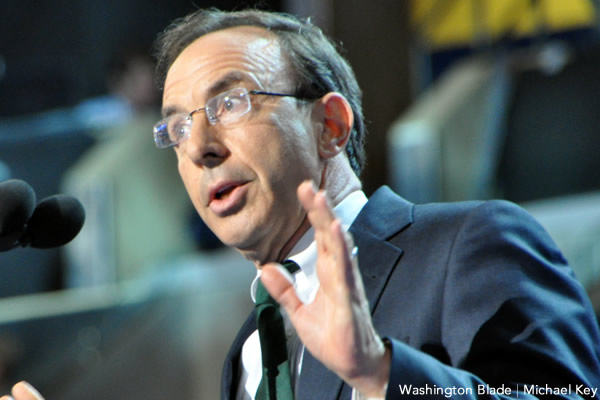
Democratic National Committee Treasurer Andrew Tobias (Blade photo by Michael Key)
Tobias, who spoke earlier in the day, said his speech marked the fourth time he’s addressed a Democratic National Convention and noted each time he’s made an address he talks about two things: money and equality.
Praising Obama for his work over his first term, Tobias said the administration has “dramatically improved” the lives of millions of LGBT Americans and “at no cost” to anyone else.
Tobias also offered a personal anecdote about being gay as a way to demonstrate the tremendous progress that has been made on LGBT rights in the past few decades.
“In college, I thought I was the only guy in the world who liked other guys,” Tobias said. “Later I found there was someone else like me, our 26-year-old resident tutor. He and I never talked about it at the time. No one talked about being gay back then. People killed themselves over being gay. Tragically, some kids still do.”
Tobias later revealed the identity of that resident tutor, saying he wed another man at a wedding just eight weeks ago, where love that was “unspeakable” nearly a half-century ago was celebrated “by hundreds of people — straight and gay, surfers and senators.”
“In a way, it was a wedding that married my two topics — money and equality — because that young tutor had grown up to become the chairman of the House Financial Services Committee: Barney Frank,” Tobias said.
Kerrigan, who was charged with managing the convention, made no explicit mention of his sexual orientation or LGBT issues during his speech and instead talked about the opportunities at the convention and access through digital media. Neither did SEIU’s Henry, who focused on labor issues while criticizing Romney, saying “Time after time, working families have paid the price for Mitt Romney’s success.”
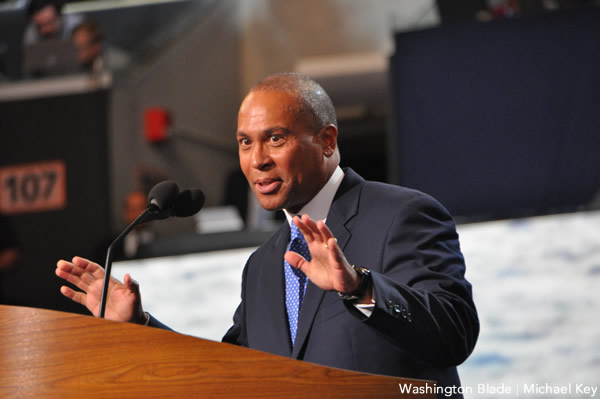
Gov. Deval Patrick (D-Mass.) (Blade photo by Michael Key)
Many other speakers throughout the evening also hit on LGBT rights as they praised President Obama. They include U.S. Senate candidate Tim Kaine, who said Obama kept his commitment to “fair treatment for LGBT Americans.” Recognition of Obama’s push to end “Don’t Ask, Don’t Tell” came in addition to Polis from Massachusetts Gov. Deval Patrick; platform committee co-chair and first woman to reach the rank of three-star general in the Army, retired Lt. Gen. Claudia Kennedy; U.S. House candidate Tammy Duckworth; Chicago Mayor Rahm Emanuel; Maya Soetoro-Ng, Obama’s sister; and actor and former White House official Kal Penn.
Richard Socarides, a gay delegate from New York City and former adviser to President Clinton on LGBT rights, said the developments at the convention added up to “a historic night” for the LGBT community and “a great night for our party.”
“Our platform plank was adopted plus every speaker seemed so proud to be the party of all America, including us,” Socarides said. “I thought — we are part of this party’s vision of America.”
The pro-LGBT developments came in stark contrast to last week’s Republican National Convention, when no openly speaker was at the podium and speakers advocated for traditional marriage. Delegates in Tampa also approved a platform limiting marriage to one man, one woman and endorsing a Federal Marriage Amendment.
Jimmy LaSalvia, executive director of the gay conservative group GOProud, nonetheless was dismissive of what happened on the first night of the Democratic convention.
“Nothing that they could put in the platform would do anything to cover up President Obama’s disastrous record on jobs and the economy,” LaSalvaia said. “All the openly gay speakers and wonderful feel-good platform language won’t change the fact that, just like everyone else in America, gay people aren’t any better off than they were four years ago.”
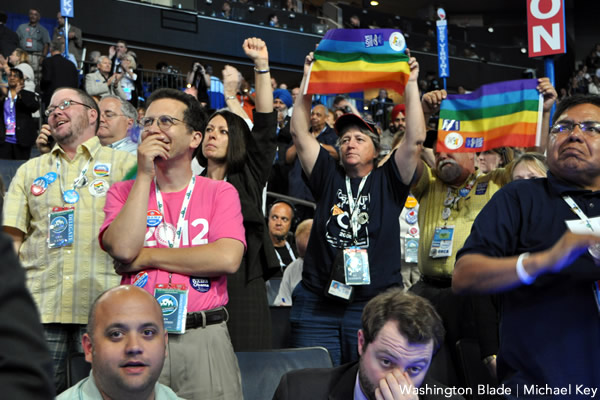
Democratic National Convention (Blade photo by Michael Key)


New York
N.Y. governor’s race presents stark contrast on LGBTQ rights
Democratic Gov. Kathy Hochul expected to face Republican Bruce Blakeman

As states across the country grapple with a rapidly changing federal landscape under President Donald Trump, governors have increasingly become the first line of defense — or enforcement — on issues ranging from healthcare and education to LGBTQ rights.
Nowhere is that more apparent than in New York, Trump’s home state, where the 2026 gubernatorial race is shaping up as a high-profile battle over the future of LGBTQ protections.
Incumbent Democratic Gov. Kathy Hochul is seeking a second full term as New York’s 57th governor and the state’s first female governor. She enters the race with strong support from LGBTQ advocates and organizations, including an endorsement from the Stonewall Democrats of New York City. Earlier this year, Hochul was also endorsed by progressive leaders like New York City Mayor Zohran Mamdani and U.S. Rep. Alexandria Ocasio-Cortez. She is running alongside New York City Council Speaker Adrienne Adams as her lieutenant governor candidate.
Throughout her tenure, Hochul has signed a series of measures aimed at strengthening protections for LGBTQ New Yorkers, particularly transgender residents.
Among the most notable is New York’s “Trans Safe Haven Act,” which protects out-of-state transyouth, their parents, and medical providers who travel to New York to access legally protected gender-affirming care. Hochul has also signed legislation requiring health insurance plans to cover HIV prevention medications, including PrEP and Post-Exposure Prophylaxis (PEP), without out-of-pocket costs.
Additionally, Hochul signed a Long-Term Care Bill of Rights that prohibits discrimination against LGBTQ seniors and people living with HIV in long-term care facilities.
“As the birthplace of the LGBTQ+ rights movement, New York has long been at the forefront of advancing equality,” Hochul said in a statement during Pride month. “During Pride month, we celebrate New York’s vibrant LGBTQ+ community and acknowledge the importance of protecting the rights and freedoms of LGBTQ+ New Yorkers. This month and every month, we proudly stand with the LGBTQ+ community and remain committed to building a more inclusive and equitable future for all where everyone can live freely with dignity, safety, and respect.”
On the Republican side, Nassau County Executive Bruce Blakeman has emerged as the party’s leading candidate. Blakeman is running with Madison County Sheriff Todd Hood as his lieutenant governor pick.
Blakeman, Nassau County’s 10th county executive, was first elected in 2021 after defeating Democratic incumbent Laura Curran. He previously served as a commissioner of the Port Authority of New York and New Jersey, a Nassau County legislator, and a Hempstead town councilman.
A longtime supporter of Trump, Blakeman appeared alongside the president during a 2024 event honoring slain NYPD Officer Jonathan Diller.
LGBTQ advocates have frequently criticized Blakeman for his positions on trans issues, particularly his opposition to trans women participating in women’s sports.
In February 2024, Blakeman signed an executive order barring women’s sports teams that include trans women from using Nassau County athletic facilities. The policy applies to youth, collegiate, and professional teams. Teams that include trans men were not affected. The order has since been halted by the New York State Appellate Division swiftly issued an injunction halting enforcement while the plaintiffs appeal the decision
Ahead of announcing the order, Blakeman repeatedly referred to trans women as “biological males” and argued they should compete on men’s or co-ed teams. LGBTQ rights groups condemned the policy, saying it discriminates against trans athletes and contributes to the marginalization of trans youth.
Trump endorsed Blakeman’s gubernatorial campaign in December 2025, shortly after U.S. Rep. Elise Stefanik (R-N.Y.) announced she would not seek the Republican nomination. The President made his endorsement via Truth Social that “Bruce is MAGA all the way, and has been with me from the very beginning.”
The Washington Blade contacted Blakeman’s campaign seeking comment on his LGBTQ policy priorities and views on issues including nondiscrimination protections, trans rights, and healthcare access. A response was not received by press time.
The race highlights two sharply different approaches to LGBTQ policy in a state widely regarded as the birthplace of the modern LGBTQ rights movement, home to the 1969 Stonewall uprising that helped launch the contemporary movement for LGBTQ equality.
Despite the ideological contrast, early polling suggests Hochul remains the clear favorite. Most public surveys show the incumbent holding a double-digit advantage over her potential Republican challengers, with some polls placing her lead at roughly 20 percentage points ahead of the November election.
Illinois
Obama Center opens with tributes to marriage equality, LGBTQ progress
19.3 acre campus honors 44th president’s legacy

The Barack Obama Presidential Center held media previews on Thursday ahead of its official Juneteenth opening, marking the debut of the first presidential center dedicated to the 44th and only Black U.S. president.
The 19.3-acre campus, located on Chicago’s South Side within historic Jackson Park, features a museum, garden, basketball court, and a new branch of the Chicago Public Library.
Multiple artifacts related to the LGBTQ rights movement appear in the presidential museum’s collection, though none appeared to be on display at the time of publication, according to the center’s website.
Among the objects in the collection are the pen Obama used to sign the repeal of the “Don’t Ask, Don’t Tell” policy that prohibited gay, lesbian, and bisexual individuals from serving openly in the military; a set of Harvey Milk commemorative stamps honoring the first openly gay elected official in San Francisco; and an Out2Enroll rainbow sweat wristband used to connect communities — specifically LGBTQ people and their families, friends, and allies — with health insurance coverage options available under the Affordable Care Act.
The artifacts reflect a broader LGBTQ legacy associated with the Obama presidency.
During the televised opening ceremony, former first lady Michelle Obama thanked her husband for “standing up for marriage equality.”
During his presidency, Obama took a number of actions affecting LGBTQ Americans, including repealing “Don’t Ask, Don’t Tell,” signing the Matthew Shepard Hate Crimes Act, directing the Justice Department to stop defending the Defense of Marriage Act in court, expanding federal benefits and leave to same-sex domestic partners of federal and Foreign Service employees, broadening Affordable Care Act coverage for LGBTQ health issues, including HIV/AIDS prevention and treatment, and signing a 2014 executive order prohibiting federal contractors from discriminating based on sexual orientation or gender identity.
The opening event drew numerous celebrities, including Stevie Wonder, Christina Aguilera, Oprah Winfrey, and Tom Hanks.
It also attracted political figures from both sides of the aisle. One notable exception was President Donald Trump, who was not invited to the ceremony. All other living former presidents were invited and attended.
The Obama Presidential Center will open to the public on June 19, with tickets available on its website.
Florida
Intersex teacher alleges Fla. school fired him over perceived trans identity
Shepard Scalf filed a complaint with Equal Employment Opportunity Commission

An intersex teacher in Florida who was fired is alleging in a new Equal Employment Opportunity Commission filing that he was terminated based on assumptions that he was transgender.
Shepard Scalf in the filing says he was assigned female at birth but identifies as male.
According to Monday’s filing with the EEOC, submitted on Scalf’s behalf by the American Civil Liberties Union, the American Civil Liberties Union of Florida, and the law firm of Chanfrau & Chanfrau P.L., the school district fired Scalf on the basis of his sex and the presumption that he is trans.
Scalf was hired for the 2025-2026 school year at Patriot Oaks Academy in the St. Johns County School District to teach language arts to 6th- and 7th-graders, after previously working in another Florida school district.
During the hiring process, Scalf submitted paperwork that disclosed he had been assigned female at birth. He was born with an intersex variation with XY chromosomes, and he lives as and presents as a man.
On Aug. 28, 2025, Patriot Oaks Academy Principal Drew Chiodo scheduled an emergency meeting with Scalf. The principal was directed to read a letter from the school district superintendent informing Scalf that he must either submit his resignation or be fired.
According to the ACLU, Scalf was provided with no legitimate reason for his termination and had not received any prior warnings or disciplinary actions. At the time of his termination, Chiodo told Scalf his work was “exemplary” and that Scalf had “met every expectation.”
“Receiving this ultimatum was confusing and overwhelming. Everything had been going so well — I couldn’t understand why this was happening,” Scalf said. “The start of a school year is always brimming with promise and excitement, and I was looking forward to continuing my teaching career at Patriot Oaks until I was cornered into resigning. It became clear to me that being fired had nothing to do with my qualifications or teaching — it was about who I am.”
According to the filing, Scalf received communications that the termination followed complaints from a parent about his gender identity. However, the filing also claims that his gender identity, sex assigned at birth, and intersex status were never mentioned in his classroom.
In a 2020 ruling, the U.S. Supreme Court in Bostock v. Clayton County found employment discrimination on the basis of actual or perceived sexual orientation or gender identity is a violation of Title VII of the Civil Rights Act of 1964.
The ACLU is claiming that under that ruling, Scalf’s rights under Title VII were violated.
“Six years ago, the Supreme Court held in Bostock v. Clayton County that employers cannot fire someone for being gay or transgender because doing so is discrimination because of sex,” said Shana Knizhnik, senior staff attorney with the ACLU’s LGBTQ & HIV Project, in a press release from the ACLU. “The same reasoning protects intersex people, who have long faced discrimination because their bodies and lives do not conform to narrow expectations about what a man or a woman is supposed to be. Mr. Scalf was an exemplary teacher, but despite his performance and qualifications, he was forced out of his job because he did not fit those expectations. As politicians and institutions increasingly seek to police sex and gender, intersex people are too often caught in the crossfire alongside transgender people — but federal civil rights law protects everyone from this kind of discrimination.”
Samantha Past, a staff attorney with the ACLU of Florida, stated in a press release that Florida’s public school system is increasingly hostile towards LGBTQ people.
“At a time when Florida’s public schools are increasingly targeted by disruptive state policies and in the midst of a teacher shortage crisis, St. Johns County School District chose to unlawfully oust a qualified and respected educator. Everyone deserves the opportunity to work and contribute to their community without fear of being targeted because of who they are. Mr. Scalf is no exception,” Past stated.
N.Y. governor’s race presents stark contrast on LGBTQ rights

Rehoboth’s ‘Poodle Beach’ to be honored with historical marker

McDuffie concedes to Lewis George in D.C.’s mayoral primary

Obama Center opens with tributes to marriage equality, LGBTQ progress

Intersex teacher alleges Fla. school fired him over perceived trans identity

PHOTOS: Lost River Pride

PHOTOS: Pride on the Pier

David Archuleta on Mormon faith, ‘Idol,’ more in new book

The advantages of owning your home