Local
D.C. cop convicted of assault with dangerous weapon in trans shooting case
Suspended officer acquitted on more serious charge of assault with intent to kill while armed
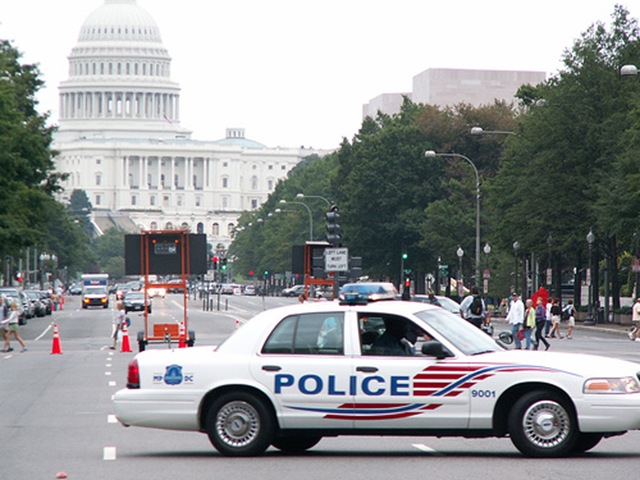
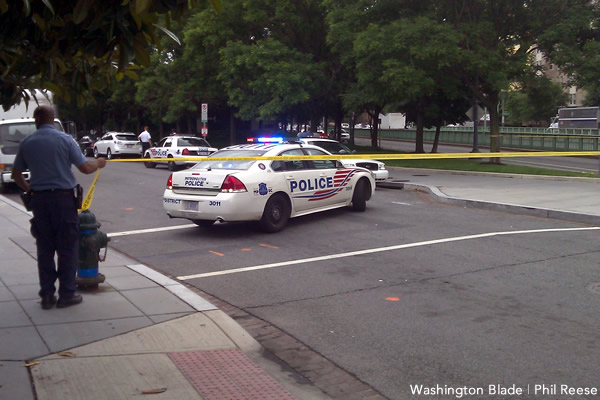
In a development likely to raise concern among LGBT activists, the jury found D.C. police officer Kenneth Furr not-guilty of all charges related to the firing of his gun through the windshield of a car with the five people inside. (Washington Blade photo by Phil Reese)
An off-duty D.C. police officer accused of firing his service revolver into a car occupied by three transgender women and two male friends in August 2011 was convicted Friday of assault with a dangerous weapon and solicitation for prostitution.
But a D.C. Superior Court jury also found Officer Kenneth Furr, 48, not guilty of six other charges, including the more serious offense of assault with intent to kill while armed.
In a development likely to raise concern among LGBT activists, the jury found Furr not-guilty of all charges related to the firing of his gun through the windshield of the car with the five people inside.
Although three of them suffered non-life-threatening bullet wounds and two weren’t hit, prosecutors said any of the five could have been killed.
“I really wonder what the jury heard and how they could decide not to find intent to kill,” said transgender activist Jeri Hughes. “You don’t fire a gun several times at people and not have intent to kill.”
“It sounds like the defense did a good job in demonizing the victims,” said Hughes, who was among many LGBT activists who viewed the incident as another in series of violent attacks against LGBT people in the city over the past several years.
Police and prosecutors said the incident started with a verbal dispute between Furr and one of the transgender women and her friends when Furr became angry and “aggressive” after the woman refused his offer of money for sex in the area of 5th and K St., N.W.
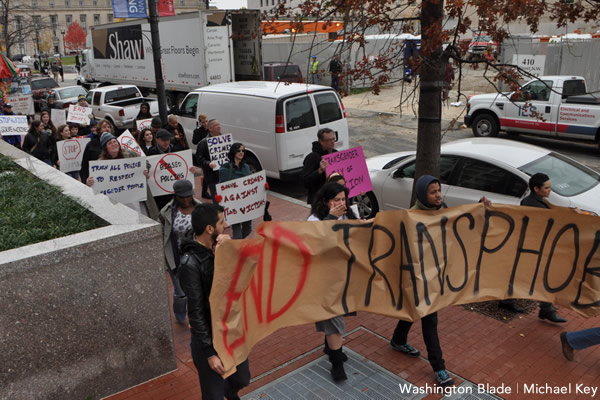
An increase in violence against trans individuals have prompted activists to become more visible. (Washington Blade file photo by Michael Key)
Superior Court Judge Russell Canan scheduled a sentencing hearing for Jan. 10, 2013. At the request of Furr’s attorneys, Canan released Furr into the court’s high intensity supervision program, which requires that he wear an electronic ankle bracelet and undergo alcohol and drug tests. He had been held in jail since the time of his arrest.
The verdict came after the jury deliberated for nearly nine hours over a two-day period and followed a five-day trial in which the defense disclosed information not previously made public that appears to have strengthened its claim that Furr acted in self-defense.
Assistant U.S. Attorney Lara Worm, the lead prosecutor, argued that Furr acted in a reckless manner and in anger by firing his gun into a car with five unarmed people inside.
A police arrest affidavit says the people in the car reported that Furr shouted, “You’re going to die” seconds before he began shooting. The affidavit says Furr had a blood alcohol level twice the legal limit at the time he was arrested. D.C. police charged him with driving while intoxicated, but that charge was later dropped.
“His actions that day were not okay for a police officer, a teacher or a construction worker,” the Washington Post quoted Worm as telling the jury in opening arguments.
Dispute unfolded prior to shooting
However, in a statement released after the verdict on Friday, the U.S. Attorney’s office acknowledged that the three transgender women and their two male friends chased after Furr in their car after the dispute between the two parties continued to unfold.
At one point, one of the men assaulted Furr, prompting Furr to flee in his car with the trans women and their male friends following him again, according to the U.S. Attorney’s statement.
Fearing for his life, Furr pulled out his gun and began to shoot after seeing the other car in hot pursuit, said David Knight, one of two Public Defender Service lawyers that represented Furr.
“He was alone, outnumbered and under attack,” the Post quoted Knight telling the jury. “He was threatened, assaulted and pursued by a car full of people who wanted to do him harm,” the Post quoted him as saying.
In its statement released after the verdict, the U.S. Attorney’s office said the incident began in the early morning hours of Aug. 26, 2011 when Furr, who was off duty, attempted to pick up transgender prostitutes in an area near 5th and K Streets, N.W., which has long been known as a hangout for transgender sex workers.
“His initial attempts to pick up one transgender woman were rejected by her,” the statement says. “He nonetheless followed her into a drug store at 400 Massachusetts Avenue. Once inside, he continued to solicit her in front of two of her acquaintances,” the statement says.
It says Furr got into a “verbal altercation” with one of the male acquaintances. The statement says a short time later Furr confronted the two acquaintances outside the store and, after more words were exchanged, reached into the glove compartment of his car and pulled out a semi-automatic pistol and pointed it at them.
“[T]his is the offense that led to the guilty verdict on the charge of assault with a dangerous weapon,” the U.S. Attorney’s statement says.
It says that about 20 minutes later three of the complainants from the incident at the drug store and two of their friends crossed paths with Furr in the area of 5th and K Streets, N.W.
“Furr once again was attempting to solicit a transgender prostitute,” the statement says. “The complainants pulled their car next to Furr’s, and at least one of the occupants in the complainants’ car assaulted Furr. Furr sped off and the complainants’ car followed.”
With the complainants following him, Furr drove to the intersection of First and Pierce Streets, N.W., parked his car and began firing his gun at the complainants’ car, the statement says.
“The driver of the victims’ car ducked and hit the accelerator, crashing into the side of Furr’s vehicle,” it says. “Furr then jumped on the hood of the occupied vehicle and continued shooting, firing a total of five rounds. Three of the occupants of the car suffered injuries.”
According to court records and a police report, D.C. police officers who had been on patrol in the area heard the shots being fired and rushed to the scene and placed Furr under arrest.
Furr was held in jail from the time of his arrest to the day of the verdict in his trial, when Canan agreed to release him into the high intensity supervision program while he awaits his Jan. 10 sentencing.
He faces a possible maximum sentence of ten years in prison on the assault with a dangerous weapon charge and up to 90 days on the prostitution charge.
A police spokesperson said Furr has been on indefinite unpaid leave since shortly after his arrest.
On March 7 of this year, a D.C. Superior court grand jury handed down a 9-count indictment against Furr, which included six counts of assault with a dangerous weapon, one count of assault with intent to kill while armed, and two counts of solicitation for prostitution.
At the conclusion of the trial but prior to the case going to the jury, Canan agreed to a defense motion to have the second prostitution charge dismissed, according to court records.
Court records show that the jury acquitted Furr on five counts of assault with a dangerous weapon and one count of assault with intent to kill while armed.
Defense attorney raises issue of victims’ criminal records, conflicting statements
At least two of the five victims were subjected to intense questioning from defense attorney Knight, who pointed to discrepancies between their trial testimony and testimony before the grand jury.
Chloe Alexander Moore, one of the transgender women involved in the case, testified that Furr solicited her for sex for money at the 5th and K Street, N.W. location and inside a CVS drug store nearby. In response to questioning by Knight, she acknowledged that she failed to tell the grand jury that one of her male friends assaulted Furr on the night of the incident prior to the shooting, according to the Washington Post.
Knight also brought up a solicitation charge pending against her in D.C. and asked if prosecutors in the Furr case promised her special consideration in her pending case if she cooperated by testifying against Furr.
“Of course,” the Post quoted her as saying. “Who wouldn’t want a case dropped for something you weren’t guilty of,” the Post quoted her as saying.
John Brand, one of the two male friends in the car with the three transgender women at the time of the shooting, testified that he was drunk at the time of the incident and could not remember whether he assaulted Furr.
Asked by Knight whether it is possible that he did commit the assault, Brand said, “Yes.”
Knight also asked Brand about his own past criminal record, which includes arrests for marijuana possession and distribution and an illegal gun possession charge.
Observers of criminal trials say it’s a common practice for defense attorneys to raise questions about the credibility of prosecution witnesses. It’s the job of prosecutors to remind jurors that a prior criminal record doesn’t mean a witness’s credibility should be automatically discarded, court observers have said.
Jeffrey Light, an attorney for the D.C. Trans Coalition who attended part of the trial, couldn’t immediately be reached for comment.
“This verdict does not seem unreasonable to me, especially considering the credibility issues of the government’s witnesses and the obvious strong self-defense component to the case,” said D.C. area attorney Dale Edwin Sanders.
“No one would have been injured if the victims had not chased down Furr in their vehicle after first assaulting him in an altercation in which apparently Furr did not respond aggressively…and left the scene,” said Sanders in speculating on how jurors may have viewed the incident.



Maryland
Md. Commission on LGBTQIA+ Affairs released updated student recommendations
LGBTQ students report higher rates of bullying, suicide
The Maryland Commission on LGBTQIA+ Affairs has released updated recommendations on how the state’s schools can support LGBTQ students.
The updated 16-page document outlines eight “actionable recommendations” for Maryland schools, supplemented with data and links to additional resources. The recommendations are:
- Developing and passing a uniform statewide and comprehensive policy aimed at protecting “transgender, nonbinary, and gender expansive students” against discrimination. The recommendation lists minimum requirements for the policy to address: name, pronoun usage, and restroom access.
- Requiring all educators to receive training about the specific needs of LGBTQ students, by trained facilitators. The training’s “core competencies” include instruction on terminology, data, and support for students.
- Implementing LGBTQ-inclusive curricula and preventing book bans. The report highlights a “comprehensive sexual education curriculum” as specifically important in the overall education curriculum. It also states the curriculum will “provide all students with life-saving information about how to protect themselves and others in sexual and romantic situations.”
- Establishing Gender Sexuality Alliances “at all schools and in all grade levels.” This recommendation includes measures on how to adequately establish effective GSAs, such as campaign advertising, and official state resources that outline how to establish and maintain a GSA.
- Providing resources to students’ family members and supporters. This recommendation proposes partnering with local education agencies to provide “culturally responsive, LGBTQIA+ affirming family engagement initiatives.”
- Collecting statewide data on LGBTQ youth. The data on Maryland’s LGBTQ youth population is sparse and non-exhaustive, and this recommendation seeks to collect information to inform policy and programming across the state for LGBTQ youth.
- Hiring a full-time team at the Maryland Department of Education that focuses on LGBTQ student achievement. These employees would have specific duties that include “advising on local and state, and federal policy” as well as developing the LGBTQ curriculum, and organizing the data and family resources.
- Promoting and ensuring awareness of the 2024 guidelines to support LGBTQ students.
The commission has 21 members, with elections every year, and open volunteer positions. It was created in 2021 and amended in 2023 to add more members.
The Governor’s Office of Communication says the commission’s goal is “to serve LGBTQIA+ Marylanders by galvanizing community voices, researching and addressing challenges, and advocating for policies to advance equity and inclusion.”
The commission is tasked with coming up with yearly recommendations. This year’s aim “to ensure that every child can learn in a safe, inclusive, and supportive environment.”
The Human Rights Campaign’s most recent report on LGBTQ youth revealed that 46.1 percent of LGBTQ youth felt unsafe in some school settings. Those numbers are higher for transgender students, with 54.9 percent of them saying they feel unsafe in school.
Maryland’s High School Youth Risk Behavior Survey reveals a disparity in mental health issues and concerns among students who identify as LGBTQ, compared to those who are heterosexual. LGBTQ students report higher rates of bullying, feelings of hopelessness, and suicidal thoughts. Nearly 36 percent of LGBTQ students report they have a suicide plan, and 26.7 percent of respondents say they have attempted to die by suicide.
The commission’s recommendations seek to combat the mental health crisis among the state’s LGBTQ students. They are also a call for local and state governments to work towards implementing them.
Virginia
Va. lawmakers consider partial restoration of Ryan White funds
State Department of Health in 2025 cut $20 million from Part B program
The Virginia General Assembly is considering the partial restoration of HIV funding that the state’s Department of Health cut last year.
The Department of Health in 2025 cut $20 million — or 67 percent of total funding — from the Ryan White Part B program.
The funding cuts started with the Trump-Vance administration passing budget cuts to federal HIV screening and protection programs. Rebate issues between the Virginia Department of Health and the company that provides HIV medications began.
Advocates say the funding cuts have disproportionately impacted lower-income people.
The Ryan White HIV/AIDS Program, a federal program started in 1990, provides medical services, public education, and essential services. Part B offers 21 services, seven of which remained funded after the budget cuts.
Equality Virginia notes “in 2025, a 67 percent reduction severely destabilized HIV services across the commonwealth.”
Virginia lawmakers have approved two bills — House Bill 30 and Senate Bill 30 — that would partially restore the funding. The Ryan White cuts remain a concern among community members.
Both chambers of the General Assembly must review their proposed changes before lawmakers can adopt the bills.
“While these amendments aren’t a full restoration of what community-based organizations lost, this marks a critical step toward stabilizing care for thousands of Virginians living with HIV,” said Equality Virginia Executive Director Narissa Rahaman. “Equality Virginia plans to continue their contact with lawmakers and delegates through the conference and up until the passing of the budget.”
“We appreciate lawmakers from both sides of the aisle who recognized the urgency of this moment and will work to ensure funding remains in the final version signed by the governor,” added Rahaman.
District of Columbia
D.C. Black Pride theme, performers announced at ‘Speakeasy’
Durand Bernarr to headline 2026 programming
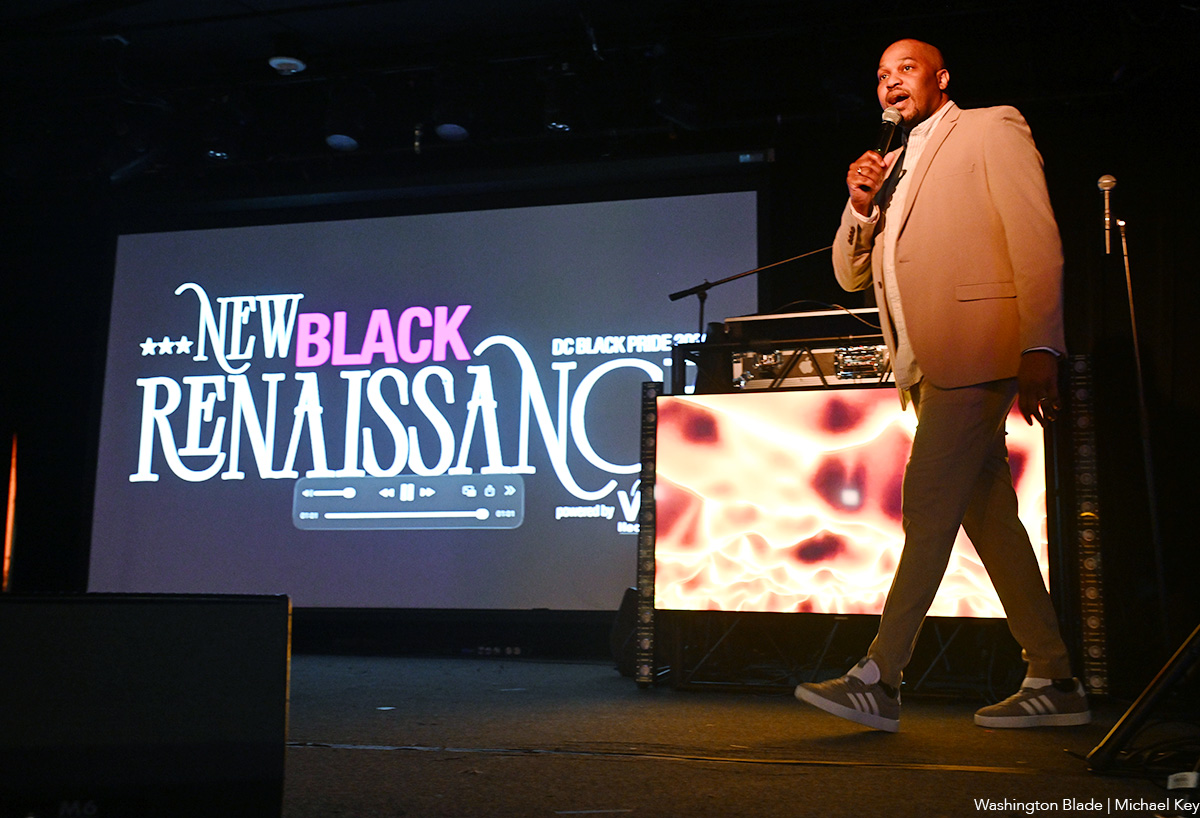
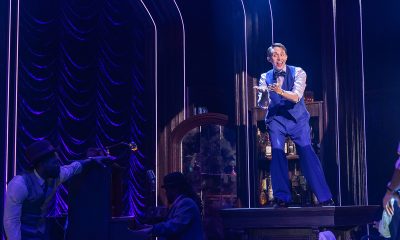
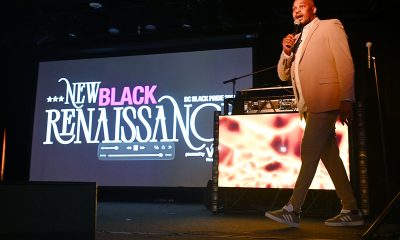
The Center for Black Equity held its 2026 DC Black Pride Theme Reveal event at Union Stage on Monday. The evening, a “Speakeasy Happy Hour,” was hosted by Anthony Oakes and featured performances by Lolita Leopard and Keith Angelo. The Center for Black Equity organizes DC Black Pride.
Kenya Hutton, Center for Black Equity president and CEO, spoke following the performances by Leopard and Angelo. Hutton announced this year’s theme for DC Black Pride: “New Black Renaissance.”
Performers for 2026 DC Black Pride were announced to be Bang Garcon, Be Steadwell, Jay Columbus, Bennu Byrd, Rue Pratt and Akeem Woods.
Singer-songwriter Durand Bernarr was announced as the headliner for the 2026 festivities. Bernerr gave brief remarks through a video played on the screen at the stage.
DC Black Pride is scheduled for May 22-25. For more information on DC Black Pride, visit dcblackpride.org.

Talarico beats Crockett in Texas primary

35 years after ‘Truth or Dare,’ Slam is still dancing

Md. Commission on LGBTQIA+ Affairs released updated student recommendations

Va. lawmakers consider partial restoration of Ryan White funds