
Arts & Entertainment
‘Smart Ass’ does Blade
Popular trivia night at Nellie’s hosts Blade edition Wednesday


Nellie’s Sports Bar (Washington Blade photo by Michael Key)
Washington Blade sponsors one of the DC Pub Trivia circuit’s most popular events, Smart Ass Trivia Night at Nellie’s Sports Bar (900 U St., NW) with two games at 8 and 9 p.m. on Wednesday night.
The trivia night involves teams competing against each other to win money off their bar tab and other prizes. The game involves a warm-up round, a theme round, a speed round and wipe out round. Each round comes with its own rules. For this week, the Blade will be providing special prizes and some of the questions will be based on facts about the Blade. The traditional first prize is $40 off the team’s bar tab, second place is $20 off and third place is $10 off.
No cover. For more information, visit smartassdc.com.





Movies
Epic ‘La bola negra’ delivers powerful romance for the ages
The must-see queer film of the year

It’s rare for a film reviewer to feel as if they’re being gifted – by the accidental fortune of being alive in a particular time and present in a particular place – the opportunity to see a future cinema classic before it becomes one.
I’ve certainly had the experience of seeing such movies; I’ve been around long enough to see a few of them embraced as classics as years went by, but I didn’t foresee it at the time. I may have had a feeling about a few of them, and occasionally I might even have been right, but never have I known, as I watched it, that it would become one.
Never, that is, until seeing “La bola negra.”
It’s not as if I went into it expecting it to be anything less than excellent. After its glowing premiere at Cannes in May, where it took the festival’s “Best Director” prize for Javier Ambrossi and Javier Calvo (known collaboratively as “Los Javis”), the buzz began to spread; it won further accolades throughout the festival circuit, the major studios had a bidding war over its American release rights, it became the third and by the time fall arrived there were already people in the cinematic web-osphere floating the possibility that it could win Oscars. Even so, I have learned from experience to be wary of “buzz,” and I approached the film with a touch of reserved skepticism.
I dropped that pose only a few minutes into the opening sequence. Immersed in a visceral experience of the Spanish Civil War and forced to confront the cold absurdities of war itself, I had no space available for such intellectual baggage. Instead, I found myself drawn – almost without noticing it – into a multi-generational saga constructed like a puzzle, expressed with passion and style, and executed with the kind of grandeur that conjures comparisons to some of cinema’s greatest epics.
Inspired – and haunted – by an unfinished play from queer Spanish poet, playwright, theater artist, surrealist, and revolutionary Federico García Lorca, it tells a sweeping story that transverses three timelines – 1932, 1937, and 2017 – to intertwine the lives of three queer men into a fictional exploration of queer experience and its omission (or erasure) from history, where it can often be gleaned only through the hidden implications of secret lives that ended long ago.
In one of them, the young scion of a wealthy family (Milo Quifes) is “black-balled” (hence the title) from membership to a prestigious social club, rejected over rumors of his homosexuality, and is forced to choose between denying his own identity or leaving his family in disgrace for a life of free expression in the theater. In the second, Sebastián, a young Nationalist soldier (Guitarricadelafuente) falls in love with Rafael, a wounded Republican prisoner (Miguel Bernardeau) he has been assigned to guard, awakened to his own homosexual desires in an impossible scenario where the notion of a “happy ending” is all but unimaginable. In the third, a disillusioned queer historian (Carlos González) is informed of an inheritance from his estranged grandfather, leading him to discover a link in his family’s past that has been obscured by secrets, trauma, and resentment. In each of them, a grounded humanism becomes the connecting thread, and it’s impossible not to feel the pull of emotional resonance as the connections grow increasingly clear. Throughout these interwoven narratives, we confront the inevitable recognition that the history of queer experience is something that must be unearthed, whether in honor of the lives of those who came before us or in celebration of having survived in spite of it all.
Ambrossi and Calvo – along with Alberto Conejero, with whom they co-wrote the screenplay, expanding his play “La piedra oscura” into a larger narrative that merges it with the surviving fragments of Lorca’s to create an imaginative work of speculative fiction – accomplish an inventive feat of cinema, building something that feels almost mystical in scope from a conceit built on the real-life historical mysteries surrounding Lorca’s death (he was reportedly assassinated by Nationalist forces in 1936 but his body was never found) and expanded into an unforgettable epic romance that confronts the monstrosities of fascist oppression and the madness of warfare while celebrating the resilience of queer truth that, somehow, manages to exist “between the lines” and transcend the horror and tragedy that surround it. Combining a flowing, florid, and fantastical sensibility with an unvarnished realism that refuses to soften its sting for the sake of emotional comfort, one might almost call it “bittersweet” if that term were not inadequate to encompass the symphonic heights toward which it successfully aspires in its stubborn belief in the long-reaching arm of redemption.
They also create a visually stunning masterpiece of cinematic art, blending the harsh realities of life under the turmoil of militarily-enforced oppression with the elegant poetry of resilience to build a film that invites favorable comparison to the most beloved epic films in our history, from the expansive-but-intimate humanity of “Lawrence of Arabia” (also, by the way, a story of queer experience) to the surreal darkness of “Apocalypse Now,” with cinematographer Gris Jordana delivering a movie that feels “vintage” yet distinguishes itself as a distinctly modern – and anti-nostalgic – reinvention of stylistic imagery, filling its margins with echoes of the past while remaining firmly rooted in a contemporary mindset that continually reminds us of a heritage, both artistic and sociological, that exists as a sort of generational lifeline constructed from imagery, association, and emotional wisdom.
Naturally, the ensemble cast provides a crucial element in making it all work. As the film’s romantic center, Guitarricadelafuente (an actor/musician who rose to Spanish fame by self-posting videos during Covid) and Bernardeau are heartbreakingly tender and infinitely relatable to any queer person who has ever had to navigate the difficulties of attraction in a circumstance of enforced distance, and Quifes captures the kind of fatalistic self-determination that has probably fueled queer rebellion since it first became “a thing.” Spanish superstar Penelope Cruz lends invaluable support as a” cupletista” performer who introduces Sebastián to the underground world of campy queer performance, and González delivers the perfect mix of resigned cynicism and reluctant hope as the modern historian, while Glenn Close provides stolid gravitas as an expert on Garcia Lorca who guides him toward a final revelation.
It’s worth mentioning that a handful of critics have been put off by the film’s romanticism, complained about its ”melodramatic” emotions, or quibbled about its historical re-imagination of Lorca and his legacy to brand it as disingenuous. Respectfully, I disagree. By the end of this remarkable film, I, as a queer man, felt not only as if I had been “seen” and acknowledged, but as if my own life was somehow part of its story.
I’m willing to wager that millions of other queer moviegoers will feel the same way, so I’m calling “La bola negra” the must-see queer film of the year – and yes, I could be wrong (I have been so many times before), but I’m fairly certain that you, like me, will recognize an instant classic when you see one.
Theater
Out actor on his 25-year love affair with ‘Mamma Mia’
Victor Wallace plays Sam in National Theatre production

‘Mamma Mia!’
Through Nov. 15
National Theatre
1321 Pennsylvania Ave., N.W.
tickets start at $59
broadwayatthenational.com
For nearly 25 years, out actor Victor Wallace has been a big part of “Mamma Mia!”
A staple wherever hit shows are performed, the high energy juke box musical is based on songs recorded by Swedish mega-pop group ABBA. The romantic tale unfolds on an idyllic Greek Island where young bride-to-be Sophie is holding her wedding. Secretly, she’s invited a trio of men from her mother’s past, hoping that one of the three will prove to be her undetermined biological father.
Wallace came to the show as Sky, Sophie’s good-looking groom, in Las Vegas as part of the highly regarded Mandalay Bay production. Not many years later, Wallace embarked on playing an older “Mamma Mia!” character – the appealing yet regretful Sam Carmichael, a successful architect and divorced father of two (and possibly Sophie’s dad) — in numerous tours and stints on Broadway.
And now, he’s brought Sam to D.C.’s National Theatre (through Nov. 15), attracting many theatergoers eager for a repeat experience, and for some, their first time.
“I’m always surprised to learn that there are ‘Mamma Mia!” virgins out there,” says Wallace, 53. “Maybe that’s because of the show’s success, or because it’s been a part of my life for so long.”
While not touring, the handsome lyric baritone is based in his native Wisconsin. “It doesn’t make sense to keep an apartment in New York when you’re always on the road,” he says.
WASHINGTON BLADE: Frequently actors, especially those in long running shows, are asked “how do you keep it fresh?” Well, how do you?
VICTOR WALLACE: For me, I really do like ABBA’s music. I’m the type of person who can put a song on repeat for hours on end. That helps a lot. And it doesn’t hurt that “Mamma Mia!” is a fun show.
BLADE: During a break from “Mamma Mia!” you spent two weeks at Coachella Valley Repertory, playing Bruce, the closeted family man and predator in “Fun Home.” Not a warm and fuzzy guy.
WALLACE: That was different, a darker place for sure, but a great part for an actor. I don’t bring the heaviness home, I can leave that onstage, but I don’t know about doing that for months on end.
BLADE: How is it you made a quick transition from Sky to Sam in “Mamma Mia!”
WALLACE: It was all about timing. At 29, I was cast as Sky a little late, and at 34, I was a young Sam. I powdered my hair, and now I’m trying to cover the gray.
I’ve played Sam for almost 20 years. Naturally, my perspective has changed. In the beginning, I couldn’t imagine having a 20-year-old but now it’s easier.
BLADE: Were some other tours squeezed in over the years?
WALLACE: Yes, “Les Miz” and “Phantom.” I like the big ones. They’re great for my 401K.
BLADE: But it’s mostly been “Mamma Mia!” Were you always a fan?
WALLACE: Ever since I first heard ABBA on the car radio when I was a kid. For me, “Winner Takes It All” was an instant favorite. I’ve always gravitated toward the ballads.
As Sam, I sing “SOS,” “Loving Me Loving You,” and the lesser known “Our Last Summer.”
BLADE: Do you have any thoughts on the show’s staying power?
WALLACE: The movie franchise has helped. So has the gay following with “Dancing Queen” and ABBA nights at gay bars. The film “Muriel’s Wedding” [the titular lead played by Toni Collette was obsessed with ABBA] gave it a good push.
BLADE: What about “Mamma Mia!” is especially appealing to queer audiences?
WALLACE: In addition to the great music and dancing, I think it’s the themes of friendship and chosen family. While pretty universal, I feel these strike a real chord with queer theatergoers.
BLADE: Aside from your charm and talent, why do the producers keep asking you back?
WALLACE: When you’re dependable, solid, and consistent you build a reputation. But I will say this, I had to reach out to be a part of the 25th anniversary after the pandemic. And that was after I’d closed the Broadway show as Sam at the Broadhurst. I put my ego aside and sent in a reel. Sometimes you have to be the squeaky wheel.
BLADE: Eight shows a week, year after year, it must be a lot.
WALLACE: Sure, some days are harder than others. When your mindset is a little off, your body knows what to do. It’s about getting through those two hours and 40 minutes, and you’re good.
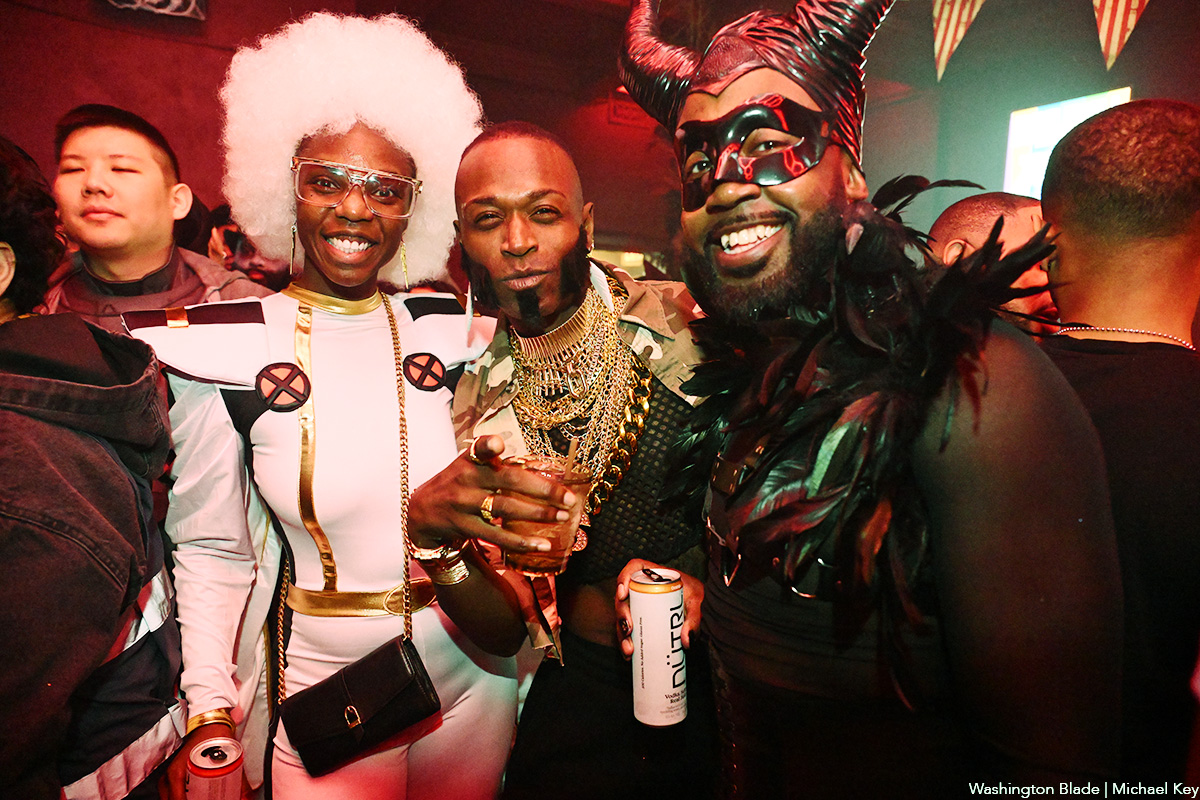
Crush Dance Bar (2007 14th Street, N.W.) was packed on Saturday night for a Halloween costume contest.
(Washington Blade photos by Michael Key)


Epic ‘La bola negra’ delivers powerful romance for the ages

Out actor on his 25-year love affair with ‘Mamma Mia’

Comings & Goings

Stephen Miller, key architect of anti-LGBTQ policies, named White House chief of staff

Escritora trans venezolana reivindica una fe sin exclusiones ante la visita del papa a Sudamérica

Sarah McBride returns to Congress after historic first term

Chris Pappas elected to U.S. Senate

Marriage equality codified in Va. constitution

Mark Warner re-elected to U.S. Senate

Democrats projected to win Senate majority, opening door to LGBTQ legislation
-

 2026 Midterm Elections5 days ago
Sarah McBride returns to Congress after historic first term
-
2026 Midterm Elections5 days ago
Chris Pappas elected to U.S. Senate
-
2026 Midterm Elections5 days ago
Marriage equality codified in Va. constitution
-

 2026 Midterm Elections5 days ago
Mark Warner re-elected to U.S. Senate