
Living
Equality Forum starts next week in Philly
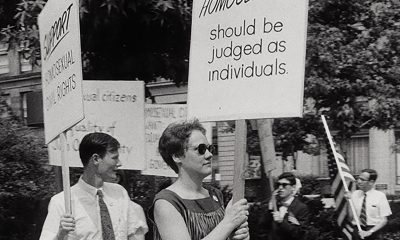
University of the Arts event seeks to advance national and international LGBT civil rights


(Image via YouTube)
The Equality Forum 2013 kicks off in Philadelphia Thursday at 7 p.m. with the National Religious Colloquy at the University of the Arts (211 South Broad St.).
The forum is part of the group’s goal to advance national and international LGBT civil rights through education. The weekend includes several panel discussions along with dinners and parties in the evening. The panels discuss several subjects including LGBT Youth Advocacy and surrogacy for prospective LGBT parents.
Most events are free. For more information, visit equalityforum.com.





Advice
Help, I’m trapped in a sexless marriage
The closer you are, the less comfortable it can feel to be frankly sexual

Dear Michael,
I’m in a sexless marriage.
My husband hasn’t been interested in sex in a long time. It’s not something he has wanted to work on. He says he just isn’t that interested.
I love him a lot. At first I pushed him to address it. There were no physical causes, he said (doctor checked testosterone). He just wasn’t interested. It didn’t matter that I wanted to have sex. He was OK with me having sex with other people.
I tried that and I didn’t like it a bit. To me the most important part of sex is that I actually love the person I am with. Sex with someone I didn’t know felt meaningless and empty to me. I felt disgusted, and disgusting, when I would hook up.
I didn’t want to leave my husband, I loved him and wanted to spend my life with him. So I accepted the situation. I wasn’t going to beg.
After a while I stopped missing sex. I (like him) am getting older.
I hear disparaging remarks from friends and the community at large about people who “settle” for relationships without sex. That they’re “just roommates.” This is hurtful to me. We are deeply committed life partners.
But sometimes I wonder, did I settle? Should I, as a gay man, be unwilling to have a sex-free life? If it’s OK with me, am I even really a gay man?
Michael replies:
Even if you are fine with the status quo, I’d suggest a few actions to take. Not because I want to push you to resurrect your sex life, but because there may be something going on that could improve your lives if addressed.
Visit your physician (as your husband evidently already has). Look into possible side effects of any medications either of you are on. Consider if there could be an undiagnosed or untreated mood disorder, such as depression, contributing to low desire (not to mention general unhappiness in life).
Another lens through which to look at your situation: The closer two people are, the less comfortable it can feel to be frankly sexual with each other.
For one thing, the more your partner means to you, the more you may fear rejection if you reveal sexual feelings and desires that might upset or even shock your partner. For another, as couples get closer over time, sex may start to feel like too much closeness, and avoiding sex may be a way to create some space. Simply put, too much emotional closeness can be a desire killer.
If these points resonate with you and your husband, my recommendation is that you find a couples therapist to work with, who has good grasp of desire issues.
All that said: If you are fine with your relationship as it is, then your job is to hold onto your own positive beliefs about yourself and your relationship. Please don’t let anyone — other gay men, close friends, whomever — shame you, or pressure you into behaving in ways that you yourself do not respect.
Being gay is a sexual and affectional orientation. You and your husband love each other and want to be spending your lives together. If that is “enough” for the two of you, then, great! There is no problem. A lot of people (and organizations, and movements) want to tell others how they should think, feel, act, and live. Guess what? You don’t have to listen to any of them.
Coming out takes a lot of work and a lot of courage. You do it because you want to live an honest and genuine life, respecting who you are. You, and you alone get to decide what is right for you. Hold steadfast to that. It isn’t easy to maintain self-respect when others around you question or demean aspects of your life, but if you know what is best for you, that is your challenge.
Michael Radkowsky, Psy.D. is a licensed psychologist who works with couples and individuals in D.C., Maryland, Virginia, New York, and all PSYPACT states. He can be found online at michaelradkowsky.com. All identifying information has been changed for reasons of confidentiality. Have a question? Send it to [email protected].
Real Estate
Clients will confide almost anything in a real estate agent
Helping buyers feel the vibes and overcome the noise

Buying a home isn’t just a financial decision. As they say, if a person makes one change, the dominoes start to fall in other areas of life. One may end up with new neighbors and stop seeing the old ones. Someone may become besties with their real estate agent (at least for a few months). There was a meme going around that an agent marked himself as “in a relationship” with his client because they had been looking for a place for so many months. While meant as a joke, it’s not completely wrong. For a period of a few months, a client and their agent may be chatting every week. In some instances, even daily.
One phenomenon I noticed in my career as an agent and even when working side hustles as a bartender and as a rideshare driver – is that people would confide in me things they often wouldn’t even tell some of their best friends. The word “agent” literally has its root in the word “agency” – meaning, to act on one’s own behalf, to side with themselves, to support their own interests. As an agent, my job was to do those things for my client. To cheer them on, to help them act on their own behalf. To side with them. Or at least to remind them to do that for themselves. Occasionally they would confide in me that a family member or an influential person in their life, such as a parent, was trying to get involved in more of the decision making than they were comfortable with. Or that all their friends wanted them to live in “X” neighborhood, but that they really were leaning toward looking in “Y” neighborhood.
My experiences as a bartender and a rideshare driver were not unlike being the priest in a confessional, to be honest. “In vino veritas” or maybe “In the back seat veritas” – the anonymity that they may never see me again, so why not spill their whole life story? Sometimes I think they just needed to tell someone what was on their mind and were trying to figure out their next move in a confusing situation.
While working as an agent, I was helping people with one of the biggest decisions in their lives: Where are they going to park hundreds of thousands of dollars, as well as live? Each person spends a huge percentage of their life in the home. The home is for decorating, personalizing, studying, working, socializing, living with pets, dreaming, laughing, crying and hitting the “reset button” when the world becomes too much. It’s only normal that on occasion the conversation turned to what made a client feel safe, feel comfortable, joyful, or not. People literally get a “vibe” off the homes they step in, the people they are around, and the places they work. Those vibes can be good, or the vibes can be bad.
I often just stood back and let my clients gather a vibe. Sometimes they would walk in the front door, get to the front living room or dining room, and stop. They would say, “this is it.” Or they would get three steps in the door and say, “Nope. Not it. Let’s go. I don’t even want to go upstairs.”
What is the point of this article? I guess it’s about vibes and listening to oneself. There is a lot of noise out there in the world. If one spends five minutes on Instagram, they will see at least 15 posts with “5 Things you NEED TO KNOW about Walk in Closets and James Talarico.” “Top Ten Reasons You Should Build your House out of Protein!” “16 ways you can clean out your colon AND your closets in the same day!”
Often, I found, as an agent, the best I could do was to help a client hear their own voice over all the noise. After all, it’s their money, and their house. And it’s their decision. And often the vibes that one is picking up from a house, or a situation can say a lot, if we listen to them. Some people may call them “vibes” and others may call it “intuition”; either way, they can often guide someone to the next step.
Joseph Hudson is a referral agent with RLAH. Reach him at 703-587-0597 or [email protected].
Real Estate
The gayborhood is changing. Are we?
Some say we priced ourselves out of our former safe enclaves

There was a time when moving to Dupont Circle wasn’t just a real estate decision. It was practically a declaration of independence.
You weren’t simply choosing an apartment. You were choosing a life. One where you could hold someone’s hand on the sidewalk, flirt badly at a bar, or walk into a room without first figuring out who was safe to be yourself around.
For many of us, the gayborhood wasn’t just where we lived. It was where we finally exhaled.
And now? Well, that same one-bedroom might cost more than your parents’ first house. The gay bar is a boutique fitness studio, the bookstore is long gone, and the guy who once organized protests now has very strong opinions about his condo association.
Progress is complicated.
But here’s a question worth asking: Did we outgrow our gayborhoods, or did we make them so desirable that we priced ourselves out?
Probably a little of both.
Washington’s LGBTQ+ geography has been shifting for decades. Dupont Circle was once the undisputed center of gay D.C. Logan Circle, Shaw, and eventually neighborhoods farther north and east became part of an expanding map of queer life.
Today, you’ll find LGBTQ+ couples planting gardens in Brookland, restoring old houses in Petworth, raising families in Takoma, dining in Mount Rainier, and hosting spectacularly opinionated “The Traitors” watch parties in Hyattsville.
And isn’t that what we wanted?
We fought for the freedom to live openly, to marry, to build families, to own homes together, and to exist in places where being gay wasn’t the first, last, and only thing anyone knew about us.
In many ways, we won something extraordinary: the freedom to choose.
But freedom and affordability aren’t the same thing.
The neighborhoods LGBTQ+ people helped make vibrant, interesting, and culturally significant have become some of the most expensive places to live. The artists, activists, bartenders, drag performers, and young people who gave those neighborhoods their pulse aren’t necessarily the ones benefiting from rising property values.
There’s a particularly bitter irony in watching a neighborhood celebrate its queer history while becoming financially inaccessible to the next generation of queer people.
A rainbow crosswalk is lovely. It doesn’t help you make the mortgage.
And yet, we shouldn’t confuse change with loss. Not entirely.
As real estate agents—and as two men who’ve built a life together in this region—we get a front-row seat to what home means to people. And what we hear isn’t always about square footage, interest rates, or whether the kitchen has enough counter space for an espresso machine nobody knows how to use.
People want to belong.
They want neighbors who notice when they haven’t been around. A porch where friends can gather. A street where their family, whatever shape that family takes, is simply another family on the block.
For LGBTQ+ buyers, those things can carry an extra layer of meaning. Some of us grew up believing that the life we have today wasn’t even possible. A house with our partner’s name on the deed. A wedding photograph on the mantel. A neighborhood where nobody asks which one of us is the husband.
Well, technically, we’re both the husband. That’s rather the point.
But here’s where we think the conversation gets interesting.
Maybe the future of the gayborhood isn’t a specific collection of streets. Maybe it’s a set of values we carry into the places we choose to call home.
The willingness to welcome the outsider. To defend the neighbor who is different. To make room for the person who hasn’t yet found their people or their place.
Because the magic of the old gayborhood was never really the bars or the rainbow flags. Those were the visible parts. The real magic was that people looked out for one another, often when nobody else would.
And we shouldn’t romanticize that history too much, either. Those neighborhoods weren’t equally welcoming or affordable to everyone. Race, gender, and money shaped who got to belong then, just as they do now.
So perhaps the question isn’t whether Dupont Circle will ever be what it once was. It won’t. Cities change. People change. Even our favorite dive bars eventually discover artisanal cocktails.
The better question is whether we’re taking the best parts of what we built and bringing them with us.
Because if we move into beautiful homes, watch our property values rise, and forget to hold the door open for the next generation, what exactly have we accomplished?
We spent decades fighting for the right to live wherever we wanted. Now we have to make sure we’re not the last ones who can afford to.
The gayborhood may be changing.
The responsibility to make people feel at home shouldn’t.
Randy LiVorsi and Daren Phillips are with the 2 Rivers Team at Compass. Learn more at 2riversteam.com.

Out actor on his 25-year love affair with ‘Mamma Mia’

Comings & Goings

Stephen Miller, key architect of anti-LGBTQ policies, named White House chief of staff

Escritora trans venezolana reivindica una fe sin exclusiones ante la visita del papa a Sudamérica

Baltimore lawmaker’s ex-treasurer charged with theft of $87K in campaign cash

Meet the talented makeup artist behind Broadway’s ‘Rocky Horror’

Sarah McBride returns to Congress after historic first term

Chris Pappas elected to U.S. Senate

Election watch parties to take place throughout DMV

Supreme Court weighs religious exemptions to LGBTQ nondiscrimination protections in Colo. preschool case
-

 a&e features4 days ago
Meet the talented makeup artist behind Broadway’s ‘Rocky Horror’
-
2026 Midterm Elections4 days ago
Sarah McBride returns to Congress after historic first term
-
2026 Midterm Elections4 days ago
Chris Pappas elected to U.S. Senate
-
Local4 days ago
Election watch parties to take place throughout DMV