Local
Washington Post publishes pro-Russia supplement
Oct. 9 insert lacked references to LGBT rights record
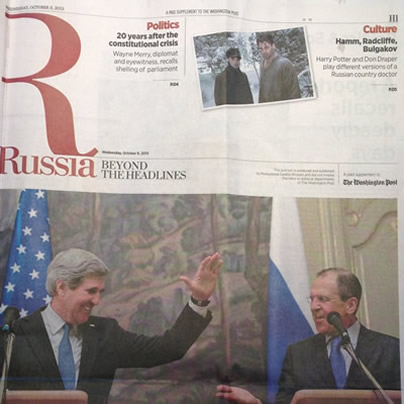
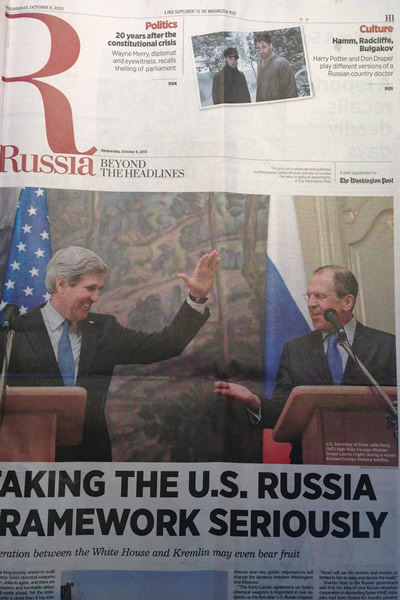
The Washington Post on October 9 ran a paid supplement from a Kremlin-backed Russian newspaper.
The Washington Post’s Oct. 9 print edition included a paid supplement produced by a Kremlin-backed newspaper that lacked any references to the ongoing controversy over Russia’s LGBT rights record.
Rossiyskaya Gazetá produced the insert – Russia Beyond the Headlines – that contained, among other things, an op-ed from Jeffrey Mankoff of the Center for Strategic and International Studies in D.C. He cited portions of the speech that Russian President Vladimir Putin delivered during a meeting of the Valdai International Discussion Club, a Russian think tank, that took place last month.
“Discussing his own view of Russian identity, Putin criticized the West for abandoning its Christian roots and ‘placing on the same level families with many children and single-sex partnerships, belief in God and belief in Satan,’” Putin said, according to Mankoff. “This cultural relativity, according to Putin, is ‘a direct path to degradation and primitivization, to a deep demographic and ethical crisis.’”
The Oct. 9 supplement is not the first time the Washington Post has published a Russia-specific insert.
The newspaper first published a Russia-themed supplement – Russia Now – in 2007.
Russia Beyond the Headlines said in a press release last month it decided earlier this year to redesign and revamp the supplement. It reappeared under the aforementioned name in the Washington Post’s Sept. 11 issue with a lead story that focused on the controversy surrounding the Russian law that bans gay propaganda to minors.
The article quoted Lyudmila Alexeyeva of the Moscow Helsinki Group, an organization that monitors human rights in Russia, as describing the statute that Putin signed in June as “a step toward the Middle Ages.” The Sept. 11 supplement reported Kirill Kobrin of Radio Free Europe’s Russia Service said he feels “it was unthinkable to even discuss these issues 20 years ago in Russia.”
“Under the Kremlin’s lead, LGBT rights are the focus of public attention and debate in Russia – albeit censored debate,” the Russia Beyond the Headlines article reads.
The New York Times on Sept. 18 published an eight-page Russia Beyond the Headlines supplement that contained articles about the gay propaganda law and coming out in the country. Putin reiterated his opposition to air strikes in Syria in an op-ed that ran in the newspaper less than a week earlier.
Ketchum PR, a public relations firm that represents Putin, placed it in the New York Times. Pro Publica reported the New York-based company received more than $1.9 million in fees and expense reimbursements from the Russian government from December 2012 through May.
The New York Times included another Russia supplement in its Oct. 16 print edition that contained an article on the arrest of 30 Greenpeace members last month who tried to board a Russian oil platform. The insert also contained a reference to the LGBT advocates who protested Russia’s gay rights record during the Metropolitan Opera’s opening night gala in New York last month.
Washington Post spokesperson Jennifer Lee declined to tell the Washington Blade how much the Russia Beyond the Headlines insert cost, but she confirmed it was a paid supplement and the advertiser provided the content. It contained a disclosure on the front page that said “it did not involve the news or editorial departments of the Washington Post.”
The top margin of each subsequent page contained a disclosure that stated the insert was “a paid supplement to the Washington Post.”
Observers and even journalists themselves have questioned the way Russian media outlets have covered the gay propaganda law, Russia’s LGBT rights record and the controversy surrounding it.
Gay American journalist Jamie Kirchick on Aug. 21 challenged Russia’s LGBT rights record during an interview with the Kremlin-backed television network RT on the sentencing of former U.S. Army private Chelsea Manning to 35 years in prison for leaking classified documents to Wikileaks.
“Being here on a Kremlin-funded propaganda network I’m going to wear my gay pride suspenders and I’m going to speak out against the horrific anti-gay legislation that Vladimir Putin has signed into law, that passed unanimously by the Russian Duma that criminalizes homosexual propaganda,” Kirchick told anchor Yulia Shapovalova. “It effectively makes it illegal to talk about homosexuality in public. We’ve seen a spate of violent attacks on gay people in Russia.”
RT aired a segment on calls to boycott the 2014 Winter Olympics in Sochi, Russia, in response to the country’s LGBT rights record less than two weeks before Kirchick appeared on the network to discuss Manning. The journalist further criticized Shapovalova and her colleagues before RT took him off the air.
Anton Krasovsky, the former editor-in-chief of the pro-Kremlin Kontr TV, said the television station fired him in January after he came out as gay during a segment on the gay propaganda law.
The Washington Post in recent weeks has published a number of stories on the controversy over Russia’s LGBT rights record and how it threatens to overshadow the Sochi games. These include a Sept. 26 article on the International Olympic Committee’s position that it has no authority to challenge the gay propaganda law and Alex Ovechkin of the Washington Capitals’ response to a question about it during the lighting of the Olympic torch in Greece late last month.
Amazon.com founder Jeff Bezos, who bought the Washington Post in August and contributed $2.5 million to a group that backed a successful 2012 ballot measure that secured marriage rights for same-sex couples in Washington State, did not return the Blade’s request for comment.
Kelly McBride of the Poynter Institute, a media ethics watchdog, told the Blade that paid supplements and advertorials have become common in newspapers. She noted the Washington Post’s use of different fonts throughout the Russia Beyond the Headlines supplement is “common practice” and “is amazingly effective at cueing regular readers to advertising content.”
“Combined with the disclosures, it looks to me the [Washington Post] is within the standard practice of the industry,” McBride said.



District of Columbia
Blade contributor, husband exchange vows in D.C.
Yariel Valdés and Kevin Vega held ceremony at Jefferson Memorial on March 23

Washington Blade contributor Yariel Valdés and his husband, Kevin Vega, exchanged vows at the Jefferson Memorial on March 23.
The couple married in Fort Lauderdale, Fla., on Nov. 24, 2025. The Jefferson Memorial ceremony — which Blade International News Editor Michael K. Lavers and Samy Nemir Olivares officiated — coincided with the third anniversary of Yariel and Kevin’s first date.
Yariel in 2019 asked for asylum in the U.S. because of the persecution he suffered as a journalist in his native Cuba. He spent nearly a year in U.S. Immigration and Customs Enforcement custody before his release on March 4, 2020.
Yariel wrote a series of articles about his time in ICE custody that the Blade published. The series was nominated for a GLAAD Media Award in 2022.
Yariel and Kevin live in South Florida.
District of Columbia
‘Out for McDuffie’ event held at D.C. gay bar
Mayoral candidate cites record of longtime support for LGBTQ rights
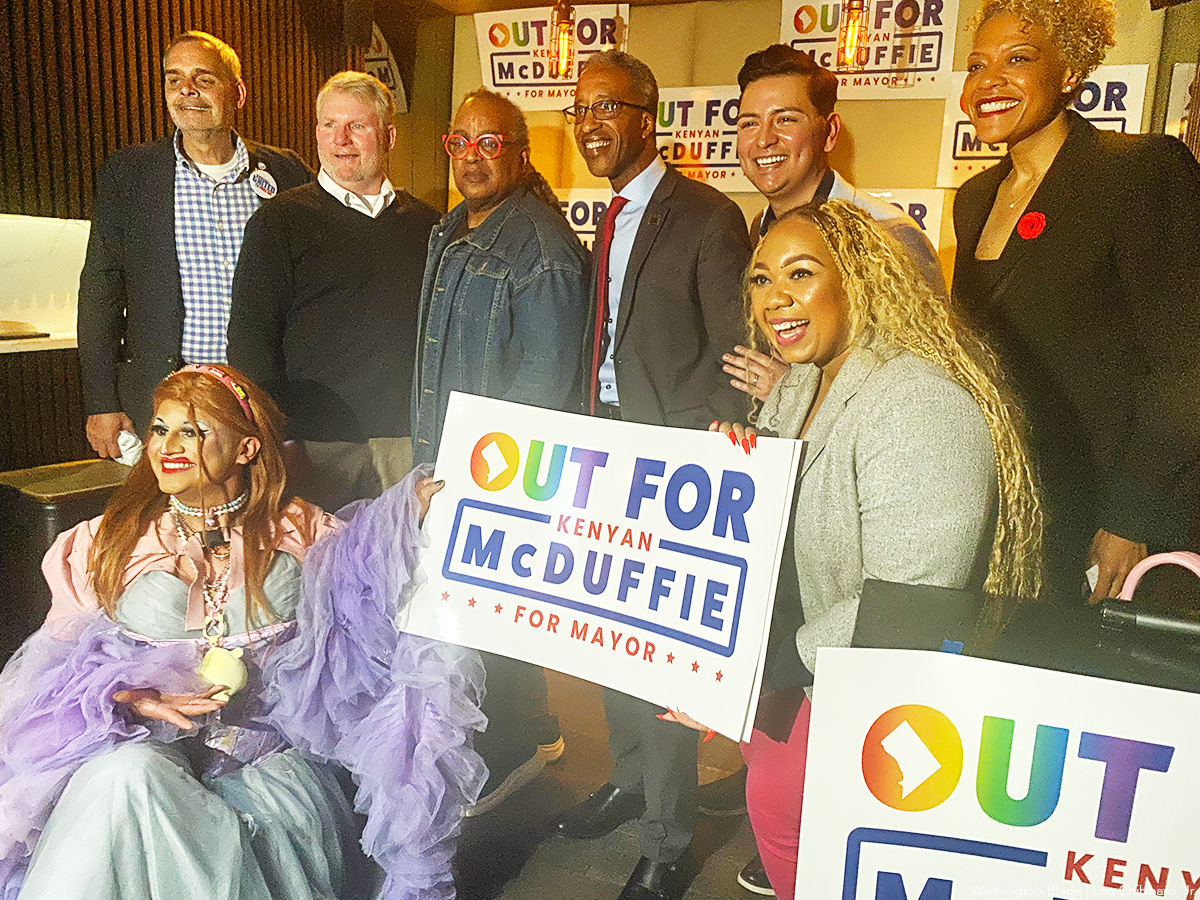
More than 100 people filled the upstairs room of the D.C. gay bar Number 9 on Thursday night, March 26, to listen to D.C. mayoral candidate Kenyan McDuffie at an event promoted as an “Out for McDuffie” meet and greet session.
Several local LGBTQ activists who attended the event said they support McDuffie, a former D.C. Council member, in his run for mayor while others said they had not yet decided whom to vote for in the June 16 D.C. Democratic primary election.
As of March 27, eight other Democrats were competing against McDuffy in the June 16 primary, including D.C. Council member Janeese Lewis George (D-Ward 4), considered McDuffie’s lead opponent. Lewis George also has a record of strong support on LGBTQ issues.
Most political observers consider McDuffie and Lewis George the two lead candidates in the race, with the others having far less name recognition.
The two lead organizers of the Out for McDuffie event were LGBTQ rights advocates Courtney Snowden, a former D.C. deputy mayor in the administration of Mayor Muriel Bowser, and Cesar Toledo, a local LGBTQ youth housing services advocate.
“I’m a candidate for mayor of Washington, D.C. and I’m running for mayor because I love this city,” McDuffie told the gathering after being introduced by Snowden. “And now more than ever we need leadership to take us to the future,” he said, adding that he and his administration would “stand up and fight” against President Donald Trump’s efforts to intervene in local D.C. affairs.
“Our strength is in the 700,000 beautifully diverse residents of Washington, D.C.” he told the gathering. “And as Courtney said, I didn’t just show up and run for mayor and then start saying that I’m going to be an ally for the queer community, for the LGBTQ+ community,” he said, “I’ve lived my entire professional life fighting for justice and fighting for fairness.”
Following his speech, McDuffie told the Washington Blade, “We’re going to fight to protect our LGBTQ+ community every single day. That’s what I’ve spent my career doing, making sure we have a beautifully diverse and inclusive city.”
He remained at Number 9, located at 1435 P St., N.W., for nearly an hour after he spoke, chatting with attendees.
District of Columbia
‘No Kings’ protests set for D.C.
Anti-Trump demonstrations to take place across country on Saturday

As President Donald Trump and his administration escalate rhetoric targeting transgender youth and student athletes, push efforts to restrict voting access for millions of Americans, and pursue foreign policy decisions that critics say bypass congressional authority, organizers across the country are once again mobilizing in protest.
For many LGBTQ advocates, the moment feels especially urgent.
In recent months, activists have pointed to a surge in anti-trans legislation, attacks on gender-affirming care, and efforts to roll back nondiscrimination protections as direct threats to the safety and visibility of queer and trans communities. Organizers say the demonstrations are not just about policy, but about defending the right of LGBTQ people — particularly trans youth and people of color — to live openly and safely.
Thousands of “No Kings” protests are planned nationwide, with multiple demonstrations set to take place in D.C.
One of the primary events, “No Kings Washington,” will be held in Anacostia, an overwhelmingly Black area of D.C. that is often at the center of conversations around racial justice, policing, and access to resources in the nation’s capital.
The protest in Anacostia is focused on what organizers describe as the “power behind the throne,” specifically Stephen Miller, the White House Deputy Chief of Staff for Policy and Homeland Security Advisor. Miller has been closely associated with the administration’s “zero tolerance” immigration policy, including the family separation practice that resulted in thousands of children being separated from their parents at the Southern border.
Activists have also linked immigration enforcement policies to broader concerns about LGBTQ migrants, including queer asylum seekers who often face heightened risks of violence and discrimination both in their home countries and within detention systems.
Anacostia protest details:
Participants are asked to gather starting at 1:30 p.m. on the southeast side of the Frederick Douglass Bridge. The closest Metro station is Anacostia on the Green Line, about an 8-minute walk from the starting point. Organizers strongly encourage attendees to use public transportation, as street parking is limited.
The march will proceed past Fort McNair and conclude near the Waterfront Metro station.
D.C. icon and LGBTQ activist Rayceen Pendarvis is set to speak at the protest around 2 p.m.
Kalorama protest details:
A separate protest will take place earlier in the day in Kalorama, a neighborhood long associated with political power and home to presidents, cabinet officials, and foreign ambassadors. Demonstrators are expected to gather at 10 a.m., with a march running until approximately noon near the intersection of Connecticut Avenue and Kalorama Road.
Arlington/National Mall protest details:
Another group is expected to assemble at Memorial Circle near Arlington National Cemetery at 10 a.m. before crossing the Memorial Bridge into D.C., passing the Lincoln Memorial and continuing on to the Washington Monument. Organizers say the march is intended to defend “American democracy, the rule of law, and a healthy planet.”
Unlike last June — when organizers discouraged large-scale demonstrations in D.C. due Trump’s military/birthday parade — activists are now explicitly calling on people to show up in the nation’s capital and surrounding areas.
The protests also coincide with Transgender Day of Visibility weekend, which includes additional gatherings and celebrations on the National Mall. At the same time, peak bloom for the National Cherry Blossom Festival is expected to draw large crowds to the city. With multiple major events happening simultaneously, officials and organizers anticipate significant congestion, increased traffic, and crowded public transit throughout the weekend.
Organizers are urging participants to plan ahead and come prepared.
“Bring your signs, noisemakers, music, and creative ideas, and gather in joyful, nonviolent protest,” they said. “Children are very welcome.”
For more information, visit nokings.org.

Blade contributor, husband exchange vows in D.C.

Ghanaian president welcomed to Philadelphia amid backlash over anti-LGBTQ bill

PHOTOS: ‘No Kings’ rally and march

‘Out for McDuffie’ event held at D.C. gay bar

‘Jonah’ an undeniably compelling but unusual memory play

Pa. House passes bill to codify marriage equality in state law

DeSantis signs emergency bill that restores Fla. ADAP funding

Introducing the Torchbearers Awards honoring queer, trans women and nonbinary people

New IOC policy bans trans women from Olympics

A surtax would end this war quickly
-

 Pennsylvania4 days ago
Pa. House passes bill to codify marriage equality in state law
-
Florida5 days ago
DeSantis signs emergency bill that restores Fla. ADAP funding
-
a&e features4 days ago
Introducing the Torchbearers Awards honoring queer, trans women and nonbinary people
-
Sports4 days ago
New IOC policy bans trans women from Olympics