News
Sciortino loses bid for Congress
Gay lawmaker married partner last week

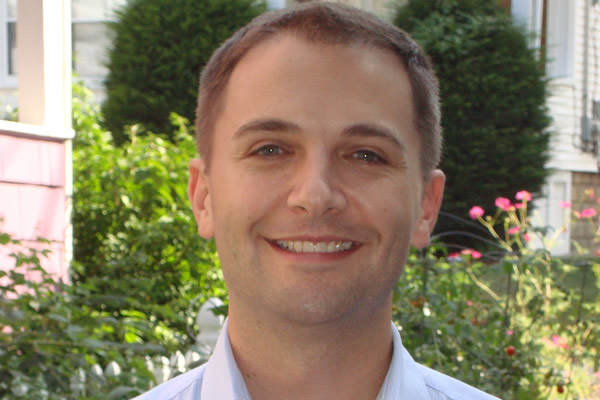
Gay Massachusetts State Rep. Carl Sciortino lost his bid to represent Massachusetts in Congress. (Photo by Seth Rau)
A gay congressional candidate lost his bid on Tuesday to claim the Democratic nomination to represent Massachusetts in the U.S. House.
Massachusetts State Rep. Carl Sciortino, who was running to fill the seat Sen. Ed Markey (D-Mass.) vacated in Massachusetts’ 5th congressional district, came in third in a crowded Democratic primary contest.
In a message via Twitter, Sciortino congratulated State Sen. Katherine Clark on her victory in addition to thanking the team that helped his campaign.
Congratulations to @KClarkCongress. A huge thank you to my awesome campaign team and all of my wonderful supporters #ma5
— Carl Sciortino (@carlsciortino) October 16, 2013
According to a tally from the Associated Press, Clark came in first with 32 percent of the vote, followed by Middlesex County Sheriff Peter Koutoujian with 22 percent of the vote, then Sciortino with 16 percent. Clark is favored in the general election in the heavily Democratic district.
Endorsed by the Human Rights Campaign and the Gay & Lesbian Victory Fund, Sciortino emphasized his progressive values in his bid for Congress. A web campaign video of him “coming out” as a progressive to his Tea Party father went viral and garnered national attention for his campaign.
As a state lawmaker, Sciortino is credited with helping beat back a state constitutional amendment banning same-sex marriage in Massachusetts and guiding a transgender civil rights law toward passage.
Last week, Sciortino married his partner of more than five years, Pem Brown, in a ceremony in Boston at the Old South Meeting House, where people came to celebrate in 2003 following the Massachusetts Supreme Court ruling in favor of same-sex marriage.
Marc Solomon, national campaign director for Freedom to Marry, praised Sciortino’s campaign.
“Carl had a strong showing in a race that was an uphill battle from the get-go,” Solomon said. “Even though he didn’t win, he inspired people all across the state and the country with his passion for liberal ideals and his decency and goodness. He has a great future in front of him as a leader advancing equality for the LGBT community and justice for us all.”
It’s possible that Clark’s victory could open a new opportunity for Sciortino. As Daily Kos pointed out, the district he represents in the state House, which consists of parts of Malden and Medford, lies within the district she represents in the state Senate. Sciortino could seek to run for the office she’s vacating. His campaign didn’t immediately respond to a request for comment on his future plans.



National
HRC report: LGBTQ students face ‘far greater challenges’ in non-supportive states
Survey finds anti-LGBTQ school harassment, bullying highest in 17 states
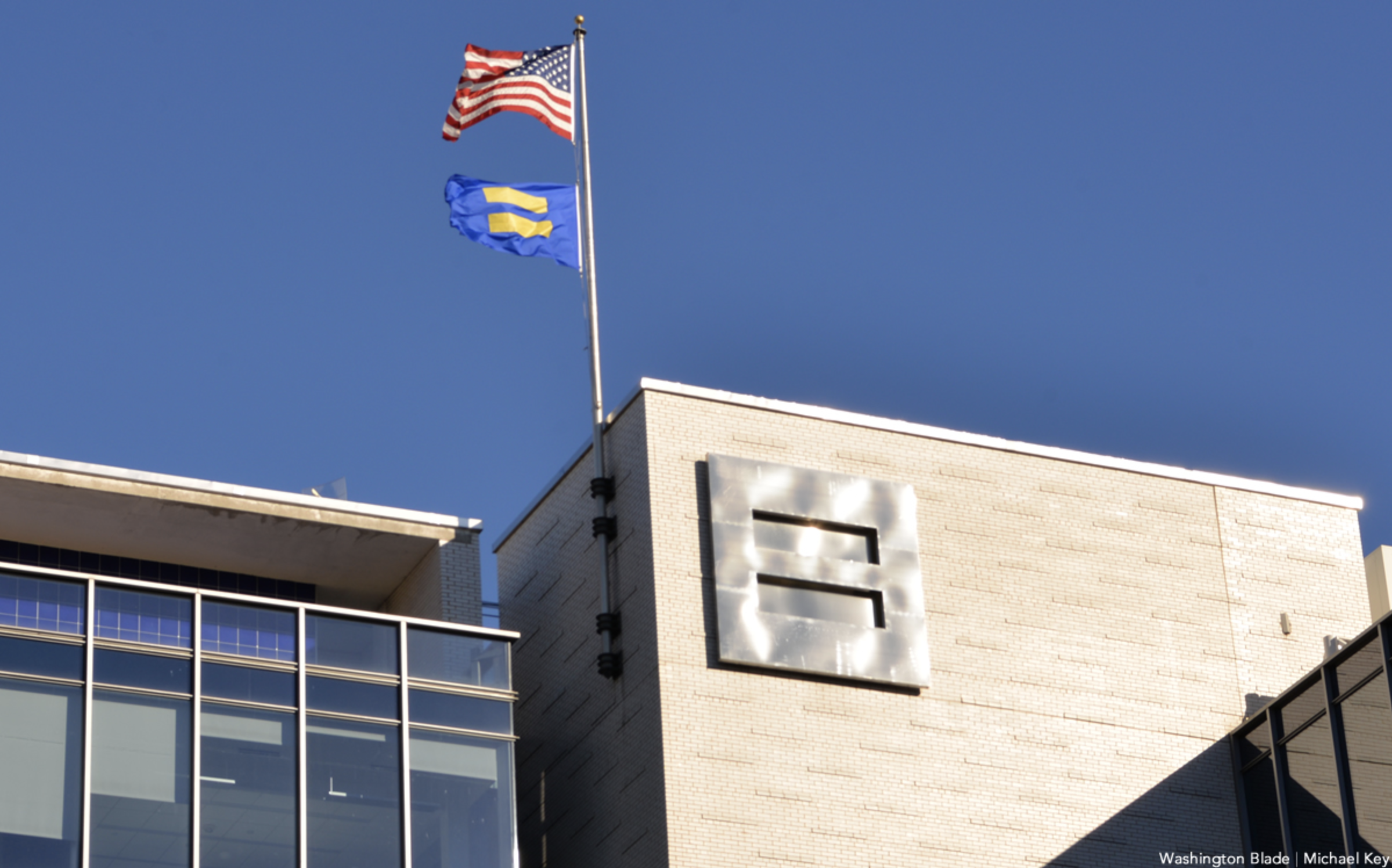
The Human Rights Campaign Foundation, the educational arm of the national LGBTQ advocacy organization Human Rights Campaign, has released a report showing LGBTQ public school students are more likely to face bullying, harassment, and “other barriers” in states that have less overall supportive LGBTQ laws and policies.
The report is based on the HRC Foundation’s National Educator Survey of School Climate and Bullying, which was released on Sept. 17.
“The report finds that harassment, bullying, and other barriers to LGBTQ+ inclusion are more prevalent in states with limiting policies, where educators report widespread restrictions on LGBTQ+ resources, visible expressions of support, and assistance for transgender students,” a statement released by HRC says.
“As just one example,” the statement adds, “while 59 percent of educators in states with limiting policies report restrictions on supporting their transgender students, just 6 percent to 8 percent of educators in states with supportive policies report the same, underscoring the impact of these policies on school climate, student well-being, and the stakes of the upcoming midterm elections for LGBTQ+ youth and inclusive classrooms.”
The report says the survey consisted of responses by 826 educators in 42 states who worked as teachers, principals, counselors, administrators, and others who worked in support services. All worked at schools with students from pre-kindergarten to 12th grade, most being public schools and a smaller number being charter schools, the report says.
It says the survey was conducted between April 15 and May 21, 2026, and included a survey questionnaire with about 55 questions covering a wide range of LGBTQ related school issues.
According to the report, its classification of LGBTQ supportive and non-LGBTQ supportive states is based on a detailed analysis of the LGBTQ related laws and policies of all 50 states, D.C., and U.S. territories conducted by the Movement Advancement Project, or MAP, which describes itself as an “independent, nonprofit thinktank.”
The report includes a chart consisting of 51 boxes representing the 50 states and D.C., with 32 plus D.C. colored as blue and said to have overall LGBTQ supportive policies. The 17 boxes colored in red are said to have overall non-LGBTQ supportive policies and laws, Each of the boxes has the initial of a state or D.C. printed inside it.
In addition to D.C., the chart shows Maryland, Virginia, New York, California, and Massachusetts as among the supportive states. Florida, Texas, West Virginia, and Ohio are among the states shown to be non-LGBTQ supportive.
The HRC statement includes these “key” findings from the survey:
- In states with restrictive LGBTQ+ inclusion policies, 59 percent of educators report restrictions on supporting transgender students, compared to just 6-8 percent of educators in states with supportive LGBTQ+ inclusion policies.
- In states with restrictive policies, nearly 50 percent of educators reported restrictions on LGBTQ+ books or resources, compared to just 7 percent of educators in states with supportive policies.
- Roughly 32 percent of educators in states with restrictive policies reported anti-LGBTQ+ harassment was a moderate or serious problem, compared with 11 percent of educators in states with supportive LGBTQ+ inclusion policies.
- In states with restrictive LGBTQ+ inclusion policies, 29 percent of educators were very worried about anti-LGBTQ+ harassment, compared to 15 percent in states with supportive LGBTQ+ inclusion policies.
- In states with restrictive LGBTQ+ inclusion policies, 36 percent of educators witnessed anti-LGBTQ+ student bullying, compared to 27 percent in states with supportive LGBTQ+ inclusion policies.
- In states with supportive LGBTQ+ inclusion policies, 75 percent of educators reported no restrictions on LGBTQ+-supportive displays, highlighting a substantially more supportive school environment than in states with restrictive policies.
- Educators in states with restrictive LGBTQ+ inclusion policies also reported significant harassment of students based on appearance (57 percent), race or ethnicity (43 percent), sexual orientation (42 percent), and gender identity or expression (39 percent). (No direct comparison figure from supportive-policy states is provided in the data above.)
“Every young person deserves to feel safe and supportive at school, but this report makes clear that fore too many LGBTQ+ students, especially transgender youth, are being failed by policies designed to exclude them,” said HRC President Kelley Robinson in the HRC statement.
“We know that when students feel seen, supported, and affirmed, they are more likely too thrive, but when schools become places of exclusion or hostility, young people pay the price through lower engagement, missed opportunities to learn, and poorer mental and physical health,” Robinson said.
The HRC statement notes that the survey findings come at a time when a growing number of states have passed laws targeting LGBTQ students and the school officials and teachers who support them. It says that for the first time, the survey found that “educators themselves are also experiencing anti-LGBTQ+ harassment, highlighting the growing impact of these policies on school staff as well as students.”
The full survey findings and report can be accessed here:
U.S. Supreme Court
Trump asks Supreme Court to allow restrictions on gender-affirming care in prisons
SCOTUS could further restrict rights of trans inmates
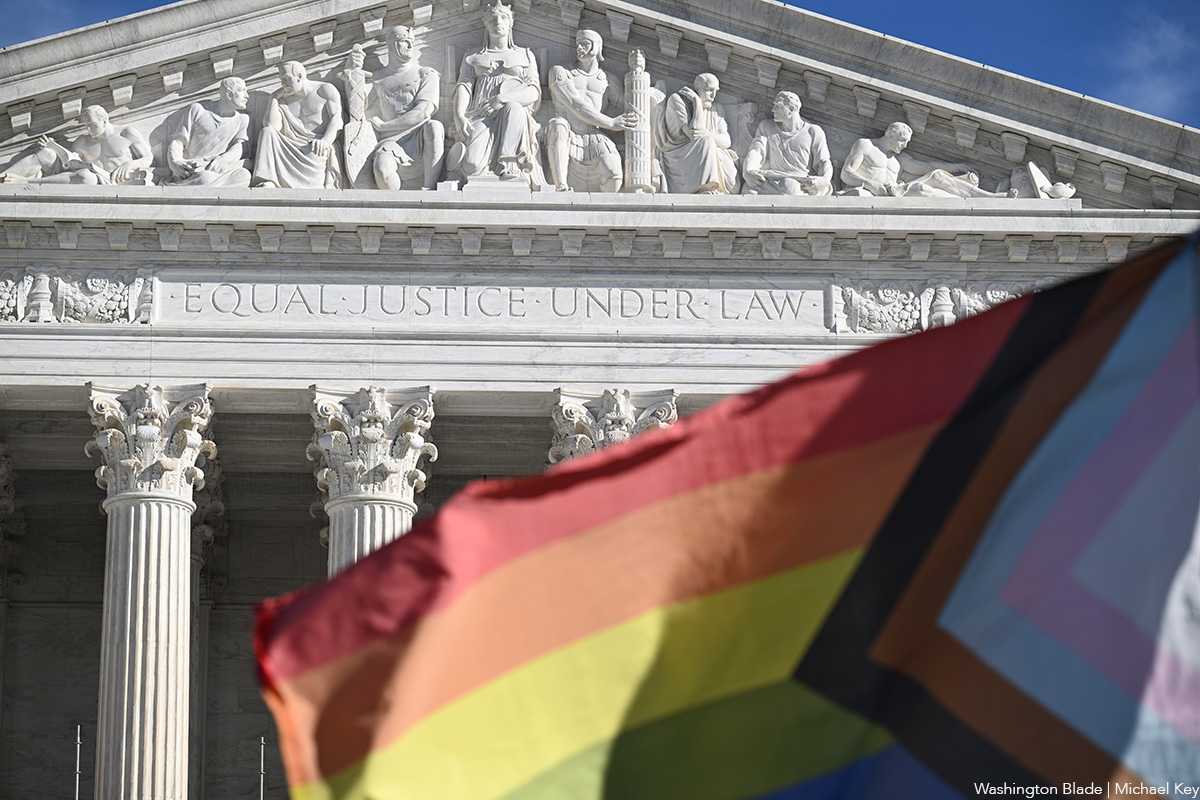
The Trump administration has asked the Supreme Court to allow its policy limiting gender-affirming treatment for federal inmates to take effect while a legal challenge plays out in court.
U.S. District Judge Royce Lamberth ordered the government to continue providing gender-affirming care, such as hormone therapy, which had become policy nearly a decade ago for inmates who were transitioning.
The Trump administration argues in its application that its policy restricting transgender rights was properly adopted and that the judge overstepped, posing nationwide “security and prison-administrative concerns.”
If allowed, the policy would halt surgeries, hormones and social accommodations such as wigs while allowing mental health therapy to continue as the legality of the policy reversal is litigated.
The government also argues in the application that the Bureau of Prisons had “determined that sex-trait-modification surgeries, hormone interventions in general, and social accommodations could no longer be justified as treatment for gender dysphoria.”
American Civil Liberties Union attorneys for the inmates said the policy is “a direct threat to the well-being of transgender people in federal custody and an open violation of their fundamental rights,” and said withholding necessary gender-affirming healthcare constitutes cruel and unusual punishment.
The Blade has covered the ongoing developments surrounding changes to Federal Bureau of Prisons transgender inmate policy that went into effect earlier in Trump’s term. The changes primarily focus on rolling back Biden-era protections for trans inmates.
Earlier this year, the Blade published a joint letter from multiple senators in response to the rollback of the policy. Multiple senators — including Edward Markey (D-Mass.), Jeffrey A. Merkley (D-Ore.) and Mazie K. Hirono (D-Hawaii) — sent a letter to Attorney General Todd Blanche and Federal Bureau of Prisons Director William Marshall III calling for them to reverse the policy change, saying it endangers inmates’ health and safety.
The senators described how the policy shift, along with President Trump’s Executive Order 14168, titled “Defending Women from Gender Ideology Extremism and Restoring Biological Truth to the Federal Government,” is forcing policy changes they argued are rooted more in political rhetoric than in medical research or evidence-based correctional practices.
Federal Bureau of Prisons responded to the Blade’s request for comment in May, declining to reconsider its transgender inmate policy.
The Blade reached out to the Federal Bureau of Prisons once again over the application to the Supreme Court, but did not hear back before publication.
Federal Government
Education Department rolls back protections for LGBTQ students under Title IX
The DoE policy rescinds Biden-era protections
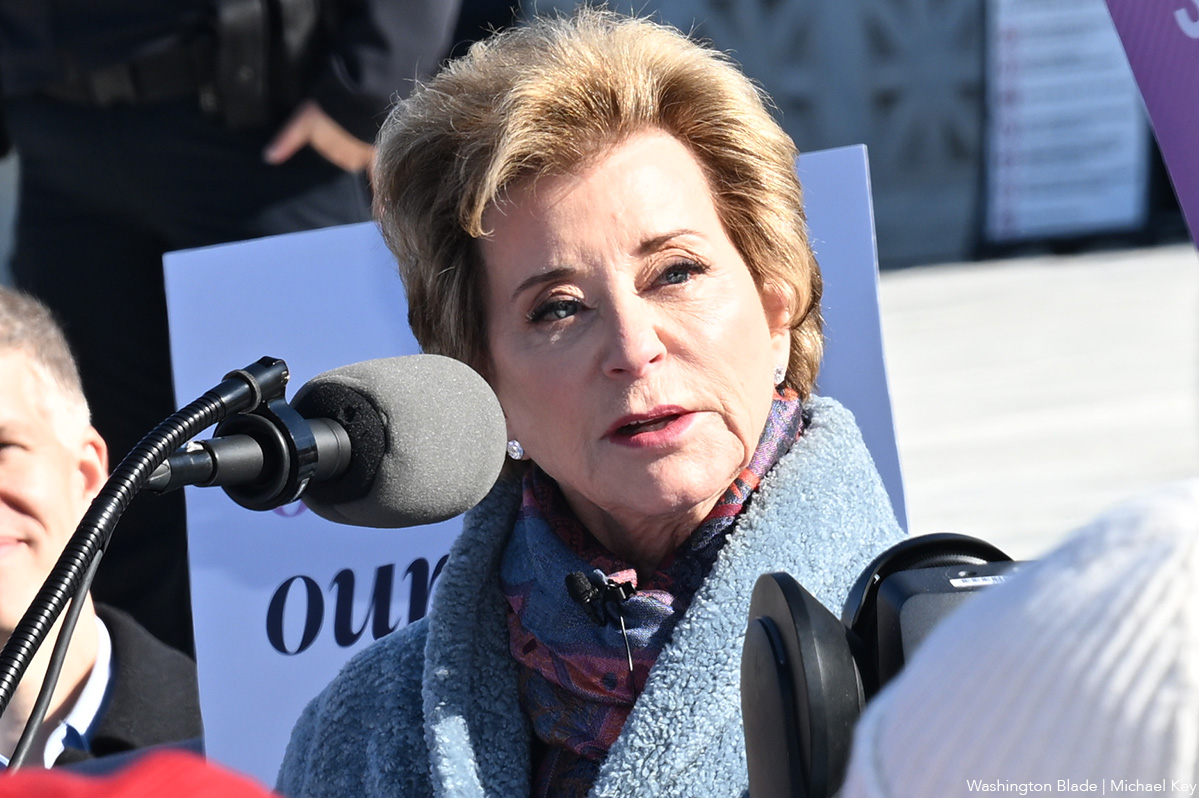
The Department of Education rolled back a Biden-era Title IX interpretation on Monday that secured sex-based discrimination protections for students on the basis of sexual orientation and gender identity.
Title IX was established in 1972 as landmark civil rights law. It prohibits sex-based discrimination in any school or any other education program that receives funding from the federal government.
Education Secretary Linda McMahon spoke about the revision of the policy, claiming the decision would explicitly help “women and girls.”
“Thanks to today’s action, the published Title IX regulations faithfully reflect court orders and congressional intent — reducing confusion for parents, students, and educational institutions. We will continue to relentlessly champion equal opportunity for all Americans and hold accountable any school or college that violates the rights, privacy, or athletic opportunities of our women and girls,” McMahon said via press release.
Prior to her work under the Trump-Vance administration, McMahon was a World Wrestling Federation/World Wrestling Entertainment executive before resigning to pursue a career in politics. She was appointed to the Connecticut State Board of Education by then-Gov. Jodi Rell in January 2009, but resigned from her role shortly afterward to run what ultimately became two failed campaigns for Connecticut’s U.S. Senate seat in 2010 and 2012.
A “fact sheet” provided by the Department of Education also called the inclusive sexual assault and gender identity protections expanded under the Biden-Harris unlawful, saying, “This change is necessary to provide clarity in the Code of Federal Regulations so that institutions, administrations, students, and families can see the rules that are actually in force and to help eliminate public confusion about the Biden administration’s unlawful attempt to stretch Title IX’s legal protections to cover ‘sexual orientation’ and ‘gender identity.’”
This is not the first time this policy has faced judicial hurdles. While Biden was still in office, the plan was struck down in multiple courts in Republican states.
Opponents of the move say it will harm transgender athletes and weaken protections for sexual assault victims.
“Sexual harassment and assault continue to be pervasive in schools and, to the fullest extent possible, we should be working to enforce the laws that protect student survivors of sexual violence. Yet, Education Secretary Linda McMahon and the Trump administration have decided to ignore what survivors need, instead weaponizing Title IX to attack trans students,” said Shiwali Patel, senior director of education justice at the National Women’s Law Center.
This is a return to a first Trump term policy after Biden issued an executive order to attempt to curb discrimination for all — especially those with different sexual orientations and gender identities — that had been given a pass during Trump’s first term. Much of Title IX’s policy has a narrow vision of what sex protections look like that often and enthusiastically leave gender-diverse and non-heterosexual people out.
In March 2021, President Joe Biden signed Executive Order 14021, “Guaranteeing an Educational Environment Free From Discrimination on the Basis of Sex, Including Sexual Orientation or Gender Identity,” to attempt to undo some of the flagrantly anti-LGBTQ policy the Trump-Pence administration had set forth relating to Title IX protections for LGBTQ students and sexual assault survivors.
The secretary focused this “win” for the administration as one more step toward restricting transgender students from competing in women’s sports, but the 2020 rule, completed under former Education Secretary Betsy DeVos, didn’t explicitly ban trans students from participating on sports teams consistent with their gender identity. It did limit the types of sexual harassment and assault complaints that schools had to investigate and required live hearings so male students could respond to accusations.
McMahon didn’t discuss those aspects in her statement or in requests for comment. The 2020 rule drew praise from conservatives and intense opposition from advocates who said it downplayed sexual abuse and left victims unprotected.
In a statement, U.S. Rep. Tim Walberg (R-Mich.), who chairs the House Education Committee, said, “Returning to the 2020 regulations restores longstanding protections for women and girls that the Biden-Harris administration attempted to dismantle and realigns Title IX policy with court precedents.”
LGBTQ activists have called this decision a direct attack on LGBTQ safety — particularly for trans students who continue to face a barrage of legislative, executive, and judicial attacks in recent years from the Trump-Vance administration.
Kelley Robinson, president of the Human Rights Campaign, the largest LGBTQ advocacy group in the world, released a statement following the DoE’s announcement.
“Title IX is, quite simply, about protecting students and ensuring that they are safe from abuse, harassment, and discrimination while they pursue their education. But Donald Trump and his cronies aren’t interested in any of that,” Robinson said. “Donald Trump’s Department of Education has completely lost sight of that mission. Instead of enforcing protections for students, they’re rescinding them. They don’t care if sexual harassment and assault go unaddressed. And they’re happy to strip funding away from school districts and states that are actually trying to keep students safe.
“We know who will be hurt: women, girls, and others who are vulnerable to sexual harassment, assault and abuse — including LGBTQ+ students. The fact that they’re dropping this rule into place abruptly, without a comment period, denying families, educators, loved ones, and the students themselves a say in how they should be treated, shows how little they care about the safety of our students.
“This is a monstrous injustice, and it drives home how essential it is that we take action at the polls this November to start bringing some accountability to an administration that has turned its back on the very students Title IX was written to protect,” she added.
The Washington Blade reached out to the DoE for comment and questions on whether Title IX protections still included LGBTQ students, and received this email response from Education Spokesman Sabin Sidney:
“Your questions indicate you are clearly missing the entire point of this Final Rule. The Biden Administration illegally rewrote Title IX to include ‘sexual orientation’ and ‘gender identification’ in the definition of sex-based discrimination. The Trump Administration is rescinding this rule—only after every federal court that heard legal challenges rejected it as unlawful.
“Since January 2025, the Department has been enforcing Title IX consistent with the President’s Executive Order grounded in biological truth that there are only two sexes. The Trump Administration is restoring the original promise of Title IX and providing clarity to students, parents, and educational institutions. We will vigorously defend equal opportunity consistent with the law’s intended purpose.”

HRC report: LGBTQ students face ‘far greater challenges’ in non-supportive states

HRC National Dinner 2026: A night of music, activism, LGBTQ history

Trump asks Supreme Court to allow restrictions on gender-affirming care in prisons

Education Department rolls back protections for LGBTQ students under Title IX

Debbie Allen shares on loss, love, and the power of speaking out

‘Star Trek: Strange New Worlds’ star Celia Rose Gooding breaks down that finale time travel twist

Charles Bowers, former owner of Baltimore gay bar the Hippo, dies

Center for Black Equity’s annual gala to take place Oct. 3

Grace Meng sharply criticizes DOJ over hospital settlements

Former Capital Pride board member reiterates sexual harassment allegation
-

 Television4 days ago
‘Star Trek: Strange New Worlds’ star Celia Rose Gooding breaks down that finale time travel twist
-
 Baltimore5 days ago
Charles Bowers, former owner of Baltimore gay bar the Hippo, dies
-
District of Columbia4 days ago
Center for Black Equity’s annual gala to take place Oct. 3
-
New York4 days ago
Grace Meng sharply criticizes DOJ over hospital settlements