News
Carney quiet on St. Patrick’s Day parades, trans military service
White House spokesperson hasn’t talked to Obama about boycotts


White House Press Secretary Jay Carney has no comment on boycotts of St. Patrick Day’s parades or transgender military service. (Washington Blade file photo by Damien Salas)
White House Press Secretary Jay Carney had no comment Monday about two issues in the news: decisions to boycott St. Patrick’s Day parades over LGBT exclusion and lifting the ban on openly transgender service members in the U.S. military.
Carney said he hasn’t spoken to President Obama about boycotts of parades in New York City and Boston — including by the mayors of those cities — as a result of organizers prohibiting LGBT contingents from identifying themselves as such during the march.
“The president does oppose discrimination, but I haven’t talked to him about boycotts of those parades,” Carney said.
The Blade also asked Carney why President Obama would act to freeze the assets of Russian officials connected to the country’s military incursion into Ukraine, but not take the same step for lawmakers responsible for Russia’s anti-gay laws. Carney said the actions taken against Russia with respect to Ukraine “are focused on the very real violation of Ukraine’s sovereignty and territorial integrity that we’ve been talking about.”
As reported by the Blade, Yelena Mizulina, a sponsor of the controversial anti-gay propaganda law and state Duma deputy, was actually among those whose assets were frozen. The White House deferred comment on whether her authorship of the law contributed to Obama’s decision to freeze her assets to the Treasury Department. [UPDATE: A Treasury Department official said Mizulina’s connection to the anti-gay law didn’t contribute to Obama’s decision to freeze her assets and she was sanctioned “because of her status as a senior Russian government official.”]
With regard to a recent Palm Center report saying there’s “no compelling medical reason” to continue prohibition of openly transgender service members in the military, Carney deferred to the Defense Department. Lt. Cmdr. Nate Christensen, a Pentagon spokesperson, said “there are no plans to change the department’s policy and regulations which do not allow transgender individuals to serve in the U.S. military.”
The brief transcript of the Q&A follows:
Washington Blade: Lots to talk about. On St. Patrick’s Day, a number of beer companies announced they wouldn’t sponsor parades in New York City and Boston as Mayors Bill de Blasio and Marty Walsh announced they would boycott the ones in their own cities because LGBT contingents were allowed to identify themselves as such during the march. Does the president believe those boycotts were the right decision?
Jay Carney: I haven’t spoken to the president about those boycotts.
Blade: You said before the president opposes discrimination. Wouldn’t that principle apply to those parades here?
Carney: The president does oppose discrimination, but I haven’t talked to him about boycotts of those parades.
Blade: On Russia. If the president will impose sanctions on officials connected to military incursion into Ukraine, why hasn’t he done the same for the officials responsible for the anti-gay laws in Russia, say by freezing their assets under the Magnitsky Act?
Carney: We’ve made our views abundantly clear about that kind of legislation and about efforts to undermine the civil rights of Russian citizens, but the actions we’ve taken today and the sanctions that have been announced today are focused on the very real violation of Ukraine’s sovereignty and territorial integrity that we’ve been talking about.
Blade: And lastly, the repeal of “Don’t Ask, Don’t Tell” enabled openly gay people to serve in the U.S. military, but transgender people are still barred because of medical regulations. Last week, an independent commission led by a former U.S. surgeon general issued a report saying there’s no compelling medical reason to [continue] this ban and called on the Commander-in-Chief to lift it. Will the president direct the Pentagon to lift the ban on transgender service?
Carney: I don’t have anything on that. I’ll have to direct you to the Pentagon at this point.


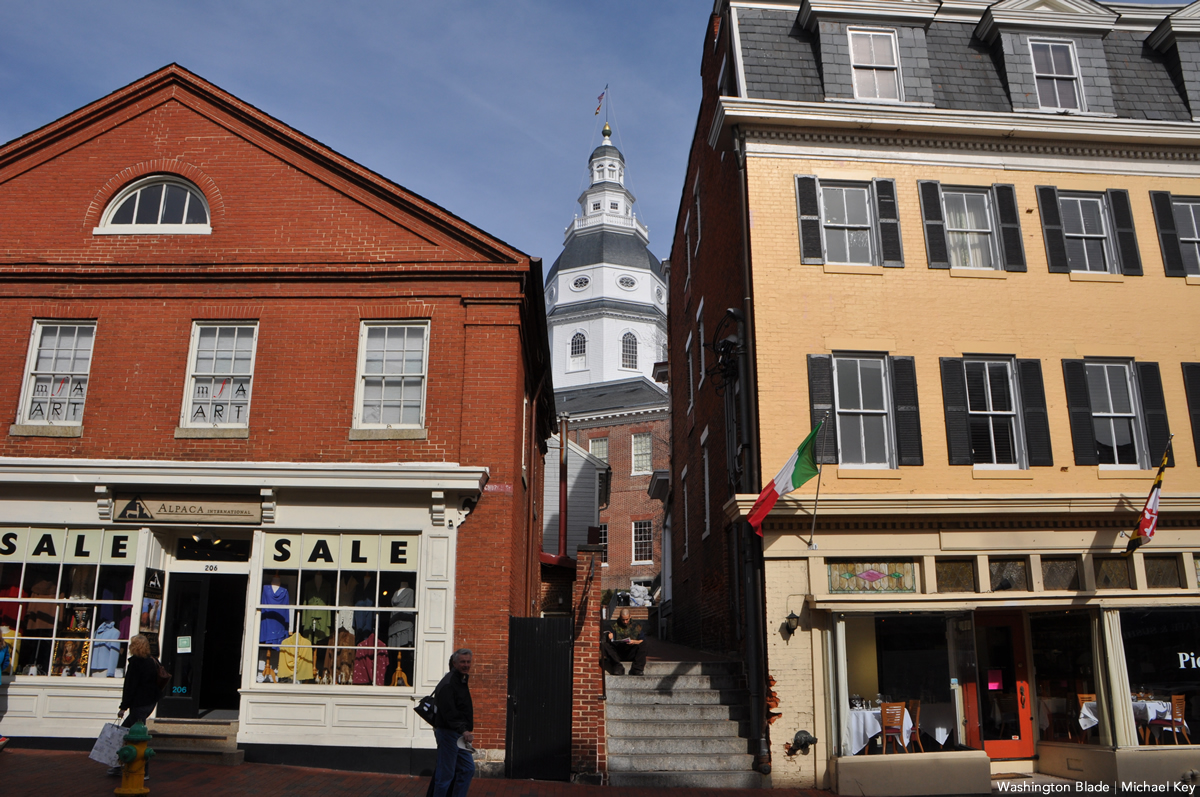
Maryland’s legislative caucuses outlined their legislative priorities heading into the final weeks of the 2026 General Assembly during a joint press conference on March 24.
The press conference was titled “We are Maryland,” where a representative for each of the legislative caucuses outlined priorities.
State Del. Kris Fair (D-Frederick County) of the LGBTQ+ Caucus opened the press conference with a statement on the unity of Maryland’s caucus.
“Together we can show our state and our community a different world, one where we mutually support one another and through that support uplift every Marylander,” he said.
In a press conference on March 5, the LGBTQ+ Caucus outlined its top legislative priorities. Fair highlighted two of those bills again during the “We are Maryland” press conference.
The first of the two highlighted pieces of legislation was Senate Bill 626 and House Bill 1589.
The bills would simplify the process of updating an individual’s birth certificate and align the Department of Health and DMV systems to reflect those changes. The bill is being led by state Sen. Clarence Lam (D-Anne Arundel and Howard Counties) and state Del. Ashanti Martinez (D-Prince George’s County).
The second piece of legislation is Senate Bill 950 and House Bill 1209, which would update and modernize laws and regulations around so-called conversion therapy. The bills have failed to pass either chamber thus far. They are being led by state Sen. Cheryl Kagan (D-Montgomery County) and state Del. Bonnie Cullison (D-Montgomery County).
(The U.S. Supreme Court on Tuesday ruled against a Colorado law that bans so-called conversion therapy for minors. Maryland is among the U.S. jurisdictions that prohibit the widely discredited practice for anyone under 18.)
Martinez and Lam have introduced bills in their respective chambers that would expand PrEP access in Maryland. Martinez did not attend the press conference, and Fair did not mention it when he spoke.
State Del. N. Scott Phillips (D-Baltimore County) represented the Black Caucus during the press conference. State Del. Dana Jones (D-Anne Arundel County) spoke on behalf of the Women’s Caucus, State Del. Teresa Woorman (D-Montgomery County) represented the Latino Caucus, and State Del. Lily Qi (D-Montgomery County) represented the Asian-American and Pacific Islander Caucus. State Del. Jared Solomon (D-Montgomery County) represented the Jewish Caucus, and state Del. Sean Stinnett (D-Baltimore County) represented the Muslim Caucus during the press conference.
Solomon ended the press conference by explaining the importance of all the caucuses coming out together.
“We are stronger when we’re together, and many of these issues that we have talked about, again, impact all of us,” said Solomon.
U.S. Supreme Court
Supreme Court rules against Colo. law banning conversion therapy for minors
8-1 decision could have sweeping impact
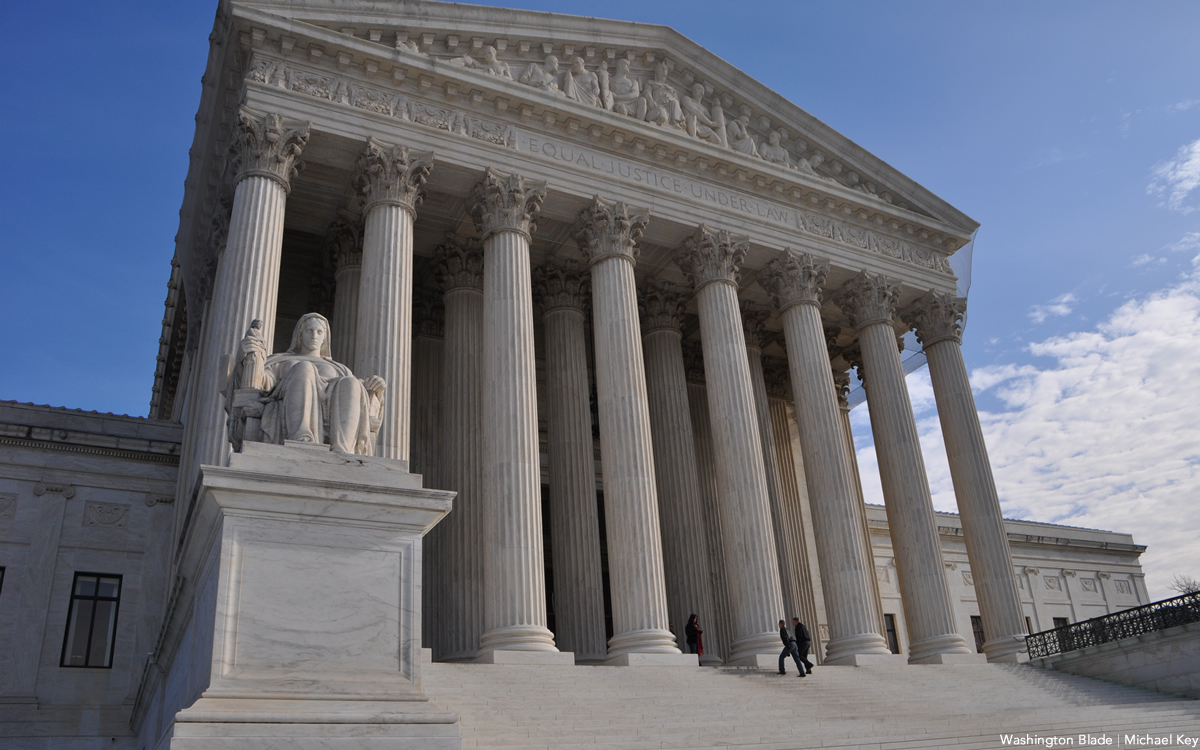
The U.S. Supreme Court on Tuesday ruled against a Colorado law that bans so-called conversion therapy for minors.
The justices last October heard oral arguments in Chiles v. Salazar. They ruled 8-1 in favor of Kaley Chiles, a Christian therapist who challenged the 2019 law.
In the case, which was heard by the justices in October 2025, Chiles successfully argued to the court that the law restricting this type of therapy was unconstitutional, leading to it being struck down.
The Supreme Court ultimately found that lower state and federal courts has “erred by failing to apply sufficiently rigorous First Amendment scrutiny,” ultimately reversing the widely discredited “medical” treatment that has support by a very narrow margin of mental health specialists — specifically religious and socially conservative ones. This is despite the fact that Colorado state officials have never enforced the measure in practice, and included a religious exemption for people “engaged in the practice of religious ministry.” The now moot law carried fines of up to $5,000 for each violation and possible suspension or revocation of a counselor’s license.
In the ruling, the court said the law, that specifically applies to talk therapy “impermissibly” interferes with free speech rights of Americans, and despite it being “regard[ed] its policy as essential to public health and safety, but the First Amendment stands as a shield against any effort to enforce orthodoxy in thought or speech in this country,” Justice Neil Gorsuch wrote for himself and seven other justices from across the ideological spectrum who overturned the low court’s ruling. He went on to add that the original ban “trains directly on the content of her speech and permits her to express some viewpoints but not others.”
Only Justice Ketanji Brown Jackson dissented, which included an in depth summary of her departure from the other eight justices, explaining her fears about the verdict — and its eventual chilling effect on legislation that could attempts to restrict religious attitudes in specifically regulatory contexts — despite that these regulations are often made as a direct creation of years of essentially unanimous research and are vetted though regulatory boards for specific jobs.
“This decision might make speech-only therapies and other medical treatments involving practitioner speech effectively unregulatable,” Jackson wrote on page 32 of the 35-page opinion issued by court in response to her opposing eight members comments on the bench.
Since the ruling late Tuesday morning, LGBTQ advocacy groups have issued statments on the directly harmful effects the rule reversal will have across the country.
Polly Crozier, director of family advocacy at GLBTQ Legal Advocates & Defenders (GLAD Law), provided a statement to the Washington Blade on the court’s decision.
“Today’s Supreme Court ruling limited Colorado’s statute that preemptively shielded minors from conversion therapy, but it leaves open avenues for states to protect families from harmful, unscrupulous, and misleading practices that divide parents from their children and put LGBTQ+ youth at risk,” Crozier wrote, pointing to the overwhelming evidence on conversion therapy that argues this type of regulatory legislation is helping those suffering rather than harming. “The evidence is clear that conversion practices lead to increased anxiety, depression, and suicidality. This is a dangerous practice that has been condemned by every major medical association in the country. Today’s decision does not change the science, and it does not change the fact that conversion therapists who harm patients will still face legal consequences, and that family advocates, mental health practitioners, and all of us who care about the wellbeing of youth will continue working to shield LGBTQ+ young people and their families from this dangerous practice.”
Human Rights Campaign President Kelley Robinson, who leads the nation’s largest LGBTQ advocacy group, also provided a statement, calling the courts choice a “reckless decision.” The statement also points out how their own data (from the group’s philanthropic arm of the organization) was cited in Brown Jackson’s dissent in the amicus brief.
“The court has weaponized free-speech in order to prioritize anti-LGBTQ+ bias over the safety, health and wellbeing of children,” her statement reads. “So-called ‘conversion therapy’ is pseudoscience, not real therapy. It has been condemned by every mainstream medical and mental health association and harms families, traumatizes children, and robs people of their faith communities. It is cruel and should never be offered under the guise of legitimate mental healthcare. To undermine protections that keep kids and families safe from these abusive practices is shocking — and our children deserve better.”
In an consistently updated document started in 2018 that cites the major harms risks conversion therapy poses to LGBTQ people, the Trevor Project, the leading suicide prevention and crisis intervention organization for LGBTQ young people, included that the federal government’s own research proved the practice at best questionable and at worst deadly.
“In a 2023 report entitled Moving Beyond Change Efforts: Evidence and Action to Support and Affirm LGBTQI+ Youth, the U.S. Department of Health and Human Services’ Substance Abuse and Mental Health Services Administration stressed that “[sexual orientation and gender identity] change efforts are harmful practices that are never appropriate with LGBTQI+
youth, and efforts are needed to end these practices,” the summary of the fight against conversion therapy in the U.S. reads.
More than 20 states and D.C. banned the widely discredited practice for minors prior to the Supreme Court’s ruling.
The Blade last October spoke to conversion therapy survivors after the justices heard oral arguments in the Chiles case.
The White House
Thousands attend ‘No Kings’ protests in D.C.
Protesters demand accountability, defend democracy, and oppose Trump administration
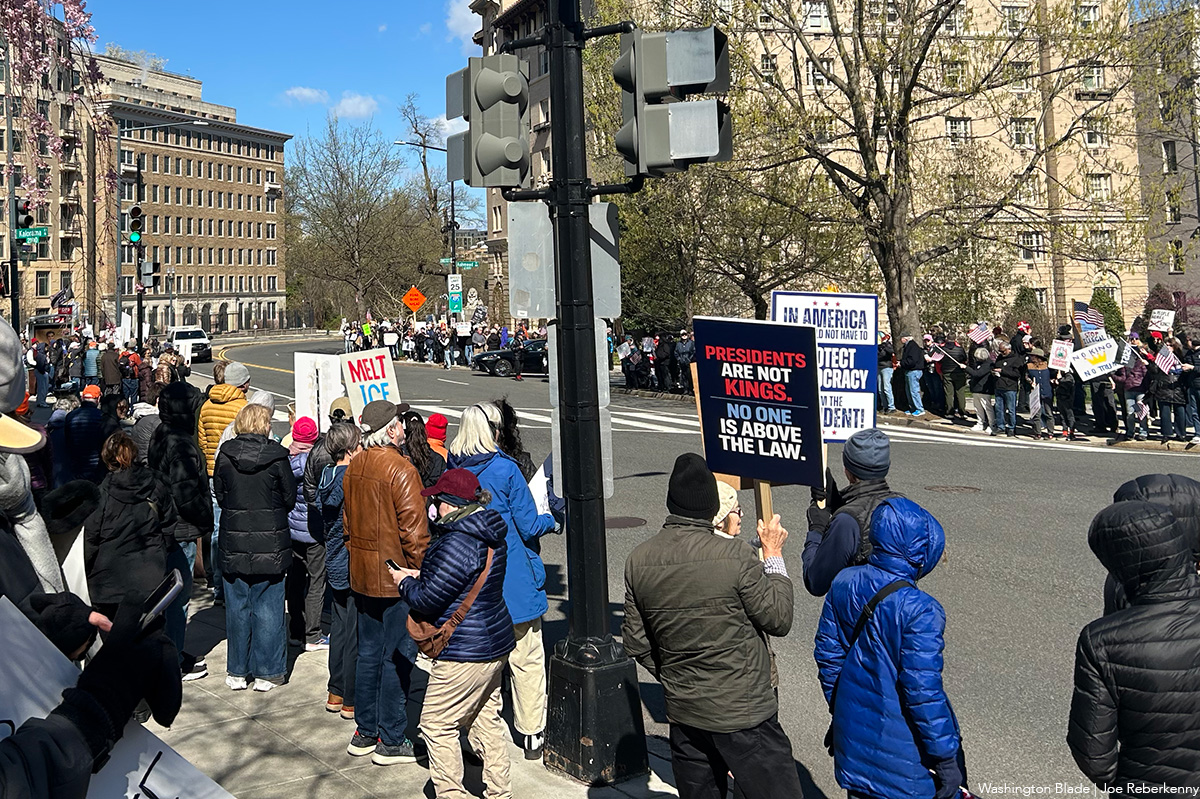
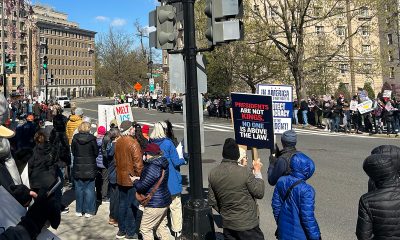
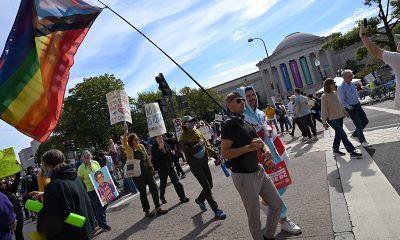
Across all 50 states — and D.C. — more than 8 million people came out nationwide from towns big and small, red and blue, to make their voices heard. That united voice echoed what nearly 20,000 protesters declared in the nation’s capital back in October 2025: the citizens of the U.S. would not sit idly by as President Donald Trump and his administration erode democracy, attempt to restrict human rights, loosens First Amendment protections, and begin wars without congressional approval.
While there were countless differences among the thousands who joined the “No Kings” protests this weekend in the DMV — from creeds and socioeconomic statuses to races, sexualities, and gender identities — there was one thing that united them all during the chilly March 28 weather: a commitment to making their voices heard.
By 10 a.m., the Washington Blade estimated around 200 people had braved bitter winds and temperatures hovering around 40 degrees, with bright sun, to stand along the cherry blossom-adorned streets of Kalorama and Connecticut Avenue. Protesters carried signs large and small from criticizing Trump’s disregard for the “everyman” to handmade signs emphasizing love, calling for the melting of ICE, and addressing issue-specific concerns like ending the wars in Gaza and Iran — both policies propagated by Trump.
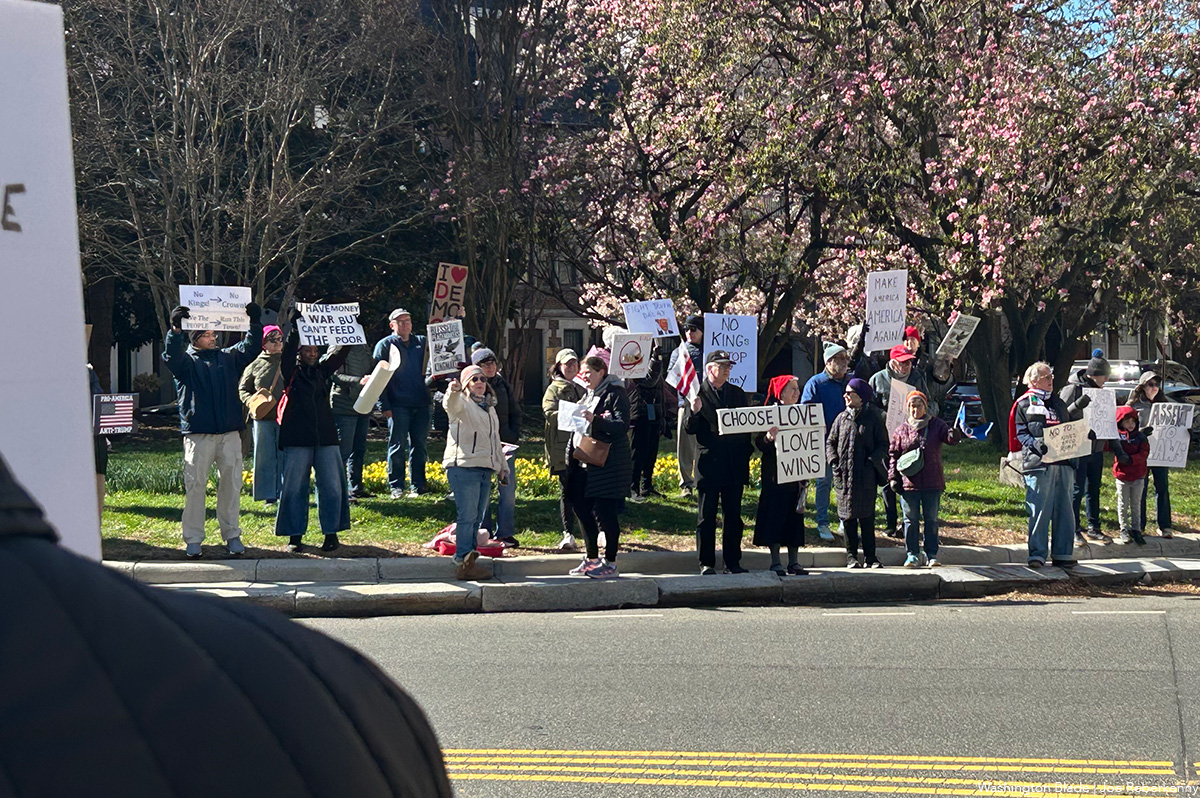
While a solid group of D.C. residents came out with babies in strollers and dogs on leashes, the Kalorama protest skewed older with a majority-white crowd.
On the other side of town, the more heavily attended protest in Anacostia started at 1:30 p.m., crossing the Frederick Douglass Bridge.
MS Now estimates that over 20,000 people marched across the bridge, sending a clear message to the president, his administration, and the Republican-controlled federal government: federal overreach is not what the majority of Americans want to see, hear, or witness as protesters in the thousands came out for, as organizers say “the single largest non-violent day of action” in American history.
The two marches on Saturday differed in both theme and location — the Kalorama protest felt like a small-town demonstration in a big city, covering a wide variety of topics, whereas the Anacostia protest was more focused, directly calling out and pushing back against the actions of Stephen Miller (the White House chief of staff)and other Trump allies.
Many participants shared their reasons for marching with glee — shouting as cars honked in support passing by and discussing the broader issues within the current political climate with those standing next to them: some neighbors, some friends, others complete strangers. Regardless, an important discussion was happening across the city.
A surprise to many participants — and the Blade reporter covering the event — was seeing U.S. Rep. Sara Jacobs (D-Calif.) stand outside in near-freezing temperatures with her staff and some signs.
Jacobs used the exclusive — and more intimate — ability to speak on her experience watching everything unfold from inside the halls of Congress.
“We had votes until midnight last night, so I couldn’t make it back to San Diego for the march, but it’s important to show up and cheer on people standing up and making their voices heard,” Jacobs said. “This is just the start. We need to make our voices heard every day through the end of the year.”
Jacobs also used the opportunity to criticize congressional inaction from those on the other side of the aisle, reminding the Blade that a legislator’s job is to protect and secure the people they represent — not the interests of a wannabe king or corporations that back many congressional campaigns through PACs.
“It makes me angry at my Republican colleagues who won’t stand up to Trump. Actions like this inject courage into my colleagues — they need to see that the American people have their back,” she added, eventually emphasizing the public responsibility lawmakers have to protect the Constitution and everyone in the country (which the Supreme Court had pointed out as far back as 1886 with Yick Wo v. Hopkins). “Congress is not going to save people. This is about everyone showing up and making our voices heard and building the democracy we want.”

Ashley Gould, a tourist visiting from Missouri, told the Blade that despite Washington being seen as one of the most politically active towns in the country, over the past few years, she and many other politically active Missourians have been preparing for this moment and were zealous to have their voices heard together as one.
“I’m actually visiting my sister from Missouri, and we’ve been doing this since the first No Kings protest [there]. I wanted to see how you guys did it here,” she said. “As someone in a red state, we’re not represented in Congress right now, so I don’t personally have a say in any of this. If I can do one small thing, I want kids in our town to see me trying to make a difference, get petitions signed. This is all we have.”
Gould continued, “I don’t know if it’s going to cause an impact for elected officials, but I hope that little kid who sees us with the posters sees that we do have a voice—and maybe one day they can, if they can’t right now.”
Gary Bowman, another early protest-goer, held a sign that pointed out the obscurity — and unconstitutional nature — of the current administration’s actions.
“I hate the direction the country is going in, and Donald Trump is not fit to be in office,” Bowman said, adding that his choice of sign exemplified that. “It’s obvious based on his policies — his attacks on the trans and LGBTQ communities — that he’s trying to suppress people. And the Republican Congress isn’t helping.”
When asked how the phrase “No Kings” resonates with him, especially since this is the third one held in two years, Bowman said it may be catchy for headlines or help inspire creative signs (like Trump on a golden throne or toilet), but the march and protest are about something much more important.
“‘No Kings’ is a catchphrase for me; I’m more concerned about losing our democracy. We, the people, have a voice we should use,” he said, elaborating on how this administration’s course of action disregards rules designed to prevent an authoritarian — or wannabe-authoritarian — from taking power. “I don’t think Trump is overstepping … I think he’s shattering democratic norms. He wants to do what’s right for Donald Trump, not for anyone else.”
He concluded bluntly that unless everyone — including Republicans in power — stand up to the president for these ludicrous choices, change won’t happen, regardless of how loud he or any other Trump critics scream at protests.
“Until we have a Congress that would actually look at protests and take action, it won’t matter. He’ll just get pissed off and act against them,” Bowman said.
When asked what he could say to those in charge, he finished strongly: “If I could say one thing to him? Fuck off, Donald Trump.”
Jameson Woosley and Elena Lacayo were standing on the corner of Kalorama Road, holding their baby tight as pink cherry blossom trees swayed behind them, as if to cheer on the protesters.
“It’s the degradation of democracy. Every day there’s an overreach by the executive branch, and Congress just sits on their hands,” Woosley said, standing side by side with Lacayo.
“It’s terrifying for my baby. This administration has turned people who’ve done nothing wrong into criminals — it’s Orwellian. Up is down, war is peace,” Lacayo noted. “I was raised in another country with authoritarians… I’m a citizen here, and I’m going to use every right I have to advocate for those who can’t.”
Lacayo then spoke about how, for many, direct protests against government action (and inaction) are the only choice — especially under a supermajority federal government with the White House, Supreme Court, and both chambers of Congress.
“We have no choice but to believe change can come. This is what we can do. We must continue fighting; that’s what the human spirit is about,” she said.
Woosley emphasized the growing impact of the protests, saying, “Every protest gets bigger, and opinion polls keep swinging in the right direction … We need to speak up and get all the right people out to bring positive change.”
“These people are nothing without us,” Lacayo added.
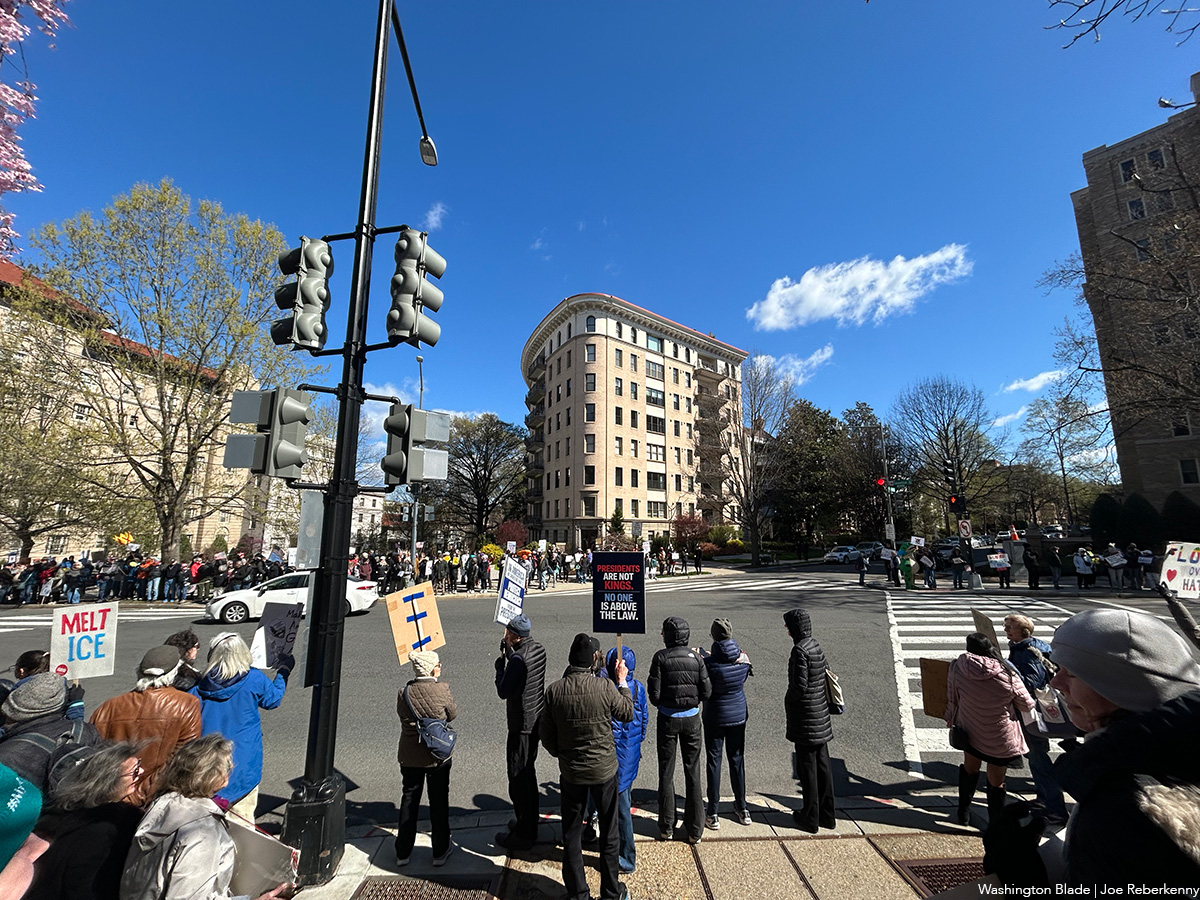
Beth Davis, a former resident of Kalorama, shared with the Blade that this place holds special meaning for her — and her children — which is in part why she chose this one over the larger protest in Anacostia.
“I used to live in the neighborhood, so this is special for me. It’s easy to bring the kids and let them be part of the movement,” Davis said, as her elementary-aged children ran around the manicured grass while bundled up, enjoying the lively atmosphere.
“What’s happening to immigrant communities is horrific, and I want to show solidarity. Also, the Iran war — it’s terrifying what’s happening,” she added before explaining what the “No Kings” name actually means to her. “’No Kings’ makes me think of the extreme grab for power — it’s unprecedented.”
Davis then noted the importance of protesting when it seems like the main goal is often to iisolate : “Coming to protests makes people feel like they’re not alone, and that momentum carries into elections,” she explained, noting why she not only brought her two children to this protest—and many others in the past as well– but uses these as real world teaching moments. “We bring kids to teach them their civic responsibilities. My oldest has been to about ten protests.”
Another remarkable aspect of D.C. protests is the diversity of participants. Teachers, retail workers, students, and even some congresspeople turned out. In Kalorama on Saturday, the No Kings protest brought out Anne Plant, a biochemist and fellow at the National Institute of Standards and Technology, where she was previously chief of the Biosystems and Biomaterials Division.
Plant focused on many issues when speaking to the Blade, but started with what many consider the most important: Trump-era policies making civic engagement more difficult, particularly regarding civil rights.
“A lot of things are going wrong, and the only way to change them is for people to act. D.C. has no statehood, no vote — it’s a civil rights issue,” Plant said. “To deny the vote to any group of U.S. citizens doesn’t make sense. These people work for us; we should be able to hold them accountable.”
She held a small, hand-painted sign with two cohesive messages: “Reject Fascism. Defend democracy.”
“Some of what’s going on now is not healthy for society. No one will benefit; it’s just ruination,” Plant concluded. “Seeing more people out here shows that others feel the same, and momentum is what it takes to move things.”
Religious activists also joined the marches. Sister Diane and Sister Claire, two Catholic nuns, were out protesting Trump and his agenda.
“We’re sisters, Catholics in support of LGBTQ rights. I work with immigrants, and we wanted to stand in solidarity,” Sister Diane said.
Sister Claire reflected on the era the U.S. is in now: “It’s so disturbing. I’m almost glad my folks aren’t alive anymore for all they cared about. It’s heartbreaking, but we need something for the future.”
John Jones, another attendee teeming with energy and anger against the regime, captured the urgency of the moment succinctly.
“We’ve got to do something. I needed to be part of the community and let them know we’re tired of all the madness,” Jones told the Blade before detailing specific atrocities by the Trump-Vance administration.
“Rounding up legal people who follow the rules — throwing them away just because he’s racist, or his friends tell him to be racist. Helping pay for a war, bombing Gaza, killing people for no reason, manipulating the stock market for personal gain. It’s crazy,” he said, still holding out hope that small acts — like the protest gathering — show everyday Americans they have power, advocating for even more people to come out for the next No Kings protest.
“I hope protests can spark change. I won’t hold my breath, but the more people out here, the more they [in power] seem to be listening.”
Patty Bowring, who had moved with her family from the United Kingdom to join her husband in D.C. for his career, is set to return soon due to immigration restrictions. She, her children, and her mother came out to protest because she believes it is just as important for non-citizens to have the right to both protest and exist in a country founded and enriched by immigrant and enslaved labor.
“Even though we’re British, we’re leaving America in two months because of the administration. But this affects everybody — it’s hugely dangerous and worrying,” Bowring said.
Despite the somber mood, she kept a smile and joked: “I hope it’s the death of dinosaurs and that nothing more radical comes next. I want them to be happy,” also pointing out that the mixed messages at the protest could dilute impact. “Protests need a clearer message. ‘Anti-fascist’ should be the focus; too many other messages muddy things.”
Finally, John Norrin highlighted the continuity of civic engagement, informing the Blade that this protest — albeit a smaller version — happens every week on the corner.
“I’m here with friends, looking for more,” Norrin said. “There’s a regular protest every Thursday morning, and I’m going to start joining … The kings today are mostly figureheads, but we also have dictators not called kings who act like one. We have an elected representative trying to be a king.”
He, much like others around him — even with Jacobs standing mere feet away — criticized Congress’ inaction.
“Congress is understepping. They should assert their rights under Article One — declare war, impose tariffs — but they’re too afraid to follow their oath,” Norrin said, eventually shifting to a note of hope. “If at least 3.5 percent of the populace regularly protests, there’s a good possibility for change. I hope that happens here. Some friends will go to Connecticut to join larger groups. I had to figure out which protest in D.C. to join—it took a while.”

Md. lawmakers reaffirm legislative priorities

Supreme Court rules against Colo. law banning conversion therapy for minors

Thousands attend ‘No Kings’ protests in D.C.

Blade contributor, husband exchange vows in D.C.

Ghanaian president welcomed to Philadelphia amid backlash over anti-LGBTQ bill

‘No Kings’ protests set for D.C.

Celebrate cherry blossoms the drag way

Lorato ke Lorato: marriage equality, democracy, and the unfinished work of justice in Botswana

The outrage economy is not the LGBTQ community

Japanese Supreme Court to consider marriage equality
-

 District of Columbia5 days ago
‘No Kings’ protests set for D.C.
-
Out & About4 days ago
Celebrate cherry blossoms the drag way
-
Botswana4 days ago
Lorato ke Lorato: marriage equality, democracy, and the unfinished work of justice in Botswana
-
Opinions4 days ago
The outrage economy is not the LGBTQ community