Theater
New Arena Stage production revisits Roe v. Wade case
Did you know Jane Roe the plaintiff in the groundbreaking 1973 reproductive rights case Roe v. Wade was in fact a lesbian named Norma McCorvey?
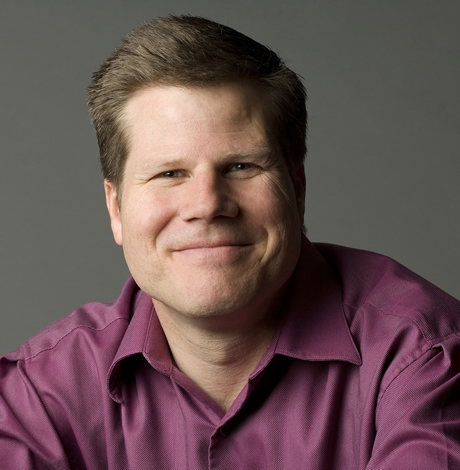
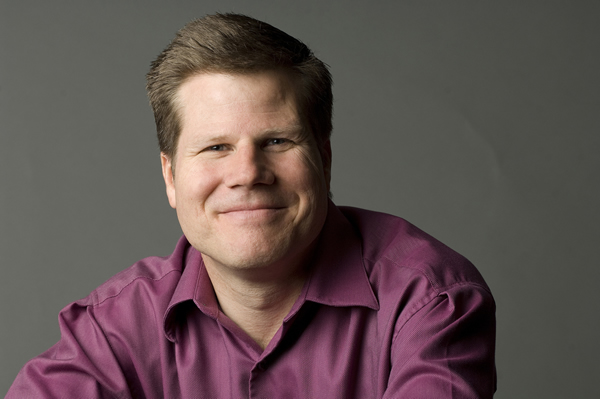
Bill Rauch, director of ‘Roe’ at Arena Stage, says the play has special meaning for LGBT people. (Photo courtesy Arena)
‘Roe’
Jan. 12-Feb. 19
Arena Stage
1101 Sixth St., S.W.
$40-90
202-488-3300
Did you know Jane Roe the plaintiff in the groundbreaking 1973 reproductive rights case Roe v. Wade was in fact a lesbian named Norma McCorvey? This and other insights come out in Lisa Loomer’s new play “Roe” soon opening at Arena Stage after a successful run at the prestigious Oregon Shakespeare Festival.
“For those who know the history it’s important to remember, and for so many people who don’t know the case, it’s revelatory,” says out director Bill Rauch. “The subject is unbelievably timely and urgent in light of election results. Just yesterday I read an article citing that 300 separate restrictions have been passed on abortion at the state level since 2011. The clock is rolling back on reproductive justice.”
“Roe” focuses on the lives of two young women, Norma McCorvey (Sara Bruner), a Texas bartender who wants to end a pregnancy and Sarah Weddington (Sarah Jane Agnew), the lawyer who argued the case before the Supreme Court at age 26, and follows their divergent paths following the landmark decision. The cast also includes Catherine Castellanos as McCorvey’s partner Connie Gonzalez, Richard Elmore as Justice Blackmun, and local Susan Lynskey plays lawyer Linda Coffee.
Loomer’s aim was to give all people access into the story whatever their personal views on abortion, and she’s pulled that off brilliantly according to Rauch. Throughout the evening, audiences will hear many sides of the argument articulated by many different characters. “It’s a difficult feat that might have sent lesser playwrights running,” he says.
“I’m very clear personally about pro-choice views and I feel it’s the job of the director to bring out the humanity in every character,” says Rauch who is married to actor/director Christopher Liam Moore. “It’s pretty rare that someone goes through life thinking they’re the bad guy. In truth, people are fighting for what they believe and that’s what makes the issue so emotional. The question of choice is rooted in people’s world view and sometimes religious belief. It’s been fantastic to work with the cast on a broad range of characters and honor each character’s views.”
“Roe” is part of Oregon Shakespeare Festival’s American Revolutions: United States History Cycle. Launched by Rauch, also the festival’s artistic director, American Revolutions’ goal is to commission 37 new American plays focusing on American moments of change in our country’s past.
The project was inspired by Shakespeare’s history cycle and the company hopes to address the anxieties and hopes of modern life through dramatizing them. So far, 32 of the 37 pieces have been commissioned and 10 have been produced, most at the festival’s home in Ashland, Ore., but some elsewhere such as “Sweat” at Arena and “All the Way,” Robert Schenkkan’s play about Lyndon Johnson and Civil Rights, both on Broadway and at Arena.
“It’s exciting to be part of the national dialogue,” Rauch says.
There are myriad reasons for LGBT audiences to see “Roe,” Rauch says.
“First of all every person should see a play that looks at the history and reality of reproductive justice. I say that hesitantly because it makes it sound like spinach, and it’s not. The work is incredibly entertaining and humor filled. It’s a great ride. For those of us in the queer community given all we’ve dealt with and will continue to deal with, I think it’s especially important to see a work like this.”
He says the lesbian relationship at the center of the play is “truly the heart of the story.”





Theater
National tour of ‘The Notebook’ retains its tearjerking power
Talented queer actor Grace Rundberg joins cast fresh out of college

‘The Notebook’
Aug. 18-30
National Theatre
1321 Pennsylvania Ave., N.W.
$89-$197
Broadwayatthenational.com
When Grace Ohwensadeyo Rundberg first imagined a career in musical theater, she wasn’t sure exactly how she’d fit in. As a gay actor would she play queer characters? Outside of “Rent” and a few other shows, would there be lesbian parts coming her way?
Rundberg, 23, remembers an acting class in college. “I was doing a romantic scene opposite a male actor when the professor interrupted to say it was ‘unconvincing.’ Well, I’d never had the experience of what it’s like to be with a man, so I’m not surprised it looked a little awkward.”
But for Rundberg, being in the national tour of “The Notebook” has quelled those misgivings. Of course, booking the show straight out of college bolstered her confidence, and playing a woman whose love interests are men has put Rundberg in a place where she’s fine playing straight or gay.
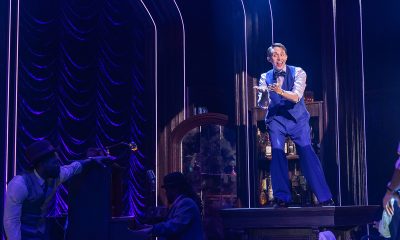
Opening this week in D.C.’s National Theatre (Aug. 18-30), “The Notebook” is a genuine tearjerker (the book, the film, and the musical). It’s the decades long love story of Noah and Allie who despite vast differences, fall in love as teenagers. Over the years, their romance faces separation, societal pressures, the challenges of Alzheimer’s disease, yet somehow prevails.
Shortly after graduating from Pace University’s musical theater program in 2025, the upfront and buoyant Rundberg was signed to play ensemble member Georgie and understudy for Middle Allie (a young woman caught between youthful passion and reflective memory).
A mezze soprano mixed belter experienced with folk, pop, contemporary styles, she proves an ideal performer to sing Ingrid Michaelson score and act Bekah Brunstetter’s romantic libretto.
And when she understudies the role of Middle Allie, whether by scheduled design or insanely short notice, she sings the familiar tune “My Days,” a standout track from the musical that serves as the show-stopping “11 o’clock number.” Here, she captures the emotional climax when Middle Allie chooses the life and loves she desires.
During a musical childhood spent in Pittsford, N.Y, just seven miles outside of Rochester, Rundberg began music classes at four; she learned piano and belonged to choirs. And though, she says, the family was not really into theater, her mom was a Cher impersonator for a while.
Significantly, Rundberg (whose middle name Ohwensadeyo translates from Cayuga as “Beautiful Earth”) is a citizen of the Cayuga Nation, an Indigenous nation native to New York state.
Recently, she began learning the Cayuga language, a very important part of the culture, particularly since it’s almost exclusively a spoken language. Rundberg’s cousin, a professor at Cornell University where he teaches Cayuga language and culture, has been a great help. She feels fortunate: “Not everyone has access to their ancestry I’m blessed in this way.”
The Brooklyn-based actor’s ambitions are bold and varied. While landing a national tour was high on her bucket list, she longs to work on Broadway and auditions for TV and film. Being the first to create a character in a new work, especially a lesbian character, is a big goal. “That would tie a lot of things together,” she says. “That’s the ultimate dream.”
In the meantime, Rundberg is working professionally and seeing the country. But touring isn’t without its drawbacks. “I miss New York a lot,” she says. “My girlfriend is there; long distance is a challenge for sure. I’m always in a different place often with different time zones. Still, she has come to see me in San Francisco, Miami, Cleveland, and a few other stops. And I fly to New York when I can. We make it work.”
As a kid, Rundberg watched and rewatched the movie version of ‘The Notebook.’ She says, “It’s one of my favorites. It’s kind of a cliché, I know, but I’m a hopeless romantic.”
The show touches a lot of people; it’s evident at every performance. From the stage, the cast sees audience members crying. In fact, “The Notebook” sells branded souvenir tissue boxes at its merchandise stands for five dollars a pop.
“Beyond elements of sadness there’s also joy,” she adds. “There’s the never-ending devotion and getting through hard times together too. We do our best to send the audience home with hope and love.”
Theater
Don’t miss summer productions at Clear Space in Rehoboth Beach
‘Cher Show,’ ‘Pretty Woman’ among season’s standouts
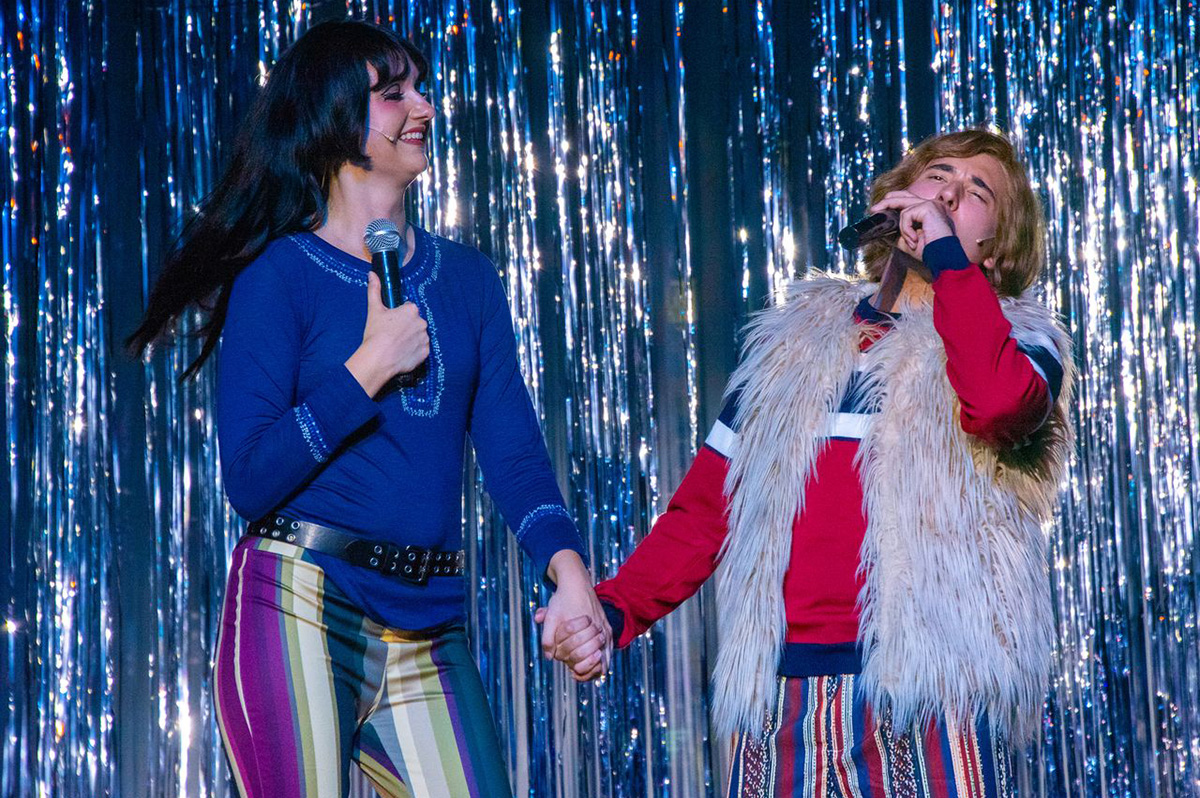
“The Cher Show” at Clear Space Theatre is wonderful. I am always amazed at the talent they attract for their summer series. Kudos to Wes Drummond, the artistic director of the theater. “The Cher Show” is written by Rick Elice. Compliments to the talented director, James FitzSimmons, who brought to life this production. His immensely talented cast includes Shannen Hofheimer as Star, Breanna Lemerise as Lady, Abby Lynne as Babe, and Anya Kay, as young Cher. Each is a pleasure to both watch and listen to. They command the stage. Then more kudos to the entire cast and ensemble. Also, the creative team, which includes among so many who make this show a hit, choreographer Shondelle Graulich; scenic designer, David Chappell; lighting designer Brendan Smith; costume designer Valerie Beardsley; and the entire orchestra led by conductor, Jerry Birl.
But the actor who I was looking forward to seeing in the production, was a young actor I had written about, and reviewed, when I saw him at Clear Space two years ago. In this production he is Sonny Bono, and he definitely didn’t disappoint.
Let me introduce Caetano de Sá. I have written about him before, but his resume is worth repeating. It says; Height: 5’7 ½, Eyes: Brown, Voice part: Tenor G2 – C5, Build: Athletic. All true. Then you add to this he speaks Brazilian Portuguese, is certified in stage combat by the Society of American Fight Directors, and is a 2nd Degree Black Belt in Taekwondo. Then as his resume of roles confirms, he can act, sing, and dance with the best. He does a great job as Sonny and is fun to watch on stage. Here he displays his talents as a singer and actor, and they are as good as I remembered them when I first met Caetano while he was still in school in 2024, and was starring as Frankie Valli in “Jersey Boys,” at Clear Space. At the time he was a rising senior at the Boston Conservatory at Berklee BFA Musical Theater program. I interviewed him, and Harry Sperduto, who played Tommy Devotee, after seeing them in the show, and being amazed by their talent. Since that time, I have followed their careers. When I heard Caetano was coming back to Clear Space for the summer, I reached out, and he agreed to sit down and chat, which we did. I knew Clear Space Theatre was planning a busy summer season. Their lineup of shows included “The Cher Show,” “Mean Girls,” and “Pretty Woman.” They always have talented casts, including the many college students who are getting their first chance to shine, which was the case for Caetano in 2024. Now he is back as a graduate, with more experience under his belt, a little more established. This season he was going to play Sonny in their production of “The Cher Show,” Martin/Coach Carr, in “Mean Girls,” and Mr. Hollister in “Pretty Woman,” and being a part of the ensemble. He told me he really enjoys being at Clear Space, and that his castmates are all talented. He is a lot more experienced than when he was here before, having performed in productions at the Prairie Repertory Theatre, the Emerald Coast Theatre Company, Firehouse Center for the Arts, and the Sullivan Rep, among others. In productions as diverse as “Oklahoma!,” “Mystic Pizza,” “Hairspray,” and “Rock of Ages.” He now lives in New York City and clearly New York is the perfect place for an aspiring actor. He has an agent at Bramante Artists, who is getting him gigs, like the one he had at 54 Below and even a TV commercial for AFLAC.
“The Cher Show” is the second show I have seen at Clear Space this summer. After our chat I got one of the last tickets available that evening for “Pretty Woman.” In that production he has a smaller role, and is part of the incredibly talented ensemble. It is also an entertaining show and its very talented stars, Abby McDonough as Vivian, and Jaiden Leo Riley as Edward, are a pleasure to watch. Kudos to the talented director, Ashley Williams, and the entire creative team.
For anyone living at the beach, or coming for a visit, I urge you to plan a night at Clear Space. You won’t regret it. But know tickets for all the shows, and Sunday evening cabaret nights, sell out fast. So, I suggest you see what’s available online and buy yours today.
Theater
Reggie White relishing first season as artistic director of Woolly Mammoth
First five shows a reminder that ‘pressure is a privilege’
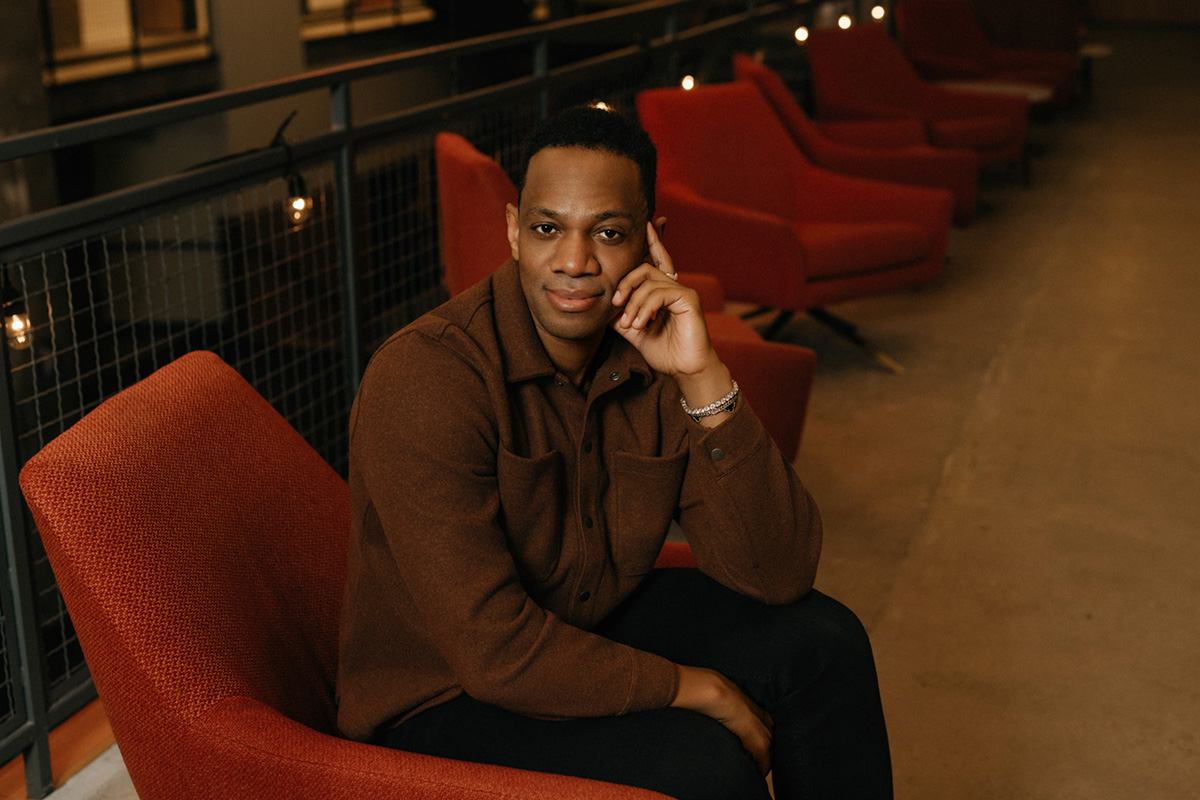
Madly talented and preternaturally energetic, Reggie D. White, 38, is about to launch his first season as artistic director of D.C.’s boundary-pushing Woolly Mammoth Theatre Company.
White brings a lot to the job. As actor, playwright, and director, his varied resume includes a 2019 Broadway acting debut in Matthew López’s Tony Award–winning play “The Inheritance,” his semi-autobiographic play “Fremont Ave.” that opened to acclaim last season at Arena Stage, and a number of exciting regional directing credits.
A longtime admirer of Woolly, the out theater-maker was selected from a pool of candidates before receiving the offer last November and starting work in January. His season of five world premieres kicks off with gay playwright Steve Yockey’s “Venus” (Sept. 9-Oct. 4), a darkly funny study of modern relationships told through two lesbians looking back on their first encounter.
White was introduced to Woolly Mammoth as a pre-law student at Cal State Hayward in the San Francisco Bay Area, long before he foresaw a life in the arts. “As part of a random theater history course, I was assigned to write a paper on a counterculture company called Woolly Mammoth,” he recalls “Strange name. I was like what the hell is that?”
Nineteen-year-old White was intrigued. Research acquainted him with Howard Shalwitz who co-founded Woolly in 1980, and the company’s commitment to living playwrights and new work. He also learned how theater could be used as a tool for difficult conversations and shape the way people thought about social issues by employing imagination and rigor.
“Never in a million years did young me envision that one day I’d be Woolly’s third artistic director in its 46-year history,” says White. “It’s kind of serendipitously insane.”
WASHINGTON BLADE: Was there a moment when the enormity of the job hit you?
REGGIE D. WHITE: After I’d signed my contract and finished all the paperwork, I got my keys and sat in the theater by myself in the dark and thought about what an incredible honor it is to be trusted with what happens in this beautiful space [in D.C.’s Penn Quarter]. I might have cried. Sometimes I have to pinch myself to remember it’s real.
BLADE: Are you curating the upcoming 2026–2027 season?
WHITE: Yes, I am. It’s very rare that an incoming artistic director gets to program their first season, but I was lucky in terms of time. After being hired late last year, I asked Woolly’s managing director Kimberly E. Douglas, if she thought it would be crazy if I programmed the season. She warned me it would be hard.
I invoked tennis legend Billie Jean King’s maxim “pressure is a privilege” and got to work.
These plays [dubbed White’s “first five”] represent both the kind of theater that Woolly can do really well and speak directly to my voice as curator and how I want to contribute to the larger theatrical conversation in the DMV.
Getting here has meant a lot of late nights. But I knew the juice would be worth the squeeze.
BLADE: As a queer artistic director, what makes you unique?
WHITE: When I was playing in “Inheritance” on Broadway, after a performance, U.S. Supreme Court Justice Sotomayer came backstage to meet the cast. She spoke about how her lens on the world as a Puerto Rican woman shapes her decisions. Similarly, because I’m a queer Black man I see through a lens that shapes my work.
I know I’m not the only queer artistic director in town. For me, it influences how I make editorial decisions. Out of this season’s five plays there are explicitly queer characters in four [“Venus,” “Chanukkah Spectacular,” “Ten Grand,” and “Love I Awethu Further”] and I’m directing two [“Venus,” “Ten Grand”].
BLADE: Will we see familiar faces?
WHITE: Every show this season will feature a Woolly Mammoth company member in its cast. Our company also includes designers and directors who we’ll include. I’m invested in continuing to provide a showcase for their work.
BLADE: How do you think queer audiences will receive the season?
WHITE: Very well, I think. For queer people who’ve had to navigate the world subversively and solve problems in unique ways, I think it will be especially interesting. I find theater a potent place for questions.
Like all artistic directors. I’ll show up for the job in my own way. I’m just excited that I’ve been invited to bring the fullness of myself to the role.

Log Cabin Republicans remove transgender rights from mission

Not all trans people are the same

Queer team brings girl power to fully baked ‘The Wrong Girls’

Democrat Maureen ‘Mo’ Madden takes on longtime GOP stronghold in Delaware’s 38th

Comings & Goings

PHOTOS: Nellie’s Drag Brunch

Remembering Barbara ‘Boo’ Price, a pioneering force in women’s music

Russian LGBTQ rights group to shut down

Winsome Earle-Sears ‘Life and Marriage Tour’ to include Northern Va. stops