Arts & Entertainment
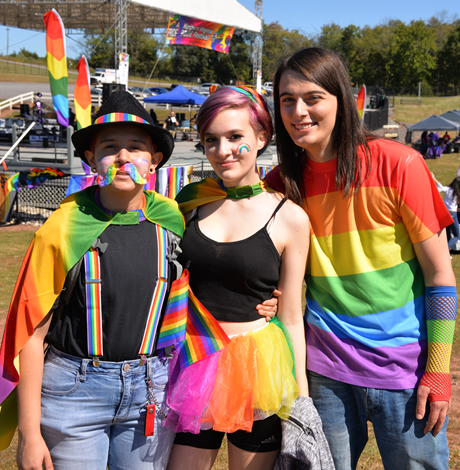
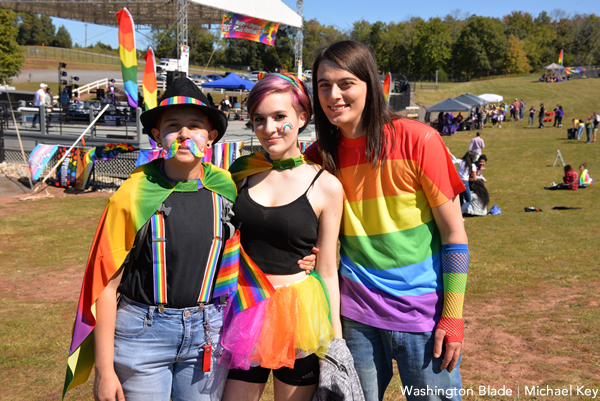
Smaller regional Prides plan virtual, postponed events
NOVA, Frederick, Annapolis et. al. thinking outside the box in pandemic’s wake
Washington
Capital Pride #StillWe launches a virtual series of streamed events June and beyond through a partnership with The D.C. Center.
Programs include monthly online town halls, expanded resources available through its website and a shared community calendar. Pride 2020 Reimagined includes new Pride month programming as well as ongoing virtual versions of the D.C. Center’s Reel Affirmations film series, Outwrite Literary Festival and more.
For more information and a listing of events, visit capitalpride.org and thedccenter.org.
This weekend would typically be D.C. Youth Pride weekend (although they had their 2017 in the fall). No virtual events are listed on either the Youth Pride Alliance website or Facebook page. Organizers did not immediately respond to Blade request for details.
D.C. Leather Pride has been postponed until further notice.
D.C. Trans Pride and Silver Pride (60 and older), usually held in May, may have fall events.
Maryland
Annapolis Pride has cancelled its second annual parade and festival due to COVID-19 concerns and gathering restrictions. But in its place will be an online event live-streamed via YouTube and Facebook on June 27 at 4 p.m. Participants are encouraged to turn their home into a “float” and show off Pride-themed outfits during the virtual event. Visit annapolispride.org to register and for more information.
Baltimore Pride 2020, originally scheduled for Saturday, June 20, has been postponed to either August or September, depending how the COVID-19 situation in Maryland and globally unfolds. The community is encouraged to monitor the Baltimore Pride website for further updates.
Frederick Pride events have been postponed due to pandemic concerns. On Sunday, Oct. 4 at 11 a.m. the rescheduled parade will travel along Carroll Creek Linear Park in historic downtown Frederick. Vendor registration is now open at frederickpride.org. News about Pride events and entertainers will be posted at a later date.
Howard County Pride has been postponed due to the spread of the coronavirus. However, they are planning virtual drag queen story times, poetry slams, a talent show and other virtual events throughout Pride month. For more information, email [email protected] or visit howardcountypride.org.
Hagerstown Pride plans a virtual Pride Festival on Saturday, July 18 at 11:30 a.m. Details at hagerstownhopesmd.org.
Virginia
Hampton Roads Pride announced on its Facebook page a decision to postpone its 32nd Annual PrideFest, ninth annual Pride Block Party and second annual Pride at the Beach all scheduled for June 19-21, 2020 due to pandemic-related health concerns. New dates have not been announced.
However, Pride Night at Harbor Park hosted by Hampton Roads Pride and the Norfolk Tides has been rescheduled to August 26 at 7 p.m. Tickets start at $13 on Ticketmaster. Continue to monitor this event’s Facebook page for any changes due to COVID-19.
Ghent Pride, presented by the Ghent Business Association and Hampton Pride, has not announced dates for this year’s event. The public is invited to monitor ghentpride.com and its Facebook page for updates as pandemic guidance evolves.
Winchester Pride is scheduled for Saturday, Oct. 24 at noon in the Downtown Walking Mall. Its third annual Pride celebration will include guest speakers, entertainment and more. For details and information about this event, the Miss Winchester Pride Pageant scheduled for Saturday, Aug. 29, or for possible postponements or adjustments, visit winchesterpridecelebration.com.
No word yet from NOVA Pride, usually held in August. Check later at novapride.org.
Reston Pride is cancelled.
Shenandoah Valley Pride hopes to have its event on Saturday, Sept. 19 from noon-6 p.m. Details at shenandoahvalleypride.org.
VA Pride (Richmond) is also looking to fall with a Sept. 26 event. Details at vapride.org.
West Virginia
Eastern Panhandle Pride in Shepherdstown, W.Va., is postponed indefinitely. Look for the organization on Facebook later in the year for updates. “Alternatives” are being considered, organizers said.
International
Global Pride is June 27 and is an international response to multiple Pride cancellations due to the ongoing global health crisis. This first-ever gathering of the worldwide LGBTQ community includes an impressive slate of speakers to include the President of Costa Rica, Prince Manvendra Singh Gohil of India and more. The show will be livestreamed on the Global Pride website and YouTube, and will be free to view. More information is available at globalpride2020.org.

Celebrity News
Madonna makes rare club appearance in West Hollywood
Gay icon brought ‘Confessions II’ to The Abbey
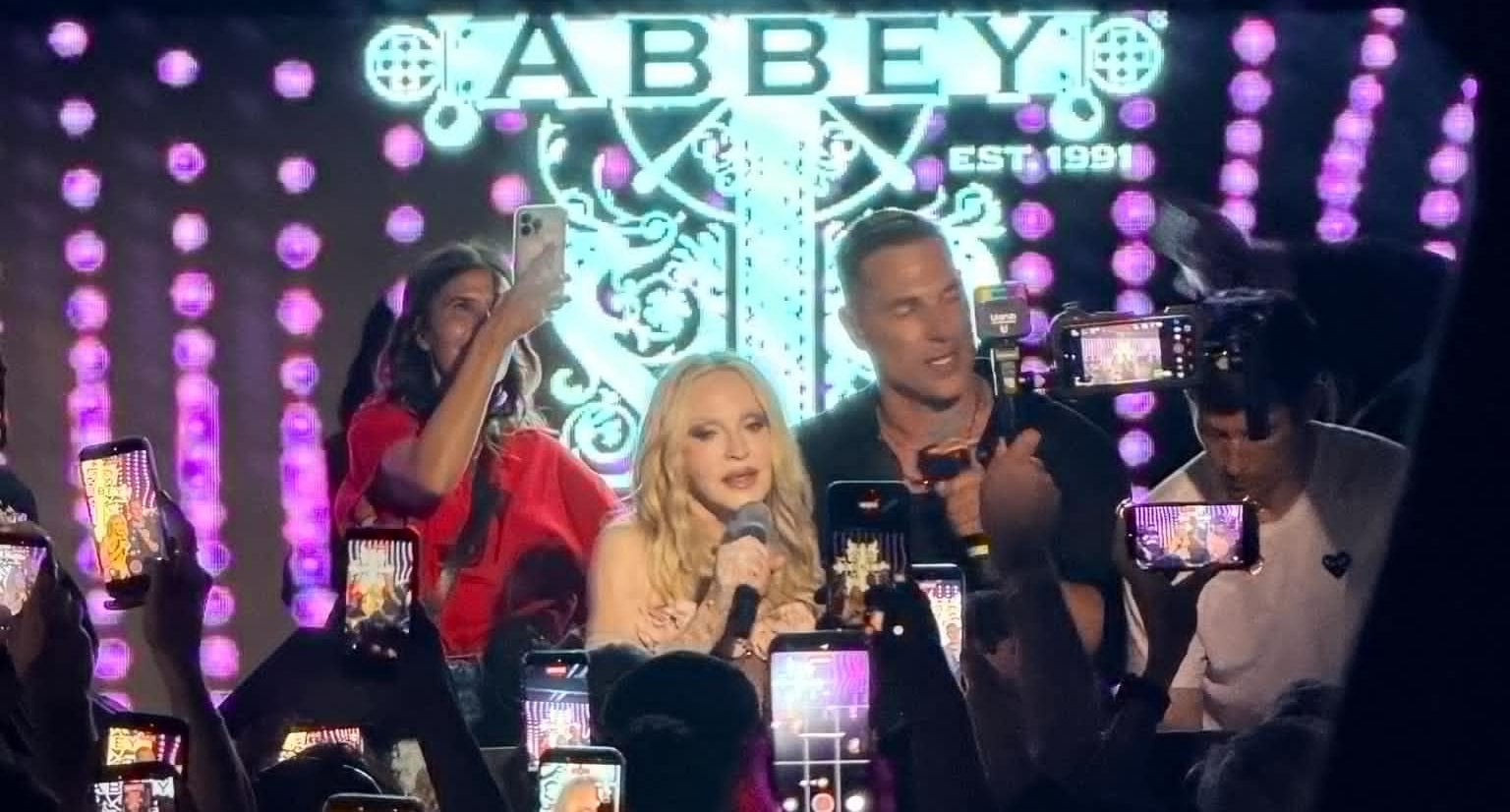
A line of celebrities, “Drag Race” queens, influencers, media, and West Hollywood socialites lined the block around West Hollywood’s The Abbey, all clamoring to get into the invite-only celebration of owner Tristan Schukraft’s birthday. The rumor, which became verified gossip, was that Madonna, the Queen of Pop herself, would be taking the stage. Of course, the Blade had to be there.
With disco balls and Abbey statues covered in pink chiffon, it was clear. This party was a direct tie-in to Madonna’s much-anticipated “Confessions on A Dance Floor” album sequel, “Confessions II.” That night, the Abbey also unveiled its remodeled dance floor, a fitting collaboration.
The club was filled to capacity with a completely open bar, keeping the crowd liquored up. Go-go dancers in black leather collars and thongs lined the room, and celebrities that included Lilly Allen, Bebe Rexha, Tori Spelling, Julia Fox, Sam Asghari, Daniel Frenzese, Cynthia Bailey, Meredith Marks, Tom Daley, and more filled the VIP booths alongside World of Wonder personalities. It was a veritable who’s who of queer folk and allies.
The lights began to dim, the dance floor began to rumble, and Madonna graphics hit the screens. At around 1 am, it was time. Introduced by Addison Rae, Madonna grabbed the mic and started chanting, welcoming her “gays.” The venue resounded in thunderous chants of “freedom,” “mother,” and “bitch.”
Madonna was not there to perform. She was there to dance. She took the stage for about 15 minutes, keeping the crowd going with her naughty and fun commentary. There is no list that needs to be provided on how Madonna’s career has become part of queer culture. Going back to her dance music roots and going back to her gay fans is smart.
Released in 2005 (yes, it has been that long), “Confessions on a Dance Floor” was an instant hit, with four singles from the album being released. The album’s lead single, “Hung Up,” topped the charts in 41 countries with Billboard calling it the most successful dance song of the decade. The album had hints of 60s and 70s flair, mixed in with dance music prevalent at that time. The music still dominates at queer clubs across the globe.
Madonna knows we need a little queer joy; she also knows that fans miss the Madonna we all knew and loved. With the nation in such turbulence, we all need some comfort, and going back to a time when we felt safer and had more to celebrate just feels good. For the new album release, she has even partnered with Grindr for a limited edition vinyl release and exclusive behind-the-scenes content.
Her night at The Abbey presented snippets of her new music mixed in with some of her classics. The new material sounded good, sounded familiar in an exciting way, and shows that this diva has still got it.
“Confessions II” releases on July 3.
Theater
World premiere of ‘Everything, Devoured’ oozes queer energy
Nonbinary playwright Katherine Gwynn delivers ferocious ghost story
‘Everything, Devoured’
Through May 10
Nu Sass Productions
Sitar Arts Center
1724 Kalorama Road, N.W.
$25 (general admission)
Nusass.com
As if the world weren’t already hideous enough, Kore, the trans woman protagonist in nonbinary playwright Katherine Gwynn’s “Everything, Devoured,” wants to summon a demon to her humble Chicago apartment. While her friends think it’s just a bit of afterwork fun akin to reading horoscopes or Tarot cards, Kansas born Kore is dead serious.
Nu Sass Productions’ world premiere of Gwynn’s play oozes queer energy. Messages come across as if delivered by blow horn. It’s not afraid of expository dialogue or padding a singular moment of queer joy.
In a truly intimate black box at Sitar Arts Centers in Adams Morgan just down the block from Harris Teeter, scenic designer Simone Schneeberg deftly creates the generic flat whose ordinariness is only overshadowed by some weak attempts at individuality, but that’s all about to change.
Plans have been made, and Kore (June Dickson-Burke) has invited her nearest and dearest to her place.
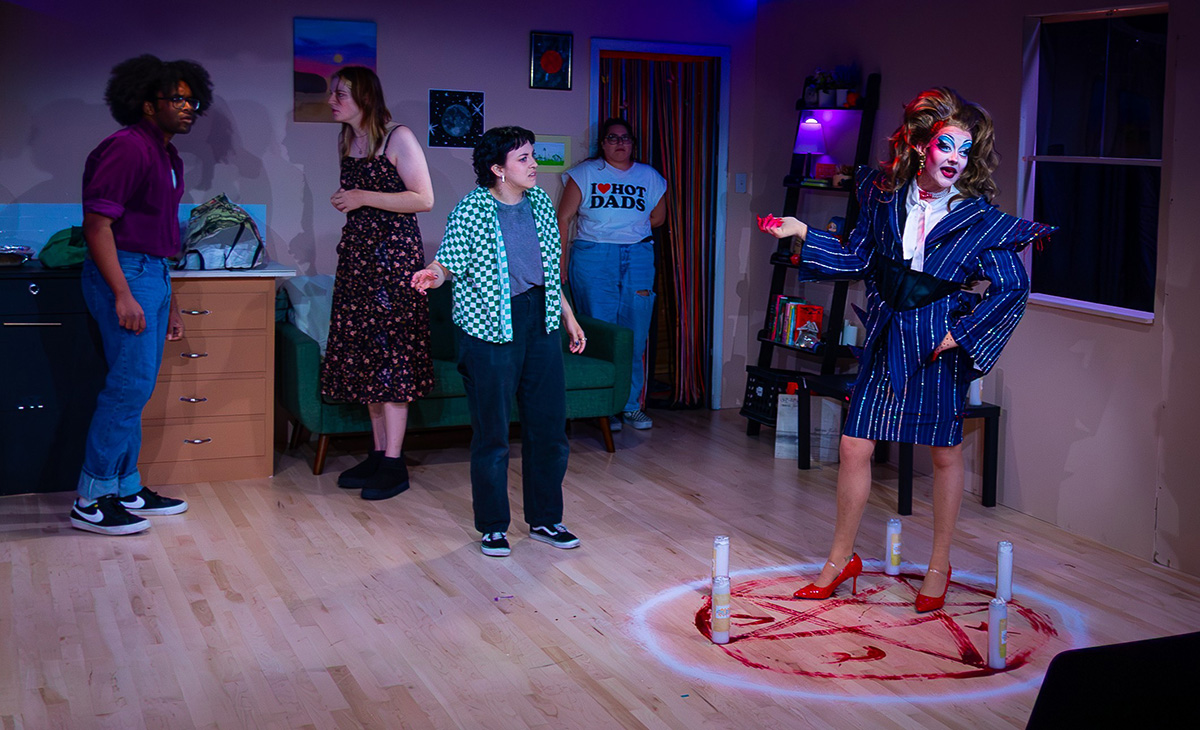
Her nonbinary lesbian partner Julian (Tristan Evans) has cheap red wine and weed on the ready. Dinner is in the oven. Soon, lively trans masc bestie Dante (Selena Gill) arrives bearing a hostess gift – it’s the specially requested bag of pig blood, integral to the evening’s fun. In little time, the twentysomething friends will have painted a pentagram circled with salt in the middle of the living room floor. Candles are lit. Sacred words are spoken.
Shifts in light and sound by designers Vida Huang and Di Carey, respectively, signal contact with the beyond. Much to the friends’ surprise, they’ve successfully summoned a demon and it’s a real doozy: Ronald Reagan as demon drag queen.
Costumed in a corseted pinstripe suit adorned with a few Gaultier cones, the pronoun-less guest star from the underworld makes quite an entrance – a full-on lip sync to Madonna’s “Vogue” replete with huge flashing eyes, an evil smile and darting tongue.
Spectacularly played by O’Malley Steuerman (“actor, DRAGster, playwright, and producer from Baltimore”) Ronald Reagan as demon drag queen is lewd, taunting, and reads with the kind of sharp wit that puts other queens in the shade.
The entertainment doesn’t stop there. Soon, the demon is juggling provocative props (fleshy dildo, a baby doll, and a copy of Marx) or performing sock puppetry to a 1982 recording of journalist Lester Kinsolving asking about the “gay plague” to which Reagan’s Press Secretary Larry Speakes charmingly replies, “I don’t have it … do you?” That proved a real knee slapper in the pressroom.
Throughout the play’s early scenes, a young man sits unnoticed at Kore’s kitchen counter. Now and then, he comments with a disapproving harrumph or a distinctly gay one-liner. He’s privy to all, but the lady of the house is unaware of him until he joins the party. His name is Michael (Christian Harris). He died in 1989 and has been hanging around ever since.
Wry and undeniably spectral, Michael is the play’s link to queer past. He remembers the hurts and horrors of the AIDS epidemic, but not so much about the emergence of ‘genderqueer’ as an identity label, reflecting a shift toward a broader gender spectrum. That came later.
Without doubt, the uniformly queer cast is committed. They play their queer characters with authenticity, lending a realness to queer people’s valid concerns and fears in the current atmosphere. (For instance, anarchist/barista Dante accuses Julian of hiding out in their safe role of social worker at a nice nonprofit; and Kore speaks about the fear surrounding the Kansas bill making it illegal for transgender people to display their gender on a driver’s license.)
Based in Chicago, Gwynn has written a queer play with a punch; and prior to ever being staged, this new work was prestigiously named both a 2025 O’Neill Semi-Finalist as well as 2025 Bay Area Playwrights Festival Finalist.
Billed as a ferocious queer ghost story, “Everything, Devoured” doesn’t disappoint. In the hands of queer co-directors Tracey Erbacher and Ileana Blustein, Gwynn’s fevered yet thoughtful and quick paced but penetrating piece unfolds compellingly.
Intuitive staging and chemistry among players, especially two hander scenes involving Kore, display a quiet intensity that feels true to life. Other scenes bring out the anger, protectiveness and some divisiveness among the friends. Gwynn’s informed and powerful writing is brought to the fore.
Nu Sass Productions has been uplifting women and marginalized genders in all aspects of theater since 2009. The company’s two-part name stems from “Nu” (Chinese for woman) and “Sass” (sassy).
Its latest offering fits the bill and then some.

Sir Ian McKellen may now be known as much for being a champion of the international LGBTQ equality movement as he is for being a thespian. Out and proud since 1988 and encouraging others in the public eye to follow his lead, he’s a living example of the fact that it’s not only possible for an out gay man to be successful as an actor, but to rise to the top of his profession while unapologetically bringing his own queerness into the spotlight with him all the way there. For that example alone, he would deserve his status as a hero of our community; his tireless advocacy – which he continues even today, at 86 – elevates him to the level of icon.
Those who know him mostly for that, however, may not have a full appreciation for his skills as an actor; it’s true that his performances in the “Lord of the Rings” and “X-Men” movies are familiar, however, this is a man who has spent more than six decades performing in everything from “Hamlet” to “Waiting for Godot” to “Cats,” and while his franchise-elevating talents certainly shine through in his blockbuster roles, the range and nuance he’s acquired through all that accumulated experience might be better showcased in some of the smaller, less bombastic films in which he has appeared – and the latest effort from prolific director Steven Soderbergh, a darkly comedic crime caper set in the dusty margins of the art world, is just the kind of film we mean.
Now in theaters for a limited release, “The Christophers” casts McKellen opposite Michaela Coel (“Chewing Gum,” “I May Destroy You”) for what is essentially a London-set two-character game of intellectual cat-and-mouse. He’s Julian Sklar, an elderly painter who was once an art-world superstar but hasn’t produced a new work in decades; she’s Lori Butler, an art critic and restoration expert who is working in a food truck by the Thames to make ends meet when she is approached by Sklar’s children (James Corden, Jessica Gunning) with a proposition. Hoping to cash in on their father’s fame, they want to set her up as his new assistant, allowing her access to an attic containing unfinished canvases he abandoned decades ago – so that she can use her skills to finish them herself, creating a forged series of completed paintings that can be “posthumously discovered” after his death and sold for a fortune.
She takes the job, unable to resist an opportunity to get close to Sklar – who, despite his renown, now lives as a bitter and unkempt recluse – for reasons of her own. Though his health is fading, his personality is as full-blown as ever; he’s also still sharp, wily, and experienced enough with his avaricious children to be suspicious of their motives for hiring her. Even so, she wins his trust (or something like it) and piques his interest, setting the stage for a relationship that’s part professional protocol, part confessional candor, and part battle-of-wits – and in which the “scamming” appears to be going in both directions.
That’s it, in a nutshell. A short synopsis really does describe the entire plot, save for the ending which, of course, we would never spoil. Even if it’s technically a “crime caper,” the most action it provides is of the psychological variety: there are no guns, no gangsters, no suspicious lawmen hovering around the edges; it’s just two minds, sparring against each other – and themselves – about things that have nothing to do with the perpetration of artistic forgery and fraud, but perhaps everything to do with their own relationships with art, fame, hope, disillusionment, and broken dreams. Yet it grips our attention from start to finish, thanks to Soderbergh’s taut directorial focus, Ed Solomon’s tersely efficient screenplay, and – most of all – the star duo of McKellen and Cole, who deliver a master class in duo acting that serves not just as the movie’s centerpiece but also its main attraction.
The former, cast in a larger-than-life role that lends itself perfectly to his own larger-than-life personality, embodies Sklar as the quintessential misanthropic artist, aged beyond “bad boy” notoriety but still a fierce iconoclast – so much so that even his own image is fair game for being deconstructed, something to be shredded and tossed into fire along with all those unfinished paintings in his attic; he’s a tempestuous, ferociously intelligent titan, diminished by time and circumstance but still retaining the intimidating power of his adversarial ego, and asserting it through every avenue that remains open to him. It’s the kind of film character that feels tailor-made for a stage performer of McKellen’s stature, allowing him to bring all the elements of his lifelong craft in front of the camera and deliver the complexity, subtlety, and perfectly-tuned emotional control necessary to transcend the cliché of the eccentric artist. His Sklar is comedically crotchety without being doddering or foolish, performatively flamboyant without seeming phony, and authentic enough in his breakthrough moments of vulnerability to avoid coming off as over-sentimental. Perhaps most important of all, he is utterly believable as a formidable and imperious figure, still capable of commanding respect and more than a match for anyone who dares to challenge him.
As for Coel’s Lori, it’s the daring that’s the key to her performance. Every bit Sklar’s equal in terms of wile, she also has power, and yes, ego too; we see it plainly when she is deploys it with tactical precision against his buffoonish offspring, but she holds it close to the chest in her dealings with him, like a secret weapon she wants to keep in reserve. When he inevitably sees through her ploy, she has the intelligence to change the game – her real motivation has little to do with the forgery plan, anyway – and get personal. Coel (herself a rising icon from a new generation of UK performers) plays it all with supreme confidence, yet somehow lets us see that she’s as wary of him as if she were facing a hungry tiger in its own cage.
It’s after the “masks” come off that things get really interesting, allowing these two characters become something like “shadow teachers” for each other, forming a shaky alliance to turn the forgery scheme to their own advantage while confronting their own lingering emotional wounds in the process; that’s when their battle of wits transforms into something closer to a “pas de deux” between two consummate artists, both equally able to find the human substance of Soderbergh’s deceptively cagey movie and mine it, as a perfectly-aligned team, from under the pretext of the trope-ish “art swindle” plot – and it’s glorious to watch.
That said, the art swindle is entertaining, too – which is another reason why “The Christophers” feels like a nearly perfect movie. Smart and substantial enough to be satisfying on multiple levels, it’s also audacious enough in its murky morality to carry a feeling of countercultural rebellion into the mix; and that, in our estimation, is always a plus.

Rep. Sarah McBride reflects on first year in Congress amid political backlash

U.S. Attorney’s Office fails to reinstate hate crime charge in anti-gay assault

Baltimore Heritage wants Md. LGBTQ historical sites added to National Registry

Democracy Forward files FOIA request for State Department bathroom policy records

House Republicans push nationwide ‘Don’t Say Gay’ bill

Why we need to recognize and celebrate Lesbian Day of Visibility

Prominent activists join ‘Living History’ panel at Freddie’s Beach Bar

BREAKING NEWS: Shots fired at the White House Correspondents’ Dinner

Community mourns passing of D.C. trans rights advocate SaVanna Wanzer

An acting legend meets his match in ‘The Christophers’
-

 Opinions5 days ago
Why we need to recognize and celebrate Lesbian Day of Visibility
-
Virginia5 days ago
Prominent activists join ‘Living History’ panel at Freddie’s Beach Bar
-
National4 days ago
BREAKING NEWS: Shots fired at the White House Correspondents’ Dinner
-
District of Columbia4 days ago
Community mourns passing of D.C. trans rights advocate SaVanna Wanzer