Theater
Non-binary actor wins Helen Hayes Award
Temídayo Amay was Gifty in ‘School Girls; or, the African Mean Girls Play’
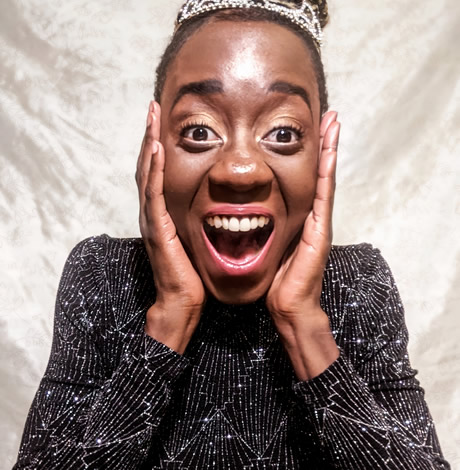

This time last year, non-binary actor Temídayo Amay was delighting audiences as Gifty, in Round House Theatre’s production of Jocelyn Bioh’s “School Girls; or, the African Mean Girls Play.”
The rangy actor gave a terrific comedic turn as a minion to the top girl at a boarding school in Ghana in 1986 where cliques, beauty pageants and skin tone were the chatter of the day.
For their efforts, Amay won a Helen Hayes Award for Outstanding Supporting Performer in a Play—the honor was presented via Zoom earlier this month (postposed from May because of Covid-19). Although this year’s awards were adjudicated through a binary lens, they were presented through a gender inclusive format. Next year will be different.
Washington-based Amay, 26, grew up in suburban Maryland, earned a BA in theater from the University of Maryland, and soon after began her career. In addition to working at Round House, their crowded bio boasts gigs at the Kennedy Center, Studio Theatre and Woolly Mammoth Theatre Company to name a few.
In a recent interview, Amay expresses gratitude and a hopeful yet savvy look forward in uncertain times.
WASHINGTON BLADE: Congrats on your Helen Hayes Award.
TEMÍDAYO AMAY: Thanks, I’ve been riding a wave of good energy since I got it. Basking in the memory, the moment, and excited to see what’s ahead.
BLADE: Your acceptance speech stood out as particularly heartfelt and poignant.
AMAY: Actually, I misplaced my prepared speech not long before my name was announced, so I spoke from the heart. I’m grateful for the global embrace of black queer, trans, and gender expansive people that is happening right now. Specifically, what’s happening in the entertainment industry. It means a lot to me and I’m very grateful to be a part of it—a lot of people have laid the groundwork over many, many years. I wanted to use that moment to encourage people to support the projects of these storytellers.
BLADE: Tell us about Gifty.
AMAY: The part came at a rough time for me. I’d just officially come out as nonbinary and was finding out what that meant and what it would look like career wise. When I was cast as Gifty and things began to come together.
BLADE: Has coming out as nonbinary affected how you’re cast?
AMAY: I’m grateful to continue to be cast in roles for ciswomen as well as parts specifically written for non-binary and gender expansive actors.
The parts are out there, more every day. As people are finding the space to understand the nonbinary experience, it’s being increasingly explored. Also, there’s some reimagining of characters from existing plays, offering more insight into the character and the depth of that human being.
I’ve been asked to audition for traditionally male roles, Puck from “A Midsummer Night’s Dream” for instance, but I’m more of a Helena or Hermia.
BLADE: When did you first want to act?
AMAY: There was a never a time I didn’t like performing. I was always entertaining family and friends in the living room or at mosque, but I got my first real part in the sixth grade at middle school. Then just two weeks before the performance date, the director replaced me. It was heart shattering. I vowed then to one day show the director what a mistake he’d made.
BLADE: Has the pandemic stalled your career?
AMAY: Quarantine gave me time reevaluate what I wanted to do. It gave me time to re-open to film and music, to remember myself as the kid sitting in front of the TV and watching “The Mask” with Jim Carrey. I’ve also been writing songs, and recorded my first music video—it’s Afro-house sound and is set to launch next month.
BLADE: And other immediate plans?
AMAY: Besides doing my part to help flatten the curve—I wear a mask and social distance—I’m writing a series about Ope, a young non-binary character who is exploring issues of intimacy. It’s an opportunity to talk about things that most audiences haven’t seen.
The Helen Hayes Awards finale ceremony, presented and produced by theatreWashington, will be celebrated virtually Friday, Sept. 25, and afterward at theatreWashington.org.






Theater
National tour of ‘Gatsby’ comes to National Theatre
Out actor Edward Staudenmayer talks playing the show’s gangster
‘The Great Gatsby’
May 12-24
The National Theatre
1321 Pennsylvania Ave., N.W.
$59-$196
Thenationaldc.com
Often dubbed “The Great American Novel” for its depiction of ambition and self-invention alongside the reversals of success, F. Scott Fitzgerald’s “The Great Gatsby” says it all in a fast read.
Set against the excesses and energy of the Roaring Twenties, “The Great Gatsby,” novel and now the same-titled hit Broadway musical with a jazz/pop original score by Jason Howland and Nathan Tysen, tells the story of Nick Carraway and his friendship with Jay Gatsby, an enigmatic millionaire intent on reuniting with ex-lover, Daisy Buchanan.
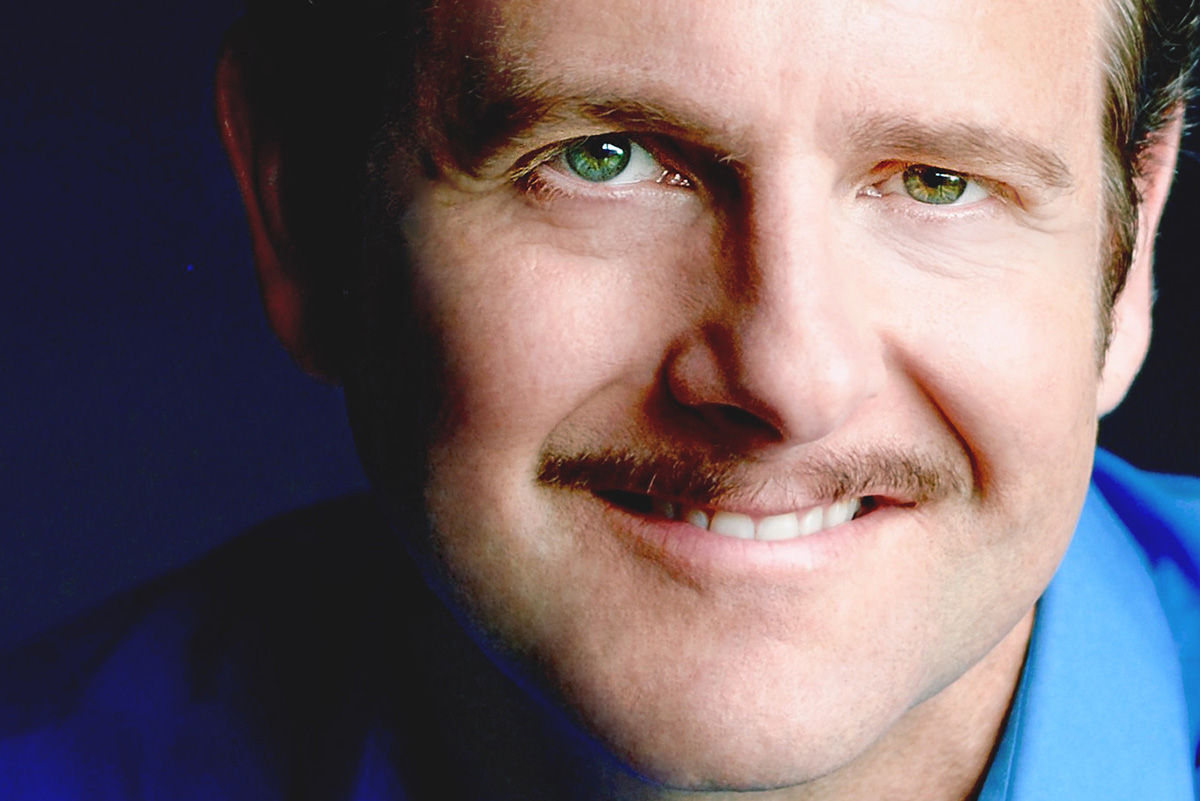
It was during a four-month 2025 run in Seoul, South Korea, that out actor Edward Staudenmayer first played the show’s heavy, Meyer Wolfsheim, a gangster who helped Gatsby make his murkily acquired fortune. As Meyer, Staudenmayer opens the second act with, appropriately enough, “Shady.”
Now three months into a year-long North American tour, the show is poised to enjoy a brief run at Washington’s National Theatre (5/12-5/24).
While putting on his eyeliner prior to a recent Wednesday matinee at Chicago’s Cadillac Palace Theatre, the upstate New York-based actor shared about Gatsby and a life in theater.
WASHINGTON BLADE: Despite your good looks and terrific voice, you’re rarely the leading the man. How is that?
EDWARD STAUDENMAYER: I’m definitely a character man. I’ve been painting lines on my face to play old men since I was in high school. I was the youngest freshman in college playing old Uncle Sorin [in Chekhov’s “The Seagull”].
There have been many villains. Some darker than others. Meyer Wolfsheim is a very bad guy, but he doesn’t haunt me once I’m offstage. I play a lot of pickleball.
BLADE: Is it true that like so many of Fitzgerald’s characters, Wolfsheim is famously based on someone the writer encountered in life.
STAUDENMEYER: That’s true, Wolfsheim is pretty much a direct portrayal of real-life mobster and 1919 World Series fixer [Arnold Rothstein].
BLADE: When did the 1925 novel first surface on your radar?
STAUDENMAYER: Like many of us, I was assigned “The Great Gatsby” in high school. It was short, and filled with sex and illicit activities. I thought it was great. Definitely wasn’t a Judy Blume novel.
Interestingly, the book wasn’t originally a huge a success for Fitzgerald, but because it was about war and having the girl at home, they gave it to GIs leaving for WWII. After returning, a lot of those guys went on the GI Bill and became English teachers. They assigned the book to their students.
BLADE The idea that the book’s first-person narrator, Nick Carraway, is gay and enamored with Jay Gatsby is long discussed among readers and scholars. Does the musical touch on that?
STAUDENMAYER: Yes, there’s conjecture about Jay and Nick, and it’s implied in our show. It’s also implied about Jordan Baker, Jay’s fleeting romantic interest. Ultimately, she’s a confirmed bachelor, and a professional golfer who only wears pants.
Our performers are really good. Josh Grasso who plays Nick is fantastic. I’ve had to stop watching him in his last scene; it’s not good for Meyer Wolfsheim to take his curtain call crying. Our Gatsby, Jake David Smith, is good too. He’s gorgeous like Superman and sings like an angel.
BLADE: Do you ever imagine backstory for your characters whose sexuality is undefined?
STAUDENMAYER: I do, but not with Wolfsheim. I don’t see it. I’m trying to be as butch as possible with this ruthless killer.
BLADE: Have you had to do that in your career?
STAUDENMAYER: For a long time, I wore a mask to hide my gayness. I worked hard on being believable, that I was into the girl or that I was a tough guy.
It’s a different world now, and it’s so refreshing to be around the younger actors today; they’re remarkably open and comfortable.
BLADE: What was your coming of age like?
STAUDENMAYER: I played high school football in Palm Springs [he chuckles, alluding to the arid gay mecca], and I was pretty good too. But much to the chagrin of my parents and coaches, I quit the team to act in our senior year play. My super butch dad played semi-pro football and he was an ex-cop. I’m named after him. While I didn’t become my dad, I’ve played him often on stage. He was a true Gaston [the bumptious rival in “Beauty and the Beast”]. And like Gaston, he used antlers in all his interior decorating.
BLADE: Did he live to see your success in theater?
STAUDENMAYER: He did. Life was challenging growing up but the last 10 years of his life we couldn’t get off the phone with each other [his voice catches with emotion]. He accepted me entirely, and we became very close.
BLADE: Looking ahead, is there a part you’d especially like to play?
STAUDENMAYER: Like all baritones I’d love to play Sondheim’s “Sweeney Todd.” I’ve come close but it hasn’t happened yet. There’s still time.
Theater
Diverse cast tackles ‘Aguardiente’ at GALA Hispanic Theatre
Best friends rediscover their Caribbean heritage in new musical

‘Aguardiente: Where Magic Transcends Borders’
Through May 24
GALA Hispanic Theatre
3333 14th St., N.W.
$25–$65
Galatheatre.org
(surtitles in English and Spanish)
With its latest musical offering “Aguardiente: Where Magic Transcends Borders,” GALA Hispanic Theatre has cast its net wide in gathering a blend of talent including the production’s diverse 18-person cast.
Commissioned by GALA, the spanking new musical is about best friends Alberto and Alejandro (two New York writers from Puerto Rico and Colombia respectively). Together, within a short timeline under unrelenting pressure, they struggle to write the project musical of their dreams.
Along the way, the friends rediscover their Caribbean heritage through cumbia, bomba, currulao, and the magical realism of García Márquez.
Offstage, the work has been created by Luis Salgado (book), and Daniel Alejandro Gutiérrez (music), also respectively from Puerto Rico and Colombia. Multiple Helen Hayes Award-winning Salgado is directing and choreographing the GALA production.
In the role of Alejandro, out actor Sebastián Treviño is making his GALA debut opposite Samuel Garnica who plays librettist Alberto. Alejandro is the music composer who doesn’t come from a musical background. He’s simply a lover of Latin music.
Is Alejandro recognizably similar to Gutiérrez?
“Oh yeah,” says Treviño, 36. “Like Gutiérrez, Alejandro doesn’t necessarily follow musical theater rules and etiquette, and it’s his uniqueness that brings a spark to their partnership.
“I got to know him and Luis [Salgado] while touring with ‘On Your Feet!’ in 2022. You really get to know people by spending endless hours together on a bus.”
Language and voice are intertwined for Treviño, and fortunately for the amiable New York-based actor, he enjoys the challenge of a new way of speaking. To play Alejandro, it helps to sound Colombian.
As a native of Monterrey, Mexico, Spanish and Mexican dialects are Treviño’s first languages. He attended American school starting in kindergarten, consequently acquiring flawless English; and because his mother is Colombian, he is familiar with that accent too.
GALA Spanish speaking patrons can be a tough crowd. For instance, when a Mexican actor is playing a Cuban character, they know at once. And while they may embrace the performance and the production, there sometimes remains a niggling dislike for what feels a vocal inaccuracy.
“Since I’ve arrived in D.C., I’ve been practicing my Colombian accent at restaurants and other places. When a Spanish speaking server asks if I’m from Colombia, I know I’m doing something right.”
“Aguardiente” (translates as “Firewater”) is composed of several layers of reality. He explains: “First it’s us creating the show, the work, and all of those pressures and limitations that the industry places on Latino centered projects; and then there’s the fantasy layer.”
A talented tenor, his lengthy bio includes Mexico City (“Wicked,” “Rent”), Off Broadway (“Kowalski”) and North American national tours (“On Your Feet!”).
He says his “Aguardiente” solo specifically feels like ‘80s Latin rock. Also, he enjoys a fun medley number where they’re playing around with “Tropipop” (Colombian pop), classic Broadway sounds, and there’s even a Beatles moment.
In this show, we meet two determined friends, one is holding an American passport because he’s Puerto Rican, while the other, a Colombian, struggles to secure a visa.
“It’s not a stretch for me to relate to that. I’m here on a working visa, so I know all about the stress and costs that comes with that,” says Treviño.
“So much reflects their own story. That includes the setbacks and obstacles faced when trying to build something from very little, and writing about themes that aren’t considered mainstream to white American audiences.”
At just eight years old, Treviño saw “A Chorus Line” at Mont Tecnológico de Monterrey, the same college that he’d later attend. He remembers, “Seated in the second row, the young actors were rock stars to me. When I asked my father who loved the arts if one day I could perform onstage, he said yes, instantly his son’s new dream.”
Looking forward, is there a role he yearns to play? Treviño ponders the trite query with some seriousness before answering “I think it’s yet to be written.”
Theater
World premiere of ‘Everything, Devoured’ oozes queer energy
Nonbinary playwright Katherine Gwynn delivers ferocious ghost story
‘Everything, Devoured’
Through May 10
Nu Sass Productions
Sitar Arts Center
1724 Kalorama Road, N.W.
$25 (general admission)
Nusass.com
As if the world weren’t already hideous enough, Kore, the trans woman protagonist in nonbinary playwright Katherine Gwynn’s “Everything, Devoured,” wants to summon a demon to her humble Chicago apartment. While her friends think it’s just a bit of afterwork fun akin to reading horoscopes or Tarot cards, Kansas born Kore is dead serious.
Nu Sass Productions’ world premiere of Gwynn’s play oozes queer energy. Messages come across as if delivered by blow horn. It’s not afraid of expository dialogue or padding a singular moment of queer joy.
In a truly intimate black box at Sitar Arts Centers in Adams Morgan just down the block from Harris Teeter, scenic designer Simone Schneeberg deftly creates the generic flat whose ordinariness is only overshadowed by some weak attempts at individuality, but that’s all about to change.
Plans have been made, and Kore (June Dickson-Burke) has invited her nearest and dearest to her place.
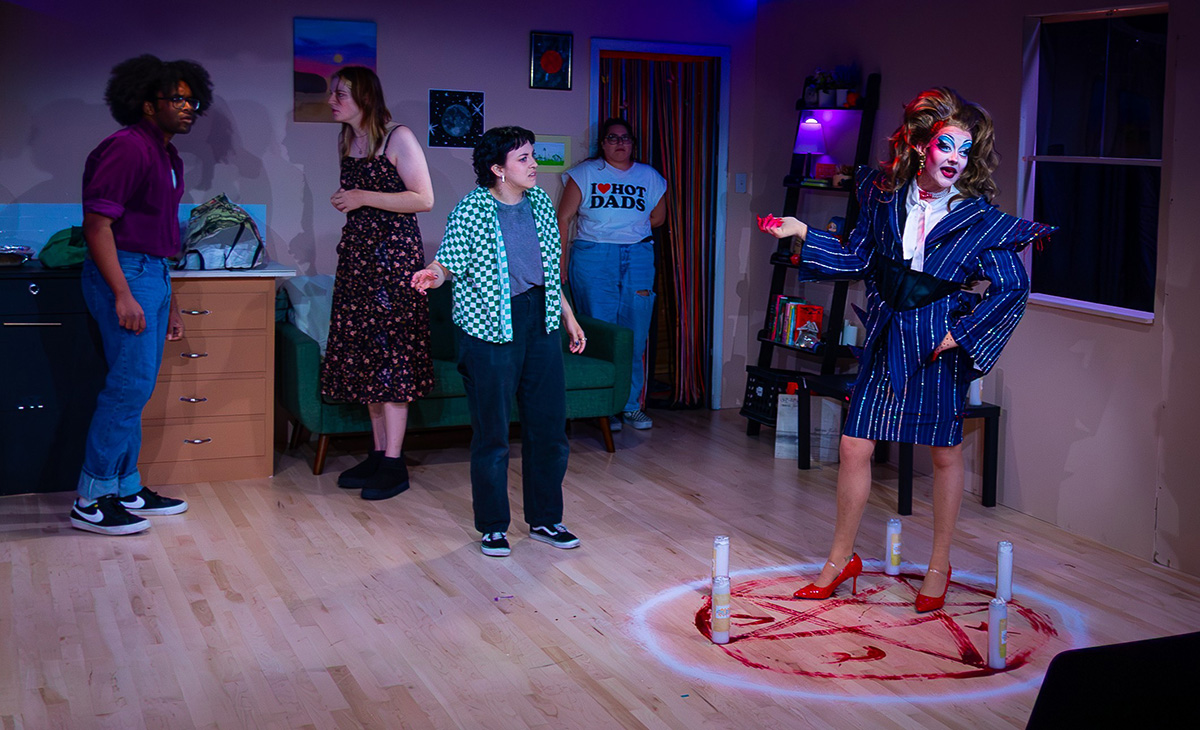
Her nonbinary lesbian partner Julian (Tristan Evans) has cheap red wine and weed on the ready. Dinner is in the oven. Soon, lively trans masc bestie Dante (Selena Gill) arrives bearing a hostess gift – it’s the specially requested bag of pig blood, integral to the evening’s fun. In little time, the twentysomething friends will have painted a pentagram circled with salt in the middle of the living room floor. Candles are lit. Sacred words are spoken.
Shifts in light and sound by designers Vida Huang and Di Carey, respectively, signal contact with the beyond. Much to the friends’ surprise, they’ve successfully summoned a demon and it’s a real doozy: Ronald Reagan as demon drag queen.
Costumed in a corseted pinstripe suit adorned with a few Gaultier cones, the pronoun-less guest star from the underworld makes quite an entrance – a full-on lip sync to Madonna’s “Vogue” replete with huge flashing eyes, an evil smile and darting tongue.
Spectacularly played by O’Malley Steuerman (“actor, DRAGster, playwright, and producer from Baltimore”) Ronald Reagan as demon drag queen is lewd, taunting, and reads with the kind of sharp wit that puts other queens in the shade.
The entertainment doesn’t stop there. Soon, the demon is juggling provocative props (fleshy dildo, a baby doll, and a copy of Marx) or performing sock puppetry to a 1982 recording of journalist Lester Kinsolving asking about the “gay plague” to which Reagan’s Press Secretary Larry Speakes charmingly replies, “I don’t have it … do you?” That proved a real knee slapper in the pressroom.
Throughout the play’s early scenes, a young man sits unnoticed at Kore’s kitchen counter. Now and then, he comments with a disapproving harrumph or a distinctly gay one-liner. He’s privy to all, but the lady of the house is unaware of him until he joins the party. His name is Michael (Christian Harris). He died in 1989 and has been hanging around ever since.
Wry and undeniably spectral, Michael is the play’s link to queer past. He remembers the hurts and horrors of the AIDS epidemic, but not so much about the emergence of ‘genderqueer’ as an identity label, reflecting a shift toward a broader gender spectrum. That came later.
Without doubt, the uniformly queer cast is committed. They play their queer characters with authenticity, lending a realness to queer people’s valid concerns and fears in the current atmosphere. (For instance, anarchist/barista Dante accuses Julian of hiding out in their safe role of social worker at a nice nonprofit; and Kore speaks about the fear surrounding the Kansas bill making it illegal for transgender people to display their gender on a driver’s license.)
Based in Chicago, Gwynn has written a queer play with a punch; and prior to ever being staged, this new work was prestigiously named both a 2025 O’Neill Semi-Finalist as well as 2025 Bay Area Playwrights Festival Finalist.
Billed as a ferocious queer ghost story, “Everything, Devoured” doesn’t disappoint. In the hands of queer co-directors Tracey Erbacher and Ileana Blustein, Gwynn’s fevered yet thoughtful and quick paced but penetrating piece unfolds compellingly.
Intuitive staging and chemistry among players, especially two hander scenes involving Kore, display a quiet intensity that feels true to life. Other scenes bring out the anger, protectiveness and some divisiveness among the friends. Gwynn’s informed and powerful writing is brought to the fore.
Nu Sass Productions has been uplifting women and marginalized genders in all aspects of theater since 2009. The company’s two-part name stems from “Nu” (Chinese for woman) and “Sass” (sassy).
Its latest offering fits the bill and then some.

Jason Collins dies at 47

Polish government to recognize same-sex marriages from EU countries

America’s broken pipeline of mental healthcare for trans youth

GLAA releases ratings for 18 candidates running for D.C. mayor, Council, AG

Blade finalist for D.C. Society of Professional Journalists awards

Maren Morris to headline Capital Pride Concert

Va. Supreme Court invalidates Democrat-backed redistricting plan

Celebrate Pride in Lost River, a slice of rural heaven

Learn more about queer love