National
New Public Justice President ‘sickened’ by anti-Trans attacks
‘This is a critical moment for our country & Public Justice has a pivotal role to play in addressing it’
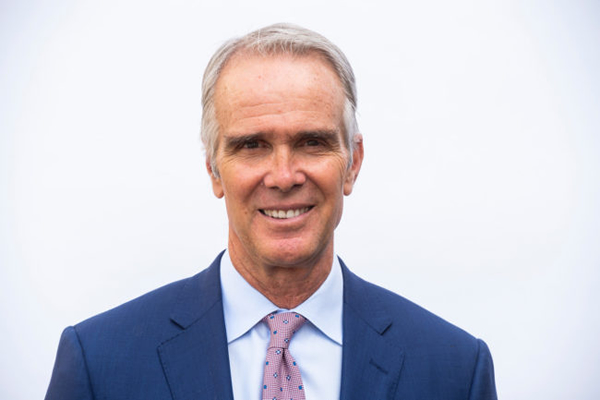
OAKLAND, Ca. – Native North Carolina attorney Dan Bryson loves people and emphatically hates discrimination. He still experiences a PTSD gut-punch whenever he recalls the national trauma visited on his beloved state in 2016 by rightwing conservatives ruthlessly seeking crass political power at the expense of the LGBTQ community through House Bill 2 (HB2), The Public Facilities Privacy & Security Act, otherwise known as the anti-transgender “bathroom bill.”
“What absolutely just repels me to my very core throughout my whole life is discrimination of any type. Whatever it is, it sickens me and I don’t understand it. I really don’t understand why every single human being on this planet can’t treat every other single human being with the respect and professionalism and love that they deserve,” Bryson says. “[HB2 was] the worst thing ever. It makes my hair go on fire to this day.”
It is this visceral commitment to LGBTQ equality that Bryson, a founding partner at the global law firm of Milberg Coleman Bryson Phillips Grossman, is expected to bring to his new post as President of Public Justice, the national nonprofit legal advocacy organization based in Washington DC and Oakland, California. His personal response to HB2 also illustrates his desire to find creative ways to engage others in discussions aimed at the public interest. Not only did Bryson financially contribute to those who opposed HB2, he commissioned artists to paint a mural on the wall of his office building opposite a popular restaurant in Raleigh, North Carolina.
“There is a big heart right in the middle, like a Valentine heart,” he says. “And on the sides are a number of arms reaching to try to get to the heart. Some are white, some are Black, some are green — they’re all different colors. The clothing on the arms may be female, may be male clothing. You just don’t know. But the point is that everyone is just to trying to find love — and why couldn’t we be a little bit more accepting as a society?”

While HB2 impacted him personally, Bryson’s deep commitment to civil rights actually reflects the work Public Justice has done throughout its almost 40-year history. To paraphrase a protest poster during the George Floyd demonstrations, Public Justice has been supportive of civil rights even “when it’s not trending.” Adele Kimmel, Director of Public Justice’s Students’ Civil Rights Project, for instance, is a widely recognized litigator on gender and sexual violence and the legal intricacies of Title IX. She has educated youth, families, school officials and other lawyers on how to use Title IX of the Education Amendments of 1972 to stop bullying of LGBT students.
Along with Public Justice Kazan Budd Attorney Alexandra Brodsky, she represents out gay retired Army Major Steve Snyder-Hill in his sexual abuse lawsuit against Ohio State University and, in a case challenging former Secretary of Education Betsy DeVos’s revised Title IX rules, represents Berkeley High School students, including nonbinary students, who are seeking to reverse DeVos’s changes, which significantly rolled back many protections for students.
Public Justice also teamed up with the National Women’s Law Center, Lambda Legal, the National Center for Transgender Equality and 46 other organizations and individuals in a 2017 campaign to reach the Departments of Education in each state telling them to properly follow federal law – and protect transgender students – or risk litigation.
“Schools that discriminate against transgender students, such as by denying them access to bathrooms and other single-sex facilities that correspond with their gender identity or failing to protect transgender students from harassment, are violating Title IX and the Constitution’s Equal Protection Clause,” the letter read in part. “Schools are obligated to protect transgender students in compliance with the law, regardless of whether they face legal recourse from the federal government. And when schools fail to comply with the law, they will continue to be subjected to lawsuits filed by and on behalf of aggrieved students.”
Public Justice also strongly supports the Equality Act , has spoken out against the Republican wave of anti-trans bills, and works with civil rights coalition members such as The Leadership Conference, the Human Rights Campaign, as well as local groups such as the San Francisco-based Equal Rights Advocates.
Under Bryson, fighting systemic oppression is only going to get deeper. “This is a critical moment for our country and Public Justice has a pivotal role to play in addressing it. As [recent Public Justice “Champion of Justice” honoree] Ben Crump’s own work shows, attorneys can be an essential part of addressing and ending injustice in America. That’s what this organization is all about and every aspect of our work aims to move us forward to a better, more equitable society and justice system,” Bryson told the audience during the organization’s recent gala. “As a North Carolinian, I’ve seen the impact of ugly, hateful laws up close. We fought hard in my home state to battle the so-called transgender ‘bathroom law’ and we’re fighting equally hard at Public Justice to take on the despicable effort to deny transgender athletes an opportunity to participate in school athletics.…. As President, I look forward to working with the staff to continue that expansion and maximize the impact of our work to tear down systemic injustice and work for a legal system – and a country – that is fairer, more inclusive and more equitable for all.”
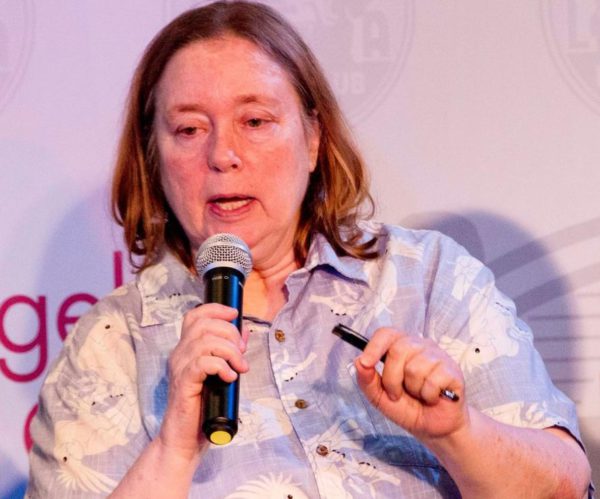
Karen Ocamb, is the Director of Media Relations for the Oakland, California based Public Justice.
Public Justice is a national nonprofit legal advocacy organization. They protect consumers, employees, civil rights & the environment.






Pennsylvania
Pa. House passes bill to codify marriage equality in state law
Governor supports gay state Rep. Malcolm Kenyatta’s measure

The Pennsylvania House of Representatives on Wednesday passed a bill that would codify marriage equality in state law.
House Bill 1800 passed by a 127-72 vote margin. Twenty-six Republicans voted for the measure.
The Republican-controlled Pennsylvania Senate will now consider the bill that state Rep. Malcolm Kenyatta (D-Philadelphia), who is the first openly gay person of color elected to the state’s General Assembly, introduced. Democratic Gov. Josh Shapiro supports the measure.
“Here in Pennsylvania, we believe in your freedom to marry who you love,” said Shapiro on Wednesday. “Today, the House has stepped up to protect that right.”
BREAKING: The Pennsylvania House just passed @RepKenyatta's bill to codify marriage equality into law in PA — and they did it with broad bipartisan support.
— Governor Josh Shapiro (@GovernorShapiro) March 25, 2026
Here in Pennsylvania, we believe in your freedom to marry who you love. Today, the House has stepped up to protect that…
Florida
DeSantis signs emergency bill that restores Fla. ADAP funding
Temporary funds to last through June 30
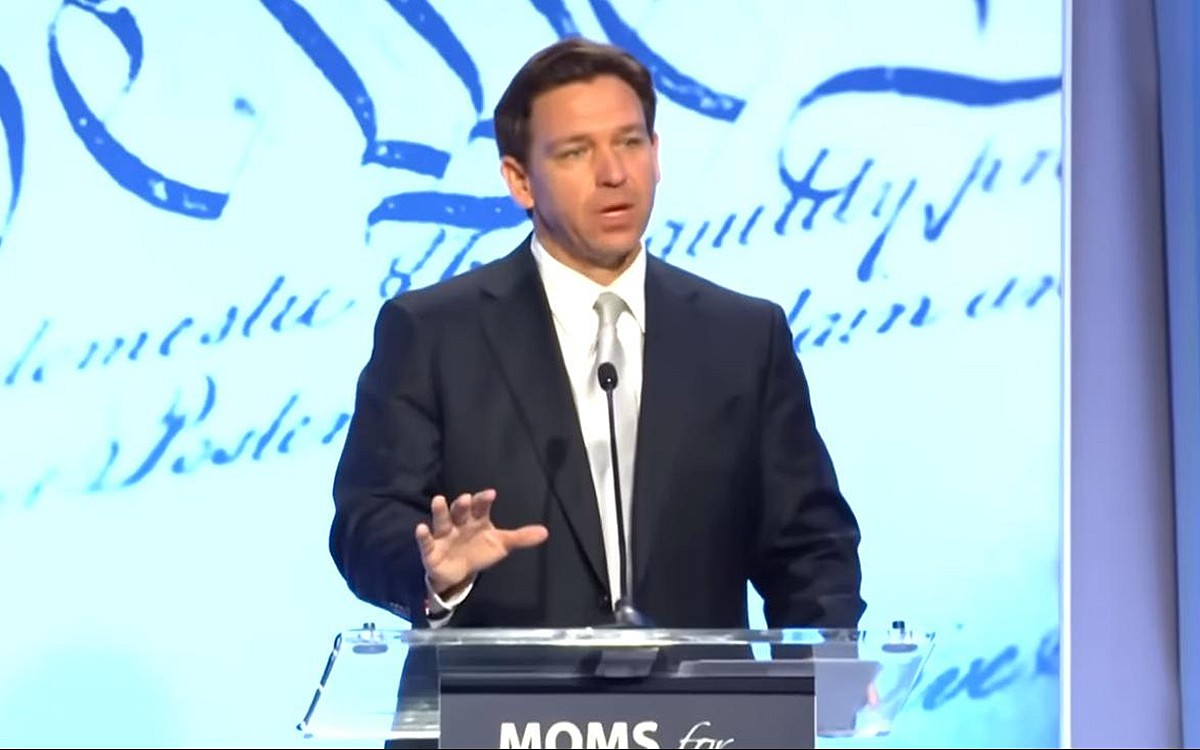
After the Florida Department of Health made huge cuts to the AIDS Drug Assistance Program in January, Republican Gov. Ron DeSantis has signed emergency legislation restoring HIV access to more than 12,000 Floridians.
Two months ago, as the Washington Blade reported, the Sunshine State cut the vast majority of those in ADAP by shifting the income levels required for eligibility — without following standard procedure when changing government policy outside of legislative or executive action.
The bill, signed by DeSantis on Tuesday, passed both chambers of the Florida Legislature unanimously and appropriates $30.9 million in emergency bridge funding through June 30, 2026. It restores Florida’s ADAP income eligibility to 400 percent of the Federal Poverty Level — the level it was prior to the January cuts. The legislation also requires the FDOH to submit detailed monthly financial reports to legislative leadership beginning April 1.
Under the old policy, eligibility would have been limited to those making no more than 130 percent of the federal poverty level, or $20,345 per year.
“For 10 weeks, 12,000 Floridians living with HIV did not know if they could fill their next prescription. Today, they can,” Esteban Wood, director of advocacy and legislative affairs at AIDS Healthcare Foundation, said in a statement.
The detailed reports now required to be sent to legislative leadership must include all federal revenues and expenditures, including manufacturer rebates; enrollment figures by county and insurance status; prescription utilization by drug class; and any projected funding shortfalls. This is the first time the Legislature has required this level of financial transparency from the program.
DeSantis signed the legislation one day after a Leon County Circuit Court judge denied AIDS Healthcare Foundation’s request for an injunction to block the significant changes the DeSantis administration is making to the program, which it claims faces a $120 million shortfall for calendar year 2026.
AIDS Healthcare Foundation, a national organization focused on protecting and expanding HIV healthcare access and prevention methods, filed a lawsuit over the change in eligibility, arguing the Florida Department of Health did not follow the laid out path for formally changing policy and was acting outside established procedures.
Typically, altering eligibility for a statewide program requires either legislative action or adherence to a multistep rule-making process, including: publishing a Notice of Proposed Rule; providing a statement of estimated regulatory costs; allowing public comment; holding hearings if requested; responding to challenges; and formally adopting the rule. According to AIDS Healthcare Foundation, none of these steps occurred.
The long-term structure of ADAP will be determined by the 2026–2027 fiscal year state budget, something that lawmakers have until June 30 to finish.
Federal Government
Markwayne Mullin confirmed as next DHS secretary
Okla. senator to succeed Kristi Noem

The U.S. Senate confirmed Markwayne Mullin as the next secretary of Homeland Security on Monday, as the agency continues to grapple with what lawmakers have described as a “never-ending” funding standoff, with Democrats attempting to withhold funding from one of the nation’s largest and most costly agencies.
Mullin — a Republican senator from Oklahoma, former mixed martial arts fighter, and plumbing business owner — was confirmed in a 54–45 vote. Two Democrats — U.S. Sens. John Fetterman (D-Pa.) and Martin Heinrich (D-N.M.) — sided with Republicans in supporting his confirmation.
The new agency head is expected to follow the policy direction set by President Donald Trump, emphasizing stricter immigration enforcement. This includes proposals to support immigration agents at polling sites and to cut funding to so-called “sanctuary cities.”
Mullin replaces Kristi Noem, who was fired earlier this month following a widely scrutinized 2-day congressional hearing on Capitol Hill.
During the hearing, Noem faced intense questioning over her response to several crises, including the fatal shooting of two American citizens in Minneapolis by U.S. Immigration and Customs Enforcement agents, a $220 million border security advertising campaign that featured her on horseback near Mount Rushmore amid one of the largest federal workforce reductions in U.S. history, and the federal response to major natural disasters such as the July 2025 Texas floods and Hurricane Helene in 2024.
Noem had previously drawn criticism for a series of policy decisions in South Dakota that broadly focused on restricting the rights of LGBTQ individuals. In 2023, she signed House Bill 1080, banning gender-affirming medical care for transgender minors. She also signed legislation and executive orders restricting trans athletes’ participation in women’s sports, as well as the state’s “Religious Freedom Restoration Act,” which critics argued enabled discrimination against LGBTQ individuals. Additionally, the state canceled contracts related to LGBTQ support services — including suicide prevention and health care navigation programs‚ and later agreed to a $300,000 settlement with trans advocacy group, The Transformation Project.
Despite her removal from DHS, Noem will remain in the Trump-Vance administration as a special envoy for the “Shield of the Americas,” an initiative aimed at promoting U.S. influence in the Western Hemisphere, including efforts to counter cartel networks, reduce Chinese influence, and manage migration.
The new head of DHS has served in Congress since 2013, in both houses of the federal legislature. While in the Senate and a member of the Health, Education, Labor, and Pensions (HELP) Committee, Mullin has been a vocal critic of policies aimed at expanding LGBTQ inclusion. He led a group of lawmakers in urging the Administration for Community Living to reverse a rule requiring states to prioritize Older Americans Act services based on sexual orientation and gender identity, arguing the policy could have unintended consequences.
Mullin also makes history as the first Native American — and a citizen of the Cherokee Nation — to lead the Department of Homeland Security. He was also among the 147 Republicans who voted to overturn the 2020 presidential election results despite no evidence of widespread fraud, and was present in the U.S. House of Representatives chamber on Jan. 6.

‘No Kings’ protests set for D.C.

Border to border: modern slavery and human trafficking in refugee movements across East Africa

New IOC policy bans trans women from Olympics

Introducing the Torchbearers Awards honoring queer, trans women and nonbinary people

Pa. House passes bill to codify marriage equality in state law

PHOTOS: Capital Stonewall Democrats 50th anniversary

‘Inherit the Wind’ isn’t about science vs. religion, but the right to think

Small is beautiful: subcompact SUVs

Polish court rules country must recognize same-sex marriages from EU states

Capital Stonewall Democrats 50th anniversary gala draws sold out crowd
-

 Photos4 days ago
PHOTOS: Capital Stonewall Democrats 50th anniversary
-
Theater5 days ago
‘Inherit the Wind’ isn’t about science vs. religion, but the right to think
-
Autos5 days ago
Small is beautiful: subcompact SUVs
-
Poland4 days ago
Polish court rules country must recognize same-sex marriages from EU states