Local
Roem challenger opposes marriage equality
Christopher Stone is a US Air Force veteran
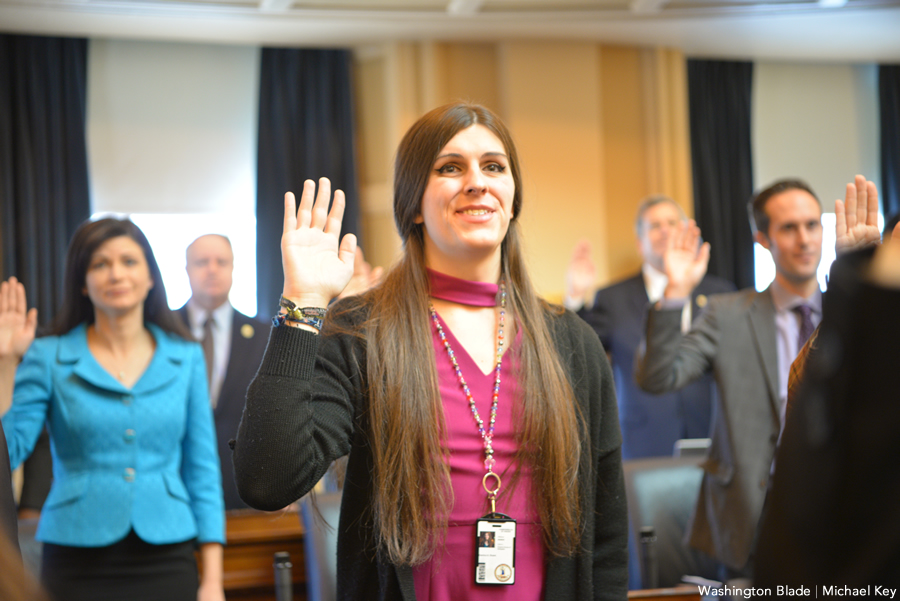
A Republican who is challenging Virginia state Del. Danica Roem (D-Manassas) stated in a recent interview that she “over-promised and under-delivered” on a core campaign pledge to reduce congestion along Route 28.
Christopher Stone, the Republican nominee who Roem will face in her reelection bid this November, told the Washington Blade the bottom line is Route 28 still isn’t “fixed.”
“You campaigned for it in 2017, in 2019 and in 2021,” he argued. “And you can’t say you’ve done anything other than a study.”
Roem defended her infrastructure record, saying while a study had to be conducted, some improvements were already completed, such as reduced traffic signals at key busy intersections. She said these changes have reduced wait times and pollution from idling engines.
“That speeds up the commute without anyone having to lose their business, front property or homes. And we know from the study’s data that my plan will make your commute quicker, safer and greener,” Roem told the Blade. “Christopher Stone has no plan for fixing Route 28.”
Stone, however, challenged “improved light signaling” doesn’t necessarily “fix” or widen Route 28 to address commuter concerns. Roem pointed out the widening of Route 28 in Centreville is currently underway.
“I voted last year for authorization for the widening to go forward,” she said. “It is happening right before your very eyes in Centreville. You cannot tell me in good faith that we have not done anything to fix 28. It is being done right now.”
She added she is currently “chasing down the dollars” to bring further infrastructure to Manassas Park.
Expanded Medicaid, LGBTQ rights among Roem’s legislative victories
Roem in 2017 became the first openly transgender person elected and seated in a state legislature in the U.S.
Her four years in office have been busy ones. She has either sponsored or co-sponsored legislation that addressed discrimination, expanded Medicaid and helped make Virginia more inclusive.
LGBTQ Victory Fund Vice President of Political Programs Sean Meloy said Roem’s record clearly shows “she’s fulfilling her campaign promises and striving to create a more inclusive Virginia.” Meloy noted Roem has done considerable work — expanding healthcare and passing numerous LGBTQ-friendly bills — for her constituents since her 2017 election.
“While Del. Roem is hard at work, her opponent has decried mask mandates, supports extremist protesters in Loudoun County and called for an investigation of the 2020 election,” Meloy said. “Virginia voters are savvy, and they know when a candidate has their backs — which is why they’ve elected Del. Roem twice and will reelect her once again this November.”
Stone said he’s running for office because he felt laws the General Assembly has passed in the last few years benefitted “special interests” and not Virginians as a whole.
Stone and his wife moved to Prince William County from Fairfax County in 2013 because they were planning on having children and a friend said it was a good place to raise them. They now have two children who are 5 and 6-years-old, and the eldest is in his second year in the county’s school system.
“And she loves it,” Stone said proudly, especially now that she gets to return to in-person classes even though she has to wear a mask.
Stone, a U.S. Air Force veteran and former graduate school professor, said his wife encouraged him to run for office “and stop complaining.” He was concerned that LGBTQ laws in particular were too narrowly focused and not written with the interests of most Virginians in mind.
“A lot of people that I talk to are concerned that the way the laws are written you are protecting one group and infringing upon the constitutional freedoms of another,” he said, adding that allowing for exemptions for religious beliefs could be one way to make the laws more equitable.
“But you don’t just ignore those people,” he added. “You accommodate both sides. I don’t like laws aimed at a single group or giving protections to one side. That is how a lot of people see LGBTQ laws.”
Stone also discussed his opposition to marriage and adoption rights for same-sex couples, stating judges shouldn’t legislate from the bench.
He pointed out the U.S. Supreme Court’s 1857 decision in the Dred Scott case, which said slaves and their descendants were not American citizens, as an example of the harm judges “legislating from the bench” could do. The 13th and 14th Amendments overturned the ruling. But Roem, a life-long Virginian, pointed out Brown v. Board of Education and Loving v. Virginia were two court cases with Virginia ties that made the state and the country a step more inclusive.
“If you have marriage equality, you can’t possibly tell an LGBTQ couple that they can’t adopt children,” Roem said. “What a horrible thing to tell any loving parent. We already litigated the hell out of this.”
For Roem, times have changed and so have the people of Virginia.
“If you are exclusionary like my challenger, then you are going to lose,” she said. “The people of the 13th district aren’t putting up with this any more.”



District of Columbia
Gay GOP group hosts Ernst, 3 House members — all of whom oppose Equality Act
Log Cabin, congressional guest speakers mum on June 25 event
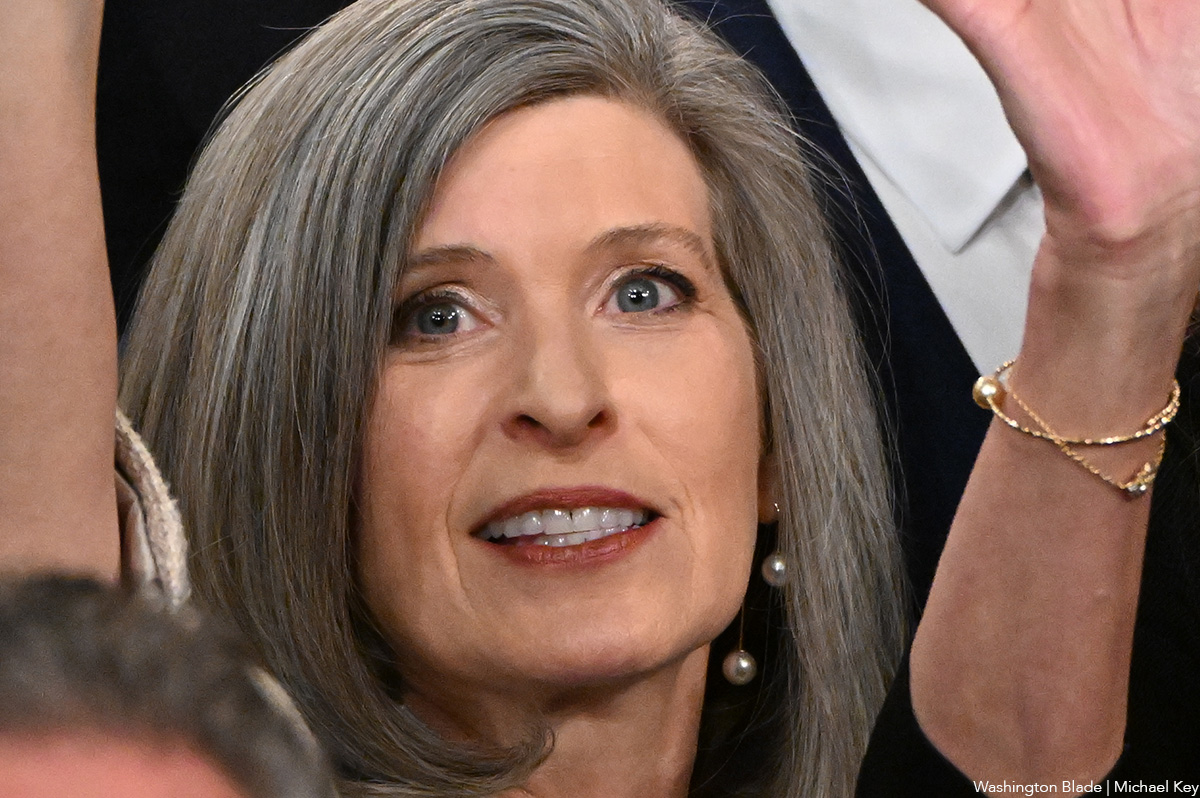
U.S. Sen. Joni Ernst (R-Iowa) and three women Republican members of the U.S. House appeared as guest speakers at the June 25 meeting of Log Cabin Republicans of D.C., the local chapter of the national LGBTQ Republican group with that same name.
The U.S. House members who joined Ernst as guest speakers at the Log Cabin meeting were Celeste Maloy (R-Utah), Kat Cammack (R-Fla.), and Julia Letlow (R-La.).
Neither D.C. Log Cabin Republicans President Andrew Minik nor spokespersons for Ernst or the three congresswomen immediately responded to a request by the Washington Blade for comment on the GOP lawmakers’ appearance at an LGBTQ GOP group’s meeting.
“Please join us for an inspiring evening as we celebrate and recognize the bold leadership and accomplishments of Republican women in Congress,” a D.C Log Cabin announcement sent to its members states.
“This month’s meeting will highlight the efforts of the Republican Women’s Caucus and explore key issues such as the Protection of Women and Girls In Sports Act and the broader fight to preserve women’s spaces in society,” the message says.
It was referring to legislation pending in Congress calling for banning transgender women from participating in women’s sports events.
According to media reports, Ernst and the three congresswomen have expressed opposition to the Equality Act, the longstanding bill pending in Congress calling for prohibiting discrimination based on sexual orientation and gender identity in the areas of employment, housing, and public accommodations.
The Log Cabin announcement says the meeting was scheduled to take place at the Royal Sands Social Club, which is a restaurant and bar at 26 N St., S.E. in the city’s Navy Yard area.
D.C. Log Cabin member Stuart West, who attended the meeting, confirmed that Ernst and the three congresswomen showed up and spoke at the event.
“It was a good turnout,” he said. “I would definitely say probably 30 or 40 people attended.” West added, “Four women came to talk to a group of mostly gay men. That’s something you don’t see very often.”
District of Columbia
D.C. police seek public’s help in July 5 murder of trans woman
Relative disputes initial decision not to list case as hate crime
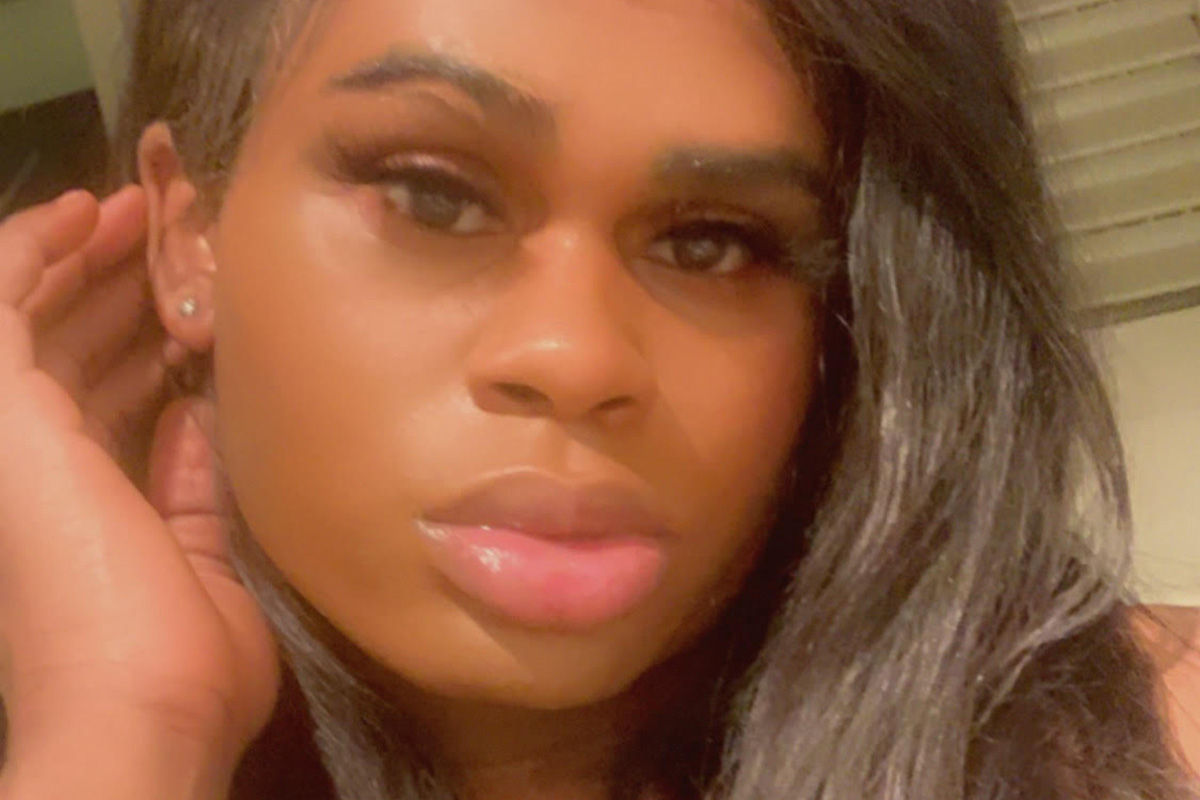
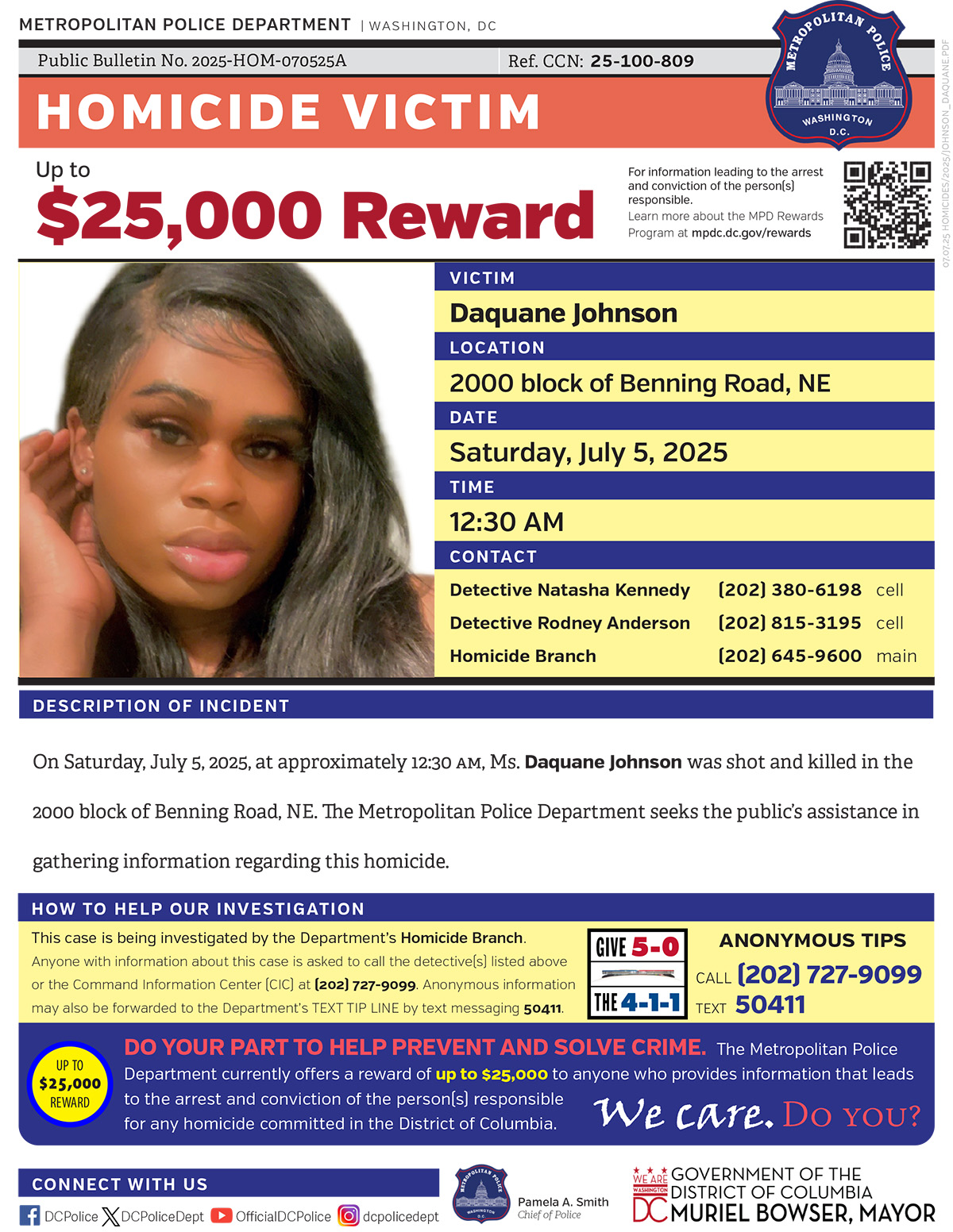
D.C. police are seeking help from the public in their investigation into the murder of a transgender woman who they say was shot to death at about 12:30 a.m. on Saturday, July 5, on the 2000 block of Benning Road, N.E.
But the police announcement of the fatal shooting and a police report obtained by the Washington Blade do not identify the victim, 28-year-old Daquane ‘Dream’ Johnson of Northeast D.C., as transgender. And the police report says the shooting is not currently listed as a suspected hate crime.
It was local transgender activists and one of Johnson’s family members, her aunt, who confirmed she was transgender and said information they obtained indicates the killing could have been a hate crime.
“On Saturday, July 5, at approximately 12:51 a.m., Sixth District officers were flagged down in the 2000 block of Benning Road, Northeast, for an unconscious female,” a July 5 D.C. police statement says. “Upon arrival, officers located an adult female victim suffering from gunshot wounds,” it says.
“D.C. Fire and EMS responded to the scene and transported the victim to a local hospital where after all lifesaving efforts failed and the victim was pronounced dead,” the statement says.
A separate police flyer with a photo of Johnson announces an award of $25,000 was being offered for information leading to the arrest and conviction of the person or persons responsible for the murder.
The flyer identifies D.C. police Homicide Detective Natasha Kennedy as being the lead investigator in the case and says anyone with information about the case should contact her at 202-380-6198.
Longtime D.C. transgender rights advocate Earline Budd told the Blade that one of the police investigators contacted her about the case and that she also spoke to Detective Kennedy. Budd said police confirmed to her that Johnson was a transgender woman.

One of Johnson’s family members, Vanna Terrell, who identified herself as Johnson’s aunt, told the Blade that Johnson used the first name of Dream and had planned to legally adopt that name instead of Daquane but had not gotten around to doing so.
Terrell said she and other family members learned more about the incident when one of two teenage high school students who knew Johnson’s brother contacted a friend and told the friend that they recognized Johnson as they witnessed the shooting. Terrell said the friend then called her to tell her what the friend learned from the two witnesses.
According to Terrell, the witnesses reportedly saw three men approach Johnson as Johnson walked along Benning Road and one of them called Johnson a derogatory name, leading Terrell to believe the men recognized Johnson as a transgender woman.
Terrell said one of the witnesses told the friend, who spoke to Terrell, that the man who shot Johnson kept shooting her until all of the bullets were fired. Budd, who said she spoke to Terrell, who also told her what the witnesses reported, said she believed the multiple shots fired by the shooter was an “overkill” that appears to have been a hate crime. Terrell said she too believes the murder was a hate crime.
In response to an inquiry from the Blade, Officer Ebony Major, a D.C. police spokesperson, stated in an email, “At this point there is nothing in the investigation that indicates the offense was motivated by hate or bias.”
Terrell said a memorial gathering to honor Johnson’s life was scheduled to be held Saturday, July 12, at River Terrace Park, which is located at 500 36th St., N.E. not far from where the shooting occurred.
District of Columbia
LGBTQ voters divided in Ward 8 special election
All four candidates on DC Council seat ballot are allies
Political observers, including LGBTQ activists, believe LGBTQ voters in Ward 8, like most if not all voters in the ward, are divided over which of the four candidates to support in the July 15 special election to fill the ward’s vacant D.C. Council seat.
Each of the four candidates, all of whom are Democrats, including ousted Ward 8 council member Trayon White, who is running to recapture his seat, have expressed support for LGBTQ related issues.
The special election was called earlier this year after the D.C. Council voted unanimously to expel White following his indictment and arrest by the FBI on a federal bribery charge in August 2024.
He has pleaded not guilty to the charge and under D.C. law he can legally run for and regain his council seat until the time he is convicted of the charge. His trial is scheduled to begin in January 2026.
The three candidates challenging White — Sheila Bunn, Mike Austin, and Salim Adofo — are longtime Ward 8 community advocates who have been involved in local government affairs for many years and, according to LGBTQ activists who know them, have been supportive of LGBTQ rights.
White also has a record of supporting LGBTQ issues while serving on the council since 2017. Following his indictment, he won re-election by a wide margin in the November 2024 general election against a lesser-known Republican opponent.
Political observers say White’s indictment on a bribery charge is likely to alienate some of his past supporters, but they say he remains popular in the ward, and with three candidates dividing the opposition vote he could win the election with less than 50 percent of the divided vote count.
Two of the candidates, Bunn and Adofo, responded to a request by the Washington Blade sent to each of the four candidates asking for a statement summarizing their positions on LGBTQ related issues. In their respective statements Bunn and Adofo expressed strong support on a wide range of LGBTQ issues.
“In my nearly 30 years of public service, I have consistently supported the rights and worked to improve the quality of life for the LGBTQIA+ community,” Bunn said in her statement. She noted that much of her work on behalf of LGBTQ rights took place when she served as chief of staff for D.C. Congressional Delegate Eleanor Holmes Norton and as a senior staff member for former D.C. Mayor Vincent Gray.
In his statement, Adofo said he advocated for a wide range of LGBTQ issues, including housing programs for homeless LGBTQ youth and supportive employment training programs for transgender residents.
“At the heart of our platform is a steadfast commitment to uplifting LGBTQ+ communities, ensuring that policy is shaped not just for them, but with them,” his statement says. Adofo’s positions in support of LGBTQ rights are also posted on his campaign website.
GLAA D.C, formerly known as the Gay and Lesbian Activists of Washington, released its ratings of three of the four candidates on June 22, based on its recent policy of basing its ratings mostly on non-LGBTQ specific issues. The group rates candidates on a scale of -10, the lowest possible rating, to +10, its highest rating.
It assigned a rating of +7.5 for Bunn, +6.5 for Austin, and +4.5 for Adofo. In a statement accompanying its ratings, GLAA said each of the three have a record of support on LGBTQ issues, but they lost rating points for not supporting non-LGBTQ related issues deemed important by GLAA.
GLAA said it did not issue a rating for White based on its policy of not rating candidates who are removed from office or resign due to allegations of ethics violations.
The Capital Stonewall Democrats, D.C.’s largest local LGBTQ political group, chose not to make an endorsement in the Ward 8 special election.
“We thought that this is best because this is a special election and in these unfamiliar times, we decided not to take a stand,” Howard Garrett, the group’s president, told the Blade.
Ward 8 gay Democratic activist Phil Pannell is supporting Adofo, he told the Blade, on grounds of Adofo’s strong support on LGBTQ issues and Adofo’s role as the only candidate in the Ward 8 special election who supported Initiative 83, the ballot measure passed by D.C. voters in November 2024 calling for a ranked choice voting system and open D.C. primaries. A lawsuit challenging the initiative filed by the D.C. Democratic Party has delayed its implementation.
Another longtime Ward 8 gay Democratic activist, David Meadows, is supporting Bunn. Meadows cites Bunn’s support for LGBTQ rights and her positions on other issues he supports as his reason for backing her candidacy.
The D.C. Board of Elections website shows that the board mailed ballots for the special election to all Ward 8 registered voters. The website shows that as of July 7, 2,483 voters sent back their ballots by mail or placed them in drop boxes located throughout the ward.
Early in-person voting at several polling places was scheduled to begin July 11, the website says, prior to the official election date of July 15 at all polling places throughout the ward.
Salim Adofo statement on LGBTQ issues:
Our campaign is rooted in the belief that everyone deserves to live with dignity, security, and opportunity. We are committed to building a safer, healthier, and more equitable District for all — where every voice is heard and every community is empowered. At the heart of our platform is a steadfast commitment to uplifting LGBTQ+ communities, ensuring that policy is shaped not just for them, but with them. We recognize that the fight for equity is interconnected, and we prioritize action in the areas that most deeply impact our residents’ daily lives. As [a] council member, I will advocate for healthcare for all, boost funding for HIV/AIDS, Hepatitis, STD, and TB Administration (HAHSTA) programs to address disparities in health outcomes.
• Expand access to care by exempting digital-only telehealth services from the Certificate of Need (CON) process and increasing funding through the Department of Behavioral Health (DBH).
• Build a culturally competent workforce by removing licensure barriers and expanding the pipeline of LGBTQ+ mental health providers.
• Employment and economic equity: sustain workforce development efforts like Project LEAP, a successful investment in economic empowerment for TGD residents.
• Foster public-private partnerships by requiring D.C. HR to work with labor unions and local employers to host trans-affirming job fairs.
• Fund community-led training by supporting programs developed by TGD organizations, modeled after California’s Transgender Economic Empowerment Initiative.
• Housing with dignity: every LGBTQ+ resident deserves stable, affirming, and permanent housing. End youth homelessness with a community-centered strategic plan focused on expanding permanent housing and wraparound services.
• Support inclusive housing by continuing funding for LGBTQ+ housing vouchers and senior housing initiatives.
• Safety and community support: create safe shelters by investing $2 million in a 20-bed LGBTQIA2S+ shelter for survivors of intimate partner violence and sexual assault.
• Empower community organizations with no-cost capacity-building support and streamlined access to D.C. grants for LGBTQ+-serving CBOs.
Sheila Bunn statement on LGBTQ issues:
In my nearly 30 years of public service, I have consistently supported the rights and worked to improve the quality of life for the LGBTQIA+ community.
As chief of staff to Congresswoman Eleanor Holmes Norton, I helped prevent Congress from overturning the District’s 2009 marriage equality bill and worked on removing congressional riders from the District’s budget that prohibited the expenditure of locally raised funds for our needle-exchange program, which has been pivotal in HIV/AIDS prevention.
As part of Mayor Vincent C. Gray’s senior staff, I assisted in launching the District’s transgender employment initiative under the Project Empowerment Program, increasing training and job opportunities for transgender residents. We also employed a member of the transgender cohort in the Mayor’s Office of Community Affairs after their tenure, demonstrating our commitment to the program. I facilitated efforts to end health insurance discrimination based on gender identity with DISB’s 2013 bulletin, ensuring coverage for services like mastectomies and hormone replacement therapy. Additionally, I helped to coordinate Mayor Gray’s first LGBTQIA+ Youth Town Hall to address the concerns of LGBTQIA+ youth and participated in cultural competency training to better support the District’s significant LGBTQIA+ population.
Currently, I am a member of the Capital Stonewall Democrats, actively engaging in Pride events and supporting LGBTQIA+ causes like the DC LGBTQ+ Community Center, a one-stop shop for services and programs with critical social service partners. Through direct outreach to organizations serving the LGBTQIA+ community, I aim to understand and represent their issues effectively. I look forward to collaborating with GLAA, Capital Stonewall Democrats, and other allied organizations to shape legislation and policies that benefit our LGBTQIA+ residents and all District residents.

PHOTOS: Independence Day Weekend in Rehoboth

Red, White, and Beyoncé: Queen Bey takes Cowboy Carter to D.C. for the Fourth of July

Gay GOP group hosts Ernst, 3 House members — all of whom oppose Equality Act

D.C. police seek public’s help in July 5 murder of trans woman

Treasury Department has a gay secretary but LGBTQ staff are under siege

Two new documentaries highlight trans history

‘A Wrinkle in Time’ comes to Arena Stage

Celebrate the power of homeownership this Fourth of July

Defying trends, new LGBTQ center opens in rural Winchester, Va.