Politics
‘Mind your own uterus’
Hundreds of thousands join Women’s March across the country

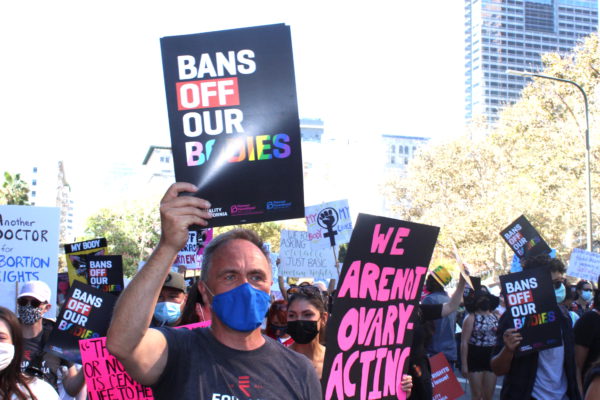
From D.C. to New York and then across the country to the City of Angels hundreds of thousands participated in more than 600 marches nationwide in the first Women’s March of Joe Biden’s presidency on Saturday.
The marches were organized with particular focus this year on women’s reproductive rights which are under siege in Republican-majority legislatures, which are passing laws meant to circumvent or present court challenges to overturn the landmark 1973 U.S. Supreme Court decision Roe v. Wade.
Conservative lawmakers and judges have put it that decision in jeopardy including Texas’ new abortion law and a Mississippi challenge which is due to be heard this fall term of the U.S. Supreme Court which began Monday.
“I think we’ve grown incredibly fast in five years,” said Emiliana Guereca, president of Women’s March Foundation. “What started as, really an anti-Trump movement, has turned into a really strong feminist movement for women, pro-choice. So we’re proud of the 500 sister marches that are stepping up into leadership to organize with us.”
Speaking to the 20,000 plus attendees on Saturday in downtown Los Angeles, Rick Zbur, the executive director of Equality California told the crowd;
“Anti-abortion and anti-LGBTQ+ extremists are fighting every day to overturn Roe v. Wade. And as you’ve heard from so many speakers before me, Roe hasn’t faced such a serious threat in the five decades since it was decided.
But I’m here to tell you that the LGBTQ+ community—young and old, women and men and non-binary folks—are bringing our collective strength, resilience and power to this fight.
Because the fight for reproductive justice is a fight for LGBTQ+ justice, and the fight for LGBTQ+ justice is a fight for reproductive justice!
LGBTQ+ people need abortion care. LGBTQ+ people need contraception. LGBTQ+ people need STI testing and HIV prevention.”
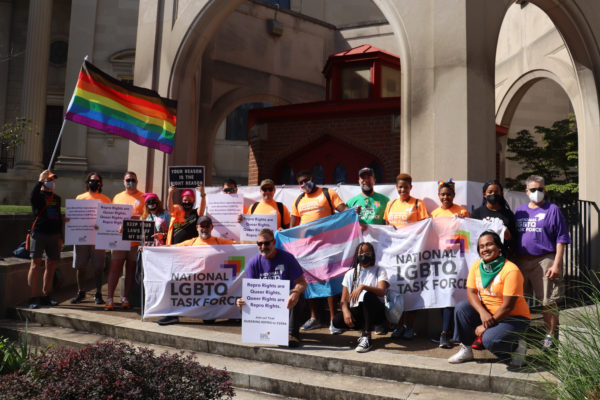
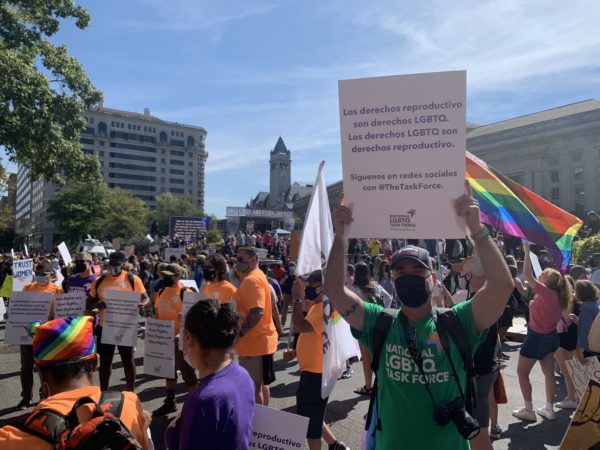
Across the country the National LGBTQ Task Force had a visible present at marches and rallies in D.C., New York, Miami and other cities and states.
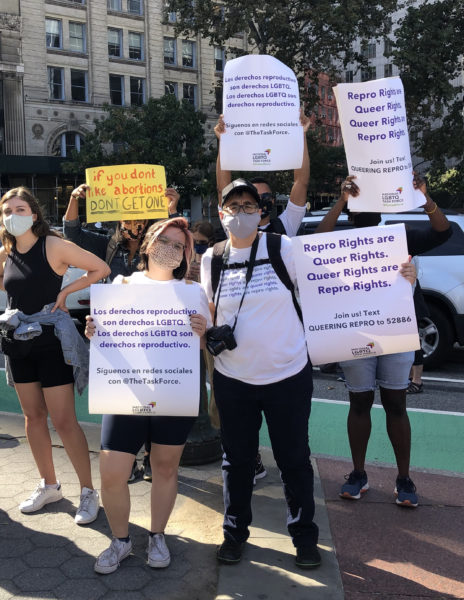


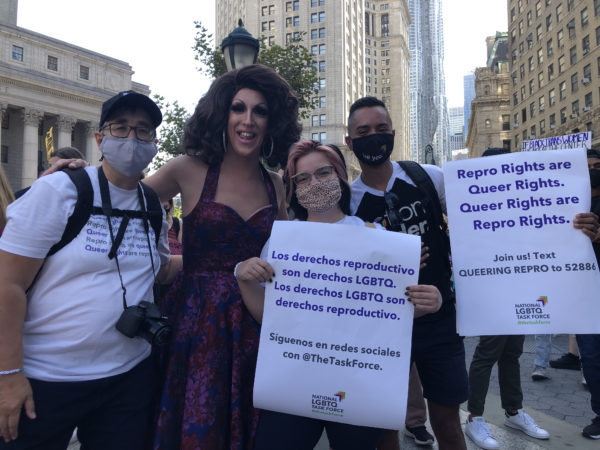

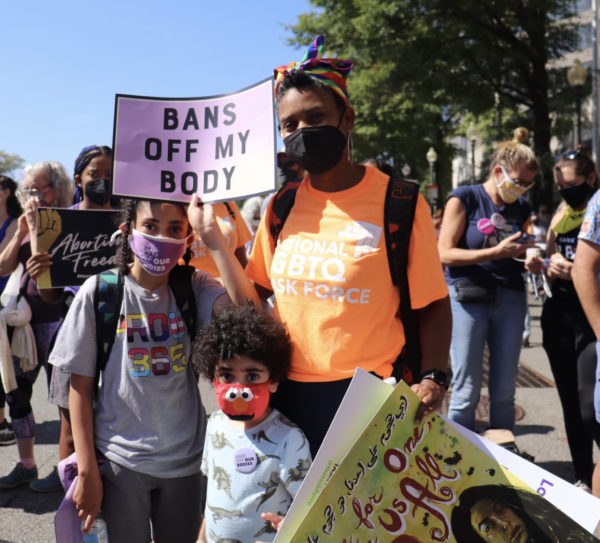
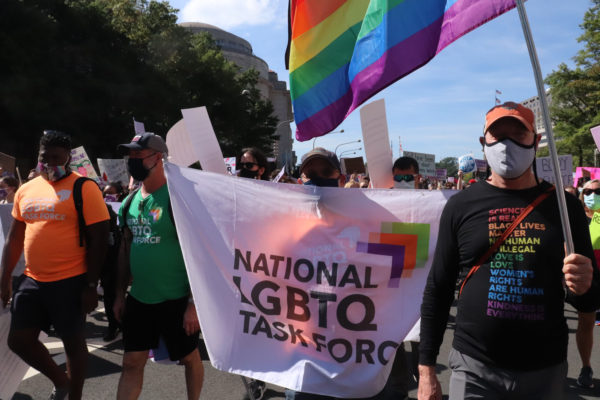

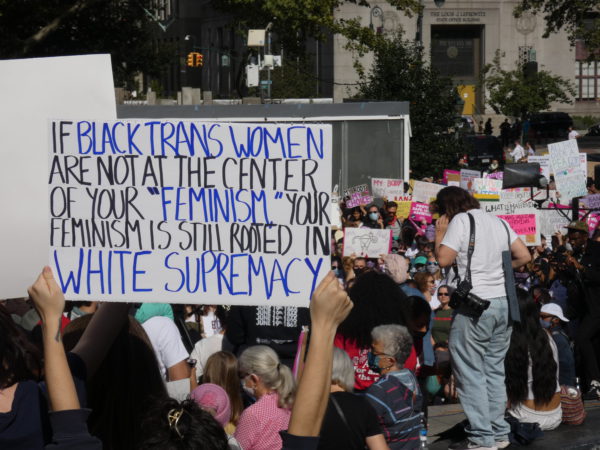
In New York, Democratic Gov. Kathy Hochul spoke at rallies in Seneca Falls and then the state’s capital city of Albany.
“I’m sick and tired of having to fight over abortion rights,” she said. “It’s settled law in the nation and you are not taking that right away from us, not now not ever.”
In her speech at Freedom Plaza near the White House and in view of the U.S. Capitol at the other end of Pennsylvania Avenue, Alexis McGill Johnson, the national president of Planned Parenthood told the crowd stories of women forced to drive hours across state lines—sometimes multiple state lines—to end pregnancies in the weeks since the Texas law went into effect.
“The moment is dark … but that is why we are here,” she told the crowd. “With the upcoming Supreme Court term- no matter where you are, this fight is at your doorstep right now,” she said.
RELATED: BNC interview with National LGBTQ Task Force Executive Director Kierra Johnson






2026 Midterm Elections
Trump uses anti-trans slur against Democratic Senate candidate
President mocked Annie Andrews

President Donald Trump used an anti-trans slur against Democratic South Carolina Senate candidate Annie Andrews on Monday as he sought to rally support for Republicans in the state’s Senate race.
In a post on Truth Social, Trump attacked Andrews three times, referring to her as “trannie” while promoting U.S. Sen. Darline Graham (R-S.C.)’s campaign.
Andrews is running against Graham for a Senate seat in the solidly Republican state.
Earlier this year, Graham was specially appointed to the seat following the death of her brother, Lindsey Graham, who represented South Carolina in the Senate from 2003 to 2026.
Andrews, the Democratic nominee from the state, is a pediatrician that lives in Charleston with her three children. She told NBC News that she will “work with anyone to put South Carolina first.”
“As a mom and a pediatrician, I’m in this race to fight for my patients, my three kids, and South Carolina,” Andrews said, adding that “lowering costs and making life better for families across our state is going to take all of us working together.”
Andrews used the attention from the president’s attack to emphasize what she described as a focus on policy issues rather than the culture wars that have dominated much of the political debate.
“If you care more about your bills than the politics in Washington, this campaign is for you,” she added.
Trump’s remarks have drawn criticism from leaders on both sides of the aisle.
Senate Minority Leader Chuck Schumer (D-N.Y.) condemned Trump’s words Monday night on social media, calling his attacks on Andrews “despicable.”
“Annie Andrews is a mom and pediatrician who’s always put her community first — and she’s exactly who South Carolina needs representing them in the Senate,” Schumer said on X.
Former South Carolina Gov. David Beasley, a Republican, also criticized the president’s attack on Andrews, urging voters to “reject politics based on division and hate.”
“This is abhorrent. Elections don’t have to be about cruelty and lies. South Carolina deserves better,” Beasley wrote Monday night on X.
South Carolina has not elected a Democratic senator in nearly three decades.
Andrews’s campaign website does not mention her positions on LGBTQ issues.
The Washington Blade reached out to Andrews’s campaign for comment on Trump’s attack and her positions on transgender rights but did not hear back by time of publication.
2026 Midterm Elections
Meet the LGBTQ candidates running for U.S. House, Senate
Pappas would become first out gay man elected to upper chamber

The midterm elections are often seen as a report card for the party in power, giving voters an opportunity to weigh in on the direction of the country after two years of unified control of the federal government. With Republicans controlling the White House, Congress and the Supreme Court, the 2026 elections could reshape the balance of power in Washington and determine what the next two years of federal policy will look like.
Among the candidates looking to shape that future are a large number of openly LGBTQ politicians running for federal office. All of the candidates listed below openly identify as members of the LGBTQ community and are running as Democrats, seeking seats in both the U.S. House of Representatives and the U.S. Senate. (See below for a list of LGBTQ incumbents.)
The New Candidates
U.S. Senate:
Chris Pappas — NH
The United States House of Representatives:
Cait Conley — NY-17
Jeremy Moss — MI-11
JoAnna Mendoza — AZ-06
Marni von Wilpert — CA-48
Scott Wiener — CA-11
Chris Gallant — NY-1
JD Ford — IN-5
Janelle Sarauw — U.S. Virgin Islands
If all of these candidates running for federal office win their seats, this would make the federal government the queerest legislative term for Congress ever.
Chris Pappas would become the first openly gay male senator if he wins the race against Republican John E. Sununu. Pappas is currently leading early polls 50% to Sununu’s 42%, and is seen as a fairly centrist Democrat with a slew of accomplishments passed through the House since his election in 2018 that make him a desired candidate for the purple “Granite State.”
Cait Conley is fighting to take two-term incumbent Republican Mike Lawler’s seat for New York’s 17th district, covering parts of Westchester, Rockland, Putnam and Dutchess counties. Conley has a long history of working as a public servant through her extensive military service, which includes six overseas deployments with the Army and work with the National Security Council. Current polling shows she has an advantage over her opponent, 64% to his 36%, making this one a race to watch.
Jeremy Moss is running for election in Michigan, after quickly rising in the ranks within the Great Lake state. Moss, who was elected to his city’s city council, then to the state House, then to state Senate has had a lengthy connection with state politics for someone so young. He also served as the state’s first gay president pro tempore. He is running in the Detroit suburbs, including Oakland County. Nearly all polling puts Moss in the lead with some already giving him 99%.
JoAnna Mendoza is a veteran of the U.S. Navy and U.S. Marine Corps running for a House seat for the Tucson and southeastern Arizona area. She has been outspoken about how the cost of everyday necessities under the current leadership of President Trump and Republicans in Congress has made people in her state less safe. She is currently locked in a tight race with her Republican counterpart, leading Juan Ciscomani 47% to 45%.
Marni von Wilpert is running to represent northern San Diego County. She has experience representing the area as a San Diego City Council member, former prosecutor, and Obama workers’ rights attorney. Von Wilpert holds a narrow lead over Republican Jim Desmond, 45% to 42%.
Scott Wiener is looking for a chance to take former House Speaker Nancy Pelosi’s seat in the San Francisco area. Weiner holds a narrow lead over the Pelosi-endorsed San Francisco supervisor Connie Chan. A New York Times poll has him leading 45% to Chang’s 40%.
Chris Gallant has a slew of federal accomplishments under his belt, from working as an FAA air traffic controller to serving in the U.S. Army and New York Army National Guard, including as a Black Hawk helicopter pilot, and is a volunteer firefighter on Long Island. Despite all of this dedication to public service, he’s running in a solidly red district with recent predictions favor LaLota 81 to 26.
JD Ford is fighting to represent the northern Indianapolis suburbs and north-central Indiana against Republican incumbent Victoria Spartz. He was the first and only openly LGBTQ person elected to the Indiana Legislature, running his campaign on making living more affordable. Polling puts him slightly behind Spartz 48% to 46%.
Janelle Sarauw is trying to win the U.S. Virgin Island’s seat in the U.S. Congress. While there is no voting power, the seat can participate in debates. Sarauw is likely to win the seat after sweeping the primary earlier this year, and will face off against Shelley Moorhead, an independent, in November.
The Incumbents
Becca Balint — VT-At Large
Emily Randall — WA-06
Eric Sorensen — IL-17
Mark Pocan — WI-02
Mark Takano — CA-39
Ritchie Torres — NY-15
Robert Garcia — CA-42
Sarah McBride — DE
Sharice Davids — KS-03
Becca Balint is running for reelection to represent all of Vermont, making her one of the few candidates on this list who represents an entire state rather than a congressional district. Balint, a former teacher and Vermont state senator, has made housing affordability, mental health, and protecting democracy central parts of her platform. Recent polling gives Balint a substantial lead over Republican challenger Gerald Malloy, 60% to Gerald’s 30%.
Emily Randall is running for reelection in Washington’s 6th Congressional District, which includes the Olympic Peninsula and parts of the Kitsap Peninsula across Puget Sound from Seattle. Randall, who previously served in the Washington state Senate, has made expanding access to affordable health care a major part of her platform. She appears to be in a relatively strong position for reelection where she won 60% of the vote in Washington’s August top-two primary, while her Republican opponent Teresa Fox received about 25%.
Eric Sorensen is running for another term representing western Illinois. The former television meteorologist has centered his congressional work on lowering costs for working families. There is no public polling in the race, but a current nonpartisan forecast gives Sorensen 59% of the vote compared to Republican Dillan Vancil, with 40%.
Mark Pocan is seeking to continue representing Madison and south-central Wisconsin. Pocan, who has served in Congress since 2013, has focused on issues including health care affordability, workers’ rights and LGBTQ+ equality. There is no public polling of the race, but the current field has no Republican candidate, and a nonpartisan forecast gives Pocan more than a 99% modeled chance of winning.
Mark Takano is running for reelection in California’s 39th congressional district, which includes Riverside and portions of the Inland Empire east of Los Angeles. Takano has made health care and veterans’ issues major parts of his congressional work. There is no public polling of the race, but in his primary he came in first with 61% of the vote compared to Republican Steve Manos’s 39%.
Ritchie Torres is running for another term representing New York’s 15th congressional district in the Bronx. Torres, who previously served on the New York City Council, has made housing, economic development, education, and public safety major parts of his platform. There is no current public polling of the race, but multiple prediction sites have it squarely his to win.
Robert Garcia is seeking another term representing California’s 42nd congressional district, which includes Long Beach and southeastern Los Angeles County. Garcia, the former mayor of Long Beach, has focused on issues including infrastructure, transportation, education, and LGBTQ+ rights while in Congress. There is no public polling of the race, but forecasting has Garcia winning the seat over Republican Brian Burley 99% to 1%.
Sarah McBride, is running for reelection to represent Delaware’s sole congressional district, meaning she represents the entire state. McBride, who made history as the first openly transgender member of Congress, has centered her campaign on lowering health care costs, protecting reproductive health care, and strengthening workers’ rights. There is no public polling of the general election, but a current nonpartisan forecast gives McBride a 99.1% modeled chance of winning against Republican Joseph Arminio.
Sharice Davids is seeking another term representing Kansas’ 3rd Congressional District, which covers the Kansas side of the Kansas City metropolitan area. Davids, a former White House fellow and attorney, has made agriculture, lowering costs, and health care central parts of her platform. There is no current public polling of the race, but prediction polling shows she has a 94% chance of winning her race.
White House
Trump-appointed judge restores White House TV pool access
Judge called in to question president’s justification of the ban

A federal judge ordered the White House to restore West Wing press credentials to three news organizations after President Donald Trump attempted to bar their access for unfavorable reporting.
Early Thursday morning, Trump-appointed U.S. District Judge Timothy Kelly granted a temporary restraining order brought by POLITICO, CNN, and MS NOW as part of a joint lawsuit. The lawsuit cites the imperative role of a “free press” and ordered the 78 journalists’ credentials returned to the three outlets for at least the next two weeks as litigation plays out.
In the eight-page ruling, the judge goes over a slew of laws that Trump may have violated in banning the three media groups — from stepping on their First Amendment rights to a free press to the Fifth Amendment right to due process.
The judge also questioned Trump’s justification for removing the outlets, originally saying it was a matter of national security.
“The court is skeptical — at least on this record — that defendants’ interest in safeguarding national security is the actual motivation for, or is even advanced by, the revocation of plaintiffs’ hard passes,” Kelly wrote in an 8-page ruling issued just before 1 a.m. ET.
“Nothing in the record that predates this suit suggests that the revocation of plaintiffs’ hard passes was motivated by national security concerns. Certainly, that is not what President Trump said when he announced that he was ‘banning’ plaintiffs from the White House — instead, he focused on the alleged lack of truthfulness and negativity of plaintiffs’ reporting,” the judge added.
The Washington Blade reached out to the White House press office asking if the administration would file an appeal to keep the journalists out of the West Wing but did not hear back before publication time.

Essential queer horror classics for Halloween

Solidarity beyond the parade: the actual cost of Pride

Physician: addiction doesn’t always look the way you think it does

Calendar: October 9-15

ICC unseals arrest warrants for Taliban officials accused of persecuting LGBTQ people, women

Alianza para la Inclusión fortalece la defensa de derechos LGBTQ en Centroamérica

The facts about Victory Fund’s investigation and the path forward

In Ga., 2 trans candidates believe voters are ready for them

Bessent says Trump chose him for his qualifications, not his sexuality

‘Some Like It Hot’ a wild ride at renovated Bernard Family Theatre
-

 Central America5 days ago
Alianza para la Inclusión fortalece la defensa de derechos LGBTQ en Centroamérica
-
Opinions5 days ago
The facts about Victory Fund’s investigation and the path forward
-
Georgia5 days ago
In Ga., 2 trans candidates believe voters are ready for them
-
Federal Government4 days ago
Bessent says Trump chose him for his qualifications, not his sexuality