Local
Howard County activists and allies hit back at censorship, hate
More than 100 people attended ‘We ARE the People’ rally
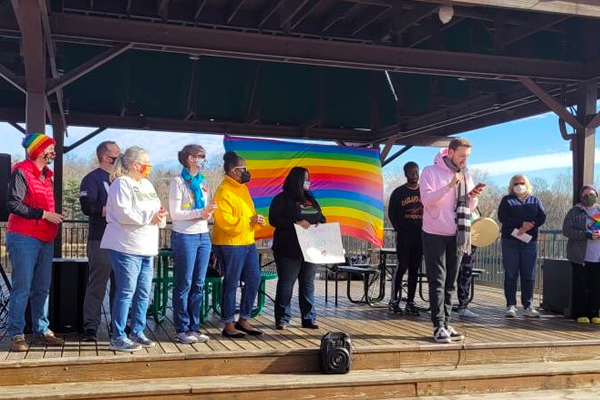
A diverse crowd of 100 to 200 folks gathered at the Columbia Lakefront on Saturday to attend a rally to push back against censorship in the county’s public schools as well as homophobia and transphobia emanating from a group of conservative parents.
The rally called “We ARE the People” was organized in response to the comments and actions by members of a Maryland-based conservative group “We the People 2” that among other things are anti-masks, anti-vaccinations and are opposed to teaching racial history in the schools. They also oppose two books that are in Howard County Public Schools library shelves: “Gender Queer” and “Lawn Boy.”
Speakers at a We the People 2 rally last month at an Elkridge warehouse condemned the books, which contain LGBTQ characters, as sexually explicit. The group later filed police reports against the Board of Education alleging the books constitute pornography with “graphic sexual content and materials being used and disseminated in public schools,” according to the group’s press release. A flier announcing this action used the loaded terminology, “We must not allow our children to be abused and victimized.”
Among the speakers at the Elkridge rally was Republican Gordana Schifanelli who is running for lieutenant governor on the ticket with Daniel Cox. Another speaker, George Johnson, a teacher from Baltimore City, was heard on a video of the event saying, “We’re doing God’s work because Marxism, homosexuality and transgenderism is the devil.”
In response, the pro-LGBTQ rally in Columbia announced the following:
We are taking a stance against hate in the community as we raise our voices in support of equity in our schools. Attacks on teachers and school staff have prompted us to stand united and drown out the noise.
In addition, We ARE the People states:
We stand for LGBTQ+ students and educational professionals
Teaching accurate history to our students
Supporting equitable practices in our schools
Providing students with relevant LGBTQ+ media through their school libraries
The two-hour rally, which was attended by several county council members, featured speakers representing a wide swath of community, educational, religious and political organizations. They included: Community Allies of Rainbow Youth (CARY), Black Lives Activists of Columbia (BLAC), Absolutely Dragulous, Howard County Schools, PFLAG-Columbia/Howard County, IndivisibleHoCoMd, Columbia Democratic Club, Howard Progressive Project, Unitarian Universalist Congregation of Columbia (UUCC), HoCo Pride, Progressive Democrats of Howard County, and the Columbia United Christian Church.
Many of the speakers denounced the censorship of materials that are needed by many LGBTQ students. Genderqueer and non-binary students, they point out, are most vulnerable and need affirming literature to help with their development and self-acceptance. The speakers also decried hate speech, which has surfaced again, as well as the opposition to teaching history as it relates to race.
Others argued that the community must not sit back and take it from extremist groups.
“You are all defenders,” said Cynthia Fikes, president of the Columbia Democratic Club, in a fiery speech. “But to succeed a strong defense also needs a strong offense.”
The two books in question were recently the center of controversy in the Fairfax County (Va.) school system. The books were removed in September from the shelves of the high schools pending a comprehensive review following opposition from a parent at a school board meeting. It should be noted that both books were previous winners of the American Library Association’s Alex Awards, which each year recognize “10 books written for adults that have special appeal to young adults, ages 12 through 18.”
The board established two committees consisting of parents, staff and students to assess the content of the books and make recommendations to the assistant superintendent of instructional services who would make the final determination.
One committee found that “Lawn Boy” includes themes that “are affirming for students” with marginalized identities. “There is no pedophilia in the book,” the committee added. The other committee found that “Gender Queer” depicts “difficulties non-binary and asexual individuals may face.” The committee concluded that “the book neither depicts nor describes pedophilia.” The books were restored to the shelves.
“As this backlash against LGTBQ+ literature demonstrates, we must be ready to stand up and defend the progress we have made,” said Jennifer Mallo, member of the Howard County Board of Education, expressing her own point of view. “We must ensure our elected officials understand and share our values and will fight for our marginalized students.”
The enthusiastic crowd was clearly pleased with the event.
“Today’s rally was meant to inspire our community to take action,” said Chris Hefty, who was the lead organizer of the rally and the emcee. “Action that protects our youth. Action that protects our educators and admins. This action comes in the form of advocacy, communication with elected officials so they know your voice, and through well informed voting to ensure those who represent us are those we know will support us. We shared a message of love, acceptance, and warmth.”
Hefty adds, “The unity we facilitated through this rally was a sight to behold. As the lead organizer I couldn’t have been more pleased! In the future we will be sure to better meet the needs of all our community members. We thank all those in our community for their support and feedback and look forward to accomplishing great things together moving forward.”


Rehoboth Beach
BLUF leather social set for April 10 in Rehoboth
Attendees encouraged to wear appropriate gear

Diego’s in Rehoboth Beach hosts a monthly leather happy hour. April’s edition is scheduled for Friday, April 10, 5-7 p.m. Attendees are encouraged to wear appropriate gear. The event is billed as an official event of BLUF, the free community group for men interested in leather. After happy hour, the attendees are encouraged to reconvene at Local Bootlegging Company for dinner, which allows cigar smoking. There’s no cover charge for either event.
District of Columbia
Celebrations of life planned for Sean Bartel
Two memorial events scheduled in D.C.
Two celebrations of life are planned for Sean Christopher Bartel, 48, who was found deceased on a hiking trail in Argentina on or around March 15. Bartel began his career as a television news reporter and news anchor at stations in Louisville, Ky., and Evansville, Ind., before serving as Senior Video Producer for the D.C.-based International Brotherhood of Electrical Workers union from 2013 to 2024.
A memorial gathering is planned for Friday, April 10, 11:30 a.m.-1:30 p.m. at the IBEW International Office (900 7th St., N.W.), according to a statement by the DC Gay Flag Football League, where Bartel was a longtime member. A celebration of life is planned that same evening, 6-8 p.m. at Trade (1410 14th St., N.W.).
District of Columbia
D.C. Council member honored by LGBTQ homeless youth group
Doni Crawford receives inaugural Wanda Alston Legacy Award

About 100 people turned out Tuesday evening, April 7, for a presentation by D.C.’s Wanda Alston Foundation of its inaugural Wanda Alston Legacy Award to D.C. Council member Doni Crawford (I-At-Large) for her support for the foundation’s mission to support homeless LGBTQ youth.
Among those who attended the event was Japer Bowles, director of D.C. Mayor Muriel Bowser’s Office of LGBTQ Affairs, who delivered an official proclamation issued by Bowser declaring April 7, 2026 “A Day of Remembrance for Wanda Alston.”
Alston, a beloved women’s and LGBTQ rights activist, served as the city’s first director of the then newly created Office of LGBTQ Affairs under then-Mayor Anthony Williams from 2004 until her death by murder on March 16, 2005.
To the shock and dismay of fellow LGBTQ rights advocates, police and court records reported Alston, 45, was stabbed to death inside her Northeast D.C. house by a man high on crack cocaine who lived nearby and who stole her credit cards and car. The perpetrator, William Martin Parrott, 38, was arrested by D.C. police the next day and later pleaded guilty to second-degree murder. He was sentenced in July 2005 to 24 years in prison.
Crawford was among those attending the award event who reflected on Alston’s legacy and outspoken advocacy for LGBTQ and feminist causes.
“I am deeply humbled and honored to receive this inaugural award,” Crawford told the Washington Blade at the conclusion of the event. “I think the world of Wanda Alston. She has set such a great foundation for me and other Council members to build on,” she said.
“Her focus on inclusivity and intersectionality is really important as we approach this work,” Crawford added. “And it’s going to guide my work at the Council every day.”
Crawford was appointed to the D.C. Council in January of this year to replace then Council member Kenyan McDuffie (I-At-Large), who resigned to run for D.C. mayor as a Democrat. She is being challenged by four other independent candidates in a June 16 special election for the Council seat.
Under the city’s Home Rule Charter written and approved by Congress, the seat is one of two D.C. Council at-large seats that cannot be held by a “majority party” candidate, meaning a Democrat.
A statement released by the Alston Foundation last month announcing Crawford’s selection for the Wanda Alston Legacy Award praised Crawford’s record of support for its work on behalf of LGBTQ youth.
“From behind the scenes to now serving as an At-Large Council member, she has fought fearlessly for affordable housing, LGBTQ+ funding priorities, and racial justice,” the statement says. “Council member Crawford’s leadership reflects the same courage and conviction that defined Wanda’s legacy.”
Organizers of the event noted that it was held on what would have been Wanda Alston’s 67th birthday.
“Today’s legacy reception was a smashing success,” said Cesar Toledo, the Alston Foundation’s executive director. “Not only did we come together to celebrate Wanda Alston on her birthday, but we also were able to raise over $10,000 for our homeless LGBTQ youth here in D.C.,” Toledo told the Blade.
“In addition to that, we celebrated and we acknowledged a rising star in our community,” he said. “And that is At-Large Council member Doni Crawford, who we named the inaugural Wanda Alston Legacy Award recipient.”
At the request of D.C. Council Chair Phil Mendelson (D-At-Large) the Council voted unanimously on Jan. 20, 2026, to appoint Crawford to the Council seat being vacated by McDuffie.
Council records show she joined McDuffie’s Council staff in 2022 as a policy adviser and later became his legislative director before McDuffie appointed her as staff director for the Council’s Committee on Business and Economic Development for which McDuffie served as chair.

Calendar: April 10-16

BLUF leather social set for April 10 in Rehoboth

Celebrations of life planned for Sean Bartel

The ‘X’ returns to court

LGBTQ community explores arming up during heated political times

D.C. is the place for the Democratic Socialists of America

Key lifestyle changes can help patients cope with diabetes

Trump budget would codify expanded global gag rule

Man faces first S.C. ‘hate intimidation’ charge

Police mental health struggles gain growing attention
-

 Opinions5 days ago
D.C. is the place for the Democratic Socialists of America
-
District of Columbia5 days ago
Key lifestyle changes can help patients cope with diabetes
-
The White House5 days ago
Trump budget would codify expanded global gag rule
-
South Carolina5 days ago
Man faces first S.C. ‘hate intimidation’ charge