Movies
Toxic masculinity gets its comeuppance in ‘Power of the Dog’
Cumberbatch, Dunst shine in unforgettable anti-Western
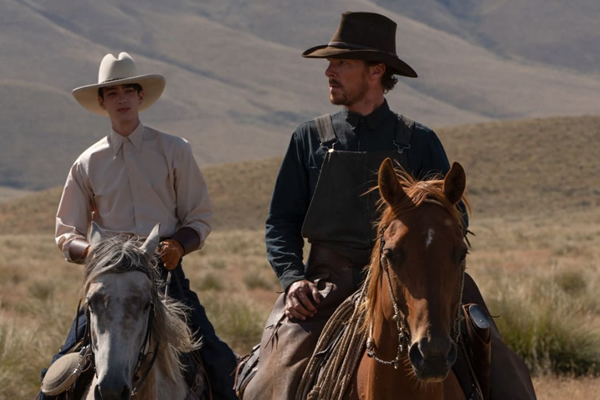
Say what you will about the Western being a tired genre, but when it comes to tracing shifts in the American cultural identity over long stretches of time, there’s still nothing quite like it.
Take, for example, “The Power of the Dog,” the newest effort from acclaimed New Zealand filmmaker Jane Campion, now playing in theaters (and on Netflix) and topping the best-of-the-year lists of critics across the U.S. Set against the expanse of the American frontier of a century ago, it leans into time-worn tropes that have become wrapped up in our nation’s self-image, much the same as the great classic Westerns have done since the first flickering images of cowboys began to appear on screens in the very dawn of cinema history.
Some of these tropes, of course, have come to be seen as toxic. The way that Western movies have perpetuated racism by equating “Cowboys vs. Indians” to “Good vs. Evil” is perhaps the most clear-cut example; almost as obviously “problematic” is a presentation of manhood in which physical prowess is held up as the ideal, while emotional sensitivity or intellectualism are devalued as tell-tale signs of weakness. With 2022 right around the corner, outmoded and tone-deaf assumptions such as these make it easy to understand why many people think of the Western as an out-of-touch and irrelevant form of cinematic expression that deserves to be retired, once and for all.
Yet as Campion’s visually eloquent, quietly subversive adaptation of Thomas Savage’s 1968 novel reminds us, Westerns have a way of reflecting our changing attitudes. Just as “The Searchers” or “Little Big Man” challenged our stereotyped ideas about indigenous people, “The Power of the Dog” forces us to confront our acceptance of the rough-and-rugged cowboy as a paragon of masculinity and suggests he might have just been an overbearing bully, all along.
The cowboy in this case is Phil Burbank (Benedict Cumberbatch), who along with his brother George (Jesse Plemons) owns a lucrative cattle ranch in 1925 Montana. He’s the embodiment of the “alpha” mentality, presiding over his life and business with absolute authority; when George marries a widow (Kirsten Dunst) and brings her home – along with her son Peter (Kodi Smit-McPhee), a young man with aspirations of becoming a surgeon – he browbeats the newcomers to his household and treats them with open contempt. He takes particular delight in tormenting Peter, whose slight build and effeminate manner make him an easy target for ridicule, but an awkward encounter in the woods sparks a change of heart; he decides to take his new nephew under his wing, hoping to turn him into a “real man” and perhaps reconnect with a tender side of his own nature he has long kept buried.
A reading of that brief synopsis is enough to make it clear that Campion’s movie plays on other tropes besides those found in Westerns. Traditional queer narratives in American culture inevitably lead us to expect an “unexpected” romance between these two initially antagonistic men, and a subsequent blossoming that will allow the hardened rancher to undergo a heartwarming transformation not unlike that of the Grinch.
But “Power of the Dog” is not that kind of queer narrative, just as it’s not the kind of Western where gunslingers resolve their conflicts with a climactic showdown on a dusty street. It leaves little doubt that romance – or some stunted, self-loathing version of it, at least – is on Phil’s mind once he hits upon the possibility of it; but it’s also keenly aware that men like Phil, who hide their own presumed desires under a mask of reflexive intolerance and are only willing to explore their secret side if they can maintain plausible deniability, are a big part of the reason why gay men – or anybody else who has been repeatedly lumped together in the category of “other” and turned into social outcasts or worse – have been subjected to so much bigotry and abuse for so very long.
To be sure, he’s a product of his time and place – but where a film from a different era might have given him the benefit of the doubt and helped him to find the redemption we’ve been conditioned to think he deserves, this one is not ready to let him get off scot-free. It doesn’t matter if he’s queer – he’s also a narcissistic tyrant who maintains his own assumed superiority by terrorizing and belittling those around him (his nickname for his brother is “Fatso,” which tells you all you need to know) to keep them submissive and docile. The days when such individuals got a pass for their bad behavior feel very much like a thing of the past in a world still reeling from the influence of Trumpism and other such movements, and Campion’s movie works its leisurely way to a conclusion that seems designed to make an example of its charismatic but unsavory central figure. Compassion is afforded, but it’s the kind of compassion that might be expressed by putting a wounded animal out of its misery.
Campion’s writing and direction of this deceptively pastoral period drama is as flawless as might be expected from a filmmaker of her caliber; she blends the awe-inspiring landscape (stunningly photographed by Ari Wegner, with New Zealand’s breathtaking natural beauty doubling for the Wyoming badlands) with the quietly jarring strains of Jonny Greenwood’s superb score to reinforce the roiling tensions below the placid surface of the story, and shrewdly trusts our own preconceptions to keep us from seeing the obvious indications of an ending that is being set up for us right in plain sight.
The cast, too, is uniformly outstanding. Cumberbatch turns in a powerhouse performance that’s as boldly unsympathetic as it is unforgettable, carrying himself with a ramrod-straight bearing that is just affected enough to suggest he’s not all that he seems but defies you to call him out on it; deservedly, he’s high on the list of likely Best Actor contenders for the next Oscars. Also award-worthy are Plemons, whose quiet underplaying of the good-hearted George helps him steal almost every scene he’s in, and Smit-McPhee, whose Peter exudes a refreshingly contemporary understanding and wisdom while retaining just enough enigma to keep us guessing about his motives. Rounding out the main ensemble, Dunst earns both our sympathy and respect in a role that might easily have been overshadowed in the hands of a lesser actress.
“Power of the Dog” is unquestionably a great film, assembled by a proven master at the peak of her powers and augmented by impressive performances – but does that mean the Western still has something to offer in a world more “woke” than it was in the heyday of the genre? For all its artistry, it tells a subtle story – and a bleak one, at that, albeit one that leaves us with a somewhat conflicted sense of satisfaction. It’s likely to leave some viewers cold – especially fans of a genre known for action, adventure, and the reinforcement of traditional values. In this way, perhaps it’s better characterized as an “anti-Western.”
Whatever label you decide put on it, it deserves your attention.





Movies
‘Heartstopper Forever’ delivers satisfying conclusion
Beloved queer phenomenon shows us hope can belong to everyone

When I wrote my review of the first season of “Heartstopper,” I said that if the series could only be summed up in one word, it would be “adorable.”
After an additional two seasons and a movie length series finale (which began streaming on Netflix July 17), I’m going to make up a new rule and say that I can choose a second word to close things out. By the time I reach the end of my review of “Heartstopper Forever,” in which our adorable Nick and Charlie must face the possibility that their tender young romance may not be able to survive their graduation to college, I hope I’ll have figured which word it would be.
Directed by Wash Westmoreland and written (as always) by Alice Oseman, artist and creator behind the YA webcomic/graphic novel that launched the whole “Heartstopper” phenomenon, this final installment finds a very different Nick and Charlie than we met in those early episodes – yet in many ways they’re still very much the same. Far from the timid and bullied queer lad of the first season, Charlie (Joe Locke) is now boldly out and confident enough to win the election for “head boy” in his final year at school, and Nick (Kit Connor) no longer struggles with being open about his bisexuality; yet as the stress of their impending separation – each to a different college in a different city – begins to become more urgent, both of them fall back on old patterns.
To those of us who have been around long enough to re-examine such a crisis with 20/20 hindsight, that’s bound to strike chords of recognition. To the younger “Heartstopper” fans, however, it’s likely to feel like high drama – exactly as it did for us when we were going through it ourselves. It’s not just Nick and Charlie, either; other characters, like transgender prodigy Elle (Yasmin Finney) and her cis-het boyfriend Tao (William Gao), must also come to terms with the changing dynamics of their relationships. The result is multiple mirrors through which queer teens can see their own experience reflected, which has always been the appeal of “Heartstopper” in the first place. And as it has from the beginning, Oseman’s intent to provide her teen audience with positive perspectives shines through, ensuring that the story’s final chapter lands in a place where hope can belong to everyone.
That doesn’t mean it doesn’t have its share of dark moments – it wouldn’t be “Heartstopper” if it didn’t, would it? Part of the show’s value for its fans, young and old alike, has always come through its various characters’ growing pains; their missteps and misjudgments, their confused emotions, their fumbling efforts at “first times,” their struggles toward self-esteem. All these and more have provided the necessary “weight” to counter the show’s bubbly optimism and keep it from becoming as insubstantial as spun sugar. More importantly, these issues have always been the real core of the story: We love the sweetness of the romance, but the deeper satisfaction comes from watching these young people navigate all their challenges, sometimes alone but more often together, and build a community through the shared experience of working through them.
The final installment, having brought Charlie, Nick, and all the rest to the cusp of young adulthood, brings a suitably more mature level of problems into the mix. Sure, Charlie has grown into the hero he once needed himself, but the uncertainty that emerges between himself and Nick as they ponder their impending separation is enough to spark a relapse of his eating disorder; likewise, Nick may be confident and unguarded about his sexuality and openly proud of being Charlie’s boyfriend, but that doesn’t stop him from slipping back into self-doubt (and bad behavior) when he contemplates the possibility that their love story might be coming to an end. We know they have the “tools” to get back on track, but with everything so up in the air, will they be able to remember how to use them?
So, too, throughout the series, we have seen these kids come to terms with their individual queerness, navigating those personal journeys and learning how to embrace who they are in an environment where, for the most part, they get a lot of support. At the same time, there have been shadows around the edges, encounters and circumstances that remind them (and us) that, outside the protective circle provided by their school and each other, bigotry still exists. In “Heartstopper Forever,” those reminders are still there, and they feel all the more ominous – not just because of the worldwide rise in anti-LGBTQ+ sentiment, though that’s tied to it, but because these bright young things will soon be moving into a larger world where safety and shelter from the hate is not quite so certain.
Still, it’s Nick and Charlie’s story above all else, and naturally the main focus of this finale is on them. There has always been a too-good-to-be-true perfection to their romance, but Locke and Connor are so good at bringing it to life we believe it; here, fittingly for a final chapter, these boys finally face the crossroad that comes with adulthood – the recognition that, one way or another, there will be an ending to their relationship. How they handle that, we won’t spoil; once again, though, this is “Heartstopper,” one can feel sure that Oseman’s characters will work their way through it in the most imperfectly perfect – and emotionally satisfying – way possible.
Deserving of mention: characters like Isaac (Tobie Donovan), Imogen (Rhea Norwood), and Charlie’s sister Tori (Jenny Walser) return to get their fair share of the spotlight, and gay teachers Mr. Ajayi (Fisayo Akinade) and Mr. Farouk (Nima Taleghani) get the chance for a new beginning of their own; and out UK acting legend Derek Jacobi (“I, Claudius”) appears alongside real-life partner Richard Clifford as an elderly couple in a quiet but important scene at the cafe where Charlie works.
With any “franchise” as popular as “Heartstopper,” the task of bringing closure to a story that has emotionally involved so many fans is almost always a thankless one (just ask George Lucas), so there are sure to be some who have objections to the way Oseman brings her beloved story to an end; but it’s her story to end, and in choosing to uphold its sensational (yet sentimental) imagining of the world as it could be, “Heartstopper Forever” doubles down on the idea that we can make it the way that it should be.
That’s why my choice for the second word we can use to sum up “Heartstopper” is “aspirational.” In the relative innocence and un-ironic preciousness of Nick and Charlie’s enduring love story, we can find no excuses; not all of us can keep our first love alive for an entire lifetime (nor, often, should we), but maybe we can learn to follow our hearts as surely and openly as they do.
That’s about as aspirational as any of us can hope to be – but don’t worry: it’s still adorable, too.
Movies
‘Into the Grey’ unites Cavill, Gyllenhaal for thrills and gay love
Did studio sabotage film’s release because of queer plot?
What if they released the LGBTQ-themed action movie we’ve all been waiting for and they didn’t bother to tell us?
It’s a rhetorical question, really, because we already know the answer, and it can be found between the lines in the distribution-and-release history of “In the Grey,” a typically slick and cynical “caper thriller” from veteran filmmaker (and former Madonna husband) Guy Ritchie, which is now available on VOD platforms after a perfunctory theatrical opening in May.
Like almost all of Ritchie’s films, it’s fast-paced, clever, and full of surprises, some of which have to do with the plot, but most of all involve its characters – who, also in the tradition of Ritchie’s former work, inhabit a rarified world in which confidence, bravado, and stoic humor define the moral environment while something else (call it “fate” or “karma” or simply “the consequence of choices”) works behind the scenes to deliver a conclusion that satisfies our jaded sense of justice even as it fairly drips with irony. Also like most of Ritchie’s films, it succeeds in sucking us into its plotting while drawing a clear line between the “good guys” (i.e. the ones who are ostensibly working toward an equitable outcome, if not a moral high ground) and the out-of-balance despotism of a weighted power hierarchy that defines the shadowy status quo of human endeavor.
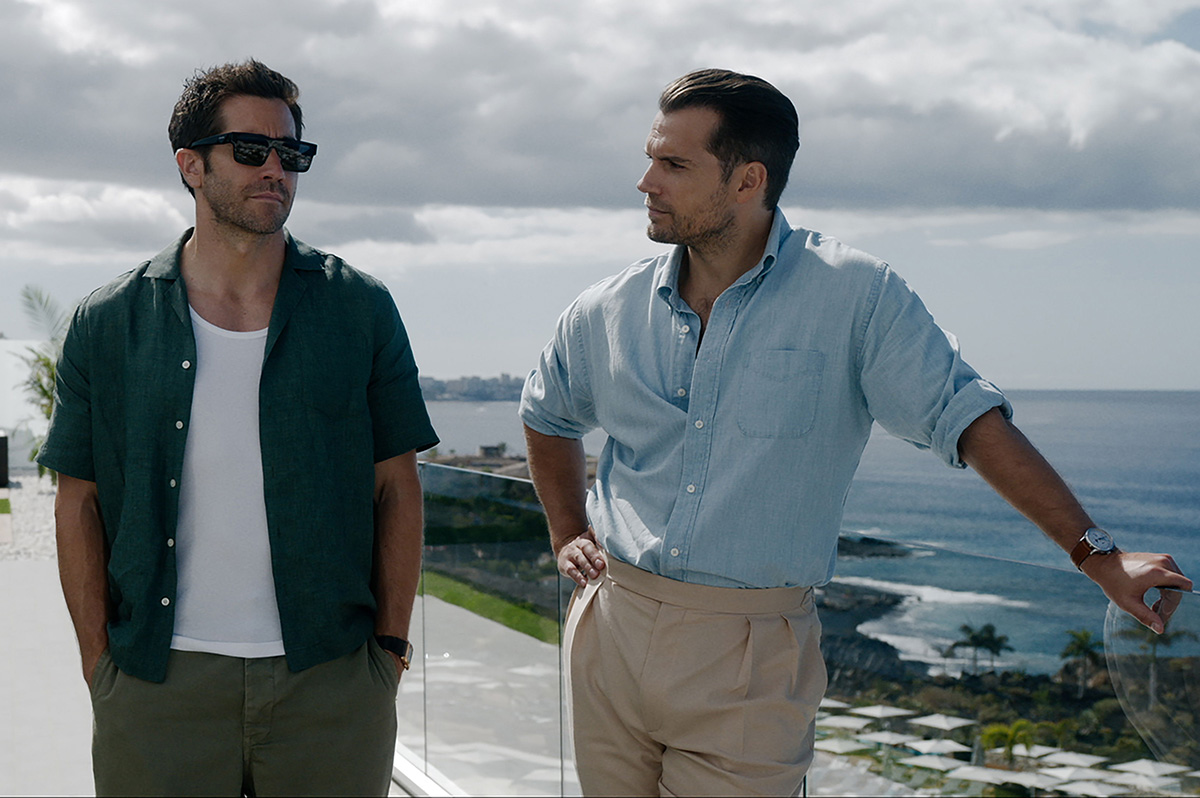
The caper in question is being run by Rachel Wild (Eiza Gonzalez), an elite lawyer who specializes in retrieving funds owed to high-finance “asset management” firms by wealthy clients, whose latest case puts her into a showdown with ruthless crime boss Manny Salazar (Carlos Bardem) over a billion-dollar debt. She’s elite for a reason, though; she’s backed up by her own small militia of “fixers” headed by trusted “extralegal” operatives Bronco and Sid (Jake Gyllenhaal and Henry Cavill, respectively), who are more than capable of carrying out her plans and have no intention of allowing Salazar to gain the upper hand. The plan involves blocking and handicapping his operations until he is forced to return the money; but when their powerful quarry decides to make things personal by going after Rachel in retaliation, it’s up to her loyal protectors (and their highly skilled team) to keep her safe.
Crafted by Ritchie with his usual blend of intricate plotting, jocular amorality, and shocking violence, it’s also a movie that fairly oozes testosterone; yes, there’s a smart and powerful woman at the center of it all, but she’s got as much (or more) macho swagger as anybody else so the effect is just the same. In fact, there’s a lot of hyper-masculine posturing, attitude, and tough talk that goes on all around, most of it delivered with that jocularity we mentioned. Action, naturally, is key to the formula, and “In the Grey” ramps it up to near orgiastic levels with an escalating collection of high-octane set pieces – chases, gunfights, explosions, zip-lining – all carefully spelled out ahead of time for us, point for point, in expository detail so that we can keep up with them as they unfold. It’s a movie about planning and strategy as much as anything else, and it wants to make sure we’re all prepped and ready for “go time.”
As for feelings, in a film like this, you might just think they don’t matter and leave it at that – but that’s not entirely true. Almost hidden in the middle of all this morally murky bluster and bravado is an unexpected angle, and it lends a touch of tenderness to the whole thing that somehow ends up being essential.
The movie takes pains to create a slow reveal, so it feels like a spoiler (consider this your warning) to say it, but underneath all the non-stop action there’s a love story going on, and it’s between the two leading men. We’re not sure at first, though the jovial banter between Cavill and Gyllenhaal has a distinct “romcom” vibe from the beginning, but as the movie goes on it gradually becomes clear that they are, in fact, a couple.
Perhaps not surprisingly, there was no mention of the nature of their relationship in any of the film’s publicity; the studio (Lionsgate) delayed release for months and eventually gave up distribution rights to Black Bear International. When it hit theaters, it finished ninth at the box office; even the popularity of its two stars was not enough to make up for the lack of push that accompanied its release. Does all of this suggest that the studio scuttled their own movie just because of the “gay angle” and the reaction it might get in today’s environment? It’s hard not to speculate on that possibility, but either way, those two characters are gay.
Does it matter to the plot? Not really; there’s no lovestruck romance here – these guys have obviously been together a long time, and they carry the comfortable familiarity to prove it – nor is there even a kiss. It’s just a layer to their characters, a nuance that offers a glimpse of relatable, everyday humanity in a plot where almost everything else is bombast. Importantly, it also raises the stakes for the audience; knowing they are together gives us a reason to root for them beyond simple “good guy/bad guy” dynamic (which is complicated in a movie where both sides are trying to gun each other down mercilessly), and while we might not be so invested in the film’s overarching plot – do we really care if a venture capital corporation gets its money back from the murderous gangster they lent it to in the first place? – we can at least hope that these two handsome mercenaries will be able to go home to their cats together at the end.
As for the acting, this is not a film that demands anything more subtle than broad strokes from its players, but Cavill and Gyllenhaal, given such rich possibilities for subtext in their otherwise formulaic dialogue, clearly play it up with enthusiasm; they also convey that all-important tenderness – especially Gyllenhaal, who stirs an occasional echo of his “Brokeback Mountain” performance from two decades back. The rest of the cast – with the exception of Fisher Stevens as Salazar’s long-suffering lawyer, and Rosamund Pike as Rachel’s treacherous client – mostly play stock characters, familiar, predictable, and not too deep, but they do it well enough.
All that said, and with or without the gay couple in the middle of it, “In the Grey” is not a very remarkable movie. It’s more clever than smart, and while it benefits from Ritchie’s signature fast-paced, edgy style it sometimes feels repetitive – it’s nothing we haven’t seen before, and even if the setting within the corrupt world of the financial elite might strike a note for some viewers today, it never gets political enough to stir up any kind of fervor.
Cavill and Gyllenhaal, however, are good enough together to make it worth a watch – so why not? After all, brains (and eyes) like candy once in a while, too.
Movies
30 years on, ‘The Birdcage’ remains a landmark
A reminder that the only thing required to make a family is love

In 1996, after the AIDS epidemic had cast its shadow over the gay community for a decade and a half, the breakthrough finally came: the success of antiretroviral medication turned a fatal disease into a manageable and survivable condition — and suddenly, “queer joy” began to feel like a possibility again.
The year 1996 also saw the release of “The Birdcage,” a remake of the farcical French film comedy “La Cage aux Folles,” about a gay couple who attempt to “play it straight” when their son brings his fiancée’s conservative parents over for dinner, starring Robin Williams and Nathan Lane — in one of his first (non-animated) film roles — as the couple. It was notable as one of the rare studio films of the era to center on gay characters, and the fact that it was a certified box office hit represented a welcome cultural shift after the years of homophobic stigma fostered by Reagan-era “moral majority” conservatism.
These two landmarks were coincidental, of course, and obviously the significance of the first (though it came a few months later) was, in the scheme of things, far more monumental. Nevertheless, there’s something about the timing that marked a definitive moment in the ongoing struggle for queer acceptance. It was a palpable turn of the tide, a moment in time when we could collectively “unclench” — and 30 years later, in the midst of a whole new onslaught of conservative bigotry that threatens to erode the progress of the intervening years, it’s a moment worth celebrating, if for no other reason than to remind ourselves of what is possible when we refuse to hide who we are.
That, after all, is the central conflict in “The Birdcage,” just as it was in the earlier French play (by Jean Poiret) and film that inspired it, as well as the hit Broadway musical (“La Cage aux Folles” (adapted by queer writer Harvey Fierstein and queer composer Jerry Herman) that came in between. Set in the famously gay Miami neighborhood of South Beach, it centers on a popular queer nightclub owned by longtime partners Armand (Williams), who runs the business, and Albert (Lane), a flamboyant drag performer known as “Starina” who serves as the club’s headlining act; as a result of a long-ago one-night stand, Armand is father to Val (Dan Futterman), whom the couple have raised together, and who has become engaged to Barbara (Calista Flockhart), the daughter of a prominent conservative senator (Gene Hackman). Fearing that knowledge of his parents’ true relationship will prevent the senator from allowing the marriage, Val convinces Armand and Albert to temporarily “straightwash” themselves for a dinner party with the would-be future in-laws. Naturally, things do not go as planned (this is a farce, after all), but by the end, the gays “save the day,” as they say, by helping the senator and his wife (Dianne Wiest) avoid a scandal, and the kids get to have their wedding, after all.
It’s true that “The Birdcage” has invited criticism from within the community over the years for offering exaggerated stereotypes, especially in its depictions of “femme” characters like Albert and Agador (Hank Azaria), the couple’s Guatemalan housekeeper — and, in more recent times, from younger queer viewers who brand Val as “the real villain” of the movie for his insistence on making his parents pretend to be straight. There’s also the quibble that two of the film’s leading gay characters are played by heterosexual actors (Williams and Azaria) and that neither the writer nor director of the film were queer themselves. We can’t dispute the validity of such positions, but we can certainly suggest that they might be missing the point.
The director, Mike Nichols, was a man who had transitioned from being a comedian to becoming a celebrated director for both stage and screen, responsible for (among many other films) “Who’s Afraid of Virginia Woolf?” and “The Graduate,” and the script was by Elaine May, his former comedy partner, known for her witty, sophisticated, and savvy screenwriting. Both came with a pedigree that included extensive collaboration with queer performers and creators, and a track record that clearly showed their dedication for humanity and truth over the social constructs they repeatedly undermined with shrewd observational satire.
Williams, known then and now for his manic, over-the-top cartoonishness, plays Armand with complete sincerity, balancing his signature lunacy (like the classic “Fosse, Fosse” moment as he directs a new act for the club) with a deeply considered emotional solidity that never strikes a false note; and Azaria, whose performance became an instantly iconic fan favorite of outrageous femme-boy camp, is lovable precisely because his iteration of the cliché is so completely un-self-conscious, and is still beloved arguably as much for this as for his decades of voice work on “The Simpsons” — not because he is ridiculous (he is, and hilariously so) but because he is so recognizably real.
As for Lane, Albert’s character is explicitly written as a “diva,” the kind of gay male “show queen” stereotype that never quite offends because we all know someone — or are someone — who fits that profile to a tee; underneath it all is a person determined to live life on their own terms, and it makes his emergence as an eleventh-hour hero/heroine all the more satisfying. Let’s face it, when the chips are down, none of us could ask for a better mom than he turns out to be.
Of course, the participation of incomparable actors Hackman and Wiest is invaluable, allowing even their stodgy characters enough grace to keep them from coming off as complete buffoons (though Hackman’s reprehensible senator, appropriately enough, comes close); for good measure, there’s even the delicious Christine Baranski as Val’s biological mother.
All those performances — along with the fabulous explosion of Miami decor in the scenic design, the depictions of vibrant queer nightlife, and a soundtrack that includes both spicy nuggets of iconic club music and a handful of songs by the great gay genius Stephen Sondheim — are enough to make “The Birdcage” a classic, but the reason it continues to resonate with queer joy emanates from the material itself.
Wrapped up in all the absurdity of its humor, “La Cage aux Folles” (in all its forms) proffers a simple story in which — despite misunderstandings, hurt feelings, and all the various kerfuffles which erupt throughout — everyone shows up for each other. It’s a portrait of a household built on love, about a family willing to leap hurdles and place the happiness of those dear to them above their own inconveniences. In the end, the queerness is really not the point; but the fact that it’s a queer family who embodies these values (and a messy one, at that) is, as the queer expression goes, everything.
Thirty years ago, “The Birdcage” was a fun celebration; today, in a world that once more feels weaponized against queerness, it’s more than that: It’s a great film that reminds us that our greatest victories arise from being ourselves, unapologetically — and that the only thing required to make a family is unconditional love.

My evening with Madonna

PHOTOS: Petal Release Party

Madonna headlines World Pride Music Festival in Amsterdam

Reggie White relishing first season as artistic director of Woolly Mammoth

PHOTOS: Amsterdam Pride Canal Parade

PHOTOS: Lambda Legal in the Pines

Calendar: July 31-August 6

Taiwan’s government has failed to update process to change gender markers on ID documents

Come showcase your singing, poetry talent