U.S. Federal Courts
Federal judge rules insurance companies can refuse to cover PrEP
Braidwood Management challenged Affordable Care Act provision
A federal judge on Wednesday ruled against a federal mandate that requires employer provided health plans to cover PrEP, a drug used for the prevention of HIV.
The mandate, a provision of the Affordable Care Act, violates tenets of the federal Religious Freedom Restoration Act, according to U.S. District Judge Reed O’Connor of the U.S. District Court for the Northern District of Texas.
Insurance plans were required to cover PrEP following a 2019 recommendation from the Department of Health and Human Services for the drug to be prescribed for high-risk patients for the prevention of HIV infection.
Braidwood Management challenged the ACA’s provision the grounds that covering PrEP would conflict with its religious convictions as the medication “facilitates and encourages homosexual behavior, intravenous drug use and sexual activity outside of marriage between one man and one woman.”
O’Connor ruled in favor of Braidwood Management in a separate case last year challenging the 1964 Civil Rights Act’s anti-bias protections for sexual orientation and gender identity, deciding Braidwood had the right to discriminate under the Religious Freedom Restoration Act and the First Amendment.
Representing the company in both cases was former Texas Solicitor General Jonathan Mitchell, a vocal opponent of LGBTQ rights who is credited as the architect of Senate Bill 8, which provides a right of action allowing private citizens to sue those who obtain an abortion.
One of the more conservative judges in one of the most conservative federal district courts, O’Connor ruled in 2018 that the entire ACA was unconstitutional, which the U.S. Supreme Court subsequently overturned in 2021.
Carl Schmid, executive director of the HIV+Hepatitis Policy Institute, told Roll Call he expects Wednesday’s ruling will be appealed. “Preventive services covered by private insurance plans without cost-sharing, such as HIV testing, hepatitis B and C testing, and PrEP, are all critical and well-established public health preventive services that must continue,” he said.
PrEP reduces by roughly 99 percent the risk of contracting HIV. It has been labeled an “essential medicine” by the World Health Organization.
*********************





U.S. Federal Courts
Renee Good’s family files two federal lawsuits
ICE officer killed lesbian mother of three in Minneapolis in January

The family of lesbian woman who a U.S. Immigration and Customs Enforcement killed in Minneapolis in January have filed two federal lawsuits.
The Associated Press notes Renee Good’s partner, Becca Good, and her brother, Brent Ganger, in the lawsuits accuse the Trump-Vance administration and ICE officer Jonathan Ross of “unjustified and excessive use of force.”
Renee Good was a 37-year-old mother of three.
Ross on Jan. 7 shot and killed her in Minneapolis.
The shooting took place during the Trump-Vance administration’s so-called Operation Metro Surge that targeted Somalis and other immigrant groups in Minneapolis. U.S. Customs and Border Protection agents on Jan. 24 shot and killed Alex Pretti, a 37-year-old nurse who worked for the U.S. Department of Veterans Affairs, in Minneapolis.
Both shooting sparked outrage across the U.S. and around the world.
“Every morning, she is my first thought. I think about how the kids are growing up without their mama, and how I will grow old without the love of my life. I think about how we should have had 40 more years together. But I also think about what she would have wanted after all of this,” said Becca Good in a statement the Human Rights Campaign released after she and her partner’s family announced the lawsuits.
“As we have tried to navigate our own massive loss, I am also devastated by how many other lives have been destroyed in this darkest of times. So many other families are dealing with the loss of their loved ones; to everyone who has had to witness it — the pain of this moment extends far beyond our family,” added Becca Good. “What happened to us should never happen to any family. No child should grow up without a parent because of it. No one should lose their sister or their daughter. No one should have to live without their soulmate. Accountability — real accountability — is the only way to make sure that no other family has to go through what we have.”
HRC President Kelley Robinson in her own statement said the Good family “is one of our own — and today, the Human Rights Campaign joins them in demanding justice.”
“It has been eight months and 24 days since Renee was shot and killed by an ICE agent, and the United States government has failed to take responsibility for its actions,” said Robinson. “Her partner, Becca, and brother Brent, have made the brave and bold decision to hold the government accountable, and we stand with them. Like every person murdered by ICE, Renee should be alive today. The Goods were robbed of what every American family deserves: to be together.”
U.S. Federal Courts
Three overlooked court rulings limited White House anti-trans policies
Supreme Court narrowed trans rights, advocates saw victories in other decisions

While the U.S. Supreme Court’s decision in West Virginia v. B.P.J. continues to dominate headlines about transgender rights, three recent federal court cases produced significant rulings that limited or temporarily blocked Trump-Vance administration policies attacking trans Americans.
Talbott v. USA
Trump issued Executive Order 14183, “Prioritizing Military Excellence and Readiness,” on Jan. 27, 2025, banning trans people from serving in the military. The following day, GLAD Law and the National Center for LGBTQ Rights filed a federal lawsuit in the U.S. District Court for the District of Columbia challenging the ban on behalf of six active-duty service members and two individuals seeking to enlist. The organizations argue the policy violates the Fifth Amendment’s guarantee of equal protection under the law.
The plaintiffs sought a nationwide preliminary injunction — a temporary block on enforcement of the executive order while the litigation continued. The district court granted that injunction and later rejected the Trump-Vance administration’s request to dissolve it, temporarily protecting trans service members from being discharged solely because of their gender identity.
That protection, however, was short-lived. In Shilling v. Trump, the Supreme Court stayed the lower court’s injunction, allowing the military to begin enforcing the trans service ban while litigation continued. The U.S. Air Force subsequently required trans service members facing involuntary separation proceedings to appear in uniforms and grooming standards corresponding to their sex assigned at birth and, in some cases, used their deadnames during those proceedings.
Despite that setback, the plaintiffs secured two significant legal victories during Pride month.
On June 1, a federal appeals court blocked the discharge of the trans service members involved in Talbott. Then, on June 30, a federal district court certified the case as a class action on behalf of all currently serving trans service members. That means future rulings in the case will apply not only to the original six plaintiffs but to all active-duty trans military personnel covered by the class.
The case remains ongoing, but class certification significantly strengthens the ability to protect trans service members as the litigation continues. Currently, there are 28 plaintiffs in total, including the two still attempting to enlist.
Z.A. v. Blanche
In Z.A. v. Blanche (formerly Z.A. v. Lucile Salter Packard Children’s Hospital at Stanford), the U.S. District Court for the Northern District of California issued an emergency order one day before a federal grand jury subpoena was set to be enforced on July 2. The order blocked the Department of Justice from obtaining confidential medical records belonging to California families whose children receive gender-affirming care.
The ruling relied in part on protections established under the Health Insurance Portability and Accountability Act (HIPAA), the 1996 federal law governing the privacy and security of medical records.
The decision represented a significant check on the administration’s efforts to obtain sensitive patient information, protecting the privacy of trans patients and their families while the legal challenge proceeds.
Doe v. Blanche
Doe v. Blanche, which remains ongoing, challenges Trump’s executive order, Defending Women From Gender Ideology Extremism and Restoring Biological Truth to the Federal Government. Under policies implementing that order, many trans women in federal custody would be housed in men’s prisons.
A federal district court in D.C. granted a preliminary injunction blocking enforcement of a Bureau of Prisons policy that would require incarcerated trans women to be housed in men’s facilities regardless of individualized safety assessments or the risk of sexual assault.
The Bureau of Prisons policy also conflicts with the goals of the Prison Rape Elimination Act (PREA), enacted by Congress in 2003 to address sexual abuse in correctional facilities through standards, research, funding, and prevention measures. Federal data has consistently shown that trans people in custody experience sexual assault at dramatically higher rates than the general prison population.
Cuba
Trans parent charged with kidnapping, allegedly fled to Cuba with child
Cuban authorities helped locate Rose Inessa-Ethington
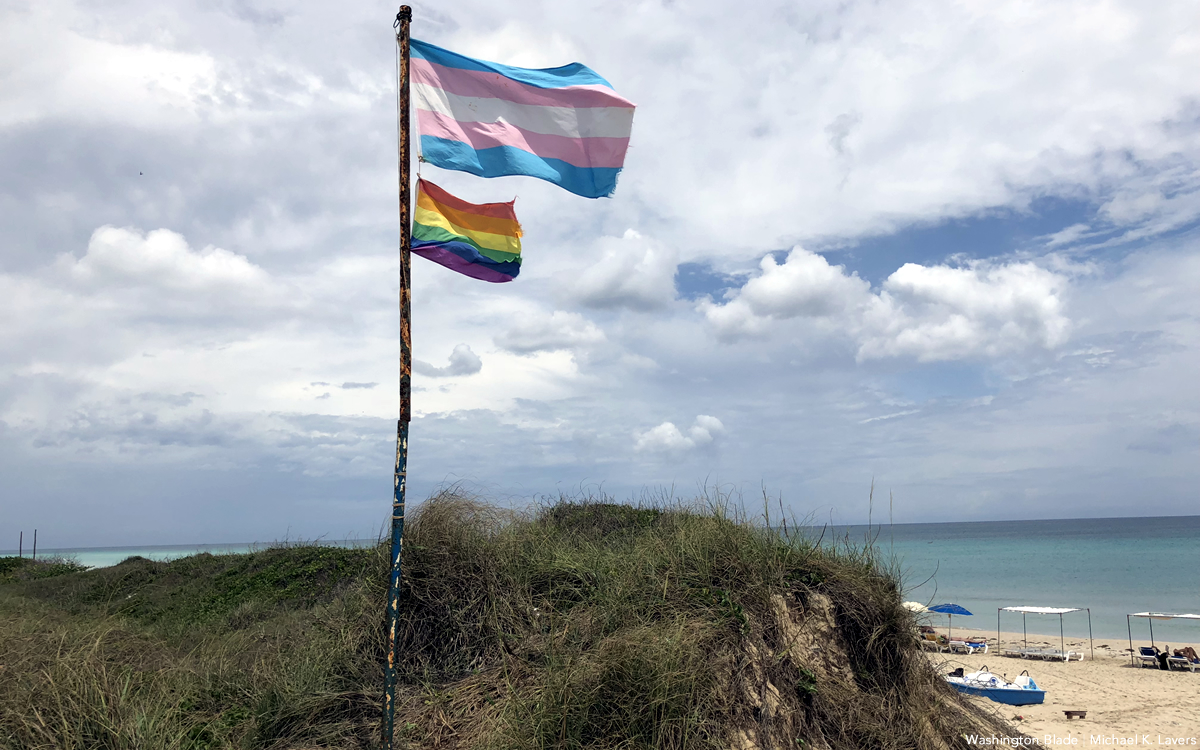
Federal authorities have charged a transgender woman with kidnapping after she allegedly fled to Cuba with her 10-year-old child.
An affidavit that Federal Bureau of Investigation Special Agent Jennifer Waterfield filed in U.S. District Court for the District of Utah on April 16 notes the child is a “biological male who identifies as a female” and “splits time living with divorced parents who share custody” in Cache County, Utah.
Waterfield notes the child on March 28 “was supposed to be traveling by car to” Calgary, Alberta, “for a planned camping trip with his transgender mother, Rose Inessa-Ethington, Rose’s partner, Blue Inessa-Ethington, and Blue’s 3-year-old child.”
The affidavit notes the group instead flew from Vancouver, British Columbia, to Mexico City on March 29. Waterfield writes the Inessa-Ethingtons and the two children then flew from Mérida, Mexico, to Havana on April 1.
The 10-year-old child called her biological mother on March 28 after they arrived in Canada. The custody agreement, according to the affidavit, required Rose Inessa-Ethington to return the child to her former spouse on April 3.
“Interviews of MV [Minor Victim] 1’s family members provided significant concerns for MV 1’s well-being, as MV 1 was born a male, however, identifies as a female child, which is largely believed to be due to manipulation by Rose Inessa-Ethington,” reads the affidavit. “Concerns exist that MV 1 was transported to Cuba for gender reassignment surgery prior to puberty.”
The affidavit indicates authorities found a note in the Inessa-Ethingtons’ home with “instruction from a mental health therapist located in Washington, D.C., including instruction to send the therapist the $10,000.00 and instructions on gender-affirming medical care for children.”
The affidavit does not identify the specific “mental health therapist” in D.C.
A Utah judge on April 13 ordered Rose Inessa-Ethington to “immediately” return the child to her former spouse. The former spouse also received sole custody.
“Your affiant believes that due to the extensive planning and preparation exhibited by both Rose Inessa-Ethington and Blue Inessa-Ethington to isolate MV 1 and take MV 1 to Havana, Cuba, without notifying or requesting permission from MV 1’s mother indicates they are likely not planning to return to the United States,” wrote Waterfield.
The affidavit notes Cuban authorities found the Inessa-Ethingtons and the child.
A press release the U.S. Attorney’s Office for the District of Utah issued notes the Inessa-Ethingtons “were deported from Cuba” on Monday “with the assistance of the FBI.”
The couple has been charged with International Parental Kidnapping. The Inessa-Ethingtons were arraigned in Richmond, Va., on Monday. The press release notes a federal court in Salt Lake City will soon handle the case.
The New York Times reported the child is now back with their biological mother.
“We are grateful to law enforcement for working swiftly to return the child to the biological mother,” said First Assistant U.S. Attorney Melissa Holyoak of the District of Utah in the press release.
The case is unfolding against the backdrop of increased tensions between Washington and Havana after U.S. forces on Jan. 3 seized now former Venezuelan President Nicolás Maduro and his wife, Cilia Flores.
President Donald Trump shortly after he took office in January 2025 issued an executive order that directed the federal government to only recognize two genders: male and female. A second White House directive banned federally-funded gender-affirming care for anyone under 19.
The U.S. Supreme Court last year in the Skrmetti decision upheld a Tennessee law that bans gender-affirming care for minors.
Cuba’s national health care system has offered free sex-reassignment surgeries since 2008.
Activists who are critical of Mariela Castro, the daughter of former President Raúl Castro who spearheads LGBTQ issues as director of Cuba’s National Center for Sexual Education, have previously told the Washington Blade that access to these procedures is limited. The Blade on Wednesday asked a contact in Havana to clarify whether Cuban law currently allows minors to undergo sex-reassignment surgery.

Bessent says Trump chose him for his qualifications, not his sexuality

Alianza para la Inclusión fortalece la defensa de derechos LGBTQ en Centroamérica

The facts about Victory Fund’s investigation and the path forward

In Ga., 2 trans candidates believe voters are ready for them

Bowser, Office of LGBTQ Affairs announce LGBTQ+ History Month events

House Democrats urge White House to confront Turkish government over anti-LGBTQ crackdown

Annapolis Pride arrives this weekend

Renee Good’s family files two federal lawsuits

Calendar: October 2-8