U.S. Military/Pentagon
New VA mission statement recognizes commitment to all veterans
‘To fulfill [Lincoln’s] promise to care for those who have served in our nation’s military & for their families, caregivers, & survivors’
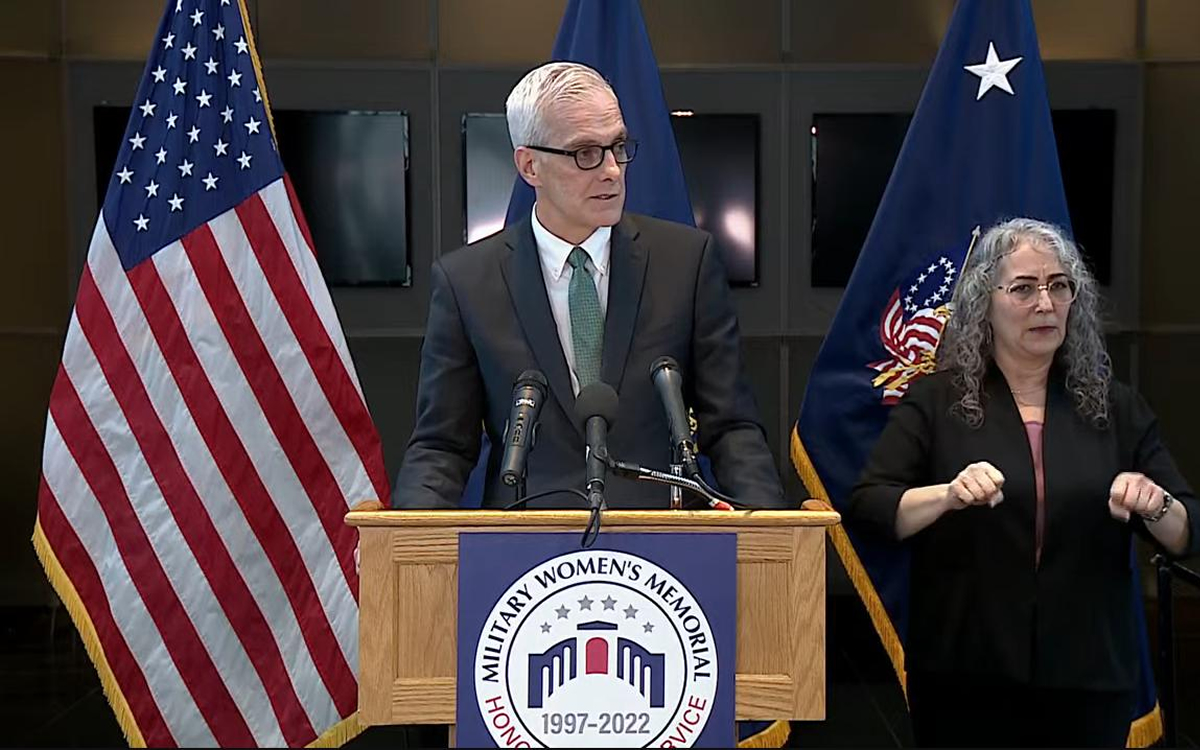
In a speech delivered Thursday at the Women in Military Service for America Memorial (WIMSA), located at the main entrance to Arlington National Cemetery in suburban Virginia, VA Secretary Denis McDonough announced the Department of Veterans Affairs has issued an updated version of its 1959 mission statement.
The new mission statement is: “To fulfill President Lincoln’s promise to care for those who have served in our nation’s military and for their families, caregivers, and survivors.”
As the VA secretary commenced his remarks, he honored several notable women in the audience including Brenda S. “Sue” Fulton, the assistant secretary of veterans affairs for public and intergovernmental affairs.
Fulton, is a 1980 graduate of the United States Military Academy at West Point, N.Y., which was the Academy’s first class to admit women. She is an out lesbian and served as a founding board member of Knights Out, the organization of LGBTQ West Point graduates, and later worked with OutServe, the association of actively-serving LGBTQ military members and SPARTA, an LGBTQ military group advocating for transgender military service.
“Whenever any veteran, family member, caregiver, or survivor walks by a VA facility, we want them to see themselves in the mission statement on the outside of the building,” said Secretary McDonough. “We are here to serve all veterans, their families, caregivers and survivors — and now, our mission statement reflects exactly that.”
In crafting the new mission statement, VA surveyed roughly 30,000 Veterans. Among veterans surveyed, the new version of VA’s mission statement was chosen over the current version by every age group; by men and by women; by LGBTQ+ veterans; and by white, Black/African American, Hispanic/Latino, Asian and American Indian/Alaska Native Veterans.
In addition to two rounds of surveys, VA conducted dozens of small-group engagements with veterans to understand what was most important to them in a VA mission statement, then incorporated that feedback into quantitative research. The new mission statement reflects that VA serves all of the heroes who have served our country, regardless of their race, gender, background, sexual orientation, religion, zip code or identity.
The previous mission statement was: “To fulfill President Lincoln’s promise ‘to care for him who shall have borne the battle, and for his widow, and his orphan’ by serving and honoring the men and women who are America’s veterans.” The previous mission statement is posted in roughly 50 percent of VA’s facilities. Over the coming months, VA’s new mission statement will replace the previous version.
VA announces new mission statement, recognizing sacred commitment to serve all who served:



U.S. Military/Pentagon
Pentagon expands testosterone screening as trans troops face hormone therapy restrictions
Defense Department says updated guidelines to be issued shortly

The Pentagon has announced that new clinical guidance will be released establishing mandatory testosterone deficiency screening for active-duty and reserve cisgender male service members ages 30 and older, advancing a policy that expands hormone-related care for cisgender troops.
The Defense Department said the existing clinical guidelines, which are not currently available on the Defense Health Agency’s website, are being updated and that the final guidance will be issued shortly.
The announcement comes amid a wave of anti-transgender policies from both the DoD and the Trump-Vance administration, which continue to prohibit trans men from receiving the same treatment.
Under the forthcoming guidance, men ages 30 and older will be forced to undergo testosterone blood tests as part of their medical care. Younger male service members will be tested if they request screening or if clinicians identify warning signs of low testosterone.
The new guidelines formalize a screening program Defense Secretary Pete Hegseth announced in July, when he said the Pentagon would begin testing service members to ensure that “you have the right testosterone levels to operate at your absolute best.”
“Taking care of your long-term health means ensuring you remain strong, resilient, and capable — not just for your next deployment, but for the rest of your life, so you can thrive long after you take off the uniform,” Hegseth said at the time.
The Defense Health Agency’s clinical guidance says the program is intended to address “hormonal and energy-availability issues.” Hegseth said in July that testosterone replacement therapy would remain voluntary for service members if treatment is recommended.
The Food and Drug Administration is also scheduled to hold a meeting later this month with experts to discuss the medical use of testosterone.
The Pentagon’s push to routinely test testosterone levels runs counter to current medical guidance, which generally recommends considering testosterone therapy only for men who have symptoms consistent with low testosterone and have documented low hormone levels on two separate blood tests.
Testosterone is a sex hormone naturally produced by people of all sexes. It plays a role in regulating muscle mass, bone density, and sex drive. Testosterone levels in men naturally decline with age and have been associated with symptoms including erectile dysfunction, low libido, mood changes and weight gain, although experts continue to debate when testosterone therapy is medically appropriate.
The policy has drawn scrutiny from LGBTQ advocates because the Pentagon and Hegseth have simultaneously cited hormone therapy as part of the rationale for removing trans service members from the military.
Under President Donald Trump’s 2025 executive order, “Prioritizing Military Excellence and Readiness,” the military has moved to bar trans people diagnosed with gender dysphoria from serving and has begun formal administrative separation proceedings against trans personnel.
The Pentagon continues to pursue implementation of the trans military ban as litigation over the policy proceeds. As a result, some trans service members have had their gender-affirming hormone therapy halted even as the Pentagon expands testosterone screening and potential treatment for cisgender service members.
SPARTA Pride, a nonpartisan nonprofit organization made up of trans service members, veterans and their allies, criticized the disparity to the Washington Blade when Hegseth first announced the screening program.
“If hormone therapy helps warfighters perform at their best, then it cannot simultaneously be used as evidence that transgender service members are unfit to serve,” said Kara Corcoran, executive director of SPARTA Pride. “The same class of evidence-based medical treatment cannot be characterized as readiness-enhancing for one group and readiness-destroying for another.”
On June 1, the U.S. Court of Appeals for the D.C. Circuit ruled that trans service members already serving in the military could continue to do so while allowing the armed services to continue refusing to enlist new trans recruits.
The Blade reached out to the Pentagon when the testosterone screening program was first announced in July, asking why cisgender service members could receive testosterone therapy while transgender service members could not. The Pentagon did not respond.
U.S. Military/Pentagon
Hegseth uses transphobic slur while campaigning for Iowa congressman
Defense Secretary was speaking in support of Republican Zach Nunn
Defense Secretary Pete Hegseth on Monday used an anti-transgender slur while campaigning for U.S. Rep. Zach Nunn (R-Iowa), drawing attention to the Trump-Vance administration’s ongoing efforts to restrict trans people from serving in the military.
“At the Department of War, we do training, not t***nies,” Hegseth said, according to the Iowa Capital Dispatch, which first reported the remarks.
Hegseth made the comment at JR’s SouthPork Ranch at the Iowa State Fair, where he joined Nunn for a rally. The remark came as Hegseth discussed his priorities for the military and argued that the department’s focus should be on military readiness rather than issues of race or gender.
In the same speech, Hegseth claimed that the military operates without regard to race or gender.
“Training, lethality, accountability, discipline, readiness — the bedrock of what it means to be an American warrior — is the only focus of our department,” Hegseth said. “Colorblind, gender-neutral, merit-based. That’s it.”
Hegseth’s remarks come as the Trump-Vance administration continues its efforts to restrict trans people from serving in the military.
Since President Donald Trump returned to the White House, his administration has moved to remove trans service members from the military while also taking steps to prevent trans people from joining.
Trump signed “Prioritizing Military Excellence and Readiness” in January 2025, which attempts to bars trans individuals from serving or enlisting in the U.S. military, citing “military readiness” as the reason, despite there being no factual basis for the ban. The policy has been challenged by LGBTQ advocates and military service members, who argue there is no evidence that trans service members undermine military readiness.
Earlier this year, Hegseth made headlines again over the administration’s contradictory approach to hormone therapy, as the military moved to restrict gender-affirming hormone treatment for trans service members while encouraging cisgender military members to receive hormone therapy for “low T,” or testosterone.
The administration’s policy has faced a series of legal challenges from trans service members and advocacy groups.
In June, a federal appeals court panel ruled the administration could not discharge the trans service members who brought one of the lawsuits challenging the ban while their case continues, providing a moment of relief amid the administration’s ongoing efforts to restrict trans military service. The Trump-Vance administration has asked the U.S. Supreme Court to review that ruling and, in the meantime, keep it from taking effect.
The Washington Blade reached out to the Pentagon for comment on Hegseth’s use of the slur, but the department did not push back on his choice of words.
“We have nothing further to add beyond the secretary’s remarks,” the statement read.
U.S. Military/Pentagon
Court to weigh class action status in trans military ban challenge
Thousands of transgender servicemembers await pivotal decision

While many eyes are on the U.S. Supreme Court awaiting the verdicts in West Virginia v. B.P.J. and Little v. Hecox, another court case involving transgender rights is unfolding less than a mile away at the U.S. District Court for the District of Columbia — one that could have lasting implications for transgender military personnel.
In January 2025, President Donald Trump signed Executive Order 14183, titled “Prioritizing Military Excellence and Readiness,” directing the Pentagon to prohibit transgender, nonbinary, and gender-nonconforming people from serving in the military.
The Trump-Vance administration and Defense Department argued that trans people are inherently incapable of meeting the military’s “high standards of readiness, lethality, cohesion, honesty, humility, uniformity, and integrity,” citing a history or signs of gender dysphoria. According to the Pentagon this creates “medical, surgical, and mental health constraints on [an] individual.” Regardless of their physical or intellectual capabilities, transgender applicants are now considered less qualified than their cisgender peers.
Almost immediately after the executive order was signed, LGBTQ Legal Advocates & Defenders (GLAD Law) and the National Center for LGBTQ Rights filed a federal lawsuit in the U.S. District Court for the District of Columbia challenging the order. The plaintiffs argue the Trump administration acted with discriminatory animus and violated the Equal Protection guarantee of the Fifth Amendment.
The case — originally filed as Talbott v. Trump and now restyled as Talbott v. USA — includes six active-duty service members and two individuals seeking to enlist. Currently, there are 28 plaintiffs in total, including the two still attempting to enlist.
On June 1 the U.S. Court of Appeals for the D.C. Circuit blocked the military ban for active-duty trans service members. The three-judge panel ruled 2-1 that Trump’s executive order was illegal — created with the intent to exclude people from military service based on their gender identity.
The Washington Blade spoke with Michael Haley, a staff attorney at GLAD Law who is part of the legal team challenging the ban and seeking to protect the constitutional rights of transgender service members. Haley previously served as an assistant attorney general in the New Hampshire Department of Justice and as a law clerk for the U.S. District Court for the District of New Hampshire.
Asked why the D.C. Circuit’s ruling blocking the ban — issued on the first day of Pride month — was so significant, Haley said the decision is about protecting the constitutional rights of trans people that have been under attack since the beginning of the Trump-Vance administration.
“I think it’s hard to understate the importance of that order, because what is really significant is that the ban is based entirely on the administration’s dislike of transgender people, and not based on any real concerns about lethality and unit cohesion,” Haley said. “The circuit court went through in pretty good detail, identifying all the ways in which it’s clear that the administration is doing this to harm transgender people, and not for any kind of real military benefit. It’s a really striking and important decision that shows all of our plaintiffs have been serving with distinction, earning medals and commendations, and the fact that they are transgender does not factor into the equation.”
On Tuesday, the plaintiffs will ask the court to certify the lawsuit as a class action on behalf of all trans service members affected by the military ban. Asked what class certification would accomplish, Haley said it would allow future rulings in Talbott to apply not only to the named plaintiffs but to all trans service members covered by the case.
“The class certification, if the court approves it — and we’re hopeful that it will — will mean that any final judgment that comes out of this case will apply not just to our named plaintiffs, but to all transgender service members serving. Simply certifying a class does not necessarily change things on the ground for folks now, but it will ensure that our final judgment, or future judgments within this proceeding, apply to everybody and not just the named plaintiffs.”
Haley said the current legal landscape has created significant uncertainty for trans troops, leaving many unsure of their futures — both those serving stateside and those stationed overseas.
“Unfortunately, there’s just really not a lot of transparency around how the government is implementing the ban,” he said. “We are hearing from service members, including our own plaintiffs, who are receiving notices that they are going to be put before separation boards, but we have no insight into their timing, their decisions for who they notify, when and why, or how they are viewing the D.C. Circuit’s order. We’re going to have to wait for a little bit more of the court process to happen before we can speak with any certainty.”
Asked whether the case could eventually reach the Supreme Court — as Defense Secretary Pete Hegseth suggested in a post on X — Haley said the central constitutional question is whether the policy is rooted in discriminatory animus.
“It will be extremely hard for any court to deny that a policy that identifies a group of people and calls them dishonest, lacking integrity, and lacking a warrior spirit — in spite of all the evidence — is motivated by animus. That’s an argument under the Equal Protection Clause of the Constitution, which says everybody is entitled to equal protection of the laws and forbids singling out a group of people and treating them disfavorably just because you don’t like them rather than because of some legitimate purpose … I think that’s going to be the central question.”
Haley also explained how the current policy differs from the trans military ban Trump announced in 2017.
“The first thing goes back to that same question of animus. The D.C. Circuit recognized that this time around, the policy on its face calls transgender people dishonorable and lacking integrity and things like that. We did not have as clear evidence as we do this time around that this is not actually about military readiness — it is about trying to harm transgender people.”
Haley echoed that view, arguing the administration’s “updated” policy is aimed at excluding trans people rather than improving military readiness.
“The fact that they are trying to push out people who are serving simply because they’re transgender goes to show that this is about harming that group rather than making sure the military can function,” Haley said.
He said the current policy is significantly broader, affecting active-duty trans service members rather than primarily those seeking to enlist.
“The other major difference is how this ban is treating folks who are serving. The last time around, those who were already serving were allowed to continue serving and the ban only applied to people seeking to join the military. This time around, the ban is going further and trying to push out people who are serving with distinction and performing to standards, which is just more evidence that this is not about any actual military benefit.”
Haley also outlined the two categories of evidence GLAD Law has presented to the court to challenge the administration’s claims that trans service members undermine military readiness.
“One [type of] evidence about these individual service members — they have served on nuclear submarines, flown Navy planes, reached ranks requiring Senate confirmation, served as field medics, and continue to excel in extremely demanding roles,” he said. “The other category is testimony from high-ranking military personnel who oversaw the inclusion policy and saw transgender people serving without any of the concerns the government now claims.”
“These are people who have to meet the standards just like anybody else, and if they meet the standards, they should be able to continue to serve. We had four years under the previous administration implementing that policy without any of the issues the government now claims, and that’s pretty strong evidence that it was working.”
Asked about the human toll of the policy — and the thousands of trans service members who have been forced out of the military or are uncertain about their futures — Haley said those personal stories have become a driving force behind the legal challenge.
“I have really heard stories of lives torn apart. These are people who, in some cases since they were children, dreamed of serving, achieved extremely high levels within the military, built their lives around it, built their families around it, and have now been sitting in limbo for more than a year not really knowing what’s coming next.”
He said the disruption extends far beyond losing a job, affecting long-term careers, financial security, and retirement plans.
“For those who have left, they have left a life where they had known no other type of career. In many cases they had served for long periods and were planning on availing themselves of the military benefits they had earned through long-term service, and because they were pushed out too soon, they are now having to reorder both their short-term and long-term lives.”
Haley also described service members stranded overseas, unable to return home or continue serving while they wait for the legal process to play out.
“We know of people who are effectively stranded on bases overseas, unable to come home but also unable to serve, and are just waiting for this to move forward so they can see their families again, whatever the outcome. It’s been really devastating, especially for a group of people who raised their hand to serve and protect.”
Asked what trans service members should take away from the upcoming class certification hearing, Haley encouraged them to stay informed through organizations such as SPARTA Pride, a nonprofit organization representing trans service members, veterans, their families, and allies.
“Until we get an order from a court saying, ‘This is what’s next,’ it’s hard for us to guess, and we certainly don’t want to send folks in the wrong direction. Folks should follow organizations like GLAD Law, NCLR, and SPARTA because they’re providing day-to-day updates as these developments happen.”
Second Lt. Nicolas “Nic” Talbott, U.S. Army, one of the plaintiffs in the case, spoke with the Blade last year about what it has been like to be a capable and willing service member stripped of his career because of the policy.
“It’s very empowering to be able to stand up, not only for myself, but for the other transgender service members out there who have done nothing but serve with honor and dignity and bravery,” Talbott told the Blade. “There are no documented cases that I’m aware of of a transgender person having a negative impact on unit cohesion simply by being transgender … Being transgender is just another one of those walks of life.”
Talbott added that a more diverse military is ultimately a stronger military because it brings together people with different backgrounds and perspectives to solve complex problems.
“I think the more diverse our military is, the stronger our military is … We need people from all different experiences and all different perspectives, because somebody is going to see that challenge or that problem in a way that I would never even think of … and that is what we need more of in the U.S. military.”
SPARTA Executive Director Kara Corcoran, an Army infantry officer with 18 years of service who is currently being separated under the trans military ban, said the upcoming class certification hearing could determine whether relief extends beyond the named plaintiffs.
“When the D.C. Circuit Court recently ruled to affirm Talbott v. USA’s preliminary injunction, SPARTA Pride was relieved to see their powerful conclusion: that this policy was not based on any evidence, but in unconstitutional animus toward transgender people,” Corcoran said in a statement to the Blade. “However, the post-CASA climate meant what was originally a universal injunction now only benefited the small number of active duty plaintiffs. This limited scope left behind the thousands of other transgender service members whose rights were also violated. Certifying the case as a class action would ensure that an ultimately positive outcome in litigation would apply to all patriots impacted by the discriminatory policy — not just the few dozen who signed on to be plaintiffs last year.”
Corcoran said the hearing carries implications far beyond the trans military community, arguing that the case could shape how courts respond when constitutional protections are challenged.
“The entire transgender military community and their families are waiting with profound anticipation and hope for the court’s decision, knowing it could determine the future of their military careers, their livelihoods, and their families. But the gravity of tomorrow’s hearing reaches far beyond those directly affected. It will serve as a test of whether our government will uphold its constitutional duty when another branch openly discriminates against a marginalized group of Americans who answered the call to serve with self-sacrifice, honor, and integrity. This is not simply about transgender service members — it is about the precedent the judicial system sets for every American when equal treatment under the law is challenged.”
The Blade also reached out to the White House regarding this ongoing situation.
“President Trump and Secretary Hegseth are restoring a military that is focused on readiness and grounded in scientific reality—not gender ideology,” said Anna Kelly, Principal Deputy Press Secretary said in an email.
The U.S. District Court for the District of Columbia is scheduled to hold the class certification hearing on Tuesday at 2 p.m. ET.

PHOTOS: Walk and 5K to End HIV

PHOTOS: Wanda Alston Foundation Fall Reception

Moving presents a chance to ‘clean house’

EV ecstacy: BMW iX3, Rivian R2

Curl up with a good book this fall

Trump’s Cabinet: Dumb, dumber, dumbest, and evil

More than 150 people detained outside Istanbul courthouse

Virginia Anti-Violence Project struggles to fill federal funding gaps

Gay man sues Delaware AG for not prosecuting partner in domestic violence case

D.C.’s fall theater season is already well underway
-

 Opinions5 days ago
Trump’s Cabinet: Dumb, dumber, dumbest, and evil
-
Turkey5 days ago
More than 150 people detained outside Istanbul courthouse
-
Virginia5 days ago
Virginia Anti-Violence Project struggles to fill federal funding gaps
-
Delaware5 days ago
Gay man sues Delaware AG for not prosecuting partner in domestic violence case