Congress
As Calvert joins House GOP attacks on LGBT centers, Will Rollins is ready to take his seat
He tells the Blade CA-41 deserves better representation in Congress

Will Rollins, the gay Democrat vying for a second chance to unseat Republican U.S. Rep. Ken Calvert (Calif.), spoke with the Washington Blade by phone on Thursday following the uproar over his opponent’s support for an anti-LGBTQ amendment to a spending bill that was advanced by conservative members of the House Appropriations Committee.
The Transportation, Housing and Urban Development (THUD) Subcommittee’s package contained a total of 2,680 Community Project Funding earmarks, all previously cleared by members from both parties, but just before its passage on Tuesday Calvert joined his Republican colleagues who removed funding for two LGBTQ centers in Pennsylvania and one in Massachusetts.
The decision to go after three CPF initiatives that provide housing and other support for LGBTQ people in need, none located in his district or state, was “pretty consistent” with Calvert’s “pattern of bigoted behavior towards the LGBTQ community,” Rollins said.
A former federal prosecutor who worked in counterterrorism and counterintelligence and was involved in the Justice Department’s pursuit of charges against participants in the deadly January 6 2021 insurrection on the U.S. Capitol, Rollins is set to square off against two other candidates in his party’s primary ahead of the November 2024 elections. According to Cook Political Report, new data shows Calvert’s seat has moved from red-leaning to a tossup.
Calvert has served in the House since 1993, representing California’s 41st Congressional District for less than a year since it was redrawn in 2022 to include more Democratic and LGBTQ constituents, many residing in the Palm Springs area. Rollins challenged him in last year’s midterm elections, decisively beating primary opponents but ultimately falling short in his gambit for Calvert’s seat by about 11,000 votes.
Reflecting on the 2022 race, Rollins noted that while “the turnout was relatively low, I was the only Democratic challenger in California to win independent voters and had the best performance of any Democratic challenger” in California as measured against the share of votes in the state for President Joe Biden in 2020.
As a first-time candidate with only five months between his Democratic primary and the general elections, Rollins added, he had nearly unseated a member of the House who enjoyed the advantages of the name recognition that comes with being California’s longest serving Republican member in that chamber.
In 2024, “we have enough support to flip the seat,” Rollins said — noting that the campaign now has 17 months to build awareness about his candidacy before voters cast their ballots, including by tapping into media markets that were prohibitively expensive in 2022.
Rollins told the Blade Calvert has a “fundamental misunderstanding of LGBTQ Americans” and is uninterested in learning about their lived experiences as sexual and gender minorities, as evidenced by his allyship with the GOP members whose move during Tuesday’s THUD markup provoked accusations by Democrats of rank anti-LGBTQ bigotry, igniting exchanges between lawmakers that became so heated the Committee was forced to recess three times.
At one point, out Democratic U.S. Rep. Mark Pocan (Wis.), who chairs the Congressional Equality Caucus and serves on the Appropriations Committee, advised Calvert that he would be wise to vote against his party’s anti-LGBTQ amendment lest he be looking for a path to retirement courtesy of the more diverse constituents he now represents.
Last month, Calvert, who chairs the Defense Appropriations Subcommittee, was criticized after passing an amendment to a military spending bill that, among other provisions, proscribes “any discriminatory action against a person, wholly or partially, on the basis that such person speaks, or acts, in accordance with a sincerely held religious belief, or moral conviction, that marriage is, or should be recognized as, a union of one man and one woman.”
In practice, Democrats on the Committee argued, this could provide a pathway for someone who is responsible for the disbursement of survivor benefits to deny them to gay and lesbian beneficiaries.
Showing voters the contrast between Calvert’s extreme positions on matters like LGBTQ rights proved successful in courting more support for his campaign last year, Rollins said, but these issues are galvanizing not just for LGBTQ communities and their straight allies in bluer areas like Palm Springs.
“Study after study has shown that where you discriminate against the LGBTQ community, whether it’s anti-gay laws in Georgia or anti-LGBT rules overseas, economic output decreases,” stunting small business growth and depressing wages, he said.
So, Rollins said, while it is difficult to conceive of an alternative explanation, let alone a benign one, for the actions this week by Calvert and his fellow ultraconservative Subcommittee members, “we also have to be making the argument that the attacks on us really are an attack collectively on our economic growth and on opportunity and equality.”
“When you’ve got a Party that is prioritizing making sure that gay seniors can’t get food when they need it, versus a Party that wants to make our streets safer, or a candidate who wants to raise wages in Riverside County,” Rollins said, regardless of their political affiliation “voters understand that those priorities are misdirected from the far right.”
Additionally, he said, “part of the job, too, has to be changing the terms of the debate because a lot of the premises that these Republicans are operating from are complete lies.” And while elected Republicans “definitely have some serious problems with the truth,” Rollins said “the good news for me in a purple district is that regular Republican voters,” many of whom are actually moderate, will stand up against extremism.
The Democratic Congressional Campaign Committee, which works to elect Democrats to the House, echoed some of these arguments in a statement to the Blade: “Ken Calvert is determined to turn back the clock on LGTBQ+ rights.”
“Calvert’s bigoted pattern of anti-LGBTQ+ extremism is disqualifying, disgusting, and wildly out of step with the values and beliefs of everyday southern Californians,” the group said.
Critics question motivations for Calvert’s support of the Respect for Marriage Act
Rollins said that contrary to Calvert’s claims last year that his thinking on LGBTQ rights had evolved, the congressman is “willing to take calculated votes to keep himself in power, which he did before the [2022] midterms” by voting for the Respect for Marriage Act — a move Rollins characterized as “a pretty transparent attempt to wash away an anti LGBTQ career that’s lasted three decades.”
Speaking to the Blade by phone on Thursday, gay U.S. Rep. Mark Takano (D-Calif.), who serves as ranking member of the U.S. House Veterans’ Affairs Committee and a co-chair of the Equality Caucus, said Calvert’s tendency to vacillate between whichever positions are most politically expedient has been on display throughout his 30-year tenure in the House.
The two ran against each other in 1992 and 1994, with Calvert winning both races, and they have served together in California’s Congressional Delegation since Takano first took office in 2013.
Takano said that when Calvert faced off against six opponents in 1992 and ultimately beat him in the general election by fewer than 600 votes, the Republican candidate had “assured key women in the community that he would moderate on social issues like abortion.”
By contrast, Takano said, today “the reality is he cannot survive a Republican primary” without embracing far-right positions, particularly on social issues. Because the GOP has become more extreme since 1992, Takano said, “for [Calvert] to stay in politics, he has to be representative of that extremism.”
The California Democrat contrasted the act of political bravery, and by an elected Republican with unambiguously conservative bona fides, with Calvert — a politician who made a “Faustian bargain” selling his soul to stay in Congress.
“Mark Sanford and I disagreed on a lot of stuff,” Takano said, referring to the Republican former politician who served as Governor of South Carolina and represented the state’s 1st Congressional District in the U.S. House from 2013 to 2019.
Takano recalled how Sanford came to the defense of “Hamilton” creator Lin Manuel Miranda when then-President Donald Trump attacked the Broadway star — “punching down at a citizen” — because Miranda had “made this appeal to Mike Pence to remember that he was Vice President for all of America.”
“From that moment on, Mark Sanford was on the pathway to lose his primary,” Takano said.
Calvert and conservative LGBT group defend his vote for the appropriations amendment
On Friday, Calvert shared a statement with the Blade about Tuesday’s appropriations markup: “I voted along with every Republican colleague on the Appropriations Committee to remove funding for three facilities in the FY2024 THUD appropriations bill due to objections over political activism by some facilities that include pro-communism propaganda, gender affirming care with no age specification, and sexually explicit material for children,” the congressman said.
“I believe most of my constituents, regardless of sexual orientation, do not believe that U.S. taxpayer dollars should be used on activities that undermine the foundations of our country. I do not condone discrimination of any kind and I will always vote my conscience,” he said.
Calvert did not answer questions about why he deserves the support of LGBTQ voters and their allies in his district or whether he encountered blowback from any LGBTQ conservative constituents over his vote on Tuesday.
Responding to the statement, Rollins said “Actions speak louder than Ken’s empty words. He’s voted to ban LGBTQ+ Americans from serving openly in the military, to prohibit us from adopting children, and to allow employers to fire people simply for being LGBTQ+.
Rollins noted that Calvert also voted against the 2009 Matthew Shepard and James Byrd Jr. Hate Crimes Prevention Act, adding that “The silver lining of these votes – and his latest vote this week – is that they will seal his loss in 2024 because LGBTQ+ Americans are just as foundational to our country as the belief that all of us must be free to control our own lives and destinies.”
Speaking with the Blade on Thursday, Log Cabin Republicans President Charles Moran disputed the allegations against Calvert along with the characterizations of his behavior and motivations that were provided by Rollins and Congressional Democrats.
Last year, Moran said, Calvert focused on strengthening relationships with his LGBTQ constituents, including through meetings with individuals and groups like Log Cabin, in a deliberate and sincere effort to better understand the community and its needs.
“I had drinks with him immediately following the vote” on the Respect for Marriage Act, Moran said. “And he presented to me a card [on which] he [had written] down the final vote total, and he handed it to me when we sat down because he was proud” to join his 46 House GOP colleagues who also backed the bill.
Moran noted that in 2020, Philadelphia’s William Way LGBT Center, one of the three CPFs whose funding was removed from Tuesday’s appropriations package, had welcomed participation from the city’s Log Cabin Republicans chapter in a forum about public health responses to the COVID-19 pandemic before reversing course and disinviting the group in response to pushback.
While he had not yet discussed the THUD amendment with the GOP members behind it or with their Congressional offices, Moran said that they likely had legitimate reasons for removing the earmarks — objections over issues like the practice by at least one of these organizations of discriminating against conservatives.
A choice between the status quo and the promise and potential of new leadership
At the same time, Calvert has arguably sought to police political speech by, for example, restricting the ability of institutions like the U.S. Armed Forces to administer programs centered around diversity, equity, and inclusion — provisions that were a major component of the amendment he passed along with the House’s Defense spending bill in June.
Takano, who has served as the Veterans’ Affairs Committee’s top Democrat since 2019, noted that the need for “affirmatively cultured” diversity in the military has been shown through, for instance, the “conflicts that arose during the Vietnam War era between an un-diverse white officers’ corps and Black and Brown grunts.”
Maintaining the status quo, therefore, runs contrary to the national interest, he added.
Today’s Congressional Republicans “don’t want to see LGBTQ service members [being] made to feel welcome, and they don’t want the officers to be trained in order to be sensitive to the backgrounds of service members of color and service members who are LGBTQ or service members who are women,” Takano said.
When it comes to next year’s race for California’s 41st District, Takano praised Rollins — a candidate whose reasons for running are “so admirable,” the congressman said, “because at its root, his efforts flow from a very high-minded devotion to our democracy, and in my mind, democracy includes space and protection for all people – LGBTQ people included.”
Rollins told the Blade that while he is appalled by Calvert and other Congressional Republicans’ “blatant targeting of a very small minority,” he is confident that it will add fuel to voters’s desire for change, including through new leadership in the Congress.





Congress
Jeremy Moss looks to bring LGBTQ advocacy from Lansing to Capitol Hill
Congressional candidate would represent Detroit suburbs if elected
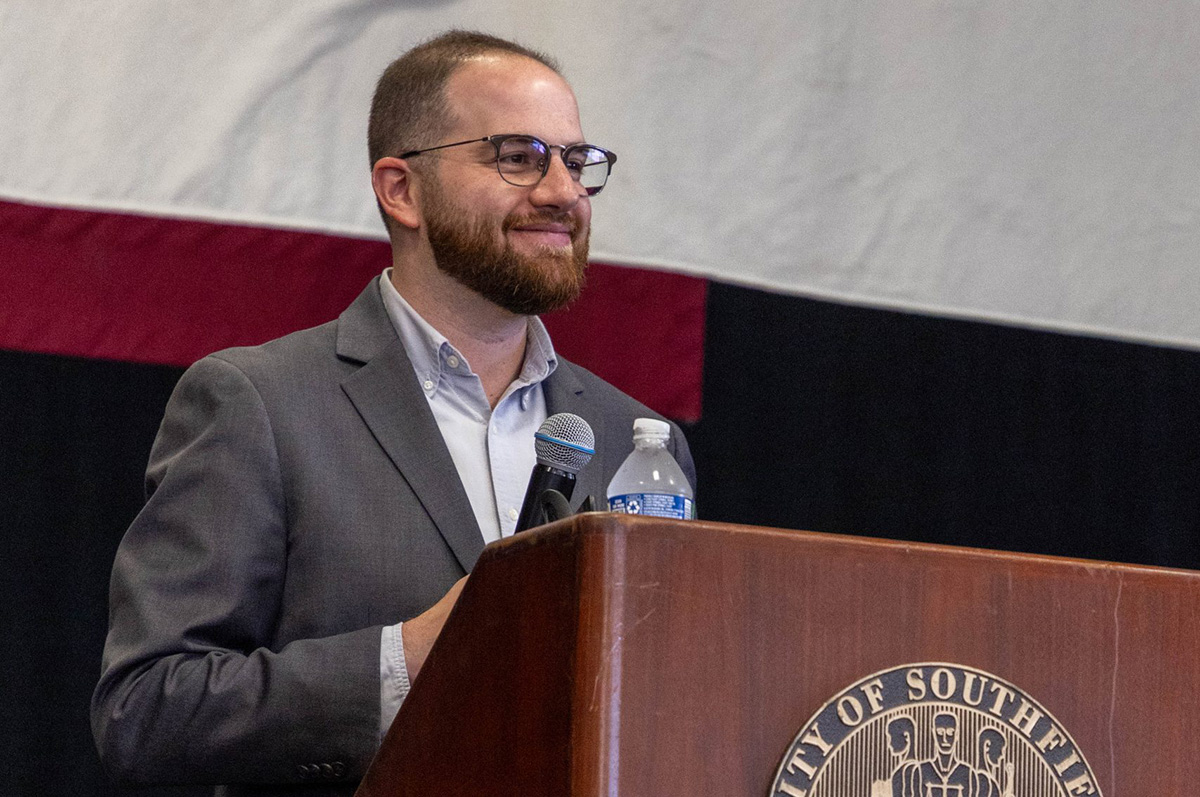
With fall comes swapping out T-shirts for sweaters, raking leaves and, of course, elections. The summer’s primaries have narrowed the playing field in a slew of races, but the big ones — the actual races for seats in federal and local elections — are still to come.
Jeremy Moss is one of those people running for a congressional seat in Michigan. Despite his young age, Moss has quickly learned the ropes of politics in the state, already serving terms in the Great Lakes State’s House of Representatives and Senate.
Moss sat down with the Washington Blade to discuss his history in Michigan politics, his experience as an openly LGBTQ legislator and his vision for a better America as he looks toward Congress.
He currently represents Michigan’s 7th Senate District, but now he is setting his sights beyond Lansing toward Capitol Hill to represent Michigan’s 11th Congressional District, which includes Detroit’s northern suburbs.
Moss earned his bachelor’s degree in journalism from Michigan State University, where just a few years later he made history as the first openly gay person elected to the Michigan Senate and the first to serve as its president pro tempore.
His political experience stretches across multiple offices.
Moss worked in the offices of Southfield Mayor Brenda Lawrence, who also served in the U.S. House of Representatives, and State Rep. Paul Condino.
Moss, at age 25, was elected to the Southfield City Council in 2011, becoming the youngest member elected in the body’s history. He then switched over to the state legislature, representing Michigan’s 35th House of Representatives District in the Michigan House of Representatives from 2014-2018, becoming the second openly gay member elected to the Michigan legislature.
He then moved from Michigan’s House to its Senate in 2018, elected to represent the 11th Michigan Senate District and becoming the Assistant Democratic Leader. Moss started his second term in the Michigan Senate in 2023, this time representing District 7.
He currently has a long list of priorities listed on his campaign website, many of which have become standard for Democrats running across the country, with a particular focus on minimizing — and cleaning up — issues that the Republican-controlled federal government has created under President Donald Trump.
Those goals include lowering healthcare costs, tackling the cost of living crisis, holding U.S. Immigration and Customs Enforcement accountable and fixing the broken immigration system, restoring national voting rights, protecting rights — with a particular focus on abortion access and LGBTQ rights — combating corruption in politics, preventing gun violence and strengthening gun safety, empowering Michigan workers, and preserving the environment.
Why Moss is running for Congress
When asked why he wants to run for Congress, Moss pointed to his lengthy resume in state leadership, with a clear voice arguing that if he can do it in Lansing, he can get it done in Washington.
“I’ve served 12 years in the legislature and have ascended into leadership as president pro tem of the Senate,” Moss explained to the Blade. “We flipped our state legislative chamber to a Democratic majority for the first time in 40 years in 2022, and we passed some big, generational-changing, consequential Democratic wins that had languished for a generation, but had improved people’s lives in our state.
“We’ve passed the first gun safety laws in a generation that are saving lives. We protected the right to vote amidst attacks from Donald Trump and other conspiracies. We pushed forward and finally put LGBTQ rights in our state civil rights law. We provided free school meals and lunches for all public school children in the state of Michigan.
“The problems from Washington, D.C., aren’t getting less severe over time,” he continued. “They’re getting more severe. So this district unexpectedly opened up due to a series of retirements and it was just a great opportunity for me to continue to advocate for big change that we’ve already achieved here in the state legislature.”
“I’m a product of this district. I grew up here. I’ve represented a bulk of the district already in the state legislature, and I knew that I was going to earn grassroots support to be able to wage this campaign. We sought it out, we earned it, including some premier endorsements from Gov. (Gretchen) Whitmer, among many others, and were highly successful in the primary because we were in tune to the needs of this district.”
Moss has been endorsed by a slew of Democratic leaders and organizations, including, as he pointed out, by Whitmer.
Other endorsements include former Gov. Jim Blanchard, Secretary of State Jocelyn Benson, Attorney General Dana Nessel, the Equality PAC, the Human Rights Campaign, the Unity Fund, and the LGBTQ+ Victory Fund.
His political identity and the Democratic Party
Moss described himself as being “on the liberal end of the spectrum,” but argued that the Democratic Party’s internal divisions should not be the central focus.
“I’m certainly on the liberal end of the spectrum, but I don’t even think it necessarily has to be this progressive versus establishment fight that we’ve seen play out,” Moss said when asked about various elements of in-party disagreements. “It has to be between action and, and inaction, fighters versus folders.”
He said that distinction between action and inaction is central to how he would approach Washington.
“At this moment, I think we need to demonstrate that we are ready to take on Donald Trump and MAGA chaos with boldness and effectiveness. I’ve been saying all along our campaign trail, we can no longer be the party that shows up to the knife fight carrying a pie chart, and so I think we have to be showing that we have spine and we have punch, and we’re really ready to be tough fighters for, for Michiganders and the American people.”
“We can’t walk on eggshells anymore. We can’t pull our punches,” he added. “We can’t fear that we’re offending someone, you know, one way or another with how we act. People are expecting a bold party to take on MAGA, and I think that’s exactly what the Democratic Party needs.”
Becoming an LGBTQ legislator
Moss also reminisced with the Blade about his first run for elected office — at a time when Michigan had no openly LGBTQ members serving in the state legislature — and how that experience became deeply connected to his identity and his approach to LGBTQ politics.
In 2014, Michigan was in the pre-marriage equality era, and the state had no openly LGBTQ members serving in the legislature.
“12 years ago in 2014 — this was pre-marriage, the pre-marriage equality era — we had zero people from our community serving in the legislature, and still they were talking about us.
“The big topic then in Michigan was whether or not to expand our civil rights law to include LGBTQ protections, so that people from our community would no longer face discrimination in housing and employment. And they were talking about us regardless of whether or not we were at the table.”
Moss eventually helped lead the effort to expand Michigan’s civil rights protections to include LGBTQ people, a measure that passed with bipartisan support.
He said his experience as an openly gay lawmaker allowed him to make the case for LGBTQ protections in terms that extended beyond LGBTQ issues.
“One thing I definitely aligned with Gov. Whitmer at the time was making the case that discrimination was not only morally wrong, but it was bad for business,” he said. “By not having these protections for our LGBTQ neighbors and family members and friends and community members, we were actually holding back our economy. We were essentially allowing people to be kicked out of Michigan as consumers and workers, because of who they are and how they identified.”
That led to various efforts — including committee hearings and meetings with advocates, businesses and the public — that helped make Michigan what the Movement Advancement Project deems the 16th most LGBTQ-friendly state, solidly above other states due to its robust LGBTQ-related legislation.
“I wanted to meet everybody where they were, including those who may have not been involved with or engaged with the LGBTQ community as legislators, but understood that we couldn’t sustain the economic impact of discriminating against our community,” Moss said. “And as I’ve said all along, discrimination is bad for business. That’s something I think helped broaden the vote and earn some bipartisan support for it.”
Representation and LGBTQ youth
For Moss, the importance of LGBTQ representation also comes from his own experience growing up.
“I think about when I was younger, when I was 18 years old. It was in 2004, and, you know, there are certain things that really shaped me in that time … Michigan had a ballot proposal that passed to have the strictest language banning marriage equality in our state constitution. We didn’t even allow civil unions in that language in our constitution to exist, and there were scandal-plagued LGBTQ politicians.”
“It was the same year that Jim McGreevey was forced to resign as he came out,” he said. “So it really was a signal to me that, you know, you don’t have a future. Not just you don’t have a future in politics; you might not even have a future. Period, and it was pretty defining for me.”
Despite those fears, Moss continued to pursue public office.
“And you can’t be what you can’t see, and so to be able to break the barriers at the state level and at this congressional level, I think is a signal to anybody who is struggling with wondering where their place is?”
“I think that visibility is incredibly important, and it’s something that I needed when I was much younger, and it’s something that I’ve been honored to be able to provide for the, for the next generation of emerging leaders.”
His LGBTQ priorities in Congress
When asked what LGBTQ issues he would prioritize in Congress, Moss emphasized the importance of growing the number of LGBTQ lawmakers while also expanding federal nondiscrimination protections.
“To have a caucus in the legislature has made all the difference because you can, you know, run these issues across the field. You can have somebody take on marriage. You can have somebody take on trans rights. You can have somebody take on LGBTQ youth. You can have somebody take on discrimination protections.”
He sees much of the work he wants to get done on Capitol Hill as a direct follow-up to his work in Lansing — most importantly, the passage of the Equality Act. The legislation has been debated in some form for more than 50 years at the federal level, with the goal of protecting LGBTQ people from discrimination under federal law.
“I think the Equality Act is incredibly important. That’s kind of the, the counterpart to what we’ve done in the state legislature, ensuring discrimination protections for the LGBTQ community,” he said.
“I think housing and, and workplace discrimination is, is everything, you know, to protect our community so that they can have a safe place to call home and earn a living … That’s incredibly important across the board. And I would really want to take a leading role in telling the story of how we were able to do it in Michigan after 50 years since this act was first written — and finally finished the job federally to ensure their federal protections in, in, in, in employment and housing.”
LGBTQ political organizations and Congress
Moss said the LGBTQ political organizations that have supported his political career from its early stages have helped him along the way.
“Obviously, I’ve been affiliated with Victory Fund since I first ran for office, and they were early endorsers, but Equality PAC, which is the political arm of the LGBTQ caucus in Congress, has been an incredible part of my support system. From day one they helped me out.
“I’ve been getting to know a lot of the members of Congress who are LGBTQ, really over the last year of this campaign. So I’m eager to join them. I’m eager to be one of the players on the field here to be able to advocate and advance our issues.”
Voting rights
Voting rights are another major focus for Moss, an issue he said dates back to his experience during the 2004 campaign over marriage equality.
“Something I’m very passionate about is voting rights, and it really does go back to that 2004 campaign where it was very evident that elections can determine your future.
“Elections can determine what rights you do have and don’t have, and so I’ve been very laser focused on increasing access to the ballot box, making sure our democracy remains whole and accessible.”
He explained how Trump’s recent attacks on voting legitimacy and mail-in voting have only made his desire to help that much stronger.
“We went through a real trial of that in 2020 with, with Michigan’s presidential election, with Donald Trump and Rudy Giuliani — as he jetted into Michigan and tried to overturn our valid and accurate election results. We were kind of the spotlight of the nation in that stop this deal movement that led to Jan. 6.”
That, according to Moss, spurred direct action on his end.
“I took the helm as chair of the Senate Elections Committee, and we wrote the law to implement pieces of that ballot proposal, including drafting the law that implemented nine days of early voting here in Michigan, increased access to absentee ballot. We further secured our canvassing and certifications so that nobody could jet in with an alternative slate of electors and send them to Congress on Jan. 6.”
“So I’ve been on the front lines in Michigan on defending our election systems and strengthening protections for both voters to access the ballot box and protections against those who want to overturn our election results.”
Those issues are still present today, he explained.
“He’s pushing for suppressive tactics like the Save Act. The Supreme Court has eroded the federal Voting Rights Act,” Moss said. “I want to really get into Congress as an election expert, we have a Michigan story to tell. I wrote a lot of that story, and, and I think the most urgent thing that we could pass is the John Lewis Voting Rights Act to make sure that there’s no pocket of discrimination anywhere in our country, and that people have the ability to exercise their constitutionally guaranteed right to vote.”
What he would do differently in Washington
Moss also shared that he believes Democrats should communicate differently in Washington, with an emphasis on getting things done.
“Yeah, again, we’ve, we’ve seen politics evolve in this Trump era, and I think that Democrats need to communicate differently.
“He talks so brazenly, and how proud he is that he’s renamed the Gulf of Mexico or Lake Ontario. I put that in the stupid category.
“He’s also done things in the harmful category that he boasts about, like cutting Medicaid and cutting SNAP. And of course, he’s doing things in the dangerous category, but proud of it, like trying to overturn our elections or suppressing the vote.
“What we’re doing is both popular and good for people, whether it’s growing our economy from the middle class outward, whether it’s lowering costs, whether it’s making healthcare more affordable, whether it’s strengthening the core functions of our democracy, we have to be talking about it with the same gusto and confidence that MAGA talks about their agenda.
“I think this is a party that needs more spine and more punch, and really meet this moment because I think that’s what people are looking for, and that’s really what I think a new generation will bring into this next Congress.”
Congress
HRC president campaigns for Chris Pappas in NH
Gay congressman running to succeed retiring U.S. Sen. Jeanne Shaheen

Human Rights Campaign President Kelley Robinson on Sunday campaigned for U.S. Rep. Chris Pappas (D-N.H.) in New Hampshire.
Robinson traveled to Manchester, the state’s largest city, nine days before the Sept. 8 primary that will determine who will vie for retiring U.S. Sen. Jeanne Shaheen (D-N.H.)’s seat.
We’re hitting the pavement across New Hampshire to fight for a freer, fairer future for everyone.
Glad to have Human Rights Campaign President @KelleyJRobinson join us for a canvass launch in Manchester today. pic.twitter.com/XWCEaQxy4o
— Chris Pappas (@ChrisPappasNH) August 30, 2026
Former U.S. Sen. John E. Sununu, who represented New Hampshire in the U.S. Senate from 2003-2009, will face off against former U.S. Sen. Scott Brown, who represented Massachusetts in the U.S. Senate from 2010-2013, in the Republican primary.
Karishma Manzur is among the Democrats challenging Pappas.
A poll the University of New Hampshire Survey Center released on Aug. 26 shows Sununu is ahead of Brown. The same survey shows Pappas ahead of Manzur and his other Democratic challengers.
The UNH Survey Center poll shows Sununu ahead of Pappas by a 45-43 percent margin if they were to face off in the general election. The margin of error is +/-2.1 percent.
Pappas would become the first openly gay man elected to the U.S. Senate if he were to win in November.
Congress
Chris Van Hollen says the Democratic Party needs change. Is he the one to lead it?
Senator is backing anti-establishment Democrats across the country
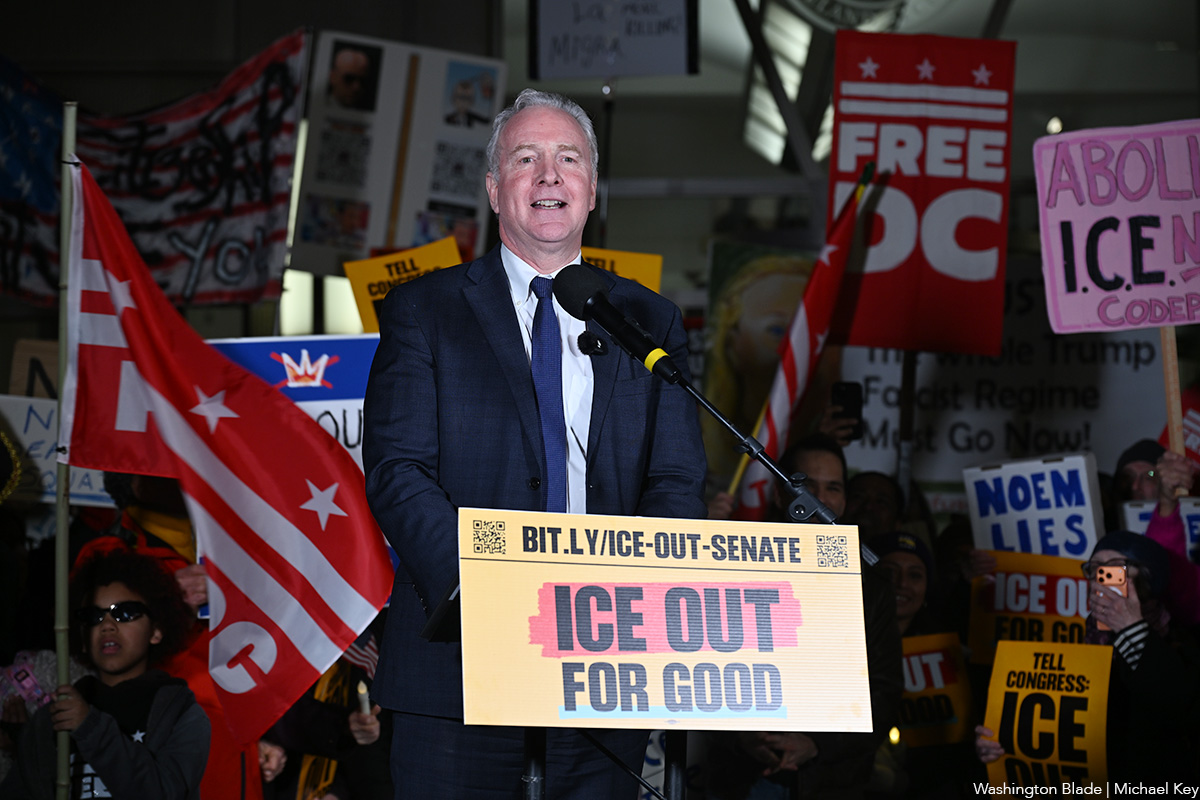
By LEE O. SANDERLIN | The Democratic Party is having something of an identity crisis — losing to President Donald Trump twice in three elections will do that.
Should the party embrace anti-establishment figures who espouse progressive policy ideas like Medicare for all and rhetoric about unrigging the economy for the 1 percent? Or should Democrats try to appeal to moderates who want to return to semi-normalcy in a time of political upheaval?
Although he’s been in Congress since 2002, with key leadership roles throughout his tenure, Maryland Sen. Chris Van Hollen, 67, counts himself firmly in the anti-establishment camp.
The rest of this article can be found on the Baltimore Banner’s website.

Renee Good’s family files two federal lawsuits

House Democrats urge White House to confront Turkish government over anti-LGBTQ crackdown

988 restores crisis services for LGBTQ youth

To school to homeschool to school again

Ryan Murphy’s ‘Monster’ vilifies the lesbian

PHOTOS: HRC National Dinner

Factors to consider when hiring an interior designer

Dr. Fauci ‘honored to be part of’ LGBTQ history

Baltimore’s oldest gay bar to reopen this week